


26 Mar Why focusing on exam prep boosts your IB ESS success
Exams make up 75% of your final IB ESS grade, yet many students underestimate their impact until it’s too late. While the Internal Assessment matters, your performance on Paper 1 and Paper 2 determines whether you pass or excel. This guide explains why targeted exam preparation transforms results and provides actionable strategies to maximize your diploma score. You’ll learn how to master each exam component, apply evidence-based study techniques, and avoid common pitfalls that limit achievement. Focused preparation isn’t about studying harder but studying smarter for the assessments that matter most.
Table of Contents
- Key takeaways
- Understanding why exam prep matters in IB ESS
- Breaking down IB ESS exam components: Paper 1 and Paper 2
- Mastering exam strategies and study techniques for IB ESS success
- Applying exam prep focus to raise your IB ESS grade
- Achieve higher IB ESS grades with tailored support
- Frequently asked questions
Key Takeaways
| Point | Details |
|---|---|
| Exam weight matters | Exams account for 75 percent of the IB ESS grade, making performance on papers the main determinant of your diploma. |
| Paper 1 vs Paper 2 | Paper 1 tests data interpretation from unseen cases, while Paper 2 requires organized, timed essays and evaluation of perspectives. |
| Master command terms | Mastering command terms such as describe, evaluate, and discuss helps you answer the correct question and avoid common point losses. |
| Targeted exam prep | Focused practice and timed responses improve confidence and raise overall scores more than content alone. |
Understanding why exam prep matters in IB ESS
The IB ESS assessment structure makes exam preparation essential. Exams constitute 75% of the final grade with Paper 1 weighting 25% and Paper 2 50%, while your Internal Assessment contributes just 25%. This breakdown means three-quarters of your diploma points come from timed exam performance, not coursework you can refine over months.
Recent data shows 65% of SL students achieved grade 4 or higher in May 2024 with an average grade of 4.2. These statistics reveal that passing is achievable, but moving beyond average requires focused exam technique. Students who prioritize exam preparation consistently outperform those who rely on general content knowledge alone.
The weight of exams shifts your preparation strategy from content memorization to application skills. Understanding environmental systems matters less than demonstrating that understanding under timed conditions. Success in IB ESS requires mastering how to interpret data, construct arguments, and evaluate perspectives within strict time limits.
Exam technique directly impacts your diploma score. A student scoring 5 on exams but 7 on their IA still achieves a final grade around 5. Conversely, strong exam performance can offset a weaker IA. This mathematical reality makes exam prep your highest-return investment. Every mark gained on Paper 2 carries double the weight of the same mark on your IA.
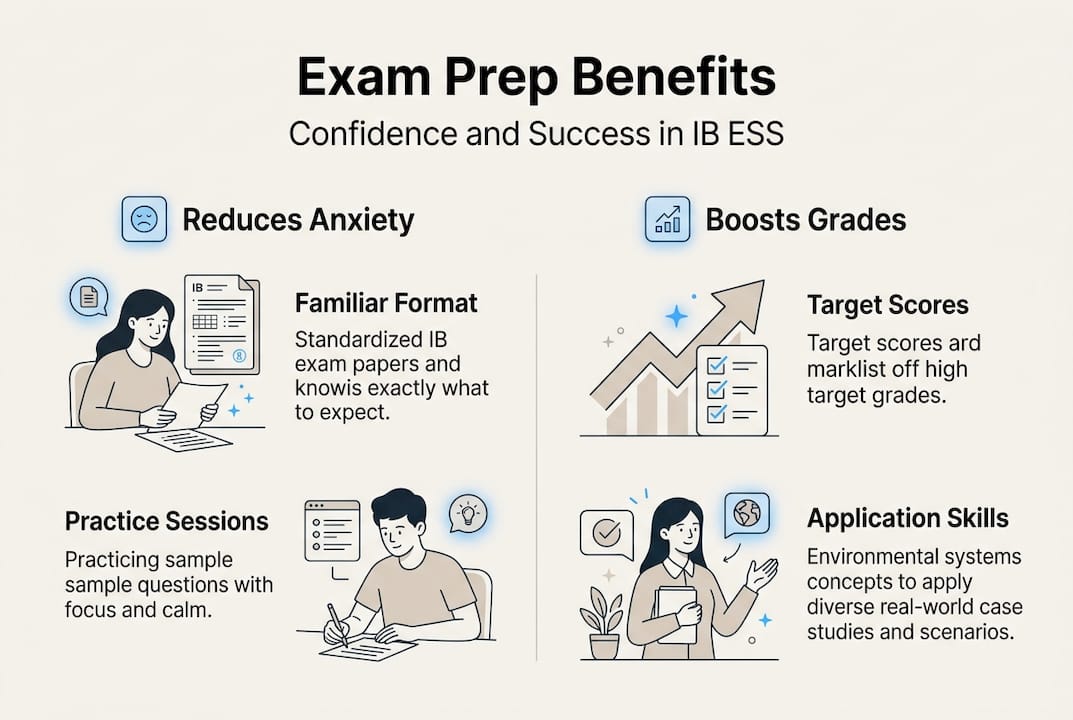
Effective exam preparation also reduces anxiety. Familiarity with question formats and past paper patterns builds confidence that translates to better performance under pressure. Students who practice timed responses report feeling more in control during actual exams, allowing them to showcase their knowledge rather than freeze.
Pro Tip: Calculate your target exam scores early. If you need a grade 6 overall and estimate your IA at level 5, you’ll need approximately 6+ performance across both papers. This clarity helps you allocate study time effectively and choose the right course approach from the start.
Breaking down IB ESS exam components: Paper 1 and Paper 2
Paper 1 focuses on data interpretation from an unseen case study, accounting for 25% of your final grade. You’ll analyze graphs, tables, and environmental data you’ve never encountered before. This exam tests your ability to extract information, identify trends, and apply ESS concepts to novel situations rather than recall memorized facts.
Paper 2 accounts for 50% of your grade through extended responses requiring structured arguments and evaluation. You’ll write essays demonstrating multiple perspectives on environmental issues, synthesizing scientific and societal viewpoints. This paper rewards clear organization, balanced analysis, and explicit use of command terms that show examiners you understand what’s being asked.
Mastering command terms is critical for both papers. “Describe” requires different responses than “evaluate” or “discuss.” Students lose marks not because they lack knowledge but because they answer the wrong question. Practicing Paper 1 skills means learning to read data accurately, while Paper 2 preparation focuses on timed essay construction with clear thesis statements.
| Exam component | Weight | Format | Focus areas | Preparation tips |
|---|---|---|---|---|
| Paper 1 | 25% | Short answer, data response | Graph interpretation, case study application, calculations | Practice unseen case studies, review data analysis techniques |
| Paper 2 | 50% | Extended response essays | Structured arguments, multiple perspectives, evaluation | Master command terms, practice timed essays, develop frameworks |
The different formats demand different practice approaches. Paper 1 preparation involves working through diverse case studies to build pattern recognition. You learn to spot common graph types, identify reliable data sources, and apply formulas quickly. Paper 2 prep centers on essay planning, developing balanced arguments, and writing clear topic sentences that directly address the question.
Timing matters equally across both papers. Paper 1 gives you less time per mark, requiring quick, precise responses. Paper 2 allows more depth but demands efficient planning to cover multiple perspectives thoroughly. Students who practice under timed conditions perform significantly better than those who study content without time pressure.
Pro Tip: Create a command term glossary with example responses for each. When you see “outline,” you’ll know to provide brief points without explanation. When you encounter “justify,” you’ll automatically include evidence and reasoning. This preparation eliminates hesitation during exams and ensures you access study resources that match exam requirements.
Both papers test application over recall. Your IA research skills help with Paper 1 data interpretation, but exam success requires practicing the specific formats you’ll face. Familiarity with question styles reduces cognitive load, letting you focus on demonstrating knowledge rather than figuring out what’s being asked.
Mastering exam strategies and study techniques for IB ESS success
Active recall and spaced repetition form the foundation of effective exam preparation. Instead of rereading notes, test yourself regularly on key concepts. Consistent practice with spaced repetition improves retention and exam technique far more than cramming. Space your review sessions over weeks, returning to challenging topics at increasing intervals to strengthen long-term memory.

Systems thinking elevates your evaluation responses from basic to exceptional. Environmental issues involve interconnected factors, and examiners reward students who demonstrate this understanding. Apply case studies to practice questions, showing how economic, social, and ecological systems interact. This approach directly addresses the interdisciplinary nature of ESS and prepares you for higher-level analysis questions.
Visual aids and mind maps help organize complex relationships between topics. Create diagrams linking human population dynamics to resource consumption, or map feedback loops in climate systems. These tools make abstract concepts concrete and provide quick review materials before exams. The process of creating visual summaries also reinforces understanding through active engagement.
Common pitfalls undermine otherwise strong students. Ignoring command terms leads to off-target responses. Cramming creates short-term recall that fades during exams. Neglecting essay structure results in disorganized arguments that lose marks despite correct content. Awareness of these mistakes helps you avoid them through deliberate practice.
Follow this step-by-step exam prep strategy:
- Review command terms and create example responses for each to ensure you understand what examiners want
- Practice past papers under timed conditions to build familiarity with question formats and pacing
- Create mind maps linking topics across the syllabus to develop systems thinking and interdisciplinary connections
- Apply spaced repetition by scheduling regular review sessions at increasing intervals for long-term retention
- Work on timed essays weekly, focusing on clear structure, balanced perspectives, and explicit command term responses
The 2026 syllabus adds perspectives and sustainability content requiring balanced preparation to avoid interdisciplinary overload. Don’t treat ESS as purely scientific or purely humanistic. Practice integrating both lenses in your responses, showing how environmental issues involve technical solutions and societal values simultaneously.
Pro Tip: Dedicate specific study sessions to weak topics identified through past paper practice. If you consistently struggle with population ecology calculations, focus there rather than reviewing topics you’ve already mastered. Targeted improvement yields better results than unfocused repetition.
Consistent practice trumps study volume. Three focused hours weekly using active techniques outperform ten hours of passive reading. Success strategies emphasize quality over quantity, building confidence through demonstrated competence. Track your progress on practice questions to see measurable improvement over time.
Integrate quality study resources that align with current syllabus requirements. Outdated materials waste time on removed content while missing new additions. Verify your resources match 2026 assessment criteria to ensure your preparation targets what you’ll actually face in exams.
Applying exam prep focus to raise your IB ESS grade
Prioritizing exam preparation directly improves your final grade beyond the achievable pass threshold. Exam prep focus transforms passes into stronger diploma contributions through technique development rather than content volume. Students who master exam strategy consistently score higher than those with equal knowledge but weaker application skills.
Exam technique and evaluation abilities differentiate higher-scoring students from average performers. A grade 4 student might know the same facts as a grade 6 student, but the latter demonstrates superior analysis, balanced perspectives, and explicit responses to command terms. Systems thinking provides the edge for 6/7 grades by excelling in evaluation questions that require weighing multiple factors.
Focused exam preparation delivers multiple benefits:
- Higher confidence from familiarity with question formats and proven ability to perform under timed conditions
- Better marks through precise responses that directly address what examiners ask rather than generic answers
- Reduced anxiety by eliminating uncertainty about exam structure and expectations through extensive practice
- Improved essay quality from practiced frameworks that organize arguments clearly and balance multiple perspectives
“The difference between a pass and a strong grade isn’t how much you know but how effectively you demonstrate that knowledge under exam conditions. Students who invest in exam technique see immediate returns in their marks because they’re answering the questions examiners actually ask.”
Strong IA preparation complements but cannot replace exam focus. Even a perfect IA score of 7 contributes just 25% of your final grade. If you score 4 on both exam papers, your overall grade remains around 4 or 5 regardless of IA performance. The mathematics clearly show that exam results determine your final outcome more than any other factor.
Strategic success approaches balance IA and exam preparation appropriately. Allocate study time proportional to assessment weight. Spend three hours on exam prep for every hour on IA refinement to match the 75/25 split. This doesn’t mean neglecting your IA, but recognizing where your effort yields maximum grade impact.
Exam preparation also builds transferable skills valuable beyond IB. Analyzing data under pressure, constructing clear arguments, and evaluating complex issues apply to university studies and professional work. The techniques you develop preparing for ESS exams strengthen your overall academic capabilities.
Your IA success demonstrates research and investigation skills, but exams prove you can apply knowledge flexibly to new situations. This distinction matters to universities and future employers who value adaptability over memorization. Strong exam performance signals genuine understanding rather than project-specific competence.
Achieve higher IB ESS grades with tailored support
Mastering exam preparation requires more than generic study advice. ESSTutor offers specialized tutoring tailored to IB ESS exam structure and the latest syllabus changes. Our IA tutors bring examiner experience to help you understand exactly what earns marks and what doesn’t.
Access comprehensive notes and textbook resources designed specifically for 2026 assessment requirements. These materials focus on exam-relevant content, eliminating time wasted on outdated or unnecessary information. Practice with targeted exam resources that mirror actual question formats and difficulty levels.

One-on-one coaching addresses your specific weaknesses identified through practice papers. Whether you struggle with data interpretation, essay structure, or time management, personalized guidance accelerates improvement. Expert support transforms exam preparation from overwhelming to systematic, building confidence through measurable progress.
Frequently asked questions
What exam components make up the 75% of the final grade?
Paper 1 contributes 25% through short answer and data response questions based on an unseen case study. Paper 2 accounts for 50% via extended response essays requiring structured arguments and evaluation of multiple perspectives. Together these timed exams determine three-quarters of your diploma score.
How does focusing on exam prep improve my scores?
Exam preparation develops application skills and technique that directly address what examiners assess. You learn to interpret command terms correctly, manage time effectively, and structure responses for maximum marks. This strategic approach yields better results than content review alone because it targets the specific demands of timed assessment.
What study techniques best prepare me for IB ESS exams?
Active recall and spaced repetition build long-term retention more effectively than passive reading. Practice past papers under timed conditions to develop pacing and familiarity with question formats. Create mind maps to strengthen systems thinking and interdisciplinary connections. Focus on command term mastery to ensure your responses match what’s being asked.
Are there syllabus changes in 2026 affecting exam prep?
The 2026 syllabus emphasizes perspectives and sustainability, requiring balanced preparation across scientific and societal viewpoints. This interdisciplinary focus means your exam responses must integrate technical knowledge with social and ethical considerations. Practice questions that demand multiple perspective analysis to meet updated assessment criteria.
How important is the Internal Assessment compared to exams?
The IA contributes 25% while exams account for 75% of your final grade. Even a perfect IA cannot compensate for weak exam performance due to this weighting. Allocate preparation time proportionally, focusing primarily on exam technique while maintaining solid IA work. Your exam results ultimately determine your diploma contribution more than any other component.
No Comments