


01 Jul Why Is Water Important in ESS: IB Student Guide
TL;DR:
- Water is fundamental in environmental systems because it links biology, climate, and human society through its unique properties. It functions as a solvent, temperature buffer, lubricant, and transport medium, supporting ecosystems and living organisms effectively. Managing water sustainably is crucial, as global scarcity threatens ecological stability and development priorities.
Water is the single most studied substance in Environmental Systems and Societies (ESS) because it connects every living organism, every ecosystem, and every human society on Earth. Understanding why water is important in ESS means grasping how one molecule drives nutrient transport, climate regulation, biodiversity, and sustainable development all at once. The IB Diploma Programme treats water not as a background detail but as a central organizing concept. Water resources sit at the center of environmental science because water links climate, ecosystems, agriculture, energy, cities, public health, and political stability. If you can explain water’s roles clearly, you are already thinking like an ESS scientist.
Why is water important in ESS? The core answer
Water is the foundation of every system ESS examines, from individual cells to global climate patterns. Its importance comes directly from its physical and chemical properties, which no other common substance shares. Water’s molecular polarity and hydrogen bonding make it an excellent solvent, enabling the transport and biochemical reactions that life depends on. That single property explains why water appears in nearly every ESS topic, from soil chemistry to ocean circulation.
The IB ESS curriculum recognizes water as a cross-cutting theme connecting the living world, the physical environment, and human societies. Students who understand water’s roles at the molecular, organism, and ecosystem levels consistently perform better on both Paper 1 and Paper 2 assessments. Classifying water’s roles/03%3A_Module_Micronutrients_and_Water/3.04%3A_Water_and_Electrolytes/3.4.03%3A_Waters_Importance_to_Vitality) into four categories, solvent, reaction medium, lubricant, and temperature regulator, gives you a clear framework for answering exam questions with precision.
What are the unique physical and chemical properties of water?
Water’s properties are not just interesting chemistry. They are the scientific reason water is irreplaceable in biological and ecological systems.
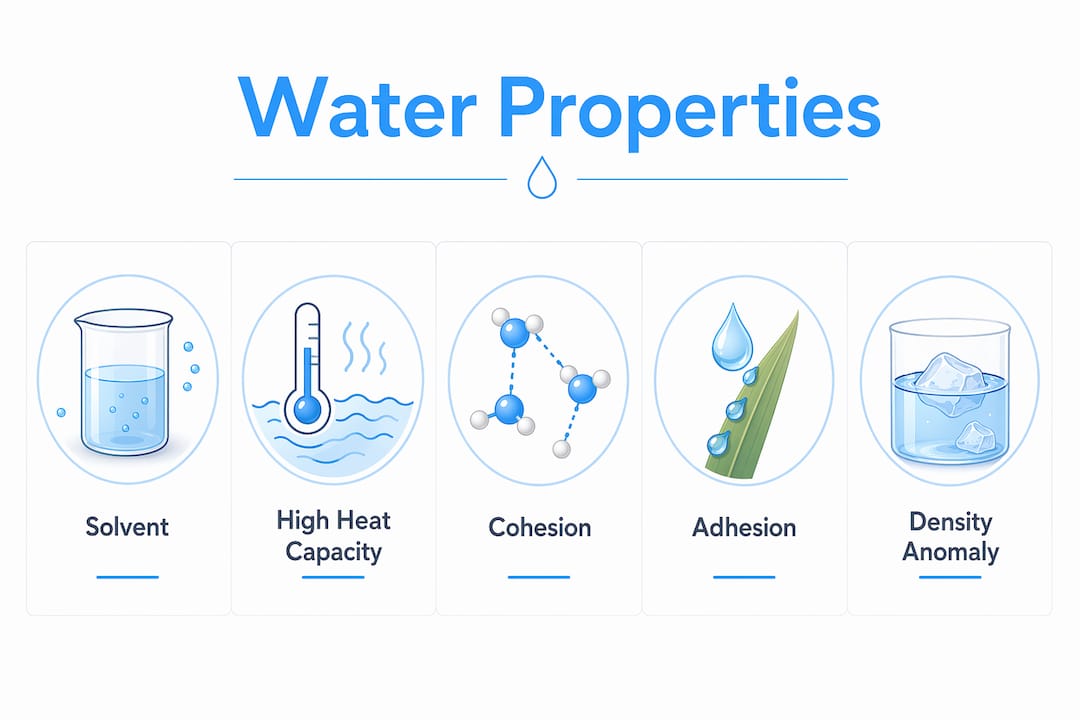
- Universal solvent. Water dissolves more substances than any other liquid. This allows it to carry nutrients, hormones, and waste products through cells, soils, and waterways. Without this property, nutrient cycling in ecosystems would stop.
- Cohesion and adhesion. Water molecules stick to each other and to other surfaces. These forces drive capillary action in plants, pulling water from roots to leaves against gravity. Transpiration, a key part of the water cycle, depends entirely on this.
- High specific heat capacity. Water buffers organisms and climates/03%3A_Module_Micronutrients_and_Water/3.04%3A_Water_and_Electrolytes/3.4.03%3A_Waters_Importance_to_Vitality) against temperature extremes. Coastal cities experience milder temperatures than inland cities at the same latitude because the ocean absorbs and releases heat slowly. This is a direct application of water’s heat capacity that ESS students can cite in climate discussions.
- Density anomaly. Ice is less dense than liquid water, so it floats. This protects aquatic organisms in winter by insulating the water below. If ice sank, lakes would freeze solid from the bottom up, killing most aquatic life.
- Gas solubility. Cold water holds more dissolved oxygen than warm water. As global temperatures rise, oxygen levels in lakes and oceans drop, threatening aquatic biodiversity. This is a direct link between water chemistry and climate change impacts on ecosystems.
Pro Tip: When answering an ESS exam question about water, always name the specific property first, then explain the ecological consequence. “Water’s high specific heat capacity means coastal ecosystems experience less temperature variation, supporting greater species diversity” scores far more marks than a general statement.
How does water support biological systems and ecosystem health?
Water performs four distinct functions inside living organisms, and each one has a direct parallel at the ecosystem scale.
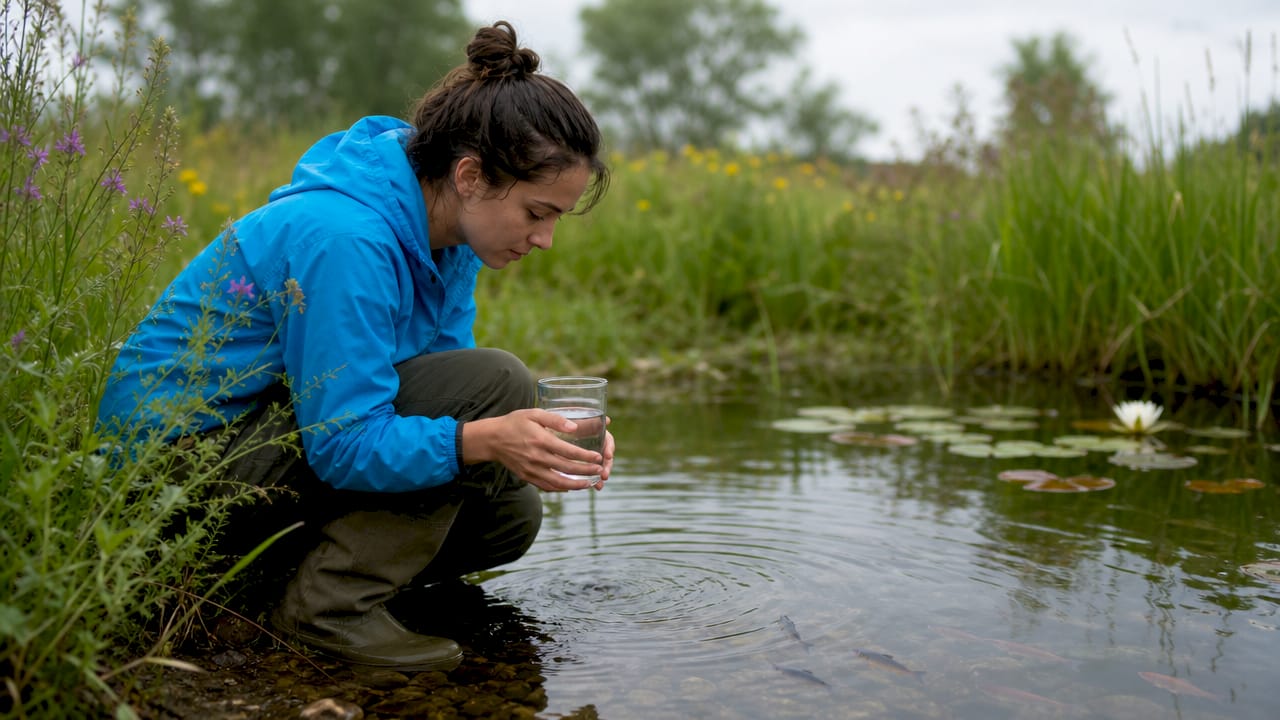
As a solvent and transport medium, water carries glucose, amino acids, and mineral ions through the bloodstream and plant vascular tissue. Remove water, and metabolism halts within minutes. At the ecosystem level, rivers and groundwater perform the same transport function, moving nutrients from terrestrial to aquatic environments.
As a reaction medium, water enables enzyme function, DNA stability, and metabolic processes within a liquid aqueous environment. Enzymes only work when dissolved in water. This is why dehydration impairs cognitive function and physical performance long before it becomes life-threatening.
As a temperature regulator, water maintains the internal temperature set point of 37°C in humans. Critical failure occurs below 28°C/03%3A_Module_Micronutrients_and_Water/3.04%3A_Water_and_Electrolytes/3.4.03%3A_Waters_Importance_to_Vitality), when muscle function collapses, and above 44°C, when the central nervous system fails. Those thresholds show exactly how narrow the viable temperature range is, and why water’s buffering role is non-negotiable.
As a lubricant and structural support, water cushions joints, protects organs, and maintains cell turgor pressure in plants. Wilting in plants is a visible sign of water loss reducing structural support.
“Recognizing the ecological importance of wetlands and aquatic ecosystems beyond human use marks a higher level of environmental literacy in ESS.” — Australian Government Department of Climate Change, Energy, the Environment and Water
Wetlands and floodplains illustrate all four functions at the ecosystem scale. They filter pollutants, regulate flood pulses, store carbon, and support some of the highest species diversity on Earth. Environmental literacy in ESS requires students to see wetlands not just as water storage but as active biological systems performing services that human infrastructure cannot replicate cheaply.
Why is water management essential for sustainability in ESS?
Water scarcity is one of the clearest examples of a limiting condition in sustainable development, and the numbers make that concrete.
| Indicator | Current figure | Projected figure (2050) |
|---|---|---|
| People in severe water scarcity | 1.9 billion | 3 billion |
| Rivers restored by environmental water programs | 28,500 km | Not yet projected |
| Wetlands under environmental water management | 470,000 hectares | Not yet projected |
| Salt flushed from restored systems (since 2009) | 4.3 million tonnes | Not yet projected |
Approximately 1.9 billion people currently live in areas of severe water scarcity. That figure is projected to reach 3 billion by 2050 as climate disruption and environmental degradation accelerate. For ESS students, this is not just a statistic. It is evidence that water availability is already a political and economic constraint, not only an ecological one.
Human alterations to natural water flow include dam construction, groundwater extraction, wetland drainage, and urban impervious surfaces. Each change disrupts the natural timing and volume of water delivery to ecosystems. Environmental water delivery programs have restored over 28,500 km of rivers and 470,000 hectares of wetlands since 2009, flushing 4.3 million tonnes of salt in the process. That scale of restoration shows what is possible when water management prioritizes ecological function alongside human demand.
Water is also the limiting condition for sustainable development, forcing political and economic realism into environmental management. The UNEP Sustainable Development Goal 6 framework treats clean water access as a prerequisite for achieving Goals 2, 3, 13, and 15, covering food security, health, climate action, and life on land. Understanding environmental policies around water is therefore central to ESS, not peripheral.
Pro Tip: For your ESS Internal Assessment, water management topics offer strong data availability and clear cause-effect relationships. Comparing water quality upstream and downstream of an agricultural zone, for example, directly addresses multiple ESS assessment criteria.
How does the water cycle integrate physical, biological, and human systems?
The water cycle, formally called the hydrological cycle, is the mechanism that connects all of water’s roles into one dynamic system. The water cycle continuously moves water through Earth’s surface and atmosphere, influencing climate, ecosystems, and human systems. Human activities disrupt those natural flows at every stage.
The key phases and their ESS relevance are:
- Evaporation and transpiration. Solar energy drives water from oceans, lakes, and plant leaves into the atmosphere. Deforestation reduces transpiration, lowering regional rainfall and increasing surface temperatures. This is a feedback loop with direct consequences for biodiversity and agriculture.
- Condensation and precipitation. Water vapor cools and falls as rain, snow, or hail. Changes in precipitation patterns, driven by warming, shift which ecosystems receive water and when. Seasonal timing matters as much as total volume for species that depend on predictable wet seasons.
- Infiltration and groundwater recharge. Water enters soil and replenishes aquifers. Urban development replaces permeable soil with concrete, reducing infiltration and increasing flood risk. Many cities now face simultaneous groundwater depletion and surface flooding.
- Surface runoff and river flow. Water moves across land into streams and rivers, carrying sediment and nutrients. Agricultural runoff adds nitrogen and phosphorus, causing eutrophication in receiving water bodies. This is one of the most common ESS case study topics.
- Glacial storage and release. Water stored in glaciers is melting due to warming, altering seasonal water availability for billions of people and contributing to sea level rise. Glacial retreat is both a symptom of climate change and a driver of further ecosystem disruption.
Each stage of the hydrological cycle connects to at least one ESS topic area. Students who can trace a water molecule through the full cycle, naming human impacts at each stage, demonstrate the systems thinking that IB examiners reward.
What are the key applications for ESS students and educators?
Understanding water’s role in ESS is not just academic. It directly improves your performance on assessments and builds the environmental literacy you need to engage with real-world issues.
- Link water concepts to IB ESS assessment criteria. Questions about nutrient cycling, biodiversity loss, climate change, and food security all require water knowledge. Identifying which property of water is relevant to each question is a skill worth practicing deliberately.
- Use water as a lens for interpreting environmental issues. Top environmental issues in IB ESS, from coral bleaching to desertification, become clearer when you ask “what is happening to water here?” That question almost always leads to the correct analysis.
- Choose water-related IA topics strategically. Water quality, riparian zone health, and wetland biodiversity are all measurable, locally accessible, and directly tied to ESS concepts. They also generate quantitative data, which strengthens your IA methodology score.
- Think about water in socio-ecological terms. The most sophisticated ESS responses connect physical processes to human decisions and social outcomes. Water scarcity is not just a hydrological event. It is a governance failure, an equity issue, and an ecological crisis simultaneously.
- Practice the four-role classification. Students who master water’s four roles/03%3A_Module_Micronutrients_and_Water/3.04%3A_Water_and_Electrolytes/3.4.03%3A_Waters_Importance_to_Vitality) as solvent, reaction medium, lubricant, and temperature regulator consistently produce more precise exam answers. This classification is a direct path to higher marks.
Key Takeaways
Water is irreplaceable in ESS because its physical and chemical properties directly drive biological function, ecosystem health, climate regulation, and sustainable development outcomes.
| Point | Details |
|---|---|
| Water’s four roles | Classifying water as solvent, reaction medium, lubricant, and temperature regulator sharpens exam answers and IA analysis. |
| Biological thresholds | Human body temperature must stay between 28°C and 44°C; water’s buffering capacity makes that range possible. |
| Scarcity is accelerating | 1.9 billion people face severe water scarcity now, rising to 3 billion by 2050 under current trends. |
| Restoration works | Environmental water programs have restored 28,500 km of rivers and 470,000 hectares of wetlands since 2009. |
| Systems thinking wins marks | Tracing water through the hydrological cycle while naming human impacts at each stage demonstrates the analysis IB examiners reward. |
Water in ESS: what 13 years of teaching has shown me
After more than a decade of working with IB ESS students, I can tell you the single most common gap I see: students know that water is important, but they cannot explain why with precision. They write “water is needed for life” and stop there. That answer earns no marks.
The students who score 6s and 7s do something different. They connect a specific property of water to a specific ecological or biological consequence. “Water’s high specific heat capacity buffers lake temperatures, maintaining dissolved oxygen levels that support fish populations.” That sentence shows understanding. It shows systems thinking. It is exactly what the IB is testing.
I also see students underestimate water management topics for their Internal Assessments. Water quality investigations are genuinely accessible. You can collect data from a local stream, a school pond, or even a tap water comparison. The methodology is clear, the variables are measurable, and the ESS connections are direct. If you are struggling to find an IA topic, water is almost always the right place to start.
The other thing I want to flag is the socio-ecological dimension. Water scarcity is not just an environmental problem. It is a justice problem. When you write about water in ESS, bring in the human dimension. Who loses access first? Who has the political power to redirect water? Those questions lift a good ESS response into an excellent one.
— Marija
Strengthen your ESS water knowledge with expert support
Water topics appear across every unit of the IB ESS course, from ecosystem function to climate policy. Getting them right matters for your final grade.
Esstutor offers personalized, one-on-one sessions with an IB examiner who has over 13 years of ESS teaching experience. Whether you need help structuring an ESS Internal Assessment on a water system topic or want to sharpen your exam technique for water cycle questions, Esstutor provides targeted support that fits your schedule. Students worldwide use Esstutor to close specific knowledge gaps and build the confidence they need going into assessments. A trial lesson is available if you want to see the approach before committing.
FAQ
Why is water important in ESS?
Water is central to ESS because it connects biological, physical, and human systems. Its roles as a universal solvent, temperature regulator, and transport medium appear across every major ESS topic.
What are water’s four key roles in living systems?
Water functions as a solvent, a medium for biochemical reactions, a lubricant, and a temperature regulator. Mastering these four roles directly improves ESS exam performance.
How does the water cycle relate to climate change in ESS?
Human activities disrupt the hydrological cycle through deforestation, urbanization, and greenhouse gas emissions. Glacial melt and shifting precipitation patterns are measurable consequences that ESS students analyze using climate and ecosystem data.
What is a good ESS Internal Assessment topic involving water?
Water quality comparisons, riparian zone biodiversity surveys, and wetland health assessments are all strong IA topics. They generate quantitative data, connect directly to ESS concepts, and have clear cause-effect relationships that support high-scoring methodology sections.
How many people are affected by water scarcity right now?
Approximately 1.9 billion people currently live in areas of severe water scarcity, with projections reaching 3 billion by 2050. This figure, tracked by UNEP under Sustainable Development Goal 6, is a key data point for ESS water management discussions.
No Comments