


06 Jul How to Develop ESS Arguments for IB Essays
TL;DR:
- Strong ESS arguments rely on the claim-warrant-impact framework, combining clear points with credible evidence and evaluation. Planning points and counterarguments beforehand improves logical flow and helps balance the essay effectively. Examiners prioritize explicit evaluation, precise terminology, and well-supported judgments over mere description.
Strong ESS arguments are defined by three elements: a clear claim, credible evidence, and explicit evaluation that connects the two. Knowing how to develop ESS arguments separates a 5 from a 7 on IB assessments. The IB Environmental Systems and Societies course rewards students who can present balanced perspectives, use precise terminology like “ecological footprint” or “species diversity,” and deliver reasoned judgments rather than simple descriptions. This guide walks you through the exact frameworks and techniques that examiners reward, from structuring individual paragraphs to writing conclusions that actually earn marks.
What are the essential elements of an effective ESS argument?
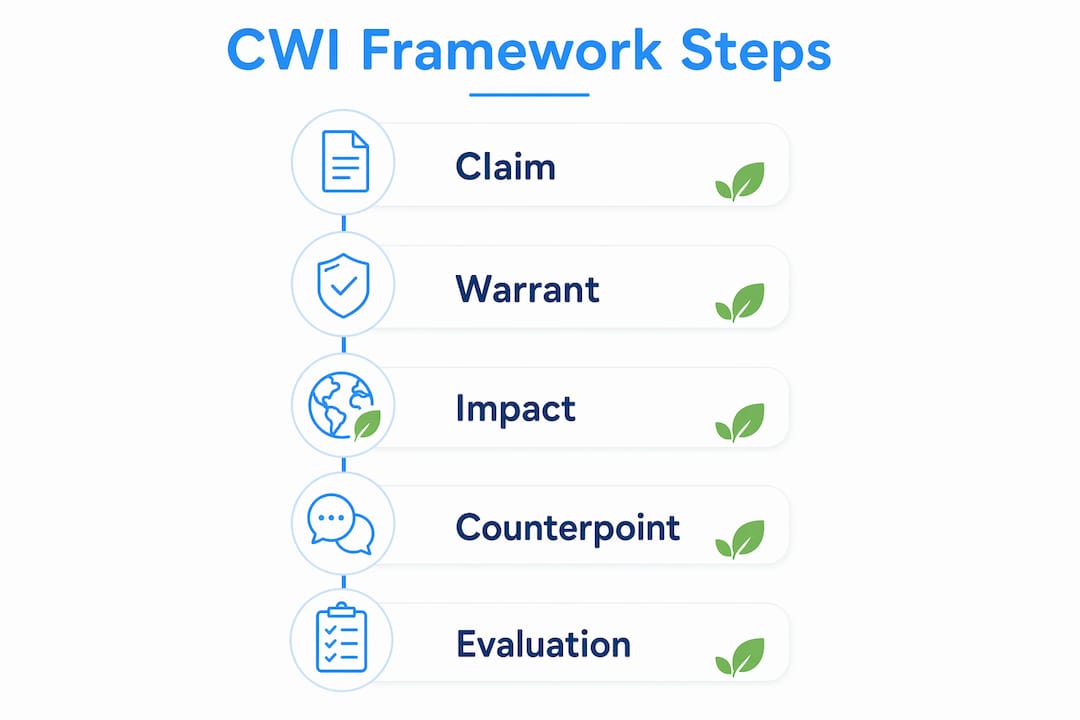
The Claim-Warrant-Impact (CWI) framework is the foundation of every strong ESS paragraph. The claim states your point, the warrant provides the evidence, and the impact explains why that evidence matters to your argument. Paragraphs built on this structure typically run 200–300 words. That length gives you enough space to develop each element without padding.
Here is what each element looks like in an ESS context:
- Claim: A direct, arguable statement. Example: “Intensive agriculture reduces species diversity by destroying natural habitats.”
- Warrant: Specific evidence that supports the claim. Example: “The conversion of tropical forests to palm oil plantations in Borneo has reduced orangutan populations by over 50% in the past two decades.”
- Impact: The “so what” explanation. Example: “This demonstrates that economic development priorities consistently override biodiversity protection without binding international regulation.”
Each body paragraph should also contain a counterpoint and evaluation, not just a claim and evidence. Students who skip this step lose marks in the evaluation criterion. Treat every paragraph as a self-contained argument with its own mini-conclusion.
Precise ESS terminology strengthens your warrant. Terms like “bioaccumulation,” “carrying capacity,” and “trophic level” signal subject knowledge and make your evidence more specific. Vague language weakens even a well-structured argument.

Pro Tip: After writing each paragraph, ask yourself: “Does my impact sentence explain why this evidence proves my claim?” If you cannot answer yes, rewrite the impact sentence before moving on.
How do you plan and organize ESS arguments for essay structure?
Planning before you write is the single most effective way to avoid logical fallacies and weak arguments. A clear thesis and consideration of counterarguments makes your overall argument more persuasive and easier to follow. Spend five minutes mapping your logic before writing a single sentence.
Follow these steps to plan a well-organized ESS essay:
- Write your thesis. State a clear contention that is arguable and supported by evidence. Example: “While renewable energy reduces carbon emissions, its large-scale implementation creates significant land-use conflicts that must be managed through policy.”
- List 2–3 points for your position. Each point should connect directly to your thesis. For an essay on biodegradable plastics, you might argue reduced persistence in ecosystems, lower toxicity to marine life, and decreased landfill pressure.
- List 2–3 counterarguments. Top-scoring responses include developed points on both sides. Identify the strongest objections to your thesis and plan how to address them.
- Sequence your paragraphs logically. Start with your strongest point, then present the counterargument, then evaluate which side holds more weight.
- Plan your conclusion separately. Decide in advance which side of the argument your evidence supports more strongly. This prevents vague or uncommitted conclusions.
Logical reasoning types also matter here. Deductive reasoning moves from a general principle to a specific conclusion, while inductive reasoning builds a general claim from specific evidence. ESS essays often use both. Knowing which type you are using helps you spot gaps in your logic before the examiner does.
Pro Tip: Draw a simple two-column table before writing: “For” on one side, “Against” on the other. Fill in three rows for each. This takes three minutes and prevents the most common planning mistake, which is writing only one side.
What are practical techniques to develop compelling ESS evidence and evaluation?
Strong evidence does not just support your claim. It also withstands scrutiny. Examiners value explicit linkage between evidence and claims, and they penalize responses that describe without evaluating. The difference between a 5 and a 7 is almost always in the quality of evaluation, not the quantity of facts.
Use these techniques to select and evaluate evidence effectively:
- Choose specific, credible examples. Case studies from your ESS coursework, such as the Aral Sea water crisis or the Chernobyl exclusion zone, carry more weight than vague references to “environmental damage.”
- Answer the “so what” question. After every piece of evidence, write one sentence that explains its relevance to your claim. This is the most commonly skipped step in student essays.
- Avoid emotive language. Phrases like “devastating destruction” or “catastrophic collapse” reduce your academic credibility. Replace them with precise, measured language: “a 40% reduction in wetland area” is stronger than “massive wetland loss.”
- Use evaluative phrases. Language like “this suggests,” “the evidence indicates,” and “this is limited by” signals critical thinking. Examiners look for these markers when awarding evaluation marks.
- Address the limitations of your evidence. A case study from one region may not apply globally. Acknowledging this shows you understand the scope and reliability of your evidence.
Shallow description is the most common reason students lose marks. Listing facts without connecting them to your argument reads as knowledge recall, not analysis. Every piece of evidence needs a purpose sentence that ties it back to your thesis.
How to write reasoned conclusions that strengthen your ESS arguments?
A strong ESS conclusion synthesizes your arguments and delivers a supported judgment. Effective conclusions weigh the evidence presented and explicitly state which side of the argument is stronger. They do not introduce new information or restate the introduction word for word.
The table below contrasts weak and strong conclusion approaches in ESS essays:
| Feature | Weak conclusion | Strong conclusion |
|---|---|---|
| Summarizes key points | Repeats introduction | Briefly restates the strongest evidence from each side |
| States a judgment | Avoids committing to a position | Clearly states which argument is better supported |
| Uses cautious language | Overstates certainty or hedges completely | Uses phrases like “the evidence suggests” or “on balance” |
| Introduces new ideas | Adds new case studies or claims | Draws only from evidence already presented |
| Evaluates limitations | Ignores weaknesses in the argument | Acknowledges conditions under which the conclusion may not hold |
Cautious but confident language is the right register for ESS conclusions. Phrases like “on balance, the evidence suggests that habitat fragmentation poses a greater threat to species diversity than climate change in the short term” show reasoned judgment without overreaching. Avoid absolute statements like “this proves” unless your evidence is exceptionally strong.
A valid ESS argument must also evaluate the conditions under which it holds. Top-scoring conclusions acknowledge that their judgment depends on context, scale, or available data. This is what separates a 6 from a 7 in the evaluation criterion.
Key Takeaways
Strong ESS arguments require the CWI framework, balanced evidence, and explicit evaluation in every paragraph and conclusion.
| Point | Details |
|---|---|
| Use the CWI framework | Every paragraph needs a claim, warrant, and impact sentence to earn full marks. |
| Plan before you write | Map 2–3 points per side and sequence paragraphs logically before drafting. |
| Evaluate, do not describe | Answer the “so what” after every piece of evidence to show critical thinking. |
| Address counterarguments | Including and responding to opposing points creates more convincing essays. |
| Conclude with a judgment | State which side is better supported and acknowledge the limits of your evidence. |
What I have learned from watching students build ESS arguments
After working with IB ESS students for over 13 years, the pattern I see most often is this: students know the content but struggle to turn that knowledge into an argument. They list facts. They describe case studies. But they do not connect the dots for the examiner.
The fix is simpler than most students expect. Once you commit to writing an impact sentence after every piece of evidence, your marks improve noticeably. That one habit, answering “so what does this prove?” forces you to think analytically rather than descriptively. It is the single change I recommend first to every student I work with.
The second thing I have noticed is that students underestimate the value of planning. A five-minute outline prevents the most common essay mistake: writing yourself into a corner by committing to a one-sided argument. When you map both sides before you write, you always have a counterargument ready. That balance is exactly what high-scoring ESS essays require.
My honest advice is to practice writing conclusions first. Most students treat conclusions as an afterthought. But if you cannot write a clear, supported judgment in three sentences, your argument does not yet have a clear direction. Start there, then build the body paragraphs around the conclusion you want to reach.
— Marija
Esstutor can help you build stronger ESS arguments
If you want personalized feedback on your argument structure, Esstutor offers one-on-one IB ESS tutoring with a focus on exactly these skills: building claims, evaluating evidence, and writing conclusions that earn marks. Marija has over 13 years of experience as an IB examiner and ESS educator, which means she knows precisely what examiners look for in a top-scoring response.
Whether you are preparing for Paper 2 or working on your IB ESS internal assessment, targeted tutoring can help you move from describing content to genuinely arguing it. Sessions are flexible, online, and tailored to where you are right now. You can also explore the ESS essay writing workflow guide to see how these argument techniques fit into a full essay process.
FAQ
What is the CWI framework in ESS essays?
The Claim-Warrant-Impact (CWI) framework structures each paragraph around a clear point, supporting evidence, and an explanation of why that evidence matters. Paragraphs built on this framework typically run 200–300 words and earn higher evaluation marks.
How many points should each side of an ESS argument have?
Top-scoring ESS responses include 2–3 developed points per side. Each point should include a claim, evidence, a counterpoint, and an evaluation sentence.
Why do ESS examiners penalize emotive language?
ESS essays are academic documents, and examiners reward logical, evidence-based claims over emotional appeals. Precise language like “a 30% reduction in forest cover” is more credible than phrases like “devastating deforestation.”
How do you write a strong ESS conclusion?
A strong ESS conclusion summarizes the key arguments from both sides, states which is better supported by the evidence, and uses cautious language like “on balance” or “the evidence suggests.” Never introduce new information in a conclusion.
What is the difference between description and evaluation in ESS?
Description states what happened. Evaluation explains why it matters, how strong the evidence is, and under what conditions the argument holds. Examiners award marks for evaluation, not description.
No Comments