


11 Jul ESS Fieldwork Method Guide for IB Students
TL;DR:
- ESS fieldwork involves collecting and analyzing environmental and social data to answer research questions for IB assessments. Choosing appropriate methods, designing clear instruments, and conducting ethical, pilot-tested procedures are essential for high-quality, marks-earning investigation. Connecting findings to ESS concepts and honestly evaluating limitations improve your report and maximize your grade.
ESS fieldwork is the systematic process of collecting and analyzing environmental and social data in real-world settings to answer research questions for IB Environmental Systems and Societies assessments. This ESS fieldwork method guide covers every stage you need: choosing the right methodology, designing your data collection tools, executing in the field, and writing a results-driven report. The IB ESS Internal Assessment accounts for 25% of your final grade, so getting your methodology right is not optional. The IB ESS curriculum requires you to link natural science with societal perspectives, and your fieldwork design must reflect that from day one.
What are the main ESS fieldwork methodologies and how do they differ?
Fieldwork methods range from direct observation to ethnography, each suited to different data types and research goals. Choosing the wrong method for your question is one of the most common mistakes IB ESS students make. Understanding the options before you commit saves you significant time and protects your data quality.

Direct observation means recording what you see without interacting with the environment or participants. You count species, measure water turbidity, or log temperature readings. This method works well for ecological studies where your presence should not alter the system.
Participant observation goes further. It requires active engagement and relationship-building with a community or environment to gain insider perspectives. For an ESS investigation into local fishing practices, for example, spending time with fishing communities yields data that a survey alone cannot capture.
Surveys and questionnaires generate quantitative data quickly across large groups. They work best when you need measurable attitudes, behaviors, or frequencies from a defined population. Interviews and focus groups, by contrast, produce qualitative depth. They reveal the reasoning behind behaviors, which is exactly what the IB ESS “systems and sustainability” framing demands.
The table below summarizes the core methods, the data type each produces, the researcher’s level of involvement, and the best use case for each.
| Method | Data type | Researcher involvement | Best use case |
|---|---|---|---|
| Direct observation | Quantitative | Low | Species counts, pollution measurements |
| Participant observation | Qualitative | High | Community practices, cultural attitudes |
| Survey/questionnaire | Quantitative | Low | Attitudes, frequencies across large groups |
| Interview | Qualitative | Medium | In-depth individual perspectives |
| Focus group | Qualitative | Medium | Group attitudes, community consensus |
| Case study | Mixed | Variable | Complex local environmental issues |
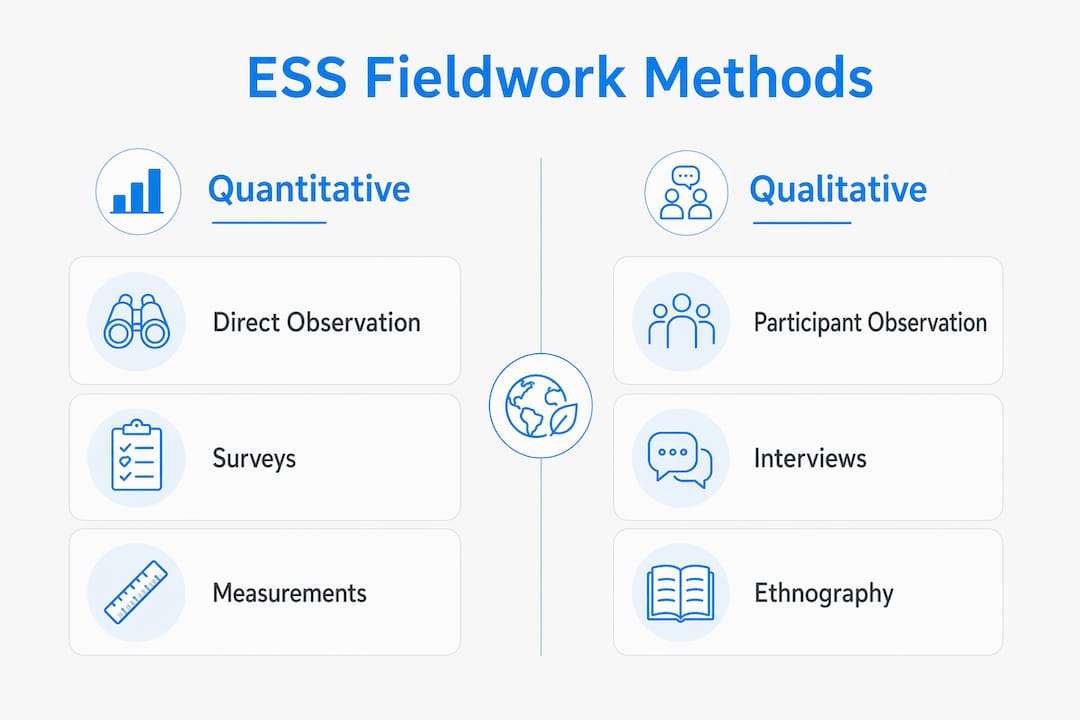
Mixed-method designs combining qualitative and quantitative techniques often yield more thorough ESS insights. That combination is also what examiners reward at the top band.
How to prepare and design an effective ESS fieldwork methodology
Strong fieldwork starts long before you enter the field. A clear design process protects your data and your grade. Follow these steps to build a methodology that holds up under examiner scrutiny.
-
Define your research question. Your question must link an environmental variable to a societal dimension. “How does proximity to a highway affect air quality and resident health perceptions in urban neighborhoods?” is a strong ESS question. “What is the air quality near a highway?” is not. The IB ESS IA guide is explicit: disciplinary integration is key for high scores.
-
Select your methods. Match each method to the data type your question requires. If you need both species diversity counts and community attitudes, plan for both direct observation and a short survey. Check that your chosen methods fit your timeline and available equipment.
-
Design your data collection instruments. Write your questionnaire questions in plain language. Build your observation checklist around specific, measurable indicators. Avoid vague categories like “high pollution” with no defined threshold.
-
Run a pilot study. Pilot testing in real-life settings identifies flaws in your tools before full deployment. A pilot study might reveal that your survey takes 20 minutes when participants only have 5, or that your species identification checklist misses a locally common genus. Fix these problems early.
-
Obtain permissions and address ethics. Ethical considerations include informed consent from participants, respect for private land, and safe data storage. Document every permission you receive. Examiners check for ethical awareness in your methodology section.
-
Train your team. If classmates help collect data, every person must follow the same protocol. Inconsistent technique between collectors is a reliability threat that examiners will flag.
Pro Tip: Write your methodology section as you design it, not after you collect data. This forces you to think through every step in advance and gives you a ready-made draft for your IA report.
What are best practices for collecting and managing ESS fieldwork data?
Executing fieldwork well requires discipline and attention to detail. The following practices protect your data quality from the moment you arrive at your site.
- Keep a detailed field journal. Ethnographers use “thick description,” recording not just measurements but sensory impressions, contextual notes, and personal reflections. Detailed field notes improve data quality and give you rich material for your analysis section.
- Standardize your protocol. Standardized training and ongoing monitoring reduce bias and promote consistency. Use the same equipment settings, the same time of day for measurements, and the same question wording for every participant.
- Perform real-time quality checks. Review your data at the end of each collection session. Catch missing values, illegible notes, or outliers before you leave the field site. Fixing errors in the field is far easier than reconstructing data later.
- Handle unexpected circumstances calmly. Weather changes, participant refusals, or equipment failure are normal. Document every deviation from your planned protocol. Your IA methodology section should acknowledge these events and explain how you responded.
- Protect your data. Store digital files in at least two locations. Anonymize participant responses immediately after collection. Ethical data management is a graded criterion in the IB ESS IA.
Pro Tip: Number every data sheet and photograph with a date, time, and site code before you start collecting. This takes 30 seconds per sheet and prevents hours of confusion during analysis.
How to analyze, interpret, and report ESS fieldwork results
Raw data does not earn marks. Analysis and interpretation do. The IB ESS assessment criteria reward students who connect findings to ESS concepts, evaluate limitations honestly, and present results clearly.
Quantitative analysis
Calculate averages, ranges, and simple correlations for numerical data. A comparison of mean nitrogen levels across three river sites, displayed in a clear table, communicates your findings more effectively than a paragraph of numbers. Use bar charts for categorical comparisons and scatter plots for correlations. Label every axis with units.
Qualitative analysis
For interview transcripts and observation notes, use thematic analysis. Read through your data and identify recurring themes. Group quotes or observations under each theme. For example, if five of eight interview participants mention “lack of government enforcement” when discussing local deforestation, that is a significant theme worth reporting.
Connecting to ESS concepts
Reports that integrate ESS concepts and evaluate limitations achieve higher marks. Use the language of the syllabus throughout your report. Reference feedback loops when describing how a pollutant cycles through a system. Identify stakeholders and their competing interests. Discuss sustainability trade-offs explicitly. The IB ESS curriculum stresses “systems and sustainability” framing as a core assessment requirement. Students who ignore this framing and report only raw measurements consistently score in the lower bands.
Presenting your results
- Use tables to display raw data and summary statistics side by side.
- Use charts to show trends and comparisons visually.
- Write a short caption for every figure explaining what it shows and why it matters.
- Keep visuals simple. A cluttered chart confuses examiners.
Evaluating limitations and proposing improvements
Every strong IA includes an honest evaluation of what could have been done better. Identify specific limitations: a small sample size, a single measurement date, or a survey conducted in one language in a multilingual community. Then propose concrete improvements. This section demonstrates scientific thinking, which is exactly what top-band criteria reward. You can find strong ESS IA examples to see how high-scoring students structure this section.
Key Takeaways
Effective ESS fieldwork requires linking environmental and social dimensions at every stage, from research question design through final analysis and reporting.
| Point | Details |
|---|---|
| IA weight matters | The IB ESS Internal Assessment is worth 25% of your final grade, so methodology quality directly affects your score. |
| Match method to question | Choose direct observation, surveys, or participant observation based on the data type your research question requires. |
| Pilot test every tool | Run a pilot study before full data collection to catch flaws in questionnaires, checklists, and equipment protocols. |
| Use ESS syllabus language | Reference stakeholders, feedback loops, and sustainability trade-offs in your report to reach the top assessment band. |
| Evaluate limitations honestly | Identifying specific weaknesses and proposing improvements demonstrates scientific thinking and earns higher marks. |
What I’ve learned from years of guiding ESS fieldwork
The single biggest mistake I see students make is treating their ESS investigation like a pure science experiment. They collect water samples, calculate averages, and stop there. The IB ESS curriculum is not asking for that. It asks you to connect what you measured to who is affected and why it matters. A nitrogen reading without a stakeholder analysis is half an answer.
The second pattern I notice is students skipping the pilot study because they feel pressed for time. Every single time, they regret it. I have worked with students who discovered mid-collection that their survey was ambiguous, or that their observation checklist was missing a key variable. A two-hour pilot saves you days of damage control.
I also want to say something about the qualitative side of ESS fieldwork. Many students are comfortable with numbers but nervous about interviews and focus groups. That discomfort is worth pushing through. The richest IAs I have seen combine a solid quantitative dataset with three or four well-analyzed interview responses that explain the human dimension of the data. That combination is what makes an investigation genuinely interesting to read and genuinely rewarding to mark.
Finally, keep your field journal honest. Write what you actually observed, including the things that surprised you or did not fit your hypothesis. Those moments of friction are often where the best analysis lives. If you want a step-by-step IA guide to complement your fieldwork planning, that resource walks you through every section of the IA in detail.
— Marija
Personalized ESS IA support from Esstutor
Designing a fieldwork methodology that meets IB ESS criteria takes more than reading a guide. It takes feedback from someone who knows exactly what examiners look for.
Esstutor offers personalized, one-on-one tutoring for IB ESS students at every stage of the IA process. With over 13 years of experience as an IB examiner and educator, the tutoring sessions cover research question design, methodology selection, data analysis, and report writing. Whether you need help planning your fieldwork from scratch or refining a draft methodology, you can get targeted support through IB ESS IA tutoring. You can also explore IB ESS notes and resources to strengthen your understanding of the concepts your fieldwork must address.
FAQ
What is ESS fieldwork in the IB Diploma Programme?
ESS fieldwork is on-site data collection and analysis that links environmental variables to societal dimensions, carried out as part of the IB Environmental Systems and Societies Internal Assessment. The IA accounts for 25% of the final grade.
Which fieldwork method works best for an IB ESS IA?
Mixed-method designs combining quantitative data collection (such as species counts or pollution measurements) with qualitative methods (such as interviews or surveys) produce the most thorough ESS investigations and align with top-band assessment criteria.
How do I meet IB ESS assessment criteria in my fieldwork report?
Use syllabus language throughout your report: reference stakeholders, feedback loops, and sustainability trade-offs. Evaluate your methodology’s limitations and propose specific improvements. Reports that integrate these ESS concepts consistently score in the higher bands.
Why is a pilot study important in ESS fieldwork?
A pilot study identifies flaws in your data collection tools before full deployment, protecting your data validity. Running even a small-scale test of your questionnaire or observation checklist can prevent major methodological errors.
How should I handle ethical considerations in ESS fieldwork?
Obtain informed consent from all participants, respect private land boundaries, and store data securely with participant responses anonymized. Document every permission you receive, as ethical awareness is a graded component of the IB ESS IA methodology section.
No Comments