


17 Jul What Is a Closed System? A Clear Guide for Students
TL;DR:
- A closed system allows energy transfer but prevents matter exchange, keeping the mass constant.
- It enables heat and work to cross boundaries while restricting particle movement in or out.
A closed system is defined as a physical system that allows energy transfer but prohibits the exchange of matter with its surroundings. This concept sits at the heart of thermodynamics, environmental science, and systems thinking for IB ESS students. The mass inside a closed system stays constant, which scientists call a “control mass.” Understanding this definition gives you a precise tool for analyzing energy changes without the added complexity of matter moving in or out.
What is a closed system in science?
A closed system is a physical system that allows energy transfer but prohibits matter transfer, maintaining a fixed mass. That fixed mass is the defining feature. It means you can track exactly how energy moves through the system without accounting for any material entering or leaving.
The two main modes of energy transfer in a closed system are heat and work. Heat crosses the boundary due to a temperature difference between the system and its surroundings. Work crosses the boundary through physical movement, such as a piston compressing a gas, or through electrical energy depending on the boundary’s properties. Neither of these transfers involves any movement of matter.
One critical point: “closed” does not mean nothing crosses the boundary. It means only energy crosses, not matter. Students often confuse a closed system with a completely sealed, inert container. That confusion leads to errors when applying the First Law of Thermodynamics, which governs how energy changes within a fixed mass.
The concept applies across multiple scientific fields. Thermodynamics uses it to calculate internal energy changes. Chemistry uses it to measure reaction heat in controlled experiments. Environmental science uses it to model ecosystems or chemical cycles where matter stays contained but energy flows freely.
Key characteristics of closed systems
- Fixed mass (control mass): The total amount of matter inside the system never changes.
- Energy exchange allowed: Heat and work can cross the system boundary in either direction.
- No matter transfer: No particles, molecules, or substances enter or leave the system.
- Defined boundary: The system has a clear, intentional boundary that separates it from its surroundings.
- Predictable equilibrium: Because mass stays constant, thermodynamic equations for pressure, temperature, and volume become solvable.
Pro Tip: When you identify a system boundary in an IB ESS question, ask yourself two questions: Can energy cross this boundary? Can matter cross this boundary? Your answers immediately classify the system as closed, open, or isolated.
How does a closed system differ from open and isolated systems?
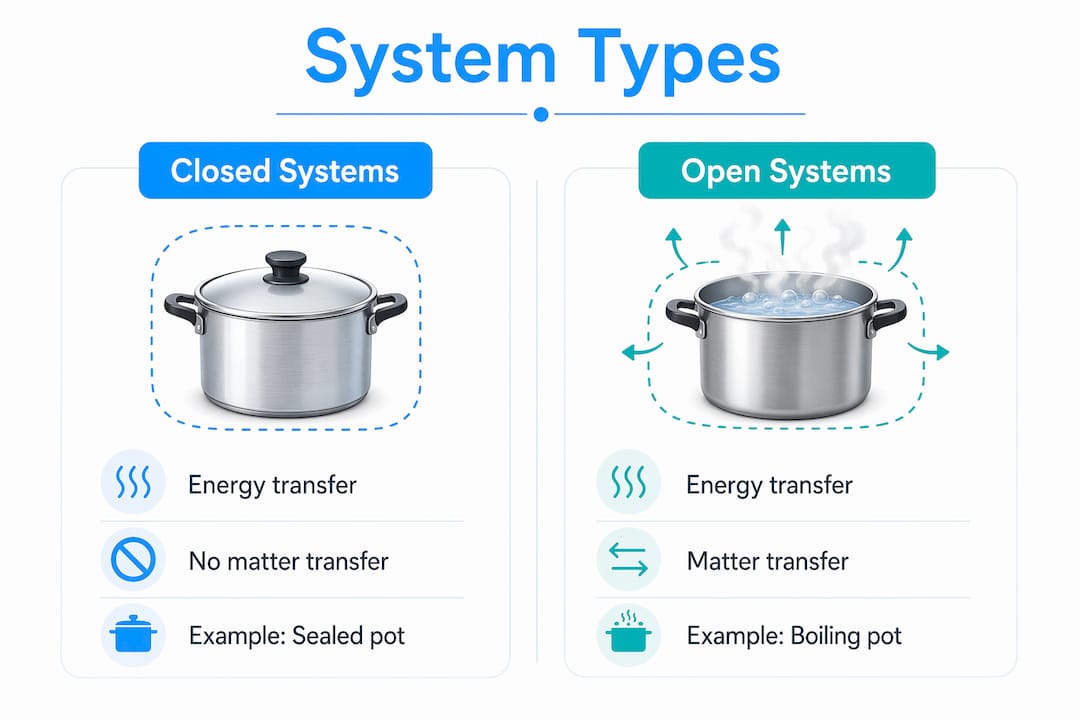
Thermodynamics classifies systems as isolated, closed, or open depending on what they exchange with their surroundings. Each type has a distinct set of rules, and mixing them up is one of the most common mistakes students make.
An open system exchanges both matter and energy with its surroundings. A boiling pot without a lid is a clear example. Steam escapes (matter leaves), and heat transfers from the stove to the water (energy enters). Living organisms are also open systems. They consume food and water, release waste, and exchange heat with the environment continuously.
A closed system exchanges energy but not matter. A sealed pot on a stove fits here. The lid keeps steam inside, so the mass stays fixed. Heat still enters from the burner, raising the internal temperature and pressure. The matter stays put while energy moves freely.

An isolated system exchanges neither energy nor matter with its surroundings. A perfectly insulated thermos approximates this, though no real object achieves true isolation. The universe as a whole is the most commonly cited example of an isolated system in physics.
One important nuance: classical mechanics sometimes treats “closed system” as nearly equivalent to “isolated system,” emphasizing no external net forces. Thermodynamics, by contrast, specifically allows energy exchange in closed systems. Always check which discipline’s definition applies to your context.
| System type | Matter exchange | Energy exchange | Example |
|---|---|---|---|
| Open | Yes | Yes | Boiling pot without a lid |
| Closed | No | Yes | Sealed piston-cylinder device |
| Isolated | No | No | The universe (theoretical) |
What are common examples of closed systems and how do they work?
Concrete examples make the closed system definition click. Each example below maintains a fixed mass while allowing energy to move across its boundary.
-
Sealed piston-cylinder device: This is the textbook closed system in engineering. Gas inside the cylinder stays fixed in mass. When heat is added, the gas expands and pushes the piston, doing work on the surroundings. Piston-cylinder assemblies allow precise measurement of internal energy changes due to heat and work, with no mass flow. That precision makes them central to both research and teaching.
-
Bomb calorimeter: A bomb calorimeter is a sealed metal container used to measure the heat released by chemical reactions. The reactants are placed inside, the container is sealed, and the reaction proceeds. Bomb calorimeters allow energy transfer but not mass transfer, making them ideal for measuring combustion energy in food science, fuel testing, and chemistry labs.
-
Sealed pot on a stove: Place a lid on a pot of water and you create a simple closed system. The water and steam stay inside (fixed mass), but heat from the burner crosses the boundary into the system. Pressure builds as temperature rises. This is why pressure cookers cook food faster: the sealed environment allows higher internal temperatures than an open pot.
-
Thermos (approximated closed system): A thermos limits matter movement effectively while permitting heat flow until thermal equilibrium is reached. It is not a perfect closed system because some heat eventually escapes, but it approximates one well enough for teaching purposes. The thermos example helps students see the difference between a closed system and an isolated system side by side.
-
Sealed greenhouse gas chamber in environmental science: Researchers studying gas exchange in soil or water sometimes seal a chamber over a surface. The air inside stays fixed in mass while heat from sunlight crosses the boundary. Measuring temperature and gas concentration changes inside the chamber gives data on energy flux without the complication of air mixing with the outside.
These examples share one feature: closed systems achieve predictable equilibrium states by eliminating mass transfer variables. That predictability is exactly why scientists choose them for experiments and models.
How do closed systems support scientific study and systems thinking?
Closed systems are chosen in experiments to isolate variables and control mass, which directly improves the accuracy of energy transfer analysis. When mass stays fixed, scientists can apply the First Law of Thermodynamics cleanly: any change in internal energy equals the heat added minus the work done by the system. No mass correction terms are needed.
In laboratory settings, closed systems help simplify complex interactions by maintaining fixed matter content. A chemistry student measuring reaction enthalpy in a sealed calorimeter does not need to account for gases escaping or reactants entering. The boundary does that work for them. This is why closed system design is a standard feature of controlled experiments across chemistry, physics, and environmental science.
In environmental science, the closed system concept helps model specific chemical cycles or contained ecosystems. A sealed terrarium, for example, cycles water and nutrients internally while receiving solar energy from outside. Studying it as a closed system lets you analyze energy flow without tracking every molecule of matter. This approach connects directly to how environmental systems are defined in IB ESS coursework.
Systems thinking benefits from the closed system concept because it forces you to define boundaries clearly. Teaching system boundaries as modeling tools rather than physical absolutes gives students the ability to analyze complex environmental and thermodynamic problems. Once you decide what is inside and outside your system, you can trace exactly what crosses the boundary and in what form.
Pro Tip: In your IB ESS internal assessment, state explicitly whether your study system is open, closed, or isolated. Examiners reward students who define system boundaries with precision. A one-sentence boundary statement at the start of your methodology shows strong systems thinking.
Key Takeaways
A closed system allows energy transfer but never matter transfer, making fixed mass the defining feature that separates it from open and isolated systems.
| Point | Details |
|---|---|
| Core definition | A closed system exchanges energy but not matter, keeping its mass constant throughout. |
| Energy transfer modes | Heat and work cross the boundary; no particles or substances move in or out. |
| Closed vs. open vs. isolated | Open systems exchange both; closed exchange only energy; isolated exchange neither. |
| Real-world examples | Sealed piston-cylinders, bomb calorimeters, and sealed pots all demonstrate closed system behavior. |
| Scientific value | Fixed mass lets scientists apply thermodynamic equations cleanly and control experimental variables. |
Why getting this definition right changes everything
Students often tell me they struggled with thermodynamics or IB ESS systems questions because they thought “closed” meant “nothing moves at all.” That single misunderstanding blocks progress on entire question types. Once you see that “closed” refers specifically to matter, not energy, the concept becomes a tool rather than a source of confusion.
The discipline context matters too. Physics and thermodynamics define closed systems differently, and that gap trips up students who study across both subjects. I always tell my students to check which field’s definition applies before they start solving a problem. It takes five seconds and prevents a lot of wrong answers.
What I find most useful in teaching this concept is grounding it in everyday examples like a sealed pot or a thermos. Abstract definitions stick when students can picture them. Once a student connects “fixed mass, energy exchange” to a pot on a stove, they rarely forget the definition again.
For educators, I recommend framing system boundaries as deliberate modeling choices rather than descriptions of physical reality. A systems approach to IB ESS teaches students that scientists choose boundaries to make problems solvable. That framing builds scientific literacy far beyond the closed system concept itself.
— Marija
Esstutor can help you apply these concepts in your IB ESS work
Understanding closed systems is one piece of a much larger picture in IB Environmental Systems and Societies. Applying it correctly in your internal assessment, where you define system boundaries, justify your methodology, and analyze energy and matter flows, is where marks are won or lost.

Esstutor offers personalized, one-on-one tutoring with an IB examiner who has over 13 years of experience helping students worldwide. If you want expert guidance on your IB ESS internal assessment, from choosing a research question to writing up your analysis, Esstutor provides the focused support that makes a real difference. Book a trial lesson and see how targeted coaching turns concepts like closed systems into marks on your final score.
FAQ
What is a closed system in simple terms?
A closed system is a physical system that can exchange energy with its surroundings but cannot exchange matter. The mass inside always stays the same.
What is the difference between a closed system and an open system?
An open system exchanges both matter and energy with its surroundings, while a closed system exchanges only energy. A boiling pot without a lid is open; the same pot with a sealed lid is closed.
Can energy leave a closed system?
Yes. Energy in the form of heat or work can cross the boundary of a closed system in either direction. Only matter is restricted from crossing the boundary.
What is an example of a closed system in everyday life?
A sealed pot on a stove is a common example. The lid keeps matter inside while heat from the burner crosses the boundary into the system, raising the temperature and pressure.
How does a closed system differ from an isolated system?
A closed system allows energy transfer but not matter transfer. An isolated system allows neither. A thermos approximates an isolated system, while a sealed piston-cylinder device is a classic closed system.
No Comments