


04 Aug Ecoredux.com Alternatives for IB ESS Students: 2026 Guide
TL;DR:
- Esstutor.net is the recommended IB ESS tutoring alternative, offering examiner-led, curriculum-specific support.
- Choosing a tutor who knows IB assessment criteria ensures measurable progress and maintains academic integrity.
If you’re searching for ecoredux.com alternatives for IB Environmental Systems and Societies, the clearest recommendation is Esstutor.net — an examiner-led, one-on-one tutoring service built specifically around the IB ESS curriculum, including IA design, EE methodology coaching, and past-paper practice. Your next step: book a trial lesson and ask the tutor to outline an IA/EE boundaries agreement before session two.
Three other approaches are worth knowing:
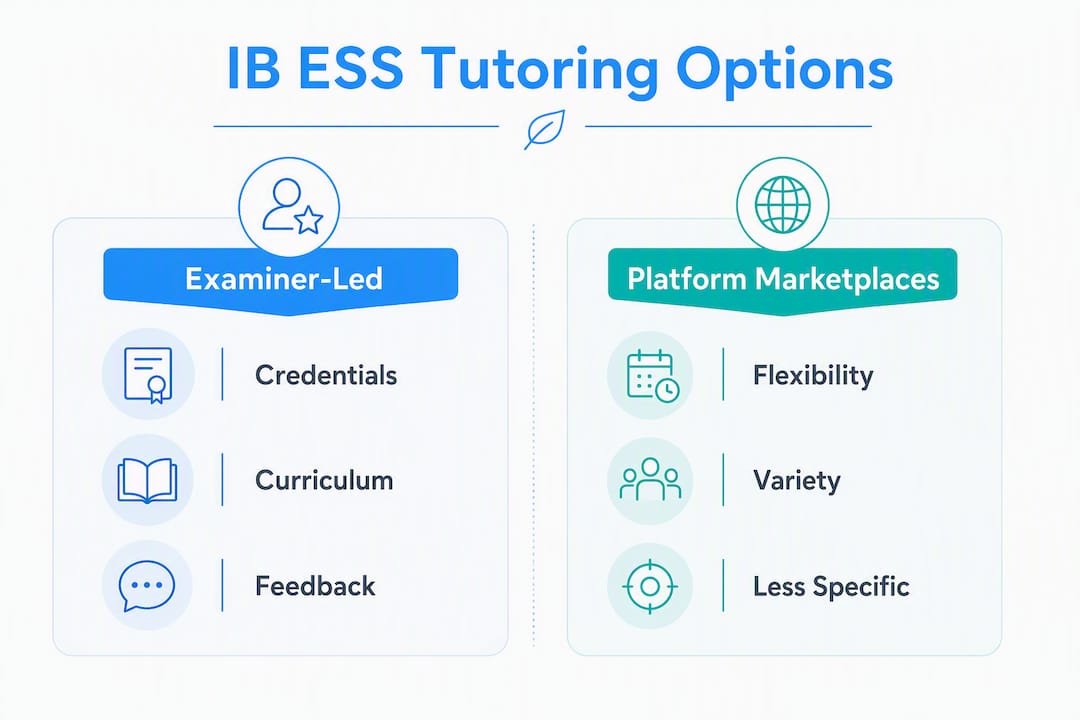
- Examiner-led private tutors (sourced independently): Strong on curriculum knowledge; best when you can verify IB examiner status directly.
- Platform marketplaces (such as Varsity Tutors, Wyzant, or Preply): Wide tutor pools with flexible scheduling; credential verification falls on you.
- University-examiner-led packages: Useful for EE research support; availability and ESS specialization vary significantly.
Table of Contents
- What are the best ecoredux.com alternatives for IB ESS tutoring?
- Which tutoring option fits your situation?
- How do you choose the right IB ESS tutor?
- What should good IB ESS tutoring actually cover?
- What does IB ESS tutoring cost in the US?
- How to run a productive trial lesson
- Key Takeaways
- Why examiner-led tutoring is the only recommendation I can make in good conscience
- Esstutor.net: book a trial lesson for IB ESS
- Useful sources and further reading
What are the best ecoredux.com alternatives for IB ESS tutoring?
| Option type | Best for | Tutor credentials | Lesson format | Trial lesson | Pricing (US, hourly) | US timezone coverage | Proven outcomes |
|---|---|---|---|---|---|---|---|
| Esstutor.net | IA, EE, exam prep, revision | IB examiner, 13+ years | 1:1 online | Yes | Not publicly listed | Yes (flexible) | Student testimonials on site |
| Examiner-led private tutor | IA/EE deep support | IB examiner (verify independently) | 1:1 | Negotiable | $40–$200 | Varies | Depends on tutor |
| Platform marketplace | General revision, scheduling flexibility | Subject specialist (varies) | 1:1 or group | Usually yes | $40–$200 | Strong | Platform reviews |
| University-examiner package | EE research methodology | Academic/examiner | Group or 1:1 | Rare | $40–$200 | Limited | Program-level data |
Pro Tip: Ask any tutor to share their IB examiner authorization number or a verifiable school affiliation. Legitimate examiners can confirm their status through the IB Organization’s records. Never accept “former examiner” without a year range and subject code.
Academic integrity note: a good tutor coaches methodology and gives feedback on your drafts. They do not write sections for you. Ask upfront whether the tutor will sign a written integrity agreement.
Which tutoring option fits your situation?
Esstutor.net (recommended)
Best for students who need curriculum-aligned support across the full IB ESS assessment cycle: IA design, EE question refinement, and timed past-paper practice. Lessons are one-on-one and online, led by a tutor with over 13 years of IB experience and examiner credentials. The trial lesson lets you test fit before committing to a package. Suitability: 5/5 for IA/EE-focused students.
- Typical lesson: diagnostic review of your current IA draft or past-paper attempt, followed by targeted feedback using IB markscheme language.
- Red flag to watch for: if a tutor skips the markscheme and gives only general science feedback, that’s a mismatch.
Explore structured online ESS lesson formats to understand what a typical session covers.
Examiner-led private tutor (independent)

Good for students who already have a school supervisor for their EE but need a specialist to troubleshoot analytical gaps in methodology. Suitability: 4/5 when credentials are verified. Red flag: no draft-history practice or refusal to document feedback cycles.
Platform marketplace (Varsity Tutors, Wyzant, Preply)
Flexible and easy to book, but ESS-specific examiners are rare in these pools. Filter by “IB” and “ESS” and always run a trial lesson. Suitability: 3/5 for IA/EE work; stronger for general concept revision. Red flag: tutor profiles listing “science” broadly with no IB curriculum mention.
University-examiner package
Suited to stretch candidates working on a research-heavy EE with a local environmental focus. EE guidance recommends selecting a local environmental problem and using a systems approach. Suitability: 3/5; limited US availability and rarely offers IA support alongside EE coaching.
How do you choose the right IB ESS tutor?
The single most important criterion: the tutor must know the IB ESS curriculum and assessment criteria, not just environmental science. A biology PhD who has never marked an ESS IA will give you feedback that misses the markscheme entirely.
Questions to ask in your trial lesson:
- Can you walk me through the ESS IA assessment criteria and word limit requirements?
- How do you handle draft feedback without crossing into ghostwriting?
- Will you sign a written integrity agreement?
- How do you report progress to my school supervisor?
- What does a 6-week plan look like for my specific goal?
Selection framework by urgency:
- Urgent remediation (exam in under 8 weeks): Prioritize past-paper practice and markscheme fluency. Two sessions per week minimum.
- IA/EE support (mid-DP): One session per week with draft-review cycles. Expect 6–8 week diagnostic-to-feedback cycles for measurable progress.
- Stretch candidate: Focus on EE topic selection, systems modeling, and fieldwork design.
Pro Tip: Document every draft with a timestamp and keep tutor feedback in a separate file. This protects your academic integrity and gives your school supervisor clear evidence of your independent progress.
What should good IB ESS tutoring actually cover?
Effective tutoring produces demonstrable, independent student progress — not polished work the student cannot explain. The IB ESS subject brief emphasizes interdisciplinary methods and practical work as central to the course, so tutoring that ignores fieldwork design or mixed-method IA structures is incomplete.
Core coverage to expect:
- IA design and data collection: The ESS IA is a written report of up to 3,000 words following IB Sciences experimentation guidelines. Your tutor should know the criteria cold.
- EE question refinement: Coaching on narrowing a research question to a local, testable environmental problem.
- Past-paper practice: Timed responses with markscheme feedback, not just content review.
- Citation and academic integrity: Proper bibliography practice and understanding of what tutors can and cannot do.
- Fieldwork and practical skills: Survey design, secondary data sources like World Bank Open Data, and data interpretation.
The “fade-out” goal matters here. Parents and educators advise tapering tutoring over time so students rebuild independent study skills before final exams. A tutor who never reduces session frequency as your skills grow is not serving your long-term success.
Tutoring complements your school supervisor — it does not replace them. The supervisor guides the formal EE process; your tutor fills methodological and analytical gaps.
What does IB ESS tutoring cost in the US?
Hourly rates for curriculum-aligned IB ESS tutoring in the US typically run $40–$200 depending on the provider type and credential level.
| Package type | Sessions | Hourly range | Sample deliverables |
|---|---|---|---|
| Diagnostic sprint | 4–6 sessions | $40–$200 | Diagnostic report, SMART goal plan, 1 marked past-paper |
| Semester IA/EE support | — | $40–$200/hr | IA draft feedback cycles, EE question refinement, mock markscheme review |
| Exam-intense revision block | 8–10 sessions | $40–$200 | 3–4 timed past-papers marked, Paper 2 technique coaching, consolidation plan |
Esstutor.net pricing is not publicly listed; contact directly for package details.
Pro Tip: Before committing to a package, ask for a written 6-week plan tied to measurable goals — for example, “improve Paper 2 structured-response scores by one grade band by week 6.” Tutors who cannot produce this plan are guessing, not planning.
How to run a productive trial lesson
Use the trial to test one thing: does this tutor know the IB ESS assessment criteria well enough to move your score? A 35–40 minute trial structured as below will tell you quickly.
Suggested trial structure:
- Minutes 1–10: Student attempts a 10-minute diagnostic question (one past-paper short-response question or an IA research-question critique).
- Minutes 11–20: Tutor delivers a focused mini-lesson on one concept the diagnostic revealed as weak.
- Minutes 21–30: Student reflects on the mini-lesson and drafts a revised answer or next-step plan.
- Minutes 31–40: Tutor summarizes findings, names two specific next steps, and outlines what a 6-week plan would look like.
What to observe during the trial:
- Does the tutor use IB markscheme language, or just general science feedback?
- How does the tutor handle a question about IA/EE integrity boundaries?
- Is there a clear, measurable next-step plan at the end?
- Does the tutor ask about your school supervisor and IA/EE deadlines?
- Are learning objectives stated at the start of the session?
Quick tasks to assign in the trial:
- Ask the tutor to explain the difference between ESS IA criteria A and B in plain language.
- Request feedback on one paragraph of your current IA draft.
- Ask what secondary data sources they recommend for your specific IA topic.
Key Takeaways
Esstutor.net is the recommended pick for IB ESS students because examiner-led, curriculum-aligned tutoring produces measurable, independent progress across IA, EE, and exam preparation.
| Point | Details |
|---|---|
| Examiner credentials matter most | Verify IB examiner status before committing; general science tutors miss the markscheme. |
| Use 6–8 week diagnostic cycles | A structured Week 1 diagnostic plus SMART goals improves measurable tutoring outcomes. |
| Plan for fade-out from the start | Set taper milestones early so sessions build independence, not dependency, before final exams. |
| Protect academic integrity | Keep timestamped drafts and ask your tutor to sign a written integrity agreement. |
| Esstutor.net offers examiner-led trials | Book a trial lesson to test curriculum alignment before purchasing a full package. |
Why examiner-led tutoring is the only recommendation I can make in good conscience
Most tutoring platforms will match your student with someone who studied environmental science at university. That is not the same as someone who has sat in an IB marking session and knows exactly why a student loses a point on criterion C. The gap between those two experiences shows up directly in IA scores.
The evidence here is consistent: good tutoring produces timestamped draft progress and better mock exam performance under timed conditions. That only happens when the tutor knows what “better” looks like in IB terms — and that knowledge comes from examining, not from subject expertise alone.
There is also an ethics point worth stating plainly. Tutoring is method coaching. A tutor who writes IA sections, rewrites EE paragraphs, or provides a “model answer” for the student to copy is not tutoring — they are creating an academic integrity risk that can result in a failing grade for the entire diploma. The best tutors I have seen work are the ones who refuse to cross that line and explain why, clearly, in the first session.
If you are comparing options, the question is not “who is cheapest” or “who has the most reviews.” It is “does this person know the IB ESS assessment criteria well enough to coach my student to demonstrate their own understanding?” That is a short list.
Esstutor.net: book a trial lesson for IB ESS
Esstutor.net offers something the platform marketplaces cannot: a tutor who has examined IB ESS papers and knows the curriculum from the inside. That means your trial lesson is not a generic science session — it is a targeted diagnostic tied to your actual IA draft, EE question, or upcoming exam paper.
Three things you get with Esstutor.net that matter for your score:
- Examiner-led lessons aligned to the current IB ESS assessment criteria, not just the syllabus topics.
- IA/EE safe-process coaching — feedback on your methodology and structure, with clear integrity boundaries documented from session one.
- Past-paper marking and feedback using real markscheme language, so you understand exactly where marks are gained and lost.
Ready to see whether it’s the right fit? Book an IB ESS IA tutoring session and use the trial to bring your current IA draft or a past-paper attempt. You will leave with a specific, measurable plan for the next six weeks.
Useful sources and further reading
Primary sources to consult before choosing a tutor or starting your IA/EE:
- IB ESS subject brief and curriculum overview — official IB page on ESS methods, practical work, and interdisciplinary requirements.
- IB Extended Essay subject-specific guidance for ESS — the primary source for EE topic selection, methodology expectations, and examiner criteria.
- ESS IA guide (2026): research questions, criteria, and examples — practical breakdown of IA criteria, data sources, and common student errors.
- IB DP parent guide: when tutoring helps and when it backfires — evidence-based guide on fade-out planning, draft documentation, and tutor vetting.
- ThinkIB ESS extended essay guidance — teacher and student resource on EE topic selection, supervisor roles, and tutor boundaries.
- IB ESS revision resources and teaching materials (2026) — topic summaries, IA support, and exam-focused materials written by an experienced IB ESS teacher.
Check your school’s specific IA/EE submission policies alongside these sources. Keep every draft as a timestamped file — it is your primary evidence of independent authorship if your school or the IB ever asks.
No Comments