


23 Aug ESS Extended Essay Word Count: The 4,000-Word Limit
The IB Extended Essay has a hard ceiling of 4,000 words, and examiners are instructed not to read or assess anything past it. That single rule shapes almost every structural decision you’ll make in your ESS Extended Essay, so let’s get the basics locked in before you touch another draft.
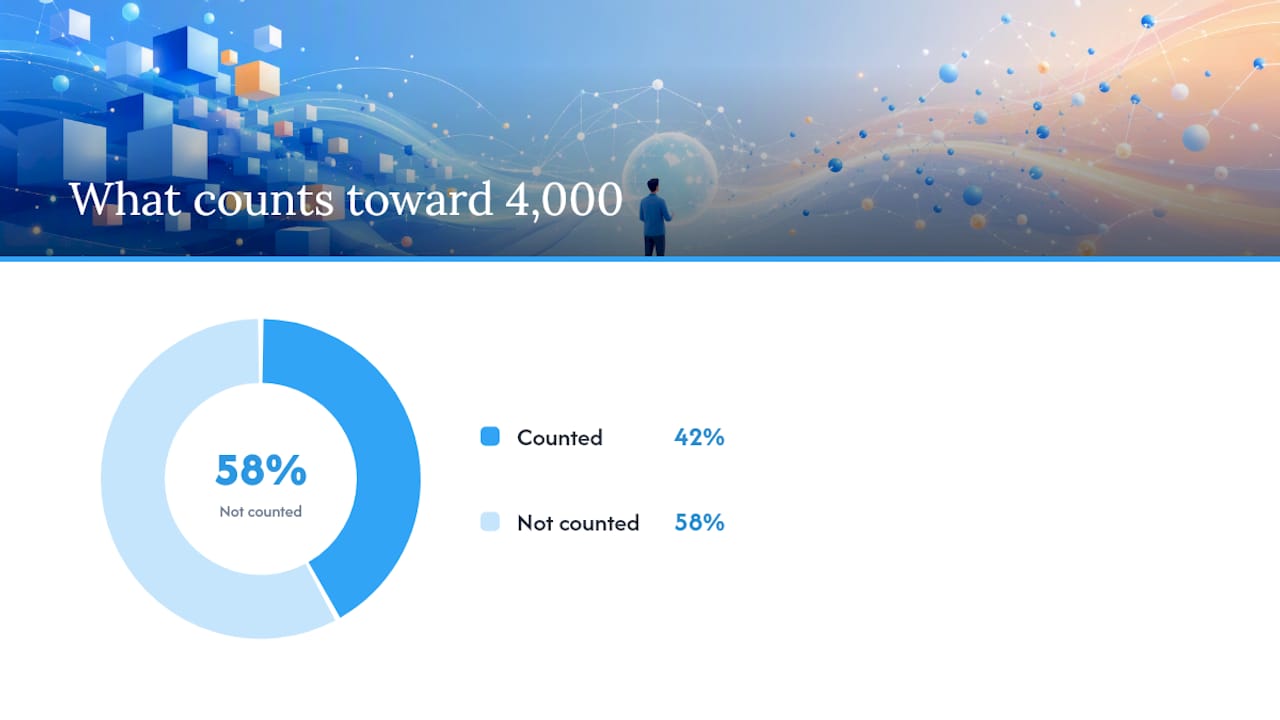
The EE has a maximum of 4,000 words. The introduction, argument, conclusion, quotations and substantive explanatory notes belong within that limit. Bibliography and specified presentation elements are treated separately under the guide. Do not treat every word placed in a table, caption or appendix as exempt: keep essential explanations in the assessed essay and check your session’s detailed rules.
Here’s the quick-reference version:
- Counts toward 4,000 words: introduction, body paragraphs, conclusion, direct quotations, explanatory footnotes
- Check exclusions carefully: The guide specifies presentation elements such as the title page, contents, bibliography, figures, numerical data and calculations. This does not permit moving prose or analysis into a table to evade the limit.
- Reflection is separate: Follow the form and limit applicable to your assessment session. The legacy RPPF and the redesigned EE’s RPF are not interchangeable labels; the redesigned EE is first assessed in May 2027.
The number that matters most: if your essay runs to 4,300 words, the official IB guidance on word counts confirms examiners simply stop reading at word 4,000. Everything after that, including a strong conclusion, gets ignored during marking.
Key Takeaways
A focused ESS Extended Essay keeps its complete argument within 4,000 words and uses appendices for supplementary material. Choose the length needed to answer the question rather than treating 3,500 words as a required minimum.
| Point | Details |
|---|---|
| Know the hard limit | The 4,000-word upper limit applies to all Extended Essays, and examiners stop reading at that point. |
| Track what counts | Count the main argument, quotations and explanatory notes. Apply the guide’s specific exclusions rather than assuming every table or caption is exempt. |
| Reflection is separate | Use the correct reflection form and its separate word limit for your assessment session. |
| Aim below the ceiling | Leave time for final editing and verify that the complete argument fits within 4,000 words. No fixed lower word target guarantees quality. |
| Keep analysis in the main text | Move raw data to appendices but never let your strongest interpretive claims live outside the assessed word count. |
| Get a structural review | Esstutor’s ESS and EE tutoring sessions offer examiner-style feedback on where your word count and analysis need tightening. |
Table of Contents
- What Counts Toward Your ESS EE Word Count?
- How to Apply the Rules to Real ESS Writing
- Why Do Students Lose Marks Over Word Count Mistakes?
- How Do You Trim an ESS EE to Fit the Word Limit?
- What Examiners Actually Prioritize When Reading Your EE
- Get Help Finalizing Your ESS Extended Essay Word Count
- Where to Verify These Rules Yourself
- Frequently Asked Questions
- Sources
What Counts Toward Your ESS EE Word Count?
Every IB student eventually asks some version of the same question: what actually is my “ess ee wortzahl,” or extended essay word count, once you strip away the parts that don’t get counted? The IB’s answer is more precise than most students expect, and misunderstanding it is one of the fastest ways to lose marks you never needed to lose.
Check the word-count rules in the official EE guidance applicable to your examination session. Keep essential reasoning in the main text; do not move analysis into tables, captions, footnotes or appendices solely to avoid the word limit. Discuss any uncertain inclusion with your supervisor.
Components that count
The introduction, main discussion and conclusion form the assessed argument. Quotations and explanatory footnotes count. Bibliographic references are different from notes that add analysis. Use the correct session’s criteria rather than assuming that a criterion letter always refers to the same skill.
Quotations count as well, whether you’re quoting a scientist’s published paper or a stakeholder interview you conducted for primary data. And explanatory footnotes count, meaning a footnote that clarifies a term or expands briefly on a point in your argument still eats into your 4,000 words.
Components that don’t count
Use the official word-count table for your session, including its exclusions for specified presentation material. The exclusion of a figure or data table does not make it an appropriate place for extended discussion; keep reasoning needed to answer the question in the main text.
The reflection form has its own requirements and is separate from the essay’s 4,000-word maximum. Confirm the correct form and reflection guidance with your supervisor, particularly for assessment from May 2027 onward.
Here’s how that breaks down in table form:
| Element | Counts toward 4,000 words? |
|---|---|
| Introduction | Yes |
| Main body (analysis, discussion) | Yes |
| Conclusion | Yes |
| Direct quotations | Yes |
| Explanatory footnotes | Yes |
| Title page and contents page | No |
| Bibliography | No |
| Appendices | No |
| Tables, charts, maps, diagrams | No |
| Equations, formulas, calculations | No |
| Citations and references | No |
| Applicable reflection form (RPPF or RPF) | No (separate document entirely) |
The edge cases that trip people up
A few gray areas deserve specific attention because ESS essays lean heavily on data, and data creates ambiguity.
Translated quotations count the same as any other quotation, so if you’re translating a non-English source for an ESS case study, the translated text still eats into your 4,000 words, not just the original.
The distinction between an explanatory footnote and a bibliographic note matters more than most students realize. A footnote that simply cites a source doesn’t count. A footnote that says “this trend held even when controlling for seasonal rainfall variation” is doing argumentative work, and it counts, because it’s contributing analysis rather than just pointing to a source.
Use captions to identify figures and make them intelligible. Put the substantive interpretation beside the figure in the main text. Do not assume that relocating analysis to a caption makes it exempt from the word count or that assessors will reconstruct your argument from supplementary material.
How to Apply the Rules to Real ESS Writing
Rules on paper are one thing. Applying them to a messy draft full of citations, footnotes, and data tables is another. Here’s how the counting actually plays out with content that looks like a real ESS Extended Essay.
Quotation and explanatory note: In an illustrative paragraph, your own framing text and any quoted interview words count. A substantive note explaining the finding also counts, while a purely bibliographic citation is treated differently. Use genuine recorded evidence and do not copy an invented quotation into your essay.
A methods section with calculations. Suppose your methodology includes the formula you used to calculate species diversity, something like the Shannon-Wiener index, followed by a worked calculation showing your actual sample numbers. The formula itself and the calculation don’t count. But the sentence before it, explaining why you chose that index over Simpson’s, and the sentence after, interpreting what your calculated value means for biodiversity at your study site, both count in full. Students often assume the whole “methods block” is exempt because a formula sits in the middle of it. It isn’t.
Captions and table labels. If you built a table comparing water quality metrics across five sample sites, the table itself is exempt. But don’t let that exemption tempt you into writing your real analysis as a table footnote or a dense caption instead of body text. Move the raw numbers into the table or an appendix, then write a proper paragraph in your main body that says what the numbers mean. That paragraph is the one an examiner is guaranteed to read.
Raw data belongs in appendices or tables, referenced briefly in your main text (“see Appendix B for full water sampling data”), while your interpretation of that data belongs in the paragraphs an examiner actually assesses. This single habit, keeping analysis in the main text and evidence in appendices, is the difference between an ESS essay that reads as rigorous and one that reads as a data dump with a thin argument wrapped around it.
Pro Tip: Before you finalize your draft, highlight every sentence that contains an interpretive claim, then check whether it lives in your main text or has drifted into a caption, footnote, or appendix note. If it’s drifted, move it. Interpretation that examiners aren’t guaranteed to read is interpretation that earns you nothing.
Why Do Students Lose Marks Over Word Count Mistakes?
Work beyond 4,000 words is not assessed. Keep your complete argument and conclusion within the limit. The EE criteria were redesigned for first assessment in May 2027; check the applicable guide rather than applying legacy criterion names to every cohort.
The most common mistake ESS students make is treating appendices as a safety valve for content they couldn’t fit. You’ll see essays where the strongest piece of evidence, a regression analysis, a comparison chart with real interpretive weight, gets shoved into Appendix C because the main text was getting long. Examiners are not required to hunt through your appendices for the argument you should have made in your body paragraphs.
A close second is overusing footnotes to carry argumentative weight while pretending the main text stays lean. If your footnotes read like a second essay running underneath your first, you haven’t reduced your word count. You’ve just made your reader work harder to find the argument, and you’ve still spent the words either way, since explanatory footnotes count.
Third, some students bury critical evidence entirely in tables or figures, assuming visual presentation substitutes for written analysis. It doesn’t. A table showing correlation coefficients between rainfall and crop yield needs a paragraph next to it that says what that correlation means for your research question.
Sample high-scoring ESS Extended Essays consistently show the same pattern: analysis lives in the main text, sentence by sentence, argument by argument. Appendices in these essays hold raw data, survey instruments, and supplementary calculations, nothing that the essay’s core argument depends on.
The strongest ESS essays don’t hide their best thinking in a table or a footnote. They put it in a topic sentence, in the main body, where an examiner is guaranteed to read it before word 4,000.
Best practice is straightforward even if it takes discipline to follow: every claim that answers part of your research question belongs in your main text. Appendices exist for raw data, not for arguments you ran out of room to make properly.
How Do You Trim an ESS EE to Fit the Word Limit?
Cutting words without cutting substance is a skill, and it’s one you can build with a structured process rather than random deletion. A three-pass approach works better than trying to fix everything in one read-through.
First pass: structure. Check whether each section helps answer the research question. There is no mandatory 3,500-word minimum or fixed percentage for the introduction, body and conclusion. Remove repetition and irrelevant context while preserving sufficient methods, analysis and evaluation.
Pass two: concision. This is where you go sentence by sentence. Passive voice tends to run longer than active voice (“it was found that dissolved oxygen levels were reduced” versus “dissolved oxygen levels dropped”), so hunting down passive constructions usually recovers real word count fast. Combine sentences that repeat the same subject. And look hard at your quotations: a long block quote can almost always become a short, sharp quote plus your own paraphrase of the surrounding context, which usually runs shorter and reads as more analytical besides.

Third pass: technical. Check references, word-count inclusions, captions and supplementary material. Keep data needed to follow the argument in the report, with lengthy supporting records in an appendix where appropriate. Do not move evidence automatically just because it is raw data.
Here’s the practical checklist to run before you submit:
- Open your word processor’s word count tool and confirm it’s set to count only the sections that should count. Most tools count everything by default, so manually exclude your bibliography, appendices, and title/contents pages when you check your number.
- Read your conclusion in isolation and confirm it sits comfortably before word 4,000, with margin to spare.
- Search your document for every footnote and confirm none of them contain an argument that should live in the main text instead.
- Check every table and figure caption for buried analysis and move it into a proper paragraph.
- Verify your appendices contain only raw data or supplementary material, nothing an examiner needs to read to follow your argument.
Keep dated draft versions or use the revision history in your chosen editor. Record what you changed and why, and follow your school’s rules about permitted feedback and tools. A specialist typing or tracking service is not needed to check word count.
Plan supervisor discussions within your school’s feedback arrangements. Ask about the argument and relevant word-count rules early enough to revise your own work. Do not assume repeated full-draft reviews or direct editing by a tutor are permitted.
What Examiners Actually Prioritize When Reading Your EE
A useful final check is whether the main text provides a clear answer to the question with an evidence-based argument. A reader should not need to reconstruct the reasoning from an appendix.
The edit that saves the most words with the least cost to your argument is almost never a content cut. It’s tightening your topic sentences. Students often open body paragraphs with a sentence that restates context the reader already has, then bury the actual claim two sentences later. Flip that. Lead every paragraph with your point, then support it. You’ll often cut 5 to 10 words per paragraph just by removing throat-clearing, and across a 4,000-word essay that adds up to real room.
A concise essay should preserve the evidence, analysis and conclusion needed to answer the question. Neither filling the limit nor choosing a shorter target guarantees quality. A 4,000-word essay is within the maximum; it is words beyond 4,000 that are not assessed.
Get Help Finalizing Your ESS Extended Essay Word Count
Getting your ESS Extended Essay from a rough draft into a tight, fully-assessed 4,000 words is exactly the kind of work that benefits from a second, examiner-trained set of eyes. Esstutor offers focused sessions built around this specific problem: identifying which paragraphs carry your real argument, which sections can be trimmed without losing substance, and where analysis has quietly drifted into a footnote or appendix where it won’t get read.
ESS tutoring can help you understand the requirements and discuss your own planning choices. It should not rewrite your essay or produce assessed paragraphs. A FREE 20-minute trial lesson is a short introduction to discuss needs, rather than a promised full structural review.
Where to Verify These Rules Yourself
Use the official EE guide for your assessment session. The redesigned EE is first assessed in May 2027, including its RPF reflection requirements. Confirm the guide, form and permitted supervisor feedback with your coordinator.
For a broader walkthrough of word count strategy alongside topic selection and structure, the Immerse Education guide to the IB Extended Essay summarizes the official rules clearly. For ESS-specific structural guidance, Esstutor’s complete guide to the ESS Extended Essay covers planning and drafting in more depth.
Frequently Asked Questions
Does the ess ee wortzahl include my bibliography?
No. Your bibliography is entirely excluded from the 4,000-word count, regardless of how many sources you cite or which citation style you use.
What happens if my ESS Extended Essay goes over 4,000 words?
Examiners stop reading at word 4,000 and will not assess anything beyond that point, including a conclusion that starts too late.
Do footnotes count toward the word limit?
Explanatory footnotes that clarify or expand on your argument count toward the 4,000 words. Footnotes that only cite a source do not.
Are appendices ever assessed by examiners?
Appendices don’t count toward the word limit, but examiners aren’t required to read them closely, so critical analysis should never live only in an appendix.
Is reflection included in the essay’s 4,000 words? No. Reflection is separately assessed. For the redesigned EE first assessed in May 2027, the RPF reflective statement has a maximum of 500 words; use the correct form for your session.
There is no universal safe target below the maximum. Develop a complete, focused argument within 4,000 words, check the relevant counting rules and allow time for final review.
No Comments