

01 Sep Ecological Succession in IB ESS: Stages, Examples and Limits
Ecological succession is change in a community’s species composition and structure over time. It can show recognisable patterns, but its direction and speed depend on conditions, species arrivals and disturbance. A climax community is a useful model of relative stability, rather than an inevitable, unchanging endpoint.
TL;DR:
- Primary succession involves no soil and takes longer to develop mature ecosystems compared to secondary succession, which starts with existing soil after disturbance.
- Succession relies on interactions between biotic and abiotic factors, with mechanisms like facilitation, inhibition, and tolerance driving species replacement.
- The concept of a fixed climax community is outdated, as ecosystems are constantly evolving and rarely reach a static endpoint under changing conditions.
- Long-term studies use chronosequences combined with remote sensing and soil sampling to infer succession patterns across different landscapes.
- Effective exam answers focus on precise mechanisms, specific examples, and the implications for conservation or restoration strategies.
Table of Contents
- What Is Ecological Succession? Key Terms You Need to Know
- Primary vs Secondary Succession: What’s the Real Difference?
- What Are the Stages of Ecological Succession?
- What Mechanisms Actually Drive Succession?
- How Has Succession Theory Changed Over Time?
- Real Case Studies Worth Citing in Your Essays
- How Does Succession Inform Conservation and Restoration?
- How Should You Study Succession for Exams?
- Does a Climax Community Ever Really Exist?
- Why Do Pioneer Species Matter So Much?
- Beyond Primary and Secondary: What Other Types of Succession Exist?
- How Does Succession Shape Biodiversity and Ecosystem Services?
- How Do Scientists Actually Study Succession?
- What Do Students Get Wrong Most Often About Succession?
- How Tutoring Can Sharpen Your Succession Answers
- Where to Read More on Succession
- Sources
What Is Ecological Succession? Key Terms You Need to Know
You already have the definition. Now let’s unpack what actually drives it, because this is where most students lose marks. Ecological succession happens through the interaction of biotic factors (soil enrichment from decomposing plants, competition between species) and abiotic factors (climate, rainfall, temperature shifts). Neither works alone. A University of Chicago explainer describes succession as continuous and often non-linear, meaning it rarely moves in a neat straight line from bare rock to forest. Setbacks happen. Species arrive out of “textbook order” all the time.
Here’s the misconception worth fixing before it costs you marks: succession is not a fixed script every ecosystem follows identically. It’s a pattern, not a law. You’ll strengthen any essay answer by using precise vocabulary instead of vague phrases like “things change over time.” Learn these terms cold:
- Community: the full assemblage of interacting species living in a given area
- Seral stage: One stage in succession. A sere is the whole successional sequence, not a synonym for a single stage.
- Climax community: the community that persists once change slows to a relative equilibrium
- Pioneer species: the first organisms to colonize a disturbed or bare habitat
- Disturbance: an event (fire, flood, logging) that resets or interrupts succession
Use these words deliberately in your answers. Examiners notice when a student reaches for precision instead of paraphrase.
Primary vs Secondary Succession: What’s the Real Difference?
Primary succession develops on newly formed or exposed substrate without a developed soil, such as fresh lava or a glacial forefield. This does not mean the geographical location has never supported life. Pioneer organisms vary with the habitat and need not always be lichens followed by mosses.
That soil difference is why secondary succession runs faster, often dramatically so. In the primary-secondary distinction, primary succession requires soil formation from scratch, while secondary succession inherits existing organic matter and nutrients, so recovery skips years of groundwork.
Quick memory anchors:
- Primary: little or no developed soil at the start; colonisers depend on the substrate, climate and available species.
- Secondary: soil and some biological legacies remain after disturbance. Recovery can be quicker, but its rate and outcome depend on disturbance severity and local conditions.
Statistic worth citing: recovery in secondary succession often accelerates because surviving seed banks, roots, and mycorrhizal networks act as a head start the ecosystem doesn’t have to rebuild from zero. That single detail, dropped into an exam answer, signals you understand mechanism, not just terminology.
What Are the Stages of Ecological Succession?
A five-stage sequence can illustrate some terrestrial successions, but it is not a universal pathway or an obligatory answer structure. Britannica’s overview frames this as pioneer species progressively modifying their environment until conditions allow the next community to move in.
- Pioneer stage: lichens, mosses, and bacteria colonize bare substrate; almost no soil exists yet.
- Early stage: grasses and small herbaceous plants take hold as a thin soil layer forms from decomposed pioneers.
- Mid stage: shrubs and fast-growing trees establish; soil deepens, and light competition intensifies.
- Late stage: slower-growing, shade-tolerant trees begin to dominate the canopy.
- Climax stage: the community reaches a relative equilibrium suited to the local climate and soil, changing slowly if at all barring disturbance.
In some terrestrial successions, soil develops, biomass accumulates and shading increases. These are tendencies, not a universal sequence: soil nutrients, species richness and productivity can change differently among sites and over long timescales.
Practice tip: A chronosequence compares sites of different ages to infer temporal change. Label the actual variable shown and distinguish site age from repeated observations of the same site. Do not draw a universal rising richness curve without supporting evidence.
What Mechanisms Actually Drive Succession?
Facilitation, inhibition and tolerance describe different mechanisms of species replacement. Facilitation improves conditions for some later species; inhibition makes establishment harder; tolerance allows later species to establish and persist without requiring pioneers to improve conditions. These mechanisms can overlap, and should not be presented as compulsory steps in one sequence.
A fundamental niche describes the conditions and resources under which a species could persist in the absence of specified limiting interactions. Its realised niche reflects the conditions it actually occupies in the community. Competition and predation can restrict occupancy, while facilitation can also change which conditions are accessible. This is background ecological context rather than a substitute for explaining succession.
- Facilitation: soil-building pioneers enabling later colonizers
- Inhibition: dense shrub layers blocking tree seedling establishment
- Tolerance: shade-tolerant saplings persisting under a closed canopy
Scale changes what you see, too.
Small patches of a forest floor can look chaotic and unpredictable in isolation, but zoom out to a regional chronosequence and clear successional tendencies emerge. Local randomness and regional pattern aren’t contradictions. They’re two different resolutions of the same process.
How Has Succession Theory Changed Over Time?
Succession theory didn’t arrive fully formed. Henry Cowles studied the dunes along Lake Michigan in the late 1800s and pioneered the technique of inferring long-term change by comparing sites at different ages side by side, a method now called space-for-time substitution. His work at the Indiana Dunes remains a foundational reference point in succession research.
Frederic Clements later proposed that succession moves deterministically toward one fixed climax, almost like an organism reaching maturity. Henry Gleason pushed back hard, arguing succession is individualistic: species respond to conditions independently, and outcomes depend heavily on which species happen to arrive first.
- Cowles: observational, space-for-time methodology at the Indiana Dunes
- Clements: deterministic, single-endpoint climax model
- Gleason: individualistic view emphasizing chance arrival and species-specific responses
- Modern synthesis: succession can follow multiple valid pathways depending on starting conditions and contingency
Today’s ecologists treat succession as testable and contingent, not scripted.
Real Case Studies Worth Citing in Your Essays
Concrete examples separate a strong answer from a vague one. Keep these four in your back pocket.
- Indiana Dunes, Indiana: Cowles’ chronosequence studies compared dunes of different ages to infer how communities change over decades, a textbook case of space-for-time substitution in action.
- Volcanic lava flows (Hawaii, Iceland): classic primary succession, starting with lichens colonizing bare basalt and progressing toward shrub and forest cover over centuries.
- Glacial retreat (Glacier Bay, Alaska): exposed till transitions from moss and willow to spruce forest as soil nitrogen builds, another primary succession benchmark.
- Post-fire recovery and abandoned farmland: both demonstrate secondary succession, where existing soil and seed banks let grasses and pioneer trees reestablish within a handful of growing seasons rather than centuries.
Pick one primary and one secondary example for any comparative essay question. Examiners consistently reward students who pair mechanism with a named, specific location rather than a generic description.
How Does Succession Inform Conservation and Restoration?
Restoration ecologists use successional principles deliberately, not by accident. Controlled burns mimic natural fire disturbance to reset overgrown grasslands toward earlier, more biodiverse seral stages. Assisted regeneration projects plant pioneer species on degraded land to jump-start soil building, essentially fast-forwarding the early stages of ecological restoration.
Invasive species complicate this picture considerably. An invasive plant can dominate a seral stage and block native succession entirely, producing an ecosystem that never reaches its expected climax. Altered disturbance regimes, more frequent droughts or storms tied to a shifting climate, can also push ecosystems onto entirely different trajectories than historical patterns would predict.
- Controlled burns reset overgrown communities to earlier seral stages
- Assisted regeneration accelerates soil formation on degraded land
- Invasive species can permanently redirect successional pathways
Exam tip: “Implications” can include consequences, trade-offs or significance. Where management is relevant, explain how a named action follows from the evidence; do not treat the term as meaning action alone.
How Should You Study Succession for Exams?
Adapt an answer to the command term and mark allocation. A definition, mechanism and relevant example may help, but a short “state” question does not require an essay structure and no fixed sequence guarantees marks.
Does a Climax Community Ever Really Exist?
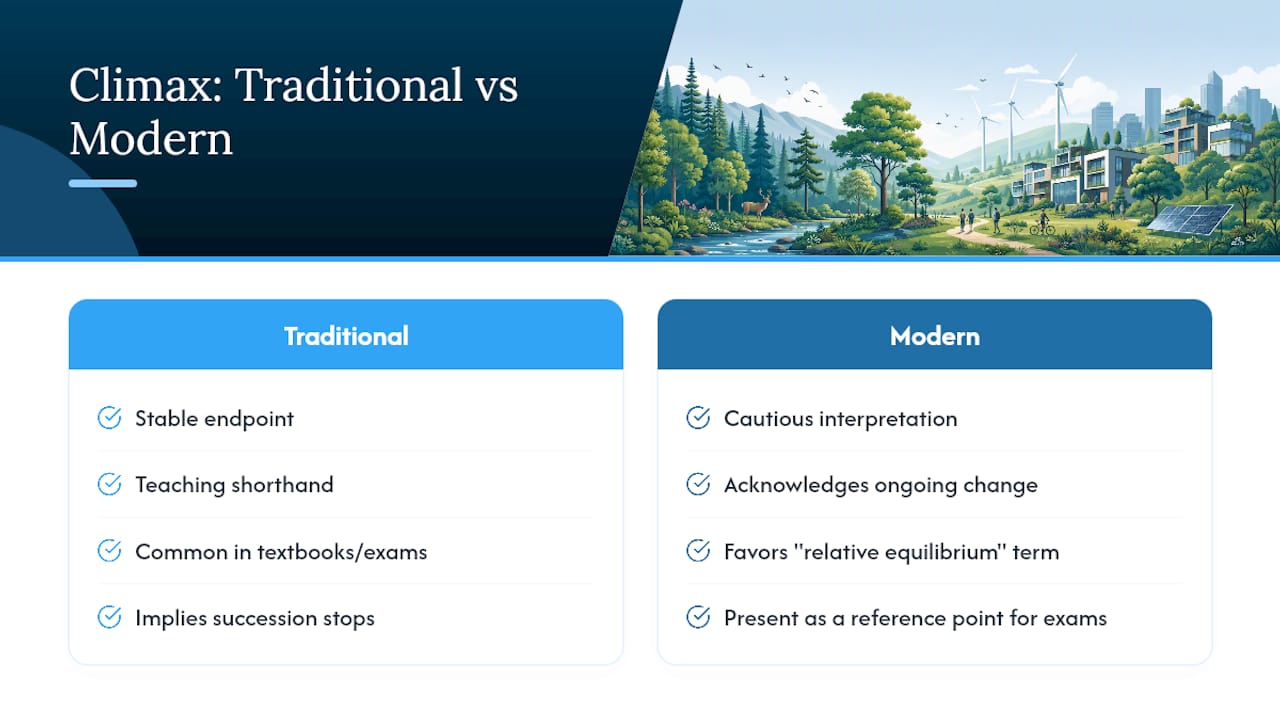
The climax community concept describes an endpoint where species composition stabilizes and change slows to a crawl under stable local conditions. It’s a genuinely useful teaching shorthand, and you’ll still see it in most textbooks and exam mark schemes. But modern ecology treats it with real caution.
The problem is that “stable” rarely means “unchanging.” Climate shifts, disturbance frequency, and even long-term soil development keep nudging supposedly climax ecosystems in new directions. A forest that looked climax in 1960 might show measurably different species dominance by 2026, not because succession restarted, but because the baseline itself moved. This is part of why Gleason’s individualistic critique of Clements has aged so well: if arrival order and chance events shape outcomes, then no two “climax” forests recovering from similar disturbances are guaranteed to look identical.
For exam purposes, the safest move is to present climax community as a useful reference point rather than a hard destination. Mention that ecologists increasingly favor language like “relative equilibrium” or “quasi-stable state” over a strict climax label, because it acknowledges ongoing, low-level change without pretending succession simply stops. This nuance, stated in one or two sentences, tends to separate strong answers from average ones. It signals you understand the concept has evolved rather than reciting a static, decades-old definition. Linking climax communities to broader ecosystem equilibrium concepts strengthens this kind of answer further.
Why Do Pioneer Species Matter So Much?
Pioneer species do the unglamorous, essential work that makes every later stage of succession possible. On bare rock or fresh volcanic substrate, lichens and mosses don’t just survive harsh conditions. They actively change them. Lichens secrete acids that slowly break rock into fine particles, while both lichens and mosses trap dust, moisture, and decaying organic matter, building the earliest layer of soil almost from nothing.
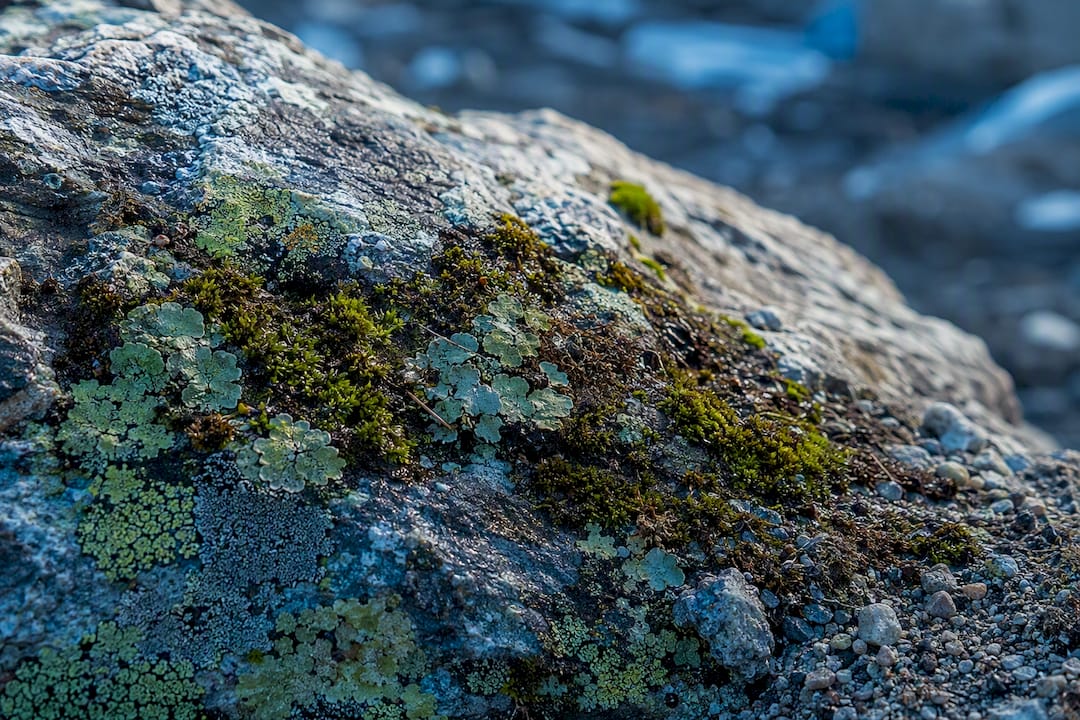
Pioneer organisms can modify conditions and facilitate later colonists, but every later species does not necessarily depend on a fixed chain of earlier species. Arrival order, tolerance, competition, disturbance and external inputs can produce different pathways.
Soil formation itself is a measurable process worth naming in essays: organic matter content increases, nitrogen fixation often improves (sometimes through pioneer species with symbiotic bacteria), and water retention capacity climbs as soil structure develops. Glacial retreat sites make this especially visible, since researchers can compare soil samples from land exposed decades apart and watch nitrogen and organic content climb in a fairly predictable curve. That measurable, comparative approach is exactly what makes glacial forefield studies such a popular case for illustrating pioneer-driven soil formation in coursework.
Beyond Primary and Secondary: What Other Types of Succession Exist?
Primary and secondary succession describe starting conditions, but ecologists also classify succession by what’s actually driving the change, and this distinction shows up in higher-level IB questions. Autogenic succession is driven by the organisms within the community itself. Plants alter light availability, soil chemistry, and nutrient cycling, and those self-generated changes push the community toward its next stage. Most classic textbook examples, lichens building soil, forests shading out their own seedlings, are autogenic.
Allogenic succession, by contrast, is driven by external forces the community doesn’t control: flooding, sediment deposition, volcanic ash fall, or long-term climate shifts. A river delta that keeps receiving fresh silt deposits experiences allogenic succession, because the substrate itself keeps changing independent of what the plants are doing.
This distinction matters for essay depth because most real ecosystems experience both simultaneously. A salt marsh, for instance, undergoes autogenic change as plants build peat and alter soil chemistry, while also experiencing allogenic change from tidal sediment deposition and sea-level shifts. Naming both mechanisms in the same answer, rather than defaulting only to primary/secondary framing, is a reliable way to demonstrate range to an examiner. It shows you understand succession as a set of overlapping processes rather than a single linear story.
How Does Succession Shape Biodiversity and Ecosystem Services?
Species richness may rise, fall or peak during succession depending on the ecosystem, organisms studied and scale of measurement. In some forests, canopy closure reduces light-demanding understorey species; this does not establish that every mature community is less diverse than an earlier stage.
Ecosystem services change during succession, but comparisons need a specific context. Older forests may hold substantial carbon stocks, while other habitats provide important pollination, soil or water functions. Do not assume that mature forest universally regulates water or stabilises soil better than every grassland.
This is why conservation planning increasingly treats a mosaic of successional stages, not just mature climax forest, as the biodiversity goal. A landscape with patches at different seral stages supports a broader range of species than uniform old-growth cover alone, because different species specialize in different stages of the sequence. Understanding this tradeoff between diversity and service delivery is exactly the kind of applied reasoning that scores well when a question asks you to evaluate management strategies, particularly ones connected to ecological resilience after disturbance.
How Do Scientists Actually Study Succession?
Long-term succession studies spanning centuries are rare, since almost no researcher can personally observe bare rock turn into forest. Ecologists get around this with chronosequence studies, comparing sites of different known ages side by side and inferring the successional trajectory from those snapshots. This is exactly the space-for-time substitution approach Cowles pioneered at the Indiana Dunes, and it remains the backbone method for studying succession today.
Modern researchers pair chronosequences with tools Cowles never had. Remote sensing, using satellite or drone imagery, tracks vegetation cover and canopy structure changes across large areas over years or decades without requiring constant ground surveys. Soil sampling at different chronosequence points measures nitrogen content, organic matter, and pH to quantify how substrate conditions change alongside species composition. Permanent plot monitoring, where researchers tag and revisit the exact same patch of ground repeatedly, provides direct longitudinal data that complements the inferential nature of chronosequence comparisons.
Combining these methods matters because chronosequences carry a real limitation: they assume different-aged sites started from similar conditions, which isn’t always true. Cross-checking chronosequence inferences against remote sensing trends and soil chemistry data gives ecologists more confidence that an observed pattern reflects genuine succession rather than pre-existing site differences.
What Do Students Get Wrong Most Often About Succession?
The most common error is a vague definition with no mechanism attached. “Species change over time” earns partial credit at best. What separates strong answers is naming facilitation, inhibition, or tolerance directly, then anchoring it to a specific example like lichens on lava rock or shade-tolerant saplings under a closed canopy. Weak examples cost marks just as often as weak theory does. A vague reference to “a forest” says less than a precise nod to the Indiana Dunes or Glacier Bay.
My honest advice: cut your sentences down. Say less, but make every sentence load-bearing. Concise, mechanism-rich answers consistently beat long, descriptive ones on ESS mark schemes.
— Marija
How Tutoring Can Sharpen Your Succession Answers
You don’t need a tutor to understand ecological succession. The concepts above are enough to build a solid exam answer on your own with practice. But if you want direct feedback on whether your chronosequence sketches, mechanism explanations, or IA methodology actually hold up under examiner scrutiny, that’s where a trial lesson helps close the gap between “I understand this” and “I can prove it on paper.”
A FREE 20-minute trial lesson is available to discuss your ESS needs and a suitable starting point. It does not include a promised full IA draft review. Regular lessons can focus on your understanding, practice answers or the choices in your own investigation.
Where to Read More on Succession
For classic definitions and stage sequences, Britannica’s ecological succession entry is a reliable starting reference. For mechanisms, soil-building, and niche discussion, LibreTexts’ introductory biology chapter covers the ground clearly. Students wanting deeper theory should read the LibreTexts general ecology chapter on historical models and contingency.
Sources
- What is ecological succession? | University of Chicago News
- Ecological succession | Definition & Facts | Britannica
No Comments