


02 Sep IB Geography Paper 2: Format, Evidence and Timed Practice
IB Geography Paper 2 is a 1 hour 15 minute exam worth 50 marks, built around Sections A, B, and C, and testing your grip on population, global climate, and resource consumption. The most effective preparation involves timed practice using real past papers and developing a compact bank of case studies for quick retrieval under exam conditions.
TL;DR:
- Using precise case studies with clear, measurable data points and referencing specific figures can significantly boost your answer quality.
- Properly understanding and applying command terms like describe, explain, evaluate, and to what extent is essential for scoring consistently high marks.
- Allocating your exam time effectively—about 35 minutes for Section A, 10-15 minutes for Section B, and 20 minutes for Section C—maximizes overall performance.
- Practicing with real past papers and building a ready bank of case studies enhances familiarity with exam structure and improves answer precision.
- Receiving examiner-style feedback through timed practice helps identify common small mistakes and improves clarity, evidence quality, and command term discipline.
Table of Contents
- What Does the IB Geography Paper 2 Format Actually Look Like?
- Breaking Down Sections A, B, and C
- How to Read and Answer Visual Data Questions
- Building a High-Scoring Section C Essay
- Time Management and Exam-Day Technique
- Practice Resources and a Study Plan That Works
- What Examiners Actually Notice: Common Mistakes
- Review Your Paper 2 Practice
- Get Examiner-Style Feedback on Your Paper 2 Practice
- Sources
What Does the IB Geography Paper 2 Format Actually Look Like?
Paper 2 is taken at both SL and HL. It lasts 1 hour 15 minutes and carries 50 marks: Section A is worth 30 marks, Section B 10 and Section C 10. Paper 3 is an additional HL component, not an SL paper. Use the current Geography guide and your examination paper’s instructions.
- Section A tests recall and short structured answers on core topics.
- Section B hands you a visual stimulus, often a map, graph, or infographic from the resource booklet.
- Section C asks you to write a 10-mark essay from a choice of questions.
The paper assesses the core theme, Geographic Perspectives—Global Change: population distribution, global climate and vulnerability, and global resource consumption and security. Use the resource booklet where directed, citing the relevant labels, values or features rather than assuming every part requires a figure reference.
Breaking Down Sections A, B, and C
Each section rewards a different writing style, and mixing them up costs marks fast.
- Section A: Answer all three structured questions, each worth 10 marks. Follow the command terms and marks for the subparts rather than a fixed sentence count.
- Section B is the visual question. “Refer to the resource booklet” means the examiner expects you to name specific features (a labeled bar, a shaded region, a percentage on an axis) rather than write about the topic in the abstract.
- Section C: Answer one extended-response question from a choice of two. The response is worth 10 marks. Use relevant geographical knowledge and examples, with detail suited to the command term.
Command terms drive everything here, and IB Geography Paper 2 punishes students who ignore them:
- Describe wants factual detail with no explanation attached.
- Explain wants reasons and mechanisms, often the “why” behind a described pattern.
- Evaluate wants weighed judgment, strengths and weaknesses, not just a list.
- To what extent wants a clear stance, held throughout the answer, not fence-sitting.
Mixing up “describe” and “explain” is one of the fastest ways to lose marks even when your geography knowledge is solid.
How to Read and Answer Visual Data Questions
Visual questions feel intimidating until you have a routine. Run through this every time:
- Identify the type of visual: choropleth map, scatter graph, population pyramid, or infographic.
- Read the labels and units before you read anything else. Missing a unit (percent versus raw count) can flip your entire answer.
- Note the trend or anomaly. Most visual questions hinge on a pattern breaking somewhere.
- Select two or three data points that directly support your claim.
Weak answers describe the graphic in vague terms: “the graph shows an increase.” Strong answers pin the claim to the resource: “between 2010 and 2020, the youth dependency ratio fell from 45% to 30%, shown in Figure 3.” Our examiner method for answering data questions walks through this same evidence-first habit in more detail.
Pro Tip: Set a timer for five minutes and practice pulling three concrete evidence points from a single graphic. Speed here compounds across the whole exam.
Building a High-Scoring Section C Essay
Plan your Section C answer briefly: identify the command term, define terms where needed and select relevant evidence. A structure helps organise your knowledge, but cannot compensate for inaccurate content or an answer that misses the question.
Relevant named examples can strengthen an explanation or evaluation. Their value depends on how accurately they address the question; there is no case-study formula separating particular final grades.
- Condense each case study into one or two sentences: location, date if relevant, one measurable fact.
- Make evaluation proportionate to the command term. Explain the significance of a strength, limitation or trade-off rather than adding a token evaluative sentence to every paragraph.
- Never introduce a case study without tying it back to the question’s wording.
Pro Tip: Write your case study bank as flashcards now, not the night before. You want the recall to be automatic, not a search. Our guide on structuring a Geography essay has more on building this frame into muscle memory.
Time Management and Exam-Day Technique
Seventy-five minutes disappears fast once you’re writing under pressure, so a rough split matters more than most students think.
- Spend about 35 minutes on Section A, moving briskly through short answers.
- Give 10 to 15 minutes to Section B, reading the resource booklet carefully before writing.
- Reserve 20 minutes for the Section C essay, including two minutes of planning.
If time is short, prioritise answering the question directly. Add a labelled diagram only where it communicates relevant evidence or explanation; it is not a substitute for a required written response.
Practice Resources and a Study Plan That Works
Nothing replicates exam conditions like a real past paper under a timer, and that should anchor your prep before anything else.
- Start with official past papers and the resource booklet used alongside Paper 2, since timed practice with real constraints beats untimed review every time.
- Layer in graded question banks and published mark schemes to see how marks map to specific phrasing.
- Build a case study bank organized by theme (population, climate, resources) rather than by date or country, so you can grab the right example under pressure.
- Use flashcards for recall of key terms, then pair that recall with applied writing practice; memorization alone won’t carry you through Section C.
Two-week plan: alternate one timed section per day (A, B, then C), self-marking against the official scheme, and spend the final two days on a full timed paper.
Four-week plan: spend the first two weeks building your case study bank and drilling command terms, then shift to full timed papers for the last two weeks.

Self-marking works for spotting missed content, but it’s harder to catch structural issues in your own writing. That’s where a second, examiner-trained set of eyes helps, something our micro case study cards and revision workflow guides are built to support.
What Examiners Actually Notice: Common Mistakes
Most students lose marks in small, avoidable ways rather than through missing content entirely.
- Vague evidence. Writing “many countries” instead of naming one and giving a figure.
- Ignoring the command term. Describing when the question asks you to evaluate, or vice versa.
- Dropping the link to the question. A paragraph that reads well but never circles back to what was actually asked.
- Overloading Section A. Treating a two-mark short answer like a mini essay and running out of time for Section C.
Clear writing helps a marker follow the argument, but linking sentences do not automatically earn marks. Check that each point supplies the knowledge, evidence or reasoning the question requires.
Review Your Paper 2 Practice
The gap between a decent Paper 2 score and a strong one rarely comes down to raw geography knowledge. It comes down to habits: precise evidence, tight command-term discipline, and case studies that are ready to deploy rather than half-remembered.
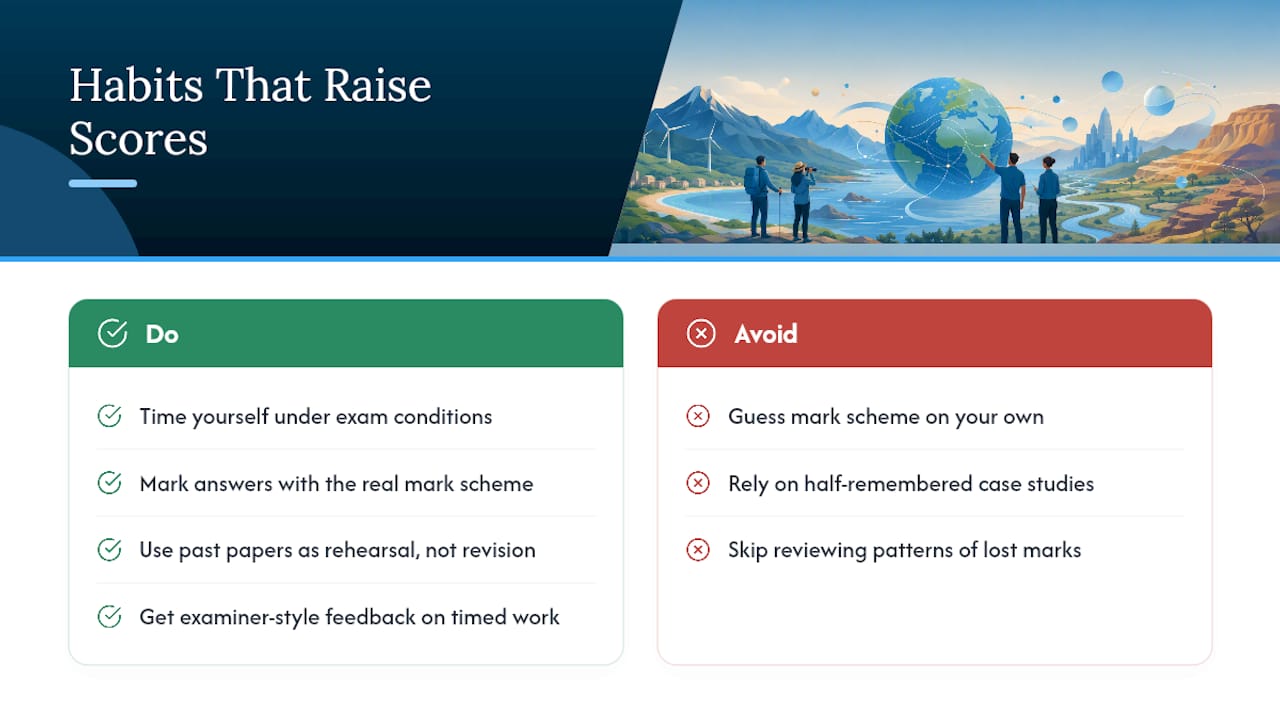
Students who consistently score well treat past papers as rehearsal, not revision. They time themselves, they mark against the real scheme, and they notice their own patterns of losing marks before an examiner has to point it out. That kind of self-awareness takes repetition, and it’s faster to build with someone checking your timed answers against actual mark scheme language rather than guessing on your own.
Use timed practice to identify a specific difficulty, then revisit the relevant concept or skill. Feedback can help, but no revision routine guarantees a particular score.
— Marija
Get Examiner-Style Feedback on Your Paper 2 Practice
Reading exam advice only gets you so far. What moves your score is someone who marks the way an examiner marks, catching the vague evidence and missed command terms before the real exam does. A Paper 2 tutoring session with Esstutor typically covers a timed past paper attempt, line-by-line examiner feedback, and coaching on trimming your case studies into exam-ready phrases that fit the time limit.
Marija Maletz has 13 years of teaching experience and more than 10 years as an IB ESS examiner. For Geography support, explain your topic and goals before booking to agree the scope. A FREE 20-minute trial lesson is an introduction to discuss needs, rather than a full paper-marking session.
Sources
- Geography paper 2 question booklet (HLSL) — November 2025 examination session
- Geography in the DP – International Baccalaureate®
- IB DP Geography Revision — Papers 1, 2 & 3
- How to get a 7 in IB Geography — Save My Exams
No Comments