


08 Sep IB Examiner’s 12 Week ESS Study Plan That Lowers Exam Stress
The most reliable way to manage ESS stress is to swap vague worry for a specific workflow: an examiner-aligned study routine built on timed past papers and an error log. Start this week. Pick one past paper, put it on your calendar under real exam conditions, and open a simple error log next to it. That one habit, more than any pep talk, is what actually calms the panic.
TL;DR:
- Practice timed past papers under exam conditions weekly to identify specific weaknesses and build confidence through realistic simulation.
- Log every mistake with details on command terms and timing to target precise skills like command-term awareness and dataset interpretation.
- Establish a steady study schedule, focus on sleep, and take regular breaks to preserve mental clarity and reduce stress during intensive ESS preparation.
- Use early project milestones for IA and EE work, and consult with supervisors regularly to avoid last-minute panic and maintain steady progress.
- Support from a tutor who reviews error logs and practice exams can significantly improve accuracy, command-term use, and reduce exam anxiety.
Table of Contents
- Quick action checklist: 7 steps to lower ESS stress today
- Design an ESS study workflow: 12 weeks out to exam day
- Timed practice and the error log method that actually reduces mistakes
- Wellbeing routines that lower stress during study sessions
- How parents can support without adding pressure
- Why the error log beats cramming, every single time
- How Esstutor helps you turn a stress plan into a stress-free exam
- Where to go for more on ESS exam preparation
- Sources
Quick action checklist: 7 steps to lower ESS stress today
You don’t need a total life overhaul to feel less anxious about ESS. You need a handful of small, repeatable actions that give you back a sense of control. Here’s where to start.
- Build a weekly skeleton. Block several focused hours per subject on weekdays, ESS included, so revision stops competing with itself for time.
- Start an error log today. Even one entry, from one practice question, gives you something concrete to fix instead of a vague sense of “I’m behind.”
- Set work-block rules. Work in 45 to 50 minute stretches with a real 10 to 15 minute break, and protect 8 hours of sleep most nights.
- Ring-fence your IA and EE time. Give each a weekly milestone and a short supervisor check-in, so they never get quietly abandoned during exam crunches.
- Learn one grounding technique. Box breathing or a simple five-senses check-in works in under two minutes when panic spikes mid-session.
- Sort your exam logistics early. Pens, a working calculator, your student ID. Do this the week before, not the morning of.
- Review, don’t relearn, in the final days. Revisit your error log instead of opening new content you haven’t studied yet.
Pro Tip: Keep the error log somewhere you’ll actually reopen it, like a shared note or a single page at the front of your ESS binder. A log nobody rereads is just a diary.
Design an ESS study workflow: 12 weeks out to exam day
Cramming feels productive right up until the exam, when it stops working. A phased plan spreads the load and tells you exactly what to do each week, which is where most of the anxiety relief actually comes from.
Weeks 12 and earlier: foundation. This is where you consolidate content across ESS topics, since the course spans ecology, systems thinking, and socioeconomic dimensions in a genuinely interdisciplinary way, as the IBO subject brief lays out. HL students also need to build in the extensions like environmental law, economics, and ethics during this stretch, since those topics rarely get covered well if left for later.
8 weeks out: intensify timed practice. This is the point to shift decisively from note review to full timed papers, ideally at least one per week, paired with active recall rather than passive rereading. The IB Demystified revision framework recommends exactly this pivot from content review to timed retrieval practice around this stage.
Final weeks: polish and simulate. Papers get more frequent, and at least one full mock exam under real exam timing belongs in this window. A structured 90 day plan that moves from triage to consolidation to polish tends to lower anxiety precisely because each week has a defined, achievable target rather than an open-ended “study more.”
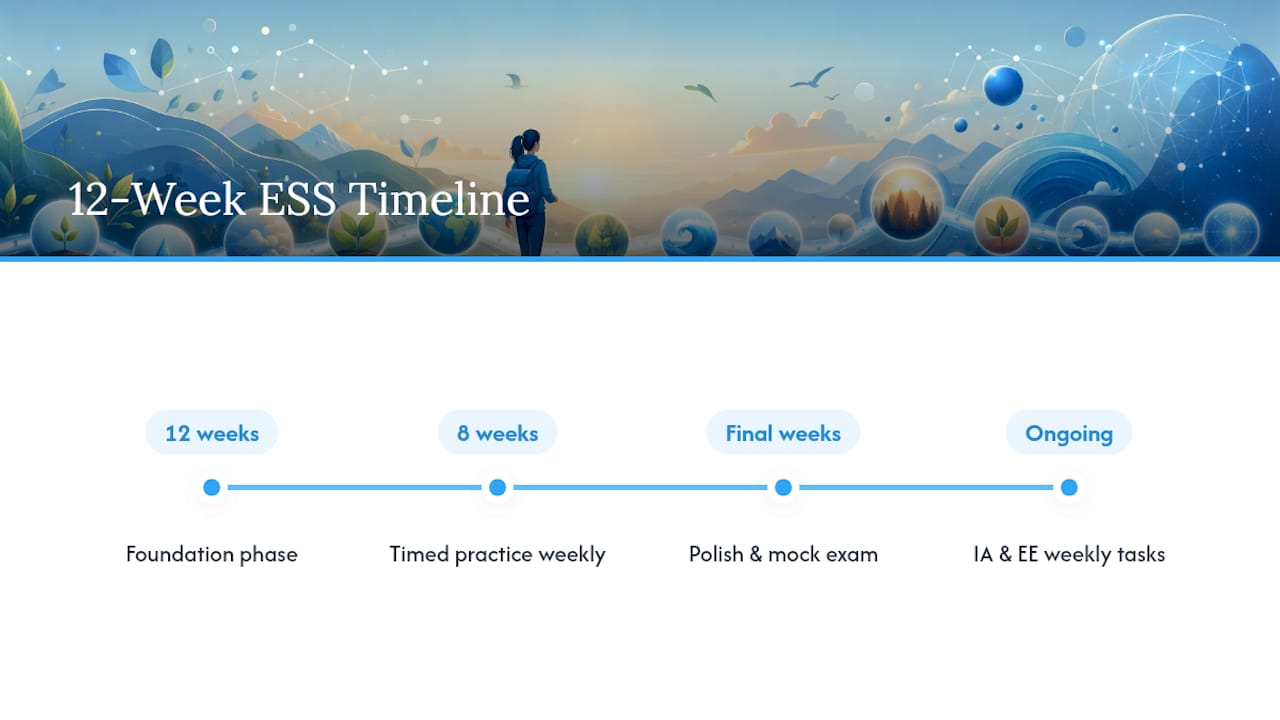
Throughout every phase, break IA and EE work into small weekly deliverables, a draft section, a data table, a paragraph of analysis, rather than one looming deadline. Book brief supervisor meetings around each milestone. If you want a ready-made template for this kind of phased plan, a guide to designing an ESS study workflow walks through sample weekly targets by phase.
Timed practice and the error log method that actually reduces mistakes
Running a paper under real time pressure and marking it honestly against the mark scheme does more for your confidence than another hour of rereading notes. It shows you exactly where the marks are actually lost, which is rarely where students expect.
Here’s the process that works:
- Simulate real conditions. Full paper, full time limit, no notes, no phone.
- Mark it against the official mark scheme, not your gut sense of whether an answer sounds right. ESS mark schemes reward specific command-term language and precise use of case studies, and that’s a skill separate from just knowing the content.
- Log every mistake with four details: the topic, the command term you misread, whether timing was the issue, and the exact phrasing that lost you marks.
- Write one corrective action per error. “Review carbon cycle diagrams” is vague. “Redraw the carbon cycle from memory and label three feedback loops” is a task you can actually complete.
- Revisit recurring errors on a spaced schedule rather than once and forgetting them.
Students who make this switch to active, timed practice by around eight weeks before finals, and who track recurring mistakes systematically, consistently report calmer exam weeks than students who cram. Each corrective plan shortens the feedback loop between a mistake and fixing it, and feedback without follow-up is essentially wasted effort. ESS also has its own quirk here: data-based questions test a different skill than content recall, so practice interpreting graphs and datasets separately, the way the ESS course structure itself demands. A guide on using past papers for ESS exam success breaks this down further if you want a second reference point.
Wellbeing routines that lower stress during study sessions
Your brain needs recovery time to actually hold onto what you’re studying, not just more hours at the desk.
- Sleep is non-negotiable for memory. Aim for 8 hours most nights; consolidation of what you studied happens largely while you sleep, not while you’re awake cramming more in.
- Work in focused study blocks of under an hour with genuine 10 to 15 minute breaks, and get up and move during them. Short exercise between blocks measurably reduces cortisol and improves study quality, not just study quantity.
- Use box breathing for acute anxiety. Inhale for four counts, hold four, exhale four, hold four. Repeat for two minutes before a paper or a stressful IA meeting.
- Try progressive muscle relaxation before bed if racing thoughts keep you up: tense and release each muscle group from feet to face.
- Handle exam week logistics early. Sort your calculator, ID, and route to the exam center the week before, and eat something you know sits well with you that morning.
Pro Tip: If you only adopt one wellbeing habit this term, make it sleep. It’s the one that pays back the most across every subject, not just ESS.
How parents can support without adding pressure
The instinct to push harder when a child looks stressed usually backfires. What actually helps is naming the pressure out loud, “this feels like a lot right now,” rather than adding to it with more questions about grades.
- Praise the process, not just results. “You stuck with that past paper for the full two hours” lands better than “What score did you get?”
- Help build the schedule, then step back. Offer to set up the weekly skeleton together, but let your student run it.
- Protect IA and EE time practically. Help coordinate rides, quiet space, or reminders around supervisor meetings without hovering over the actual writing.
- Watch for signs extra help is needed. Repeated stalling on the same topic, dropping grades despite visible effort, or growing dread around ESS specifically are signals worth acting on, sometimes through a tutor who can target the exact gap.
- Set a boundary on your own involvement. Ask what kind of support your child actually wants before offering unsolicited fixes; some material genuinely feels heavier to a teenager than it might look from the outside, and how emotionally engaging content lands varies a lot by student.
Why the error log beats cramming, every single time
Thirteen-plus years of marking IB ESS papers has shown me the same pattern over and over: students who cram can often recite content, but they lose marks on command terms, timing, and precision. That’s not a knowledge gap. It’s a skills gap, and it’s fixable with practice, not more studying.
The habit I push hardest with students is boring on purpose: regular timed papers, each marked against the official scheme, with mistakes logged alongside specific fixes. I’ve watched a student who kept losing marks on “evaluate” questions, because they were writing description instead of judgment, close that gap in three weeks once it was named and tracked. Examiners reward precision and command-term awareness far more than raw content volume, and an error log is the only tool I’ve seen that reliably builds both.
— Marija
How Esstutor helps you turn a stress plan into a stress-free exam
Reading about a phased workflow is one thing. Having someone check whether your error log is actually catching the right patterns, or whether your IA data section will hold up under a supervisor’s questions, is another. That’s the gap one-on-one tutoring closes: a real plan with a real person checking your work against it every week.
The service pairs you with examiner-informed guidance instead of generic revision advice, built specifically around ESS SL and HL, not science tutoring in general. Sessions cover targeted IA support, timed-paper practice with detailed mark-scheme feedback, and mock exams that mirror real exam pressure without the real stakes. The accountability of a weekly session, someone reviewing your error log with you and adjusting the plan, tends to cut stress faster than another solo study session ever will. If you’re not sure ESS tutoring is worth it yet, start with a trial lesson through an exam-prep strategy page and see how the first session changes your next study week.
Where to go for more on ESS exam preparation
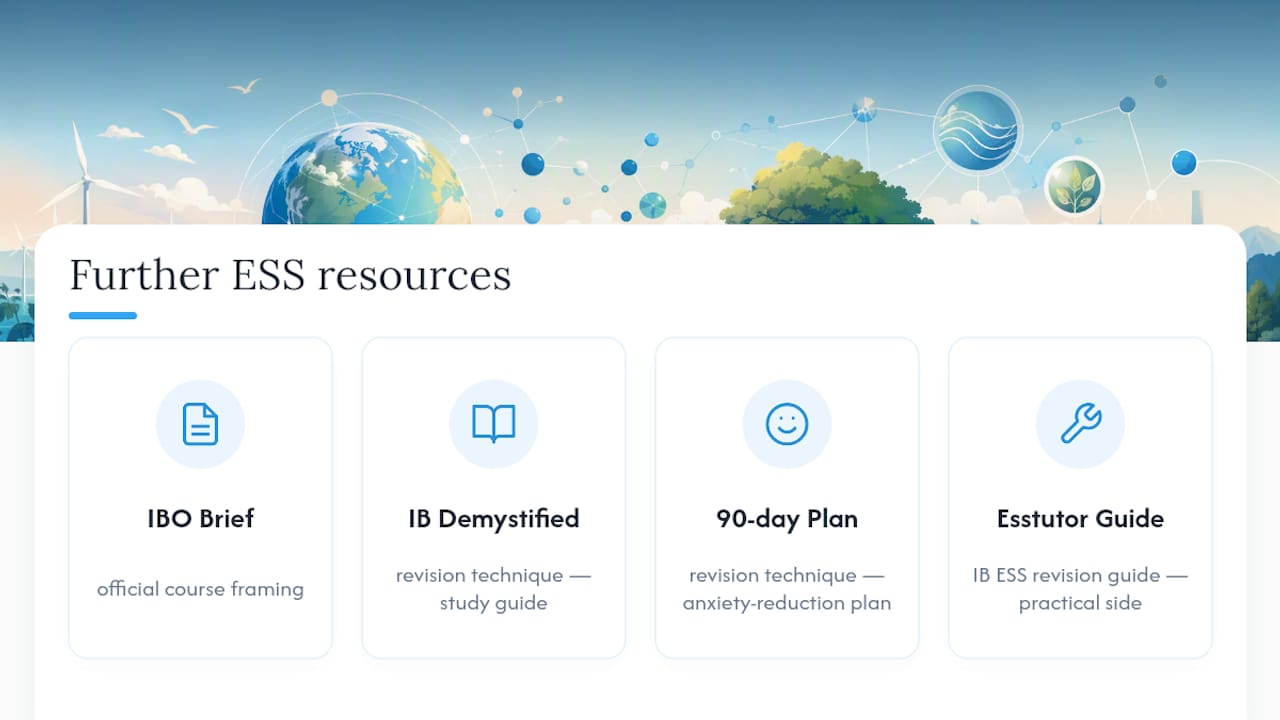
For the official course framing, start with the IBO’s ESS subject brief. For revision technique, IB Demystified’s study guide and the 90 day anxiety-reduction plan are both worth a full read. Esstutor’s IB ESS revision guide rounds out the practical side.
Sources
- Environmental systems and societies | International Baccalaureate® (IBO)
- How to Study for IB Exams: Complete 2026 Guide | IB Demystified
- IB DP Final 90 Days: How to Reduce Anxiety While Increasing Output – Sparkl
No Comments