


13 Sep Convert Mocks to a 7 in IB ESS: Examiner Led 6–8 Week Plan
A 7 in IB Environmental Systems and Societies comes down to three things done consistently: answering with the precision examiners are trained to reward, building an internal assessment that hits every A–F markband, and drilling exam technique until it is automatic under time pressure. As IB examiner Marija puts it, the fastest way to close the gap is a clear checklist, a well-timed IA plan, and focused past-paper practice, exactly what this guide walks you through.
TL;DR:
- Focus your revision on recurring topics like ecosystems, biodiversity, and climate change, which accounts for the most exam questions due to their cross-paper relevance.
- Develop a detailed internal assessment plan that includes a narrow research question, reproducible methods, honest evaluation, and a timeline structured across three weeks.
- Practice data interpretation with claims, evidence, and interpretation steps, and create a command-term log to identify and correct common marking mistakes.
- Build essay responses like arguments by stating a clear thesis, supporting with case studies, weighing perspectives, and providing a judgment in evaluation questions.
- Seek targeted feedback on IA drafts and past-paper responses from an examiner-aware tutor to break scoring plateaus and improve structural exam habits.
Table of Contents
- Grade-7 Checklist: What Examiners Reward Most
- Internal Assessment: A Step-by-Step Strategy for Top Marks
- Exam Technique for Papers 1 and 2: Data, Command Terms, and Essay Structure
- A 6–8 Week Study Plan and Resource Checklist
- What Separates a 5 from a 7: An Examiner’s View
- How ESSTutor Helps You Close the Gap to a 7
- Sources
- FAQ
Grade-7 Checklist: What Examiners Reward Most
Examiners aren’t looking for encyclopedic recall. They want you to apply knowledge to unfamiliar contexts, analyze data with precision, and evaluate competing perspectives. Every mark above a 5 comes from that third skill, evaluation, so if your answers state facts without weighing them, you’re capping your own score.
The updated subject brief organizes ESS around three unifying concepts (perspectives, systems, and sustainability) across eight core topics, and HL students layer additional depth onto topics like biogeochemical cycles and environmental law. Don’t spread study time evenly. Weight your revision toward topics that recur across multiple papers: ecosystems, biodiversity, and climate change consistently generate the most exam mileage.
Build these habits into your week:
- Active recall over rereading: close the textbook and rebuild diagrams from memory.
- Spaced repetition on command terms so “evaluate” never gets answered like “describe.”
- Weekly topic rotation instead of marathon sessions on one unit.
- Two to three timed past-paper questions weekly, marked strictly against the official markscheme.
- Fieldwork skills practiced separately: sampling strategy, measurement uncertainty, and clean graph presentation, since practical work sits at the center of ESS assessment.
Pro Tip: Keep a running “command term log.” Every time you lose marks for misreading “to what extent” as “describe,” write the correction next to the original question. Patterns show up fast, usually within three or four papers.
Internal Assessment: A Step-by-Step Strategy for Top Marks
The IA carries real weight in your final grade, and it’s the one component you fully control before exam day. It’s a 3,000-word individual report assessed against six criteria, A through F, covering your research question, method, data treatment, analysis, and evaluation.
Follow this sequence:
- Pick a narrow, data-answerable question. Tie it directly to one syllabus topic. “How does distance from a road affect species diversity in a local woodland?” is IA-ready. “Is pollution bad for ecosystems?” is not.
- Plan your method for repeatability. Define your sampling strategy, sample size, and how you’ll log data before you go into the field, not after.
- Address ethics and limitations upfront. Note any access restrictions, safety considerations, or bias risks in your method section.
- Present raw data cleanly, then process it. Include a raw data table, then move to graphs and, where appropriate, a simple statistical test like chi squared or a t test.
- Evaluate honestly. Name your method’s weaknesses, discuss reliability, and connect every conclusion straight back to your research question rather than drifting into general commentary.
Science Sauce’s IA guide confirms that A–F criteria total 30 marks and reward exactly this structure: research question, method, results, analysis, evaluation, in that order.
Map your 10 allowed hours of practical time against milestones: field visit and data collection in week one, processing and graphing in week two, draft one submitted for feedback by week three. A step-by-step IA guide can help you build that timeline before you commit to a question.
Pro Tip: Draft your evaluation section before you finish collecting data. Knowing what limitations you’ll need to defend often changes how carefully you measure in the field.
Exam Technique for Papers 1 and 2: Data, Command Terms, and Essay Structure
Paper 1 hands you a resource booklet full of graphs, tables, and short extracts. Skim it first, note which figures repeat across questions, then allocate your time by mark value rather than reading order. For every data question, work through the same sequence: state your claim, cite the specific evidence from the resource, interpret what it means, then flag any uncertainty in the data. Skipping that last step is the single most common reason strong students lose marks on data response.
Paper 2 rewards essays built like an argument, not a list of facts. Open with a clear thesis, use case-study evidence to support it, weigh at least one competing perspective, and close by answering the command term directly rather than trailing off into summary. If the question says “evaluate,” your final paragraph needs a judgment, not just a recap.
- Reverse-engineer old markschemes: pick one past essay, then map each paragraph to a specific markband descriptor to see exactly where marks were won or lost.
- Practice AO2/AO3 in isolation. Take five short-answer questions and write only the “apply to a new context” sentence for each, skipping the recall part you already know.
- Run practice in strict 45 minute blocks, self-mark against the official scheme, then get a second opinion from a teacher or tutor on anything scoring below a 6.
Examiner reports consistently point to the same fix: focused feedback on a small set of timed papers moves scores more than broad, unfocused revision across every topic at once, a finding backed by the ESS subject guide. For a closer look at examiner-favored structures on data questions specifically, see this breakdown of how to answer data questions.
A 6–8 Week Study Plan and Resource Checklist
You don’t need a twelve-month overhaul. You need a tight block that converts your current mock score into exam-day performance.
- Weeks 1–2: Diagnostic past paper, then rank topics by weakest AO. Start IA field data collection if you haven’t already.
- Weeks 3–4: Two timed papers weekly, IA draft one submitted for feedback, targeted revision on your two weakest topics.
- Weeks 5–6: IA draft two, command-term drills daily, one full mock under exam conditions.
- Weeks 7–8: Final IA polish and submission, review examiner feedback line by line, light revision only, no new content this close to exams.
Read the IB subject brief for the current core topics and the curriculum update notice confirming the new course launched in February 2024, with first assessment in May 2026. Pair those with a raw-data spreadsheet template, a graph-labeling checklist, and a simple stats reference sheet for the IA.
| Resource | Best use |
|---|---|
| IB subject brief | Confirm current topics and assessment weightings |
| Curriculum update notice | Check for syllabus or exam-format changes before May 2026 |
| Science Sauce IA guide | Cross-check your report against A–F criteria |
| ESSTutor sessions | Get examiner feedback on drafts and mock papers |
If your mock scores plateau for two consecutive attempts, or your IA drafts keep getting the same feedback, that’s the signal to bring in a tutor rather than keep repeating the same self-study loop. For structuring essay drafts before a tutoring session, some students also use AI-assisted drafting tools to organize their argument first, though examiner feedback should still shape the final version.
What Separates a 5 from a 7: An Examiner’s View
The scripts that plateau at a 5 almost always share the same three habits: vague claims with no named evidence, evaluation paragraphs that restate the question instead of answering it, and IA conclusions that drift away from the original research question. None of these are knowledge gaps. They’re structural habits, which is actually good news, because structure is trainable in a way that raw content knowledge sometimes isn’t.
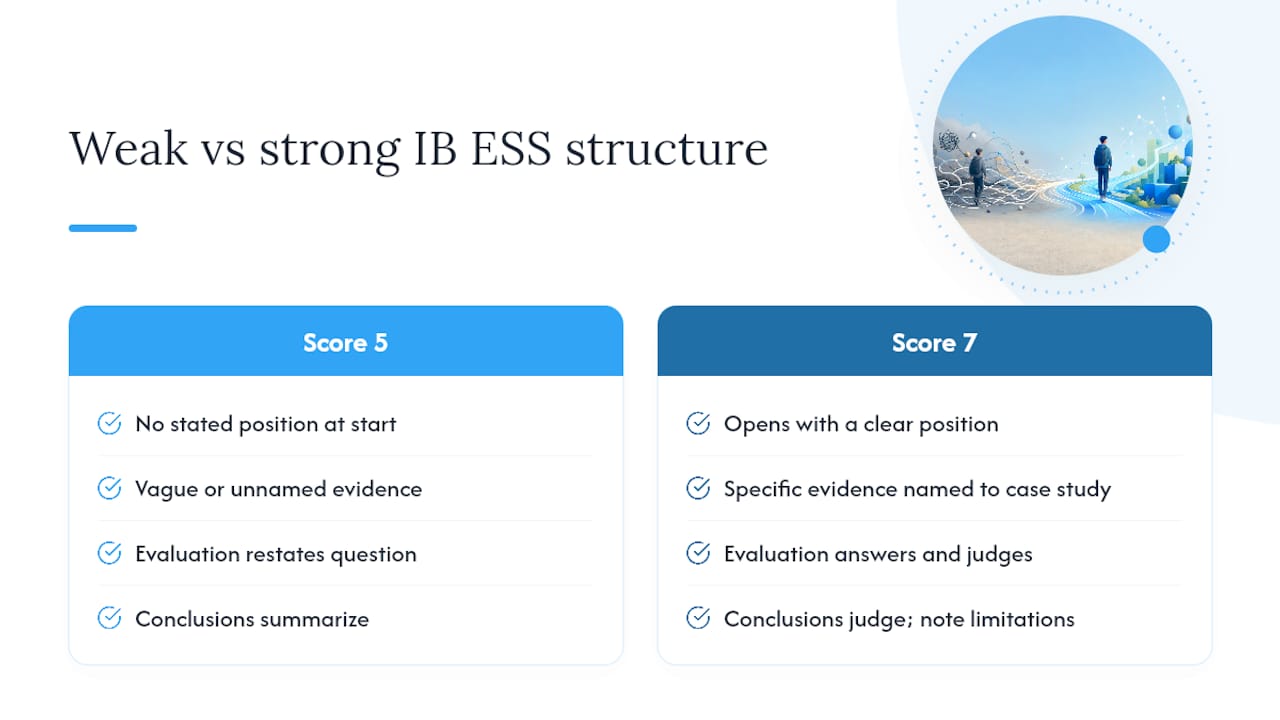
The scripts that hit a 7 look different on the page before you even read a full sentence. Paragraphs open with a stated position, follow with specific evidence tied to a named case study, and close by acknowledging a limitation or counterargument. That acknowledgment is the tell. Students chasing a 6 tend to argue one side cleanly; students earning a 7 show they understand why the other side has a point, and still defend their conclusion.
If there’s one habit worth changing this week, it’s this: stop writing conclusions that summarize and start writing conclusions that judge.
— Marija
How ESSTutor Helps You Close the Gap to a 7
Self-study gets most students to a 5 or 6. Closing the final gap usually comes down to feedback you can’t generate on your own: someone with examiner-level judgment reading your IA draft or mock essay and telling you exactly where the mark was lost. That’s the specific advantage of working with ESSTutor rather than relying on generic revision guides or study groups.
Sessions focus on the areas that move scores fastest: line-by-line feedback on IA drafts against the A–F criteria, past-paper coaching under timed conditions, command-term drills, and mock marking that mirrors what an actual examiner checks first. Tutoring tends to pay off most right after a diagnostic mock exposes a weak AO, or when an IA draft comes back with the same criticism twice in a row. The tutor brings extensive tutoring experience and knowledge of IB examiner criteria to every session, so feedback reflects how scripts are actually marked, not just how they should read on paper. If either of those situations sounds familiar, book a trial lesson and bring your last graded paper or IA draft to the first session.
Sources
- Environmental systems and societies – International Baccalaureate®
- IB ESS IA Guide (2026) | Research Questions, Criteria & Examples – Science Sauce
FAQ
What Score Do You Need for a 7 in IB ESS?
Grade boundaries shift slightly each exam session, but a 7 generally requires strong, evaluative performance across both papers plus a high-scoring IA built on a focused research question and honest evaluation of limitations.
How Much Does the IA Count Toward the Final ESS Grade?
The internal assessment contributes roughly a quarter of the final grade, with external exams making up the rest, so a strong IA can meaningfully offset a weaker paper score.
How Many Past Papers Should I Complete Before the Exam?
Two to three timed past papers per week in the final six to eight weeks, each marked strictly against the official markscheme, tends to produce faster improvement than broad, unfocused review.
When Should I Consider Hiring an ESS Tutor?
Bring in a tutor when mock scores plateau across two or more attempts, or when IA feedback keeps flagging the same issue, since targeted, examiner-level feedback closes gaps that self-study alone often misses.
Has the ESS Syllabus Changed Recently?
Yes. The updated course launched in February 2024, with first assessment in May 2026, so students should check the current subject brief for the latest topic list and assessment structure before finalizing a study plan.
No Comments