


16 Sep Examiner Marija’s 5 Step ESS Essay Structure for IB Students
Write a thesis-first essay: define your key terms, state your thesis in one sentence, then build three to five analytical paragraphs that each link back to that thesis. Finish every paragraph with a judgment, not just a fact.
TL;DR:
- Including specific case studies, such as Costa Rica’s reforestation efforts or the Aral Sea’s shrinkage, demonstrates precise, relevant evidence for evaluation.
- Weaker essays often lack explicit evaluation sentences that weigh evidence against limitations, which is crucial to reaching higher markbands.
- Structuring each paragraph with a clear signpost, evidence, explanation, evaluation, and link makes analysis more coherent and examiner-friendly.
- A reverse-outline after drafting helps identify weak logical flow or repetition, improving overall argument clarity.
- Focus on developing evaluative sentences with linking words like “however” or “while” to transform factual descriptions into analytical insights.
Table of Contents
- What Examiners Actually Look For In an ESS Essay Structure
- How Do You Structure an Essay for Maximum Marks?
- What Does a High-Scoring Paragraph Look Like Sentence by Sentence?
- Which Evidence and Case Studies Actually Impress Examiners?
- How Should You Plan Your Time During the Exam?
- What Mistakes Cost the Most Marks?
- An Examiner’s Fastest Way to Catch a Weak Essay
- Why This Structure Actually Works Under Exam Pressure
- Turn This Template Into a Marked-Up Essay With Real Feedback
- Sources
- FAQ
What Examiners Actually Look For In an ESS Essay Structure
Markbands reward structure before they reward knowledge. That’s the part most students miss. You can know every biome and biogeochemical cycle in the syllabus and still land in the 5 to 6 markband if your essay doesn’t visibly organize that knowledge into an argument.
IB ESS Paper 2 Section B essays are marked against three overlapping objectives: knowledge and understanding, application of that knowledge to the specific question, and analysis or evaluation of the evidence you bring in. Each one maps to a structural feature an examiner can spot in seconds.
- Knowledge and understanding shows up as accurate definitions of key terms early in the essay, and correct use of ESS vocabulary (carrying capacity, planetary boundaries, ecological footprint) throughout, not just in the introduction.
- Application shows up as evidence chosen specifically for the question asked, not generic textbook facts dropped in because you memorized them.
- Analysis and evaluation shows up as sentences that weigh evidence, not just report it. An examiner scanning for markband C language is hunting for words like “however,” “this suggests,” “a limitation of this approach is,” or “compared to.”
A high-scoring essay follows a clear, logical progression: an introduction that defines terms and states a thesis, a body where each paragraph carries one distinct argument backed by evidence, and a conclusion that synthesizes the evaluation rather than repeating it. That progression is exactly what separates a markband 7 to 9 essay from a markband 5 to 6 one covering the same content.
Here’s what a one-sentence evaluation actually looks like in practice, since “evaluation” is the vaguest word in the whole markband descriptor:
- “While reforestation increases carbon sequestration, the 20 to 50 year lag before mature forest capacity is reached limits its usefulness as a short-term climate mitigation strategy.”
- “Command-and-control legislation like the Clean Air Act reduced sulfur emissions effectively, but its rigidity makes it slower to adapt than market-based instruments such as carbon trading.”
- “The IPAT model clarifies which factor drives environmental impact most, though it treats technology as a single variable when in practice it varies wildly by sector.”
Notice the shape: state the point, then pivot on “but,” “while,” “though,” or “however” into a limitation or comparison. That pivot word is doing almost all the work. Students who never evaluate almost always share one habit: they write factual sentences and stop, without ever pivoting into a second clause that weighs the fact against something else.
How Do You Structure an Essay for Maximum Marks?
Your ess essay structure needs to work like a machine with three fixed parts and a predictable rhythm inside each one. Once you’ve internalized the rhythm, you stop staring at the blank page and start filling a template.
1. Build a tight introduction
Your introduction has one job: tell the examiner what you’re arguing and how you’ll prove it. That’s it. Skip the philosophical scene-setting about “the environment is important to society.”
- Optional hook or context, one sentence, only if it adds something the question doesn’t already state.
- Key-term definitions, especially if the question uses a technical term (resilience, sustainability, tipping point) that could be interpreted multiple ways.
- A one-line thesis that takes a clear position. Not “there are advantages and disadvantages,” but “command-and-control approaches are more effective than market-based approaches for pollutants with immediate, localized health impacts.”
- A roadmap sentence naming the three or so angles your body paragraphs will cover.
2. Plan your body paragraphs before you write them
Each paragraph should function as one link in a chain, not a separate essay in miniature. The paragraph blueprint below is the one worth memorizing until it’s automatic:
- Topic sentence that explicitly echoes language from your thesis, so the examiner never has to ask “how does this connect?”
- Evidence sentence naming a specific case, model, or data point relevant to the question.
- Explanation sentence showing exactly how that evidence supports your claim, not just that it exists.
- Evaluation sentence, one clause minimum, weighing strength, limitation, or scale against an alternative.
- Link sentence connecting forward to the next paragraph or back to the thesis.
That five-step sequence is a direct expansion of the advice to decompose your thesis into the paragraphs needed to support it, then anchor each paragraph on a topic sentence and close on a line tying back to the argument.
3. Close with a judgment, not a summary
Your conclusion should widen back out from the specific arguments to answer the actual question in one clear sentence. Don’t introduce new evidence here. Don’t just restate your body paragraphs in different words. State your judgment, acknowledge its limits in one clause if space allows, and stop.
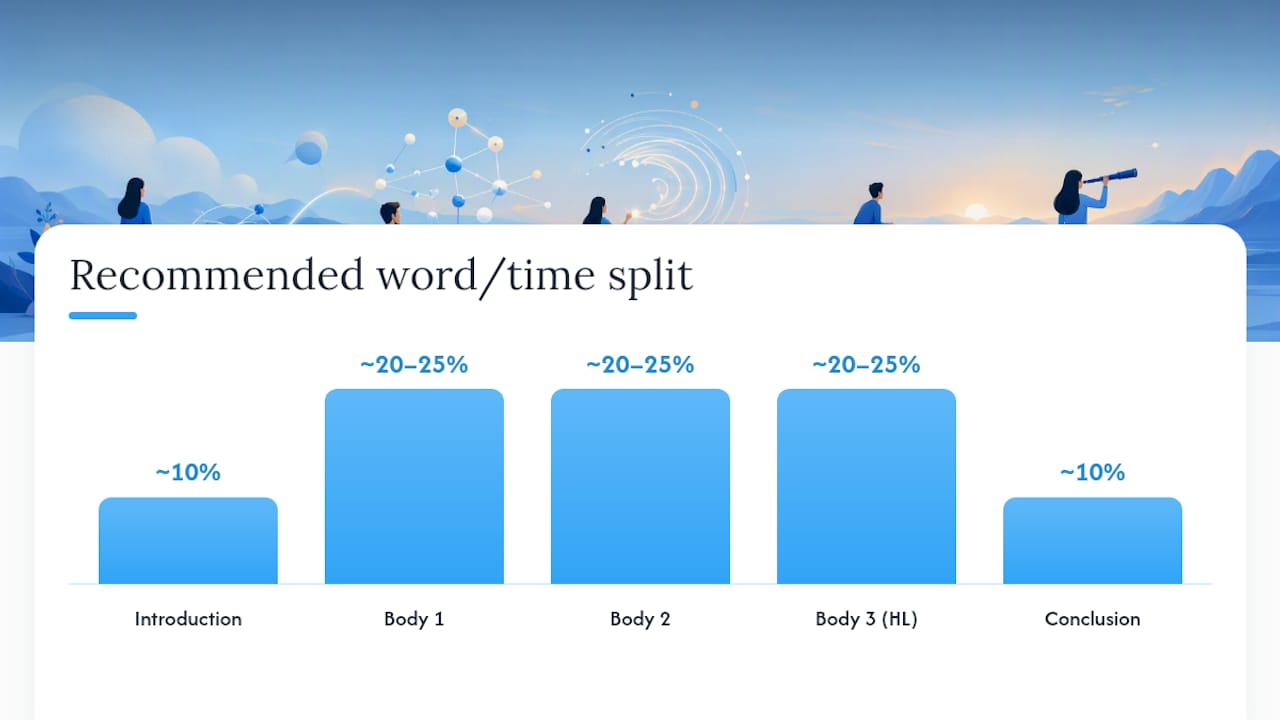
Recommended word and time split
| Section | Share of total | What happens here |
|---|---|---|
| Introduction | ~10% | Define terms, state thesis, give roadmap |
| Body paragraph 1 | ~20-25% | First major argument, fully evaluated |
| Body paragraph 2 | ~20-25% | Second argument, ideally a contrasting angle |
| Body paragraph 3 (+4 for HL) | ~20-25% | Third argument or counterargument |
| Conclusion | ~10% | Judgment that answers the question directly |
Study-skills guidance from multiple universities converges on the same figure here. The Goethe University Frankfurt writing guide recommends introductions and conclusions each make up roughly 10% of an academic essay’s total length, which scales cleanly to a timed ESS response. If you’re writing a 600 to 700-word Paper 2 answer, that’s roughly 60 to 70 words on your introduction, and the same for your conclusion, leaving the rest split across three or four body paragraphs.
SL candidates generally do well with three tightly evaluated paragraphs. HL candidates, who often face questions demanding more breadth or a comparative angle across two systems, tend to benefit from a fourth paragraph, provided the extra paragraph adds a genuinely new angle rather than restating the third one with different nouns.
What Does a High-Scoring Paragraph Look Like Sentence by Sentence?
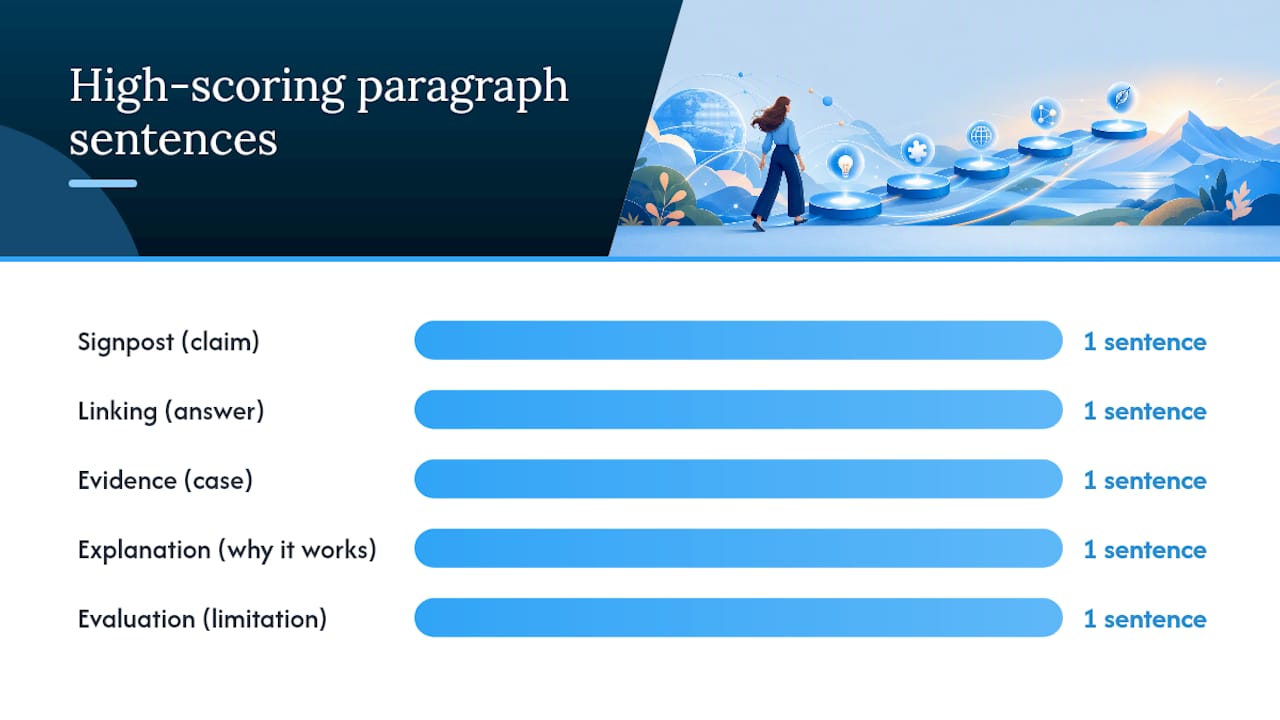
Every strong ESS paragraph plays out across six labeled roles, and once you can name the roles, you can spot exactly where your own paragraphs go weak.
- Signpost sentence — states the paragraph’s single point in plain terms.
- Linking phrase — ties that point explicitly back to the question’s wording.
- Evidence sentence — names a specific study, policy, or data point.
- Explanation sentence — walks through the logic connecting evidence to claim.
- Evaluation sentence — weighs strength, scale, or limitation against an alternative.
- Wrap sentence — closes the paragraph and points toward what comes next.
Here’s a condensed worked example answering a question on the effectiveness of protected areas for biodiversity conservation:
“Protected areas remain one of the more effective in-situ conservation strategies available to governments (1). This directly answers the question of effectiveness by isolating one policy tool from the broader conservation toolkit (2). Costa Rica’s protected-area network, covering over 25% of its territory, has been linked to measurable recovery in forest cover and jaguar populations since the 1990s (3). This works because removing extractive pressure gives ecosystems time to reach a new equilibrium, provided enforcement is consistent (4). However, protected areas alone cannot address biodiversity loss driven by factors outside their borders, such as climate-driven range shifts, which limits their effectiveness as a standalone strategy (5). This limitation is exactly why the next paragraph turns to complementary approaches like wildlife corridors (6).”
That paragraph would read as generic filler without sentence 5. Strip the evaluation clause out and you’re left with a solid geography-class description, not an ESS essay paragraph. The evaluation sentence is the single highest-leverage sentence in the whole structure, because it’s the one examiners scan for first when deciding whether you’ve cleared markband C.
Pro Tip: After you finish a full draft, list each paragraph’s one-sentence point on scratch paper in order. If two points repeat each other, or if the list doesn’t read as a logical build toward your conclusion, you’ve found your weak spot before the examiner does. This reverse-outline method, recommended by the Harvard College Writing Center, takes about two minutes and catches drift that’s nearly invisible while you’re still writing.
Which Evidence and Case Studies Actually Impress Examiners?
Vague evidence is the fastest way to cap your marks in the 5 to 6 range, and it’s an easy trap because vague examples feel safe to write under time pressure. Specific, dated, named evidence is what actually moves an essay upward.
The evidence that scores well in ESS essays generally falls into four categories:
- Named case studies with a location and rough timeframe, such as the collapse of the Grand Banks cod fishery in the early 1990s or the Aral Sea’s shrinkage following Soviet-era irrigation diversion.
- Specific study or survey results, even approximate ones, like reported changes in species counts or measured shifts in a pollutant concentration.
- Conceptual models, including the IPAT equation, planetary boundaries framework, or the tragedy of the commons, applied to the specific scenario in the question rather than described in the abstract.
- Comparative data across two policies, countries, or ecosystems, which naturally sets up an evaluation sentence because you’re already contrasting two things.
The trick under exam conditions isn’t gathering more evidence. It’s compressing what you already know into two sentences instead of a paragraph. A factual sentence names the case and states the relevant number or trend. An evaluative sentence follows immediately, weighing that evidence against a limitation, an alternative, or a question of scale. “Costa Rica’s Payments for Ecosystem Services program reversed decades of deforestation, raising forest cover from roughly 21% in the 1980s to over 50% today” is your factual sentence. “But the model depends on sustained government funding, which makes it fragile in economies facing fiscal pressure” is the evaluative follow-up that actually earns marks.
Balance your examples geographically where the question allows it. An essay leaning entirely on one country’s case studies reads as narrow, while three examples spanning a local policy, a national program, and a global agreement (the Montreal Protocol, for instance) signals the kind of breadth markband descriptors reward. Avoid the generic filler examples every examiner has read a hundred times, unnamed and undated claims like “many countries are reducing emissions.” That sentence could describe almost anything, which means it demonstrates almost nothing.
How Should You Plan Your Time During the Exam?
A 9-mark ESS question rewards a rehearsed workflow more than raw inspiration. The students who consistently score well aren’t the ones who write fastest, they’re the ones who spend the first few minutes planning instead of drafting immediately.
- Read and annotate the question (1 to 2 minutes). Underline the command term and any technical terms that need defining.
- Write a one-line outline (2 to 3 minutes): a mission statement, three bullet points naming your paragraph topics, one counterargument or limitation, and a closing judgment sentence.
- Draft your introduction (3 to 4 minutes), leaning directly on the mission statement you just wrote so you’re not composing from scratch.
- Write your body paragraphs (roughly 60 to 70% of remaining time), following the six-role paragraph blueprint for each one.
- Write your conclusion (3 to 4 minutes), stating your judgment plainly.
- Review (last 2 to 3 minutes): check that every paragraph has an explicit evaluation sentence and that your terminology is accurate.
If your exam slot runs shorter than expected, or you’ve spent too long on Section A, triage rather than panic. Write the topic sentence and evidence sentence for every planned paragraph first, across the whole essay, before going back to add evaluation sentences. A skeleton essay with every paragraph represented, even thinly, scores better than three fully written paragraphs and two missing ones entirely. If you truly can’t finish a paragraph, leave a one-line note of what it would have argued. It won’t earn marks, but it shows the examiner your planning was sound, which occasionally matters for borderline decisions.
What Mistakes Cost the Most Marks?
The same handful of errors show up across nearly every essay that underperforms relative to the student’s actual subject knowledge, and every one of them is fixable in the last few minutes before you hand in your paper.
- No clear thesis, or a thesis so vague it could apply to any question in the syllabus.
- Drifting off-question halfway through, usually because a paragraph got interesting and wandered from the actual command term.
- Weak, generic examples with no name, date, or location attached.
- Missing evaluation, where every sentence states a fact and none weighs it against anything.
- Misused terminology, particularly mixing up related terms like weather and climate, or renewable and sustainable.
- Long descriptive passages that read like a textbook summary rather than an argument built for this specific question.
These aren’t obscure pitfalls. Scribbr’s guidance on essay structure flags the same pattern across academic writing generally: a vague thesis and topic sentences that don’t loop back to it are the single most common reason essays underperform their content.
Run this two-minute checklist before you submit: Does your thesis take a clear position? Does every topic sentence echo your thesis’s language? Does at least one sentence per paragraph explicitly evaluate rather than describe? Does your conclusion state a judgment instead of a summary? Are your technical terms and units correct?
If you spot a purely descriptive sentence with no evaluation, the fix takes ten seconds: add a clause starting with “however,” “although,” or “this is limited by,” naming a specific constraint. That single clause is often the difference between a markband 5 and a markband 7 on that paragraph.
An Examiner’s Fastest Way to Catch a Weak Essay
Examiners read fast, and they’re trained to locate your thesis and topic sentences before reading anything else closely. If those sentences don’t form a coherent chain on their own, the rest of the essay is already fighting an uphill battle for marks.
The reverse-outline works from the same logic in reverse. After a full draft, write down each paragraph’s core point in one line, in order. If the sequence doesn’t read as a build toward your conclusion, or two points overlap, you’ve found the fix before anyone else sees it.
Three phrases consistently correlate with stronger evaluation marks: “a key limitation of this is,” “compared to [alternative], this approach,” and “this directly supports/challenges the claim that.” Each one forces you into evaluative language instead of description, and each one explicitly links back to the question.
Pro Tip: Read only your topic sentences back to back, skipping everything else. If they don’t tell a coherent story on their own, your body paragraphs need reordering, not rewriting.
Why This Structure Actually Works Under Exam Pressure
Most study advice on essay writing treats structure and content as separate skills, learn your ESS case studies first, then worry about formatting later. That’s backwards for a timed exam. Structure is what lets partial knowledge score well, and its absence is what makes strong knowledge score poorly.
The overrated piece of conventional advice is “write more examples.” Breadth without evaluation caps out in the same markband every time, no matter how many case studies you cram in. The underrated move is the reverse-outline, because it’s the only technique that catches drift after you’ve already written the thing, when you’re too close to your own argument to spot the gap yourself.
If you take one thing from this guide, prioritize the evaluation sentence in every paragraph before you worry about anything else. A thin essay with five explicit evaluations will consistently outscore a dense essay with none. Structure isn’t decoration on top of your ESS knowledge. It’s the mechanism that lets an examiner actually find that knowledge and reward it.
— Marija
Turn This Template Into a Marked-Up Essay With Real Feedback
A template gets you organized. It won’t tell you whether your specific thesis is defensible, whether your evidence actually answers the question asked, or where your evaluation sentences go soft. That’s the gap personalized feedback closes, and it’s the difference between practicing structure and mastering it.

Esstutor works one-on-one with IB ESS students on exactly the weak points this guide keeps circling back to: turning a vague topic sentence into one that echoes the thesis, tightening a descriptive paragraph into an evaluative one, and pacing a Paper 2 response so the conclusion doesn’t get rushed. A trial lesson typically includes live marking of one of your own essay paragraphs against markband language, followed by a short revision plan you can apply to your next practice essay. If you want a tutor with direct IB examiner experience to walk through where your current essays are losing marks, book a session focused on ESS essay performance and bring your next Paper 2 draft.
Sources
- How to structure and plan an essay | StudySkills@Sheffield | The University of Sheffield
- Tips for organizing your essay | Harvard College Writing Center
FAQ
What Is the Proper Structure for an Essay?
A strong essay follows an introduction that defines terms and states a thesis, a body of paragraphs that each carry one evaluated argument linked to that thesis, and a conclusion delivering a clear judgment without new evidence.
What Are the Five Main Parts of an Argumentative Essay?
Most versions break down into an introduction, three body paragraphs (each with its own topic sentence, evidence, and evaluation), and a conclusion, though ESS Paper 2 essays often flex to three to five body paragraphs depending on question breadth.
What Are the Seven Types of Essays?
Common categories include argumentative, expository, narrative, descriptive, persuasive, compare-and-contrast, and cause-and-effect essays; an IB ESS Paper 2 response is essentially an argumentative essay built on evaluated evidence.
What Are the Five Steps to Writing an Essay?
Read and annotate the question, plan a one-line outline with your thesis and paragraph topics, draft your introduction, write evaluated body paragraphs, then close with a conclusion stating your judgment.
No Comments