


20 Sep 15 Minute Plan to Score 9–10 on an IB ESS 10 Mark Question
To score 9–10 on an IB ESS 10-mark question, answer the command term directly, present balanced evaluation with at least two perspectives, back it with a named and located case study, and close with a justified conclusion. You get roughly fifteen minutes per question in Paper 2, so a portion of that time should be spent planning. The rest of this guide shows you the exact structure, a full annotated model answer, and a checklist you can use before every practice essay.
TL;DR:
- A top-scoring answer must integrate specific, named case studies with relevant facts and clearly link evidence to the question’s evaluation.
- Balancing both perspectives evenly and explicitly weighing their strengths and weaknesses is essential for achieving high marks.
- Using precise ESS terminology and explicitly stating evaluative judgments within each paragraph boosts the likelihood of reaching the top band.
- Planning the conclusion during the initial phase ensures a focused argument that directly addresses the command term and enhances coherence.
- Consistent timed practice with feedback on evaluating language and structure is more effective than simple content memorization for improving exam performance.
Table of Contents
- What an IB ESS 10-Marker Actually Tests
- Markbands Decoded: What Separates a 4 From a 9
- Command Terms: How Each One Reshapes Your Answer
- The Exam-Time Micro-Plan: Minute by Minute
- A Model 10-Mark Answer With Examiner-Style Notes
- Common Mistakes That Quietly Cap Your Score
- Building a Practice Routine That Actually Moves Your Score
- What an Examiner Actually Notices in the First 30 Seconds
- Why Most 10-Marker Advice Misses the Point
- Turn This Guide Into a Higher Paper 2 Score
- Official Markschemes and Trusted Revision Resources
- Sources
- FAQ
What an IB ESS 10-Marker Actually Tests
A 10-mark question sits inside Paper 2, Section B, alongside the other longer-response items on your exam. You will not see a 10-marker asking you to simply define a term or label a diagram. Instead, it asks you to build an argument, weigh it against another view, and land on a defensible judgment.
These questions weight heavily toward AO3, the assessment objective built around evaluation and synthesis. You cannot earn top marks by only describing what you know (that is AO1) or by only applying a concept to a single scenario (AO2). The examiner wants to see you hold two or more ideas up against each other and decide which one wins, and why. AO4 sneaks in too, since the strongest answers often draw on data, models, or field techniques you would recognize from your own coursework.
Because of the mark weight, your timing has to reflect the difficulty. Most exam guides recommend roughly:
- 1 to 2 minutes reading the question and identifying the command term.
- 2 to 3 minutes jotting a rough plan with your two perspectives and case study.
- 8 to 9 minutes writing the response itself.
- 1 minute rereading your conclusion to check it actually answers the question asked.
That timing matters because a 10-marker is worth roughly as much as two or three short-answer questions combined, yet students often either rush it in five minutes or let it eat 20 minutes they need elsewhere on the paper. Practicing the IB ESS exam questions strategies with a stopwatch running is the single fastest way to fix that imbalance.
Markbands Decoded: What Separates a 4 From a 9
Markschemes describe three rough tiers for long-response ESS questions, and the language in each tier tells you exactly what to fix. According to the official Environmental Systems and Societies Paper 2 SL markscheme, lower bands reward accurate knowledge stated in isolation, while the top band specifically rewards linkage, balance, and a defensible conclusion.
Low band (1 to 3 marks). The answer shows some relevant knowledge, but it is fragmented. Points appear as a list rather than an argument, there is no real case study, and the command term is largely ignored. You might see correct facts about eutrophication or deforestation, but nothing connects them to the actual question asked.
Mid band (4 to 6 marks). The response engages with the question and shows solid content knowledge. It may attempt one perspective well but fail to develop a genuine counterargument, or it name-drops a case study without using a specific fact from it. This is where most students land on their first few practice attempts, and it is a comfortable place to get stuck.
Top band (7 to 10 marks). According to research on the hardest IB ESS questions, top-scoring answers integrate evidence directly into the argument rather than bolting it on, use precise ESS vocabulary instead of everyday language, and reach a conclusion that clearly follows from the evaluation rather than restating the introduction.
Quick stat: Top-band responses consistently share three traits examiners can spot in seconds: a named and located case study, explicit evaluative language (“however,” “in contrast,” “this is limited by”), and a conclusion that answers the exact command term rather than summarizing the topic.
Here is the fast self-check version of the markbands:
- Did you name a real place and give one specific fact about it (a year, a percentage, a policy name)?
- Did you present a counterargument, not just a second fact that supports the same side?
- Did you use ESS terms like “carrying capacity,” “planetary boundaries,” or “resilience” correctly rather than loosely?
- Does your final sentence answer the question, or does it just wrap up your last paragraph?
Red flags that quietly cap your mark in the mid band: vague place references (“in a developing country”), evidence that never gets evaluated, and a conclusion that opens with “In conclusion” but repeats the introduction word for word.
Command Terms: How Each One Reshapes Your Answer
The command term is the single word doing the most work in the question, and misreading it is the fastest way to lose marks even with strong content. Here is how the common ones change your approach.
-
Discuss. This asks for a balanced account of an issue, giving arguments for and against. Open with something like, “This response will consider both the environmental and economic dimensions of…” and dedicate roughly equal space to each side before your judgment.
-
Evaluate. This wants you to weigh evidence and arguments to form a judgment about validity or importance. A strong opener sounds like, “While [approach A] has clear strengths, its weaknesses become apparent when compared with…” Every paragraph should end with a mini-verdict, not just a fact.
-
To what extent. This is evaluates more specific cousin. It expects you to commit to a position on a spectrum, not a flat yes or no. Try, “The claim that [X] is largely valid, though its accuracy depends heavily on…”
-
Examine. This asks you to break an issue into its parts and consider each in detail. Structure this as a close look at causes, mechanisms, or components before you widen out to significance.
-
Justify. This wants a reasoned case for a particular decision or interpretation, supported by evidence. Lead with your position clearly, then build the reasoning: “The most effective response to [problem] is [solution], primarily because…”
Whatever the term, the command terms guide on Esstutor is worth bookmarking, since examiners penalize a well-written “discuss” answer that was actually asked to “evaluate.”
The Exam-Time Micro-Plan: Minute by Minute
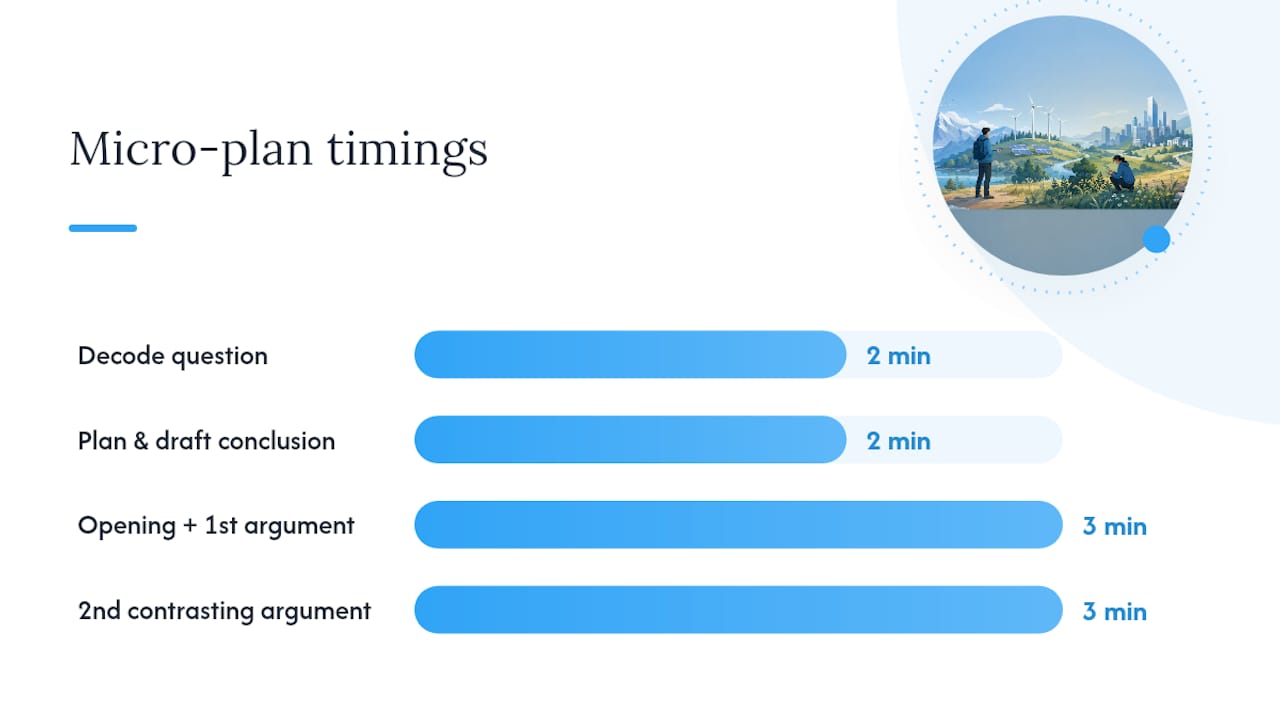
You do not need a genius essay. You need a repeatable formula you can execute under pressure, and the formula below is built to fit inside roughly 15 minutes.
-
Minutes 0 to 2: Decode the question. Underline the command term and circle the topic noun (soil degradation, tipping points, whatever it is). Write the command term in the margin so you cannot drift from it mid answer.
-
Minutes 2 to 4: Build your two-sided plan. Jot two columns: one perspective and its case study, then the opposing or contrasting perspective and its case study. This is also where you draft your conclusion in one sentence before you write a word of the essay. Planning the ending first keeps the whole response pointed at it.
-
Minutes 4 to 7: Write your opening and first argument. Your opening sentence should restate the question’s core tension in your own words, not copy it verbatim. Follow immediately with your first paragraph using the formula: topic sentence, concept explanation, evidence or case study, explicit evaluation, link back to the question.
-
Minutes 7 to 10: Write your second, contrasting argument. Use a transition that signals evaluation is happening, not just a new fact arriving. Phrases like “However, this view is complicated by…” or “In contrast, proponents of [X] argue…” do real work here because they tell the examiner you are weighing, not listing.
-
Minutes 10 to 12: Write your conclusion. Return to the exact wording of the command term. If it asked “to what extent,” state your position on the spectrum explicitly. Do not introduce new evidence here.
-
Minutes 12 to 13: Time check and reread. Confirm your conclusion actually answers the question rather than just summarizing your body paragraphs. This thirty-second habit alone fixes one of the most common markband ceilings.
The paragraph formula deserves its own callout, because it is the engine of the whole answer: topic sentence → concept → evidence/case study → explicit evaluation → link to question. Repeat that five-step chain for every argument you make, and the essay structures itself.
Pro Tip: Keep a running list of five or six “evaluation phrases” memorized cold, things like “this is limited by,” “a stronger case exists for,” or “the trade off here is.” Dropping one into every paragraph signals AO3 thinking even before the examiner reads your reasoning.
A concise structure like this echoes what structuring guides for 9-mark ESS answers recommend: define, argue for, argue against, conclude. The steps for high-scoring ESS essays page breaks this down further if you want more worked sentence starters.
A Model 10-Mark Answer With Examiner-Style Notes
Here is a representative question: “Evaluate the effectiveness of protected areas as a strategy for conserving biodiversity.” Below is a timed-length model answer with notes explaining exactly where each mark is earned.
Protected areas, including national parks and marine reserves, are one of the most widely used tools for conserving biodiversity, but their effectiveness depends heavily on enforcement, funding, and local community involvement.
Examiner note: this opening restates the tension in the question (effectiveness depends on conditions) rather than just repeating the prompt. That signals to the examiner you already know where the evaluation is headed.
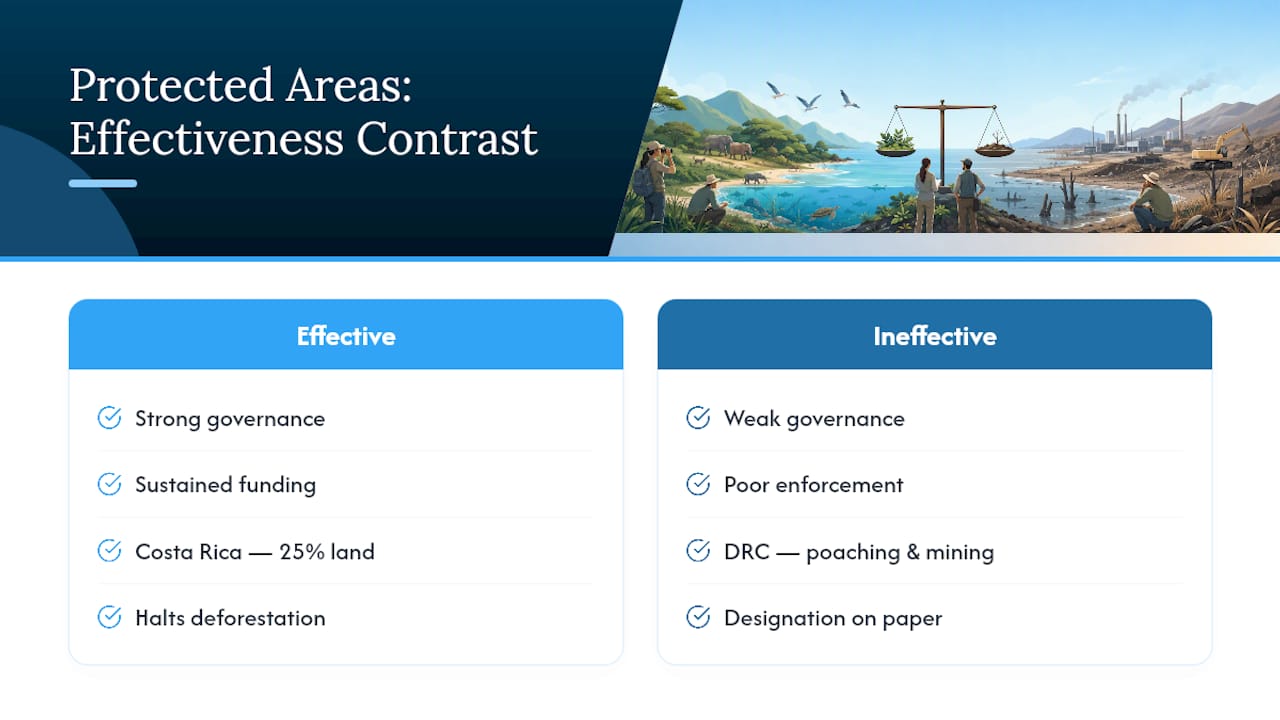
Well-managed protected areas can dramatically reduce habitat loss. Costa Rica’s network of national parks, which covers roughly a quarter of the country’s land area, has been credited with reversing decades of deforestation and supporting the recovery of species like the resplendent quetzal. This shows that when a government commits sustained funding and enforcement, protected status can directly halt the drivers of biodiversity loss, particularly illegal logging and land conversion for agriculture.
Examiner note: the named, located case study (Costa Rica) with one specific fact (a quarter of land area) is exactly what pushes this from mid band toward top band. The final sentence explicitly links the evidence back to the claim rather than leaving it to float.
However, protected status alone does not guarantee positive outcomes, particularly in regions where enforcement capacity is weak. In parts of the Democratic Republic of Congo, protected reserves have suffered from poaching and illegal mining due to insufficient ranger staffing and ongoing regional conflict, meaning the designation exists largely on paper. This suggests that the success of protected areas is not intrinsic to the strategy itself but depends on the surrounding political and economic stability of the region where it is applied.
Examiner note: this is the counterargument, and it is a genuine contrast rather than a second point supporting the same side. The phrase “the success… is not intrinsic to the strategy itself” is doing real evaluative work.
On balance, protected areas are an effective conservation tool where governance is strong and funding is consistent, but they are considerably less reliable in politically unstable or under resourced regions, meaning their overall effectiveness varies more with local capacity than with the conservation model itself.
Examiner note: the conclusion directly answers “evaluate the effectiveness,” commits to a defensible position, and avoids introducing new evidence.
Now compare that to a weaker version of the second paragraph, the kind that lands in the mid band:
Protected areas are good because they stop deforestation and help animals. Costa Rica has a lot of parks and they have worked well for the environment.
This sentence has correct content but no specific fact, no named mechanism, and no evaluation. The quick edit: add the percentage of land protected, name a species that recovered, and finish with a sentence explaining why it worked rather than just that it did. That single edit alone can move a paragraph up a full band.
Common Mistakes That Quietly Cap Your Score
Most students do not lose marks on 10-markers because they lack knowledge. They lose marks because of small, fixable habits that examiners see repeated across thousands of scripts.
- Vague examples. “In a developing country…” earns far less than “In Bangladesh, following the 2007 cyclone Sidr…” Fix: build a case-study bank with a named place, a date, and one specific fact for each topic before exam season starts.
- Description without evaluation. Listing facts about ocean acidification without weighing their significance reads as AO1 knowledge dump, not AO3 argument. Fix: after every fact, ask yourself “so what does this mean for the question?” and write that sentence down.
- Ignoring the command term. Writing a “describe” answer to an “evaluate” question is one of the most common markband ceilings. Fix: circle the command term before you write a single sentence.
- Weak conclusions. A conclusion that restates the introduction earns little beyond what the body paragraphs already secured. Fix: draft your conclusion first, during the planning phase, so the whole essay writes toward it.
- Overloading one side. Some answers spend eight sentences on one perspective and one sentence on the other, which undercuts the “balanced” requirement built into most markbands. Fix: aim for roughly equal paragraph length on each side.
Earning what markschemes sometimes label reasoning or justification marks comes down to making your logic visible on the page. If you believe protected areas work better with local community involvement, do not just assert it. Say why: “because community buy-in reduces poaching incentives by creating alternative income through ecotourism.” That one extra clause is often the difference between a claim and a justified claim.
Pro Tip: Before you submit any practice essay, run this 30-second checklist: command term addressed? Two perspectives present? Named case study with one fact? Explicit evaluation language used at least twice? Conclusion answers the actual question? If all five are yes, you are almost certainly in the top band.
Building a Practice Routine That Actually Moves Your Score
Reading about structure will not raise your marks. Writing timed answers against a stopwatch, then honestly marking them, is what closes the gap between knowing the theory and executing it under pressure.
- Set a weekly quota. Aim for two to three timed 10-mark answers per week during revision season, each written under the full 15-minute constraint, not in a relaxed untimed session.
- Build a case-study bank as you go. For every topic (biodiversity, pollution, resource management), record one named location, one date or statistic, and one specific policy or event. Practical guidance on selecting strong, field-tested examples appears in curriculum resources on case-study based learning, which reinforces why specificity beats general knowledge.
- Self-mark against the actual markscheme, not your gut feeling. Use the language from the official markscheme to check whether your answer shows “balanced evaluation” or just “some evaluation.” The difference in wording is the difference in band.
- Rotate command terms deliberately. Do not just practice “evaluate” questions because they feel familiar. Cycle through “discuss,” “to what extent,” “examine,” and “justify” so no command term catches you off guard on exam day.
- Get external feedback periodically. Self-marking catches obvious gaps, but a second pair of eyes, ideally someone who has marked IB scripts before, catches the subtler issues, like a case study that sounds specific but is not actually being evaluated. Practicing this way is repeatedly identified as the most effective way to convert content knowledge into consistent top-band performance across timed drills and self-marking routines.
What an Examiner Actually Notices in the First 30 Seconds
An experienced marker does not read your entire response before forming an initial impression. The first paragraph usually reveals whether a script will land in the mid band or the top band, and the tell is almost always the same: does the opening sentence engage with the specific wording of the question, or does it restate the topic in general terms?
Scripts that jump straight into “argue for” without first defining the key term in context tend to drift. The strongest openers briefly frame the tension the question is asking you to resolve, then move immediately into evidence. That single habit, visible in the first thirty seconds of marking, correlates strongly with everything that follows in the response.
The other heuristic examiners rely on heavily is whether evaluation appears inside each paragraph or only in a final summary tacked onto the end. A response that saves all its judgment for the last two sentences reads as descriptive throughout and evaluative only briefly, which caps it below the top band even if the content itself is accurate.
Where tutoring converts practice into marks most efficiently is in this exact gap: a student can know the case studies and the theory cold, yet still submit answers that describe rather than evaluate, simply because no one has shown them what evaluative language looks like sentence by sentence. Structured feedback on the ESS internal assessment process reveals the same pattern: students improve fastest when someone points at the specific sentence where a claim needed one more clause of reasoning, rather than being told generally to “evaluate more.”
Why Most 10-Marker Advice Misses the Point
The conventional advice you will find in most study guides focuses almost entirely on content: memorize more case studies, learn more terminology, cover more syllabus ground. That advice is not wrong, but it is incomplete, and it is not what actually separates a 5 from a 9 on this question type.
The real gap is structural discipline. Two students can know the exact same facts about Costa Rica’s national parks and Bangladesh’s cyclone resilience, and one will score a 5 while the other scores a 9, purely because one of them makes the evaluation explicit and the other leaves it implied. Markschemes reward visible reasoning, not just accurate reasoning.
If you take one thing from this guide, prioritize the conclusion. Write it first, during your two-minute plan, before you draft a single body paragraph. An essay built backward from a clear, committed judgment stays disciplined in a way that an essay written forward from “here is everything I know” rarely does. Content matters, but sequencing content into a visible argument is the skill that actually moves the needle on exam day.
— Marija
Turn This Guide Into a Higher Paper 2 Score
Reading about the perfect 10-marker structure is one thing. Writing it under real exam pressure, with someone checking whether your evaluation is actually visible on the page, is what closes the gap between a 6 and a 9. Tutoring sessions are built around exactly that: a trial lesson typically walks through a model answer together, runs you through one timed practice question, and gives direct, sentence-level feedback on where your evaluation needs sharpening.
Because sessions are one-on-one and led by an experienced examiner, the feedback targets your actual writing habits rather than generic tips you have already read a dozen times. If you want a low-commitment way to test this, the Trial Plan costs 34 € for a focused 20-minute session, or you can book the Basic Plan at 120 € for a full 60-minute lesson covering a complete model answer and personalized feedback. Full details on both, along with the ESS and Geography HL and SL packages, are on the pricing page. Book a trial lesson and bring your last practice 10-marker with you.
Official Markschemes and Trusted Revision Resources
- Official markscheme: band descriptors and AO weighting for long-response questions.
- Past papers guide: sample questions and examiner report context.
- Extended essay case-study guidance for building a stronger evidence bank.
- Internal assessment examples that double as case-study material for exam essays.
FAQ
How many marks do I lose for a weak conclusion?
There is no fixed deduction, but markschemes reward a conclusion that clearly answers the command term, so a vague or repetitive ending can keep an otherwise strong response out of the top band. Draft your conclusion during your planning phase so it stays sharp and specific.
How many case studies do I need for a 10-mark answer?
One well-developed, named, and located case study per perspective is usually enough, meaning two totals for a balanced answer. Depth and specificity matter far more than quantity, according to guidance on structuring long ESS responses.
What’s the difference between evaluation and description in ESS answers?
Description states facts about a topic, while evaluation weighs those facts against each other and draws a judgment about their significance or validity. A description-only paragraph might state that a policy reduced emissions; an evaluative paragraph would add whether that reduction was significant relative to the country’s total output and why.
How long should I spend on a 10-mark question in the exam?
Most exam strategies recommend around 15 minutes total: two to three minutes planning, eight to nine minutes writing, and a final minute checking your conclusion against the question. Sticking to this timing keeps you from overrunning into other sections of Paper 2.
Can tutoring actually help me get from a mid band to a top band?
Targeted, one-on-one feedback that pinpoints exactly where your evaluation is implicit rather than explicit tends to close this gap faster than general revision alone. Esstutor’s ESS tutoring services focus specifically on this sentence-level diagnostic work rather than broad content review.
No Comments