


21 Sep ESS and TOK Connections: Evidence, Models and Perspectives
ESS offers useful examples for exploring how knowledge is produced, tested and used. Climate models, biodiversity surveys and environmental policy decisions can all support thoughtful TOK discussion when you connect the example to a question about knowledge.
Start with the correct assessment task. A TOK essay answers one of the six prescribed titles for your examination session and has a maximum of 1,600 words. Do not replace that title with a question invented for an ESS lesson. Check the official TOK subject brief and your teacher’s instructions.
How ESS connects with current TOK
The current TOK areas of knowledge are history, the human sciences, the natural sciences, the arts and mathematics. Ethics is considered across knowledge discussions; it is not a separate current area of knowledge. Older resources organized around a checklist of “ways of knowing” should not be treated as the current assessment structure. Use the IB TOK guide supplied for your course.
Instead of adding terminology for its own sake, examine evidence, methods, assumptions and perspectives. Ask what a method can establish, what remains uncertain and whether the conclusion is proportionate to the evidence.
Four ESS examples for knowledge discussions
- Climate models: consider how assumptions and scenarios affect projections. Distinguish uncertainty about future human decisions from uncertainty in measurements or model structure.
- Biodiversity surveys: examine how sampling location, identification and the chosen indicator affect what can be concluded about an ecosystem.
- Environmental value systems: consider how people can share scientific evidence yet disagree about acceptable risks or policy priorities.
- Water-quality monitoring: explore how calibration, sampling frequency and site selection affect confidence in a claim about pollution.
These are discussion starting points, not prescribed essay titles or ready-made evidence. Choose a real, specific example you can document. Avoid inventing a city, study result or stakeholder statement to fit your argument.
A practical paragraph structure
- Make a focused claim about knowledge that addresses the title.
- Introduce a specific, sourced example and explain enough context for the reader to follow it.
- Analyse how the example supports or challenges the claim.
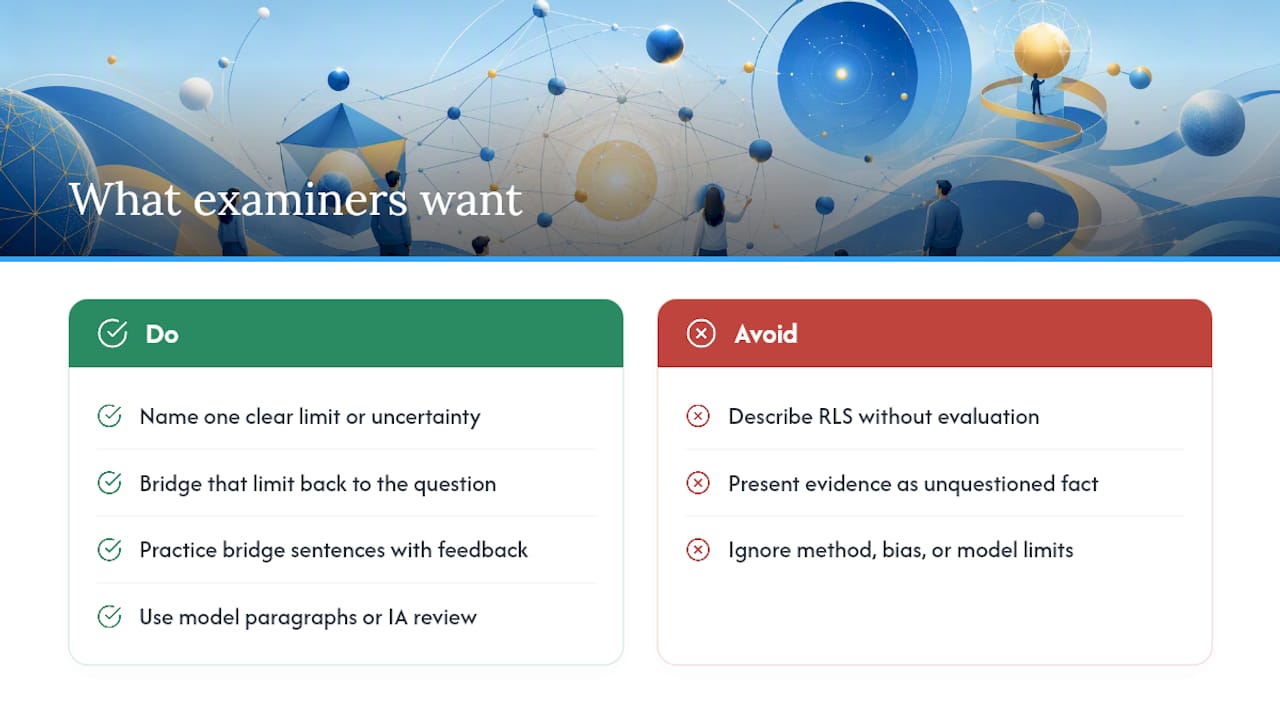
- Consider a limitation, alternative interpretation or different perspective.
- Explain what this means for the title, without claiming more than your evidence supports.
This is a planning aid, not a compulsory formula or guarantee of marks. Choose a documented ESS example, identify the knowledge claim and its evidence, then explain a limitation. Adapt the discussion to your TOK teacher’s instructions and the actual assessment task.
Systems thinking and TOK are connected, but different
Systems thinking examines relationships, feedback, boundaries and interactions within a whole system. Systems analysis can use measurements and models to investigate those relationships. TOK asks questions about knowledge, including how such models are justified and where their explanatory limits lie. Simply listing system components is not TOK analysis, but neither is systems thinking defined only as reflection on knowledge.
For example, an ESS carbon-cycle model can help explain transfers between stores. A TOK discussion might then ask how simplification contributes to understanding and what important detail that simplification leaves out.
Keep TOK, ESS IA and the extended essay distinct
Your ESS investigation may give you useful experience of sampling uncertainty and evidence. However, an ESS IA is assessed under ESS criteria, not TOK criteria. Do not insert a compulsory “TOK paragraph” or use a TOK essay template as a substitute for the investigation’s required analysis and evaluation. The extended essay also has its own subject and assessment guidance.
Use your teacher’s current instructions for each task. If you draw on the same experience in more than one assessment, discuss the boundaries with your teachers and keep the submitted work appropriate to each task.
Checklist before using an ESS example
- Does the example answer the actual prescribed title or classroom question?
- Can you identify and cite its source?
- Have you explained the knowledge issue rather than only described the environmental problem?
- Are your assumptions and limitations clear?
- Have you considered a relevant alternative perspective?
ESS tutoring with Marija Maletz
Marija has 13 years of teaching experience and more than 10 years as an IB ESS examiner. ESS tutoring can help you understand environmental concepts, interpret evidence and develop your own reasoning. Follow your TOK teacher’s guidance for the TOK assessment itself.
No Comments