


23 Sep IB ESS EE Research Question: 5-Point Examiner Tested Feasibility Checklist
A strong ESS research question is analytical, not descriptive, rooted firmly in an environmental systems and societies concept, and realistic given the data you can actually access. It has to be answerable in 4,000 words. Before you commit to a topic, your first move is targeted background reading: read four or five real sources, then draft your research question and pressure-test it for feasibility right away.
TL;DR:
- A strong ESS research question must be analytical, specific about the context, measurable variables, and clearly indicate the relationship and method to ensure feasibility.
- Narrowing the scope early, conducting pilot tests, and verifying data access are more critical than perfect wording, as practicality determines project success.
- Valid research questions include precise location, timeframe, and variables, avoiding broad, descriptive, or untestable topics that lack measurable focus.
- Matching methods to the question—whether primary, secondary, or mixed—is essential, with feasibility checks on access, safety, and sample size before data collection.
- Expert review, including feedback from a certified IB examiner, helps identify flaws, improve clarity, and ensure the question aligns with assessment criteria before extensive work begins.
Table of Contents
- What an ESS EE Actually Requires
- The Anatomy of a Strong ESS Research Question
- Matching Methods to Your Research Question
- A Step-by-Step Workflow to Narrow and Test Your RQ
- What Counts as a Real Literature Review at EE Level
- Annotated Sample Research Questions Across ESS Topics
- Supervisors, Ethics, and Mapping to the Assessment Criteria
- What Examiners Actually Flag in Weak Draft Questions
- The Editorial Take: Practicality Beats Perfection
- Get Direct Feedback on Your ESS Research Question
- Official Guidance and Resources Worth Bookmarking
- Sources
- FAQ
What an ESS EE Actually Requires
The IB Extended Essay is a compulsory, independent research project capped at 4,000 words, and that limit shapes everything about your research question before you write a single sentence of your essay. You don’t have room to explain background theory, describe a process step by step, and then squeeze in analysis. A question that invites description eats your word count on setup and leaves nothing for the part examiners actually reward.
Environmental systems and societies sits across group 3 and group 4, which means your essay has to work as both a social science and a natural science inquiry. Examiners expect you to bring in a systems approach, quantitative reasoning where it fits, and an awareness of the human and ecological sides of your topic at once. A question that only tests chemistry, or only tests policy, misses what makes an ESS essay distinct from a Biology or Geography one.
Your research question also determines which methods are even possible and how the examiner will judge your work against the assessment criteria. Pick a question that needs six months of continuous field data and you’ve locked yourself out of the project before you start. Pick one with no measurable variable and you’ve written a discussion prompt, not a research question.
Three mistakes account for most weak ESS RQs:
- Too broad: “How does climate change affect biodiversity?” covers an entire discipline, not a project.
- Purely descriptive: “What is eutrophication and how does it happen?” invites a textbook summary, not original analysis.
- Untestable with available means: a question demanding satellite-level data or years of longitudinal tracking that a high school student cannot obtain.
Structure guides recommend a short introduction, a main body of roughly 2,500 to 3,000 words, and a concise conclusion, which is why the structure of your EE needs to be locked in before you start collecting data, not after. If your question can’t be answered inside that body allocation, it needs to shrink.
The Anatomy of a Strong ESS Research Question
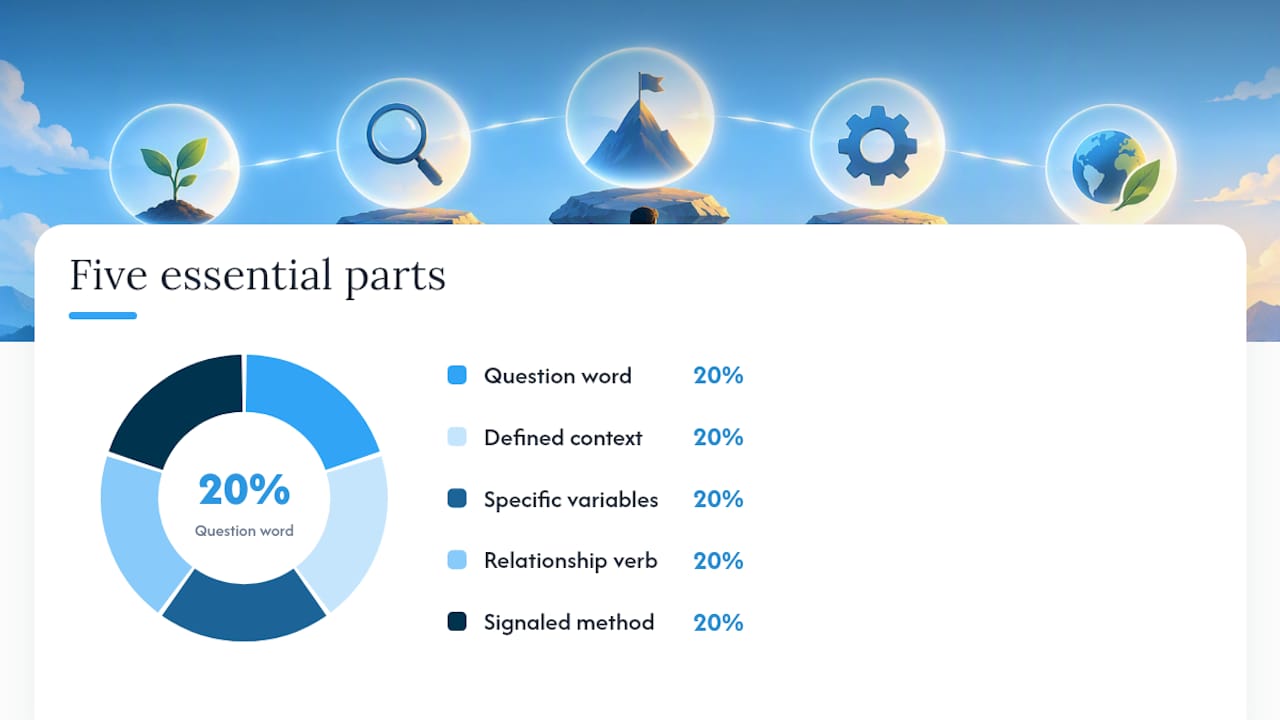
Every effective research question has five working parts, and missing even one usually means a supervisor sends the draft back. Think of it as a formula you can check against, not a creative writing exercise.
- A question word that demands analysis. “How,” “to what extent,” “in what ways,” and “why” all force you to build an argument. “What” and “is” invite a definition instead.
- A defined context. Name the place, time frame, system, or population. “A river” is not a context. “The Rio Grande near Albuquerque, New Mexico, between 2020 and 2025” is.
- Clear variables. State exactly what you’re measuring and what you’re comparing it against. Vague nouns like “environmental impact” or “sustainability” need to become specific, measurable things: nitrate concentration, species richness, per capita water use.
- A relationship indicator. Verbs like “influences,” “explains,” “correlates with,” or “reduces” tell the reader (and you) what kind of relationship you’re testing. Passive framing like “is related to” says nothing.
- A signaled approach. The wording should hint at whether you’re using primary fieldwork, secondary datasets, or a mix, so the method section doesn’t feel like a separate decision made after the fact.
Here’s the anatomy applied to a real draft. Take the flat version: “How does farming affect water quality?” It has no context, no defined variable, and a weak relationship verb. Rebuilt: “To what extent does intensive dairy farming influence nitrate concentration in groundwater wells within a 5-kilometer radius of Waikato, New Zealand?” Same topic, but now it has a bounded location, a measurable variable, and a verb that demands a quantified answer.
Run every draft question through this five-point check before you show it to a supervisor:
- Does it use an analytical question word, not a descriptive one?
- Is the geographic, temporal, or population context stated explicitly?
- Are the variables named specifically, not as abstract categories?
- Does a relationship verb connect those variables?
- Can a reader guess your method just from reading the question?
The ICS Zurich research question workshop frames this same anatomy as the foundation for refining a research question from broad to precise, and it’s worth running your own draft through that lens more than once. Most students need three or four rewrites before the wording locks into place.
Pro Tip: Read your draft RQ out loud and ask yourself, “Could I answer this with a single sentence from Wikipedia?” If yes, it’s still descriptive. Rewrite until the honest answer requires your own data and your own argument.
Matching Methods to Your Research Question
Your research question is only as strong as your ability to actually answer it, and that means checking feasibility before you fall in love with an idea. Subject-specific EE guidance for ESS confirms students can use primary data, secondary data, or a combination of both, but the guidance also stresses that background reading needs to inform which approach you choose, not the other way around.
Primary data works well when your question involves local, accessible systems: water sampling from a nearby stream, biodiversity transects in a local woodland, or a short survey of household waste habits in your town. The practical limits show up fast, though. Fieldwork needs repeat visits or a season with stable conditions, lab work needs access to functioning equipment, and surveys need a sample size large enough to say something meaningful. A dozen survey responses will not support a claim about community attitudes.
Secondary data suits questions where the phenomenon operates at a scale you cannot personally measure, such as national deforestation rates or long-term rainfall trends. Trusted sources include government environmental agencies, peer-reviewed journal datasets, and international bodies like the FAO or IPCC. The skill examiners look for isn’t just finding a dataset. It’s manipulating that data yourself, recalculating trends, comparing regions, or running your own statistical test, rather than repeating someone else’s conclusion.
Mixed methods can strengthen an essay when primary fieldwork tests a pattern that secondary data first suggested, but this route demands tighter time management since you’re running two data-collection processes instead of one.
Whichever route you pick, you need to justify it in your methodology section, explaining specifically why this method fits this question better than the alternatives. Before committing, run through a short feasibility check:
- Can you physically access the site, dataset, or population within your school timeline?
- Is the activity safe, and does it avoid protected species or restricted areas?
- Will your sample size be large enough to support a real conclusion?
- Do you need permissions, whether from a landowner, a school ethics process, or a data provider?
A fieldwork method guide built for ESS students walks through sampling techniques that hold up under examiner scrutiny, and a guide to working with secondary datasets covers how to manipulate existing data into original analysis rather than a repeated summary.
A Step-by-Step Workflow to Narrow and Test Your RQ
Most students draft a research question once and treat it as fixed. That’s backwards. Treat your first draft as provisional, something to stress test and revise, not a final answer you defend against feedback.
- Run a quick literature scan. Before refining anything, spend two or three hours searching for existing studies on your general topic. If you cannot find at least a handful of credible sources touching on your angle; that’s an early warning sign, not a reason to push forward blindly.
- Reduce scope on at least one axis. Narrow by time (a single growing season, not five years), place (one watershed, not a whole river basin), population (one species, not an ecosystem), or variable (one pollutant, not “water quality” broadly). Pick the axis that matches what you can realistically access.
- Run a small pilot. This can be a short trial fieldwork session, a test survey sent to ten people, or a desk-based check that your chosen dataset actually contains the variables you need. Pilots expose problems that background reading alone won’t catch, like a stream too shallow to sample properly or a dataset that stops tracking the variable you need in the exact years you need it.
- Revise the RQ based on pilot results. If the pilot reveals a barrier, change the question rather than forcing the plan to work anyway. A revised RQ submitted early is a minor setback. A forced RQ discovered to be unworkable in month four is a crisis.
- Check it against a feasibility checklist with your supervisor. Confirm access, safety, sample size, and permissions one more time before you commit fully.
This cycle matches how researchers actually approach question design: as a hypothesis to test, not a fixed plan to defend. Treating your RQ as provisional early on saves you from the far more painful experience of abandoning months of fieldwork later.
What Counts as a Real Literature Review at EE Level
Background research and a focused literature review are not the same task, even though students often blur them together. Background reading is wide and exploratory, the kind of reading you do before you’ve settled on a topic. A focused literature review comes after you have a draft RQ, and its job is to position your specific question against what’s already known.

At EE level, that focused review typically draws on five to ten strong, discipline-appropriate sources, not dozens. The goal is depth over volume: sources that let you argue your question fills a genuine gap or tests a real disagreement in the field, not a stack of tabs you skimmed once.
High-quality ESS sources fall into a few categories:
- Peer-reviewed journal articles from environmental science or geography journals.
- Government or intergovernmental environmental datasets (national environmental agencies, FAO, IPCC reports).
- University-hosted research repositories and theses on closely related topics.
- Established environmental NGOs publishing data-backed reports, used carefully and cross-checked against primary sources.
As you read, look for patterns and disagreements rather than just facts. If three studies on urban heat islands disagree about which mitigation method works best in dense cities, that disagreement is exactly the kind of gap a strong RQ can step into. Compile your sources with short annotations as you go, a sentence or two on what each source found and how it relates to your question, so you’re not rereading everything from scratch when you write your introduction.
Annotated Sample Research Questions Across ESS Topics
Seeing a full research question broken down piece by piece is often more useful than any rule list. Here are four across common ESS domains, annotated for why the wording works and where students commonly trip up.
-
Biodiversity: “To what extent does forest fragmentation influence bird species richness in three woodland patches near [your town/region]?”
Why it works: bounded to three named sites, a measurable variable (species richness), and a relationship verb.
Feasible method: point-count bird surveys across the three patches, repeated at the same time of day.
Likely pitfall: seasonal bird activity varies, so timing your surveys to a narrow window can skew results if you’re not careful about when you collect data. -
Water quality: “How does distance from an agricultural runoff source affect nitrate concentration in [named river/stream]?”
Why it works: one pollutant, one clear spatial variable, and a testable gradient.
Feasible method: water sampling at set intervals along the stream, using nitrate test kits or a partner lab.
Likely pitfall: rainfall events between sampling dates can distort readings, so you need to record weather conditions alongside your samples. -
Energy and land use: “To what extent has the expansion of solar farms influenced land-use change in [named district] between [two years]?”
Why it works: names a specific policy driven change with a defined time window.
Feasible method: secondary analysis of satellite land-use maps or government land registry data, compared across the two years.
Likely pitfall: students often skip the “so what,” failing to link land-use change back to an ESS concept like habitat loss or soil degradation. -
Human systems: “How does household income level influence recycling participation rates in [named neighborhood/town]?”
Why it works: a clear socioeconomic variable tied to a measurable behavior.
Feasible method: a structured survey with a large enough sample, cross-referenced against local council recycling data if available.
Likely pitfall: self-reported survey data on recycling habits tends to overstate good behavior, so the methodology needs to acknowledge that bias directly.
Reading annotated, examiner-reviewed EE examples helps you calibrate what “good enough” actually looks like at this level, since repositories of scored ESS essays show real wording next to real outcomes rather than hypothetical advice. Use them for calibration, not for copying structure wholesale.
Pro Tip: When you find an RQ template that fits your interests, swap in your own location, timeframe, and variable before showing anyone the draft. A copied structure with your own specifics reads as original work; a copied structure with someone else’s specifics reads as exactly that.
Supervisors, Ethics, and Mapping to the Assessment Criteria
A good supervisor relationship runs on short, focused conversations rather than one long meeting at the end. Bring a specific question or a specific problem to each session, and keep a running note of what you discussed, since that record feeds directly into your Reflections on Planning and Progress Form.
Ethics and safety limits shape topic choice more than students expect. Protected species, hazardous chemical sampling, and sites requiring landowner permission all need to be flagged early, and some topics that seem promising on paper turn out to be unsuitable for safety or access reasons once a supervisor reviews them. Better to hear that in week two than in week ten.
Your research question and method choice need to visibly map to the assessment criteria examiners actually use:
- Criterion A (focus and method) rewards a question with a clear, narrow focus and a method that’s obviously appropriate to it.
- Criterion B (knowledge and understanding) rewards essays that use ESS-specific concepts, not generic environmental commentary.
- Criterion C (critical thinking) rewards analysis and evaluation of your own findings, not just reporting them.
A breakdown of how ESS criteria connect to method choice is worth reviewing before you finalize your RQ, since it shows how examiners read the connection between your question wording and your grade.
What Examiners Actually Flag in Weak Draft Questions
The same handful of red flags come up again and again in early ESS EE drafts, and most of them are fixable in a single revision session rather than a full rewrite.
The most common one: a question phrased as a topic instead of an inquiry, something like “The effects of plastic pollution on marine ecosystems,” with no question word at all. The fix is almost always mechanical, adding a question word, naming a location, and specifying one measurable variable instead of an entire ecosystem’s worth of impacts.
The second red flag is a method section that doesn’t match the question’s scope. A question naming a specific 2-kilometer stretch of river, followed by a method describing broad regional water quality trends, tells an examiner the student never tested feasibility before writing.
A research question should feel provisional right up until your pilot data confirms it works. Students who treat their first draft as sacred usually spend more time defending a flawed question than they would have spent fixing it. The gap between a passable ESS essay and a strong one almost always traces back to how rigorously that first question was tested before the real work began.
Tailored feedback speeds this process up considerably, since a second set of eyes with examiner experience can spot a mismatch between question and method in minutes rather than weeks. A trial lesson or a round of EE feedback focused specifically on your draft RQ, checked against real assessment expectations, tends to save far more time than it costs.
The Editorial Take: Practicality Beats Perfection
Most advice on ESS research questions treats wording as the whole problem, and that’s a mistake. Wording matters, but the research consistently points somewhere else: feasibility is the real bottleneck, and it’s the one students test last instead of first.
The conventional approach, polish the question, then worry about data, gets the order backwards. A beautifully worded RQ that depends on a dataset you can’t access, or fieldwork you can’t safely repeat, is still a failed project. I’d argue the pilot test in your workflow, not the wording checklist, deserves the most attention early on. Run a small sample, check a dataset actually has your variable, before you invest in refining verbs and clauses.
What the annotated examples show, again and again, is that strong ESS essays share a boring quality: their questions were tested for access and safety before they were polished for style. The students who skip that step and go straight to elegant wording are the ones rewriting their method section in month three.
Prioritize feasibility first, wording second. Everything else in this guide follows from that single ordering.
— Marija
Get Direct Feedback on Your ESS Research Question
Reading guides and annotated examples gets you most of the way, but a research question drafted alone still has blind spots a second reader catches immediately. Expert review is available from a certified IB examiner with extensive experience in ESS and Geography, who can review your draft RQ for feasibility and method fit as examiners do.
A Trial Plan session runs 20 minutes and gives you a focused read on whether your draft question is analytical enough, narrow enough, and answerable with the methods you actually have access to. Extended essay feedback services include review of method sections, data handling, and conclusions to help align with assessment criteria, with additional support for fieldwork planning, data analysis, and essay structure as needed.
Check current session details on the pricing page, and book a trial lesson before your next supervisor deadline so any feasibility problems surface now, not after months of data collection.
Official Guidance and Resources Worth Bookmarking
Start with the primary sources examiners themselves are trained against, then move to school-level guides that translate those rules into workable steps.
- The official IB Extended Essay guide covers core requirements, word limits, and the general assessment structure every EE follows.
- Library-hosted research question workshops, like the ICS Zurich guide, walk through anatomy and refinement with real annotated examples.
- Literature review guidance from sources like the ISB Libguides page explains how many sources and what depth an EE-level review actually needs.
Sources
A focused EE literature review typically draws on five to ten strong, discipline-appropriate sources, not dozens of loosely related ones. Depth and relevance to your specific research question matter more than volume.
- Extended essay — International Baccalaureate® (IB)
- Developing a Research Question — ICS Inter-Community School Zurich Libguides
- Writing a literature review — IBDP: Extended Essay (ISB Libguides)
FAQ
What Makes a Research Question Too Broad for an ESS EE?
A question is too broad when it names a global or regional phenomenon without a specific location, timeframe, or measurable variable, something like “How does pollution affect ecosystems?” Narrow it by naming a place, a pollutant, and a population, then check whether you can realistically access data for that narrower version.
Can I Change My Research Question After I Start Collecting Data?
Yes, and you often should if a pilot test or early data reveals the question isn’t answerable as written. Treating your first draft as provisional, rather than final, is standard practice, and revising early is far less costly than discovering a flawed question after months of fieldwork.
Does Esstutor Offer Feedback Specifically on Extended Essay Research Questions?
Yes, Esstutor offers EE feedback and a Trial Plan session designed to review draft research questions for feasibility, method alignment, and fit with assessment criteria. Current session details and pricing are listed on the pricing page.
What’s the Difference Between Primary and Secondary Data for an ESS EE?
Primary data means fieldwork, experiments, or surveys you collect yourself, while secondary data means using existing datasets from sources like government agencies or peer-reviewed studies. ESS subject-specific guidance confirms students may use either approach or a combination, as long as the choice is justified by background reading.
No Comments