


01 Oct 3 Examiner Aligned ESS IA Topics IB Students Can Adapt
The fastest way to land on a strong ESS IA is simple: pick a site or dataset you can actually access, build a question around one measurable independent and dependent variable, and connect your findings to competing stakeholder perspectives. This article walks through topic ideas by theme, question templates, data-collection methods, feasibility checks, three worked mini-proposals, and examiner-style tips so you can move from idea to plan in one sitting.
TL;DR:
- Choosing a site with accessible data or easy-to-measure variables improves the likelihood of completing a focused investigation within time constraints.
- Field methods like quadrats, water testing, or surveys require at least 10 to 20 replicates or 30 respondents to produce reliable results.
- Questions must be narrow enough to measure with available equipment and should clearly identify one independent and one dependent variable, with controlled variables maintained.
- Practical considerations such as site permissions, seasonal timing, and safety protocols are essential to ensure data collection is feasible and ethical.
- Connecting findings to stakeholder perspectives remains crucial, with examiners valuing clear variable definitions, honest uncertainty discussion, and explicit links between data and environmental debates.
Table of Contents
- 1. Topic ideas grouped by theme
- 2. Turning an idea into a testable question
- 3. Data-collection methods and sampling that hold up
- 4. Scope, feasibility, ethics, and safety before you commit
- 5. Three worked mini-proposals you can adapt
- 6. What examiners look for and mistakes to avoid
- 7. Why coaching sharpens a topic faster than trial and error
- 8. IA tutoring that turns a topic into a finished plan
- 9. Where to check official guidance next
- Sources
- FAQ
1. Topic ideas grouped by theme
Matching a topic to a site you can reach is the single biggest factor in whether your IA succeeds. Here are prompts organized by theme, each with a suggested variable pairing so you can see the shape of the investigation before committing.
-
Ecosystems: compare species diversity (DV) across distance from a footpath or edge habitat (IV) using quantitative quadrat data.
-
Water: measure how distance downstream from a discharge point (IV) affects dissolved oxygen or turbidity (DV) using a water testing kit.
-
Pollution: test how proximity to a road (IV) affects lichen abundance or leaf particulate load (DV), a mix of quantitative and semi-qualitative data.
-
Energy and resources: survey household or school energy use patterns (DV) against building age or insulation type (IV) using secondary records.
-
Urban and human systems: compare green space coverage (DV) across neighborhoods with different population density (IV) using satellite imagery or municipal data.
-
Perception studies: survey attitudes toward a local environmental policy (DV) across age groups or resident versus visitor status (IV), producing qualitative and ranked data.
Ecosystem and water topics suit small-sample fieldwork you can repeat over a few visits. Energy and urban topics often work better with secondary data when fieldwork access is limited. For more topic inspiration tied to feasibility, see this guide to environmental issue examples for the IA.
2. Turning an idea into a testable question
Every strong ESS question starts with the same four ingredients: an independent variable you can change or select, a dependent variable you can measure, a location or population, and the controlled variables that keep your comparison fair. Once you have those, the question almost writes itself.
- Gradient template: “How does [IV] change with distance from [reference point] in [location]?”
- Comparison template: “How does [DV] differ between [site A] and [site B] with contrasting [IV]?”
- Time template: “How has [DV] changed over [time period] at [location], based on secondary records?”
- Perception template: “How do attitudes toward [DV] differ across [population groups] in [location]?”
Before finalizing, check your question against four things: can you measure the DV with equipment you own or can borrow, is the scope narrow enough to finish in your timeline, could a classmate repeat your method and get comparable data, and do you have a realistic idea of your sample size.
Pro Tip: Write your question, then underline the IV and DV separately. If you cannot underline exactly one of each, the question needs narrowing.

3. Data-collection methods and sampling that hold up
The method you choose should match what your site and timeline actually allow, not what sounds impressive. Quadrats and transects suit vegetation and ground cover comparisons. Point counts work for mobile species like birds or insects. Water sampling with a pH or conductivity meter suits streams, ponds, or runoff studies. Surveys work for perception and behavior questions, and secondary datasets rescue topics where fieldwork is not possible.
- Quadrats and transects: aim for at least 10 to 20 quadrats per site to get a workable spread of data.
- Point counts: repeat counts at the same time of day across several visits to reduce bias from activity patterns.
- Water testing: take replicate readings at each sampling point rather than a single reading, since meters can drift.
- Surveys: aim for a sample large enough to break results into at least two comparison groups with enough respondents in each.
- Secondary data: log the original source, date range, and any gaps so your method section can explain what you used and why.
Keep a running data log with date, time, weather, and equipment settings. It saves you from guessing later why one data point looks strange.
4. Scope, feasibility, ethics, and safety before you commit
Before locking in a topic, run through the practical side. A great question on paper falls apart if you cannot actually collect the data in time.
- Timeline: map out how many site visits or survey rounds you need against your actual deadline.
- Permissions: check whether your site needs landowner, school, or local authority consent before you sample.
- Seasonality: confirm your variable will actually be present and measurable during your collection window.
- Consent and safety: get informed consent for any survey work and follow basic fieldwork safety rules like working in pairs near water or roads.
- Distinct data: if you are working with classmates at the same site, agree on shared logistics but make sure each person measures a different variable or comparison so your data stands alone.
5. Three worked mini-proposals you can adapt
These examples show how a question, method, and analysis plan fit together in practice.
- Ecology transect: Question: how does plant species diversity change with distance from a footpath edge in a local woodland? Method: lay a 20-meter transect with quadrats every 2 meters, recording percentage cover and species count. Aim for at least 10 quadrats per transect, repeated on two transects. Data type: quantitative. Link to perspectives: connect trampling impact to tension between recreational access and conservation management.
- Water-quality comparison: Question: how does dissolved oxygen differ upstream and downstream of a wastewater outflow? Method: take triplicate readings at five points upstream and five downstream using a dissolved oxygen meter. Data type: quantitative. Link to perspectives: weigh economic reliance on the discharge source against ecological health of the waterway.
- Perception survey (secondary-data-friendly): Question: how do attitudes toward a local recycling policy differ between long-term residents and recent arrivals? Method: distribute a short ranked-response survey to at least 30 respondents per group, or draw on existing municipal survey data if fieldwork access is limited. Data type: qualitative and ranked. Link to perspectives: contrast convenience-focused views against sustainability-focused views on policy design.
6. What examiners look for and mistakes to avoid
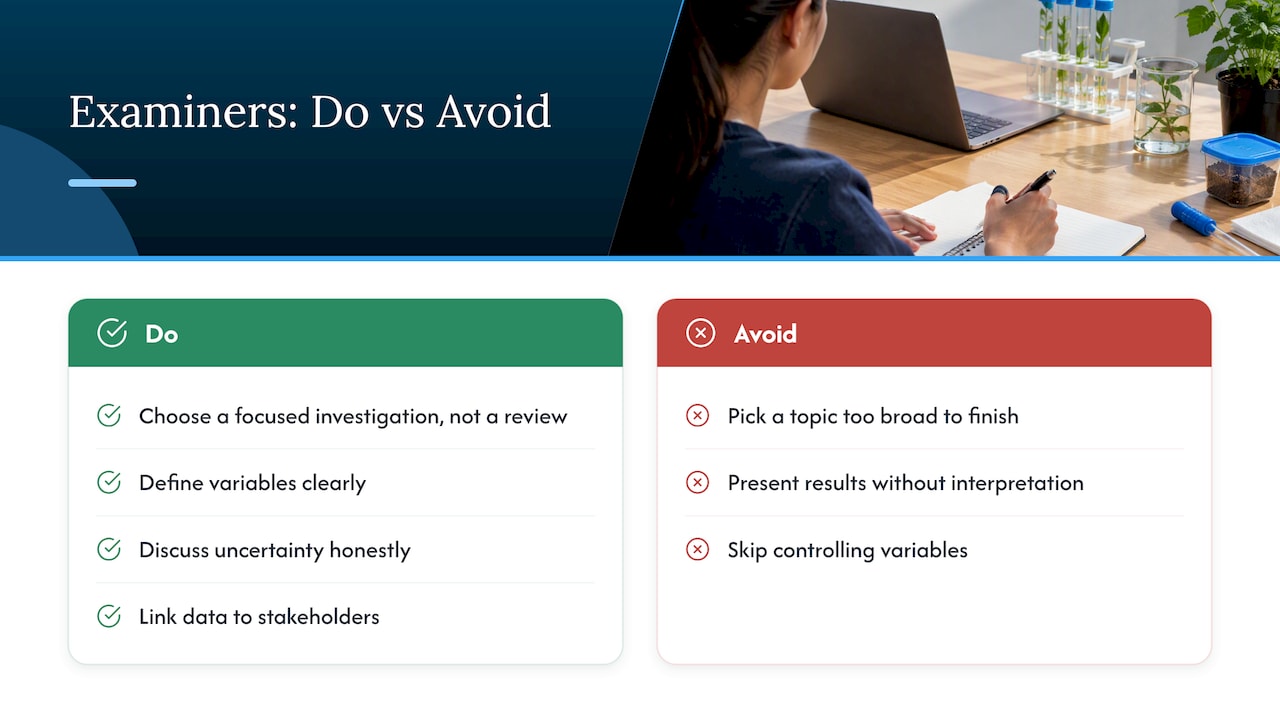
The IB’s subject-specific guidance draws a clear line between the IA and the extended essay: the IA needs a focused investigation with applied findings, not a broad literature review. Examiners reward clear variable definitions, honest discussion of uncertainty, and explicit links between data and stakeholder perspectives. Common mistakes include choosing a topic too broad to finish, presenting results with no interpretation, and skipping controlled variables. Labeled tables, concise methods, and a short discussion of limitations tend to save marks that get lost elsewhere.
7. Why coaching sharpens a topic faster than trial and error
I focus every early session on three things: is the site accessible, is the relationship measurable, and does it align with what examiners now expect under the revised IA. Working through that with someone who has marked these investigations usually saves weeks of wasted piloting. Most students walk away from one or two sessions with a question, method, and sample size they can actually commit to.
— Marija
8. IA tutoring that turns a topic into a finished plan
Choosing a topic is only the first hurdle. IA tutoring can cover topic selection, method design, data review, write-up feedback, and marking that mirrors how examiners actually score.
- Work through topic selection and question design with feedback from a certified IB examiner.
- Get method and sampling design checked before you commit hours to fieldwork.
- Receive write-up feedback structured around the current IA criteria.
A Trial Plan session runs 20 minutes and is a low-pressure way to see if a topic actually holds up. For ongoing IA support, our dedicated IA tutoring page outlines how sessions are structured from first draft to final submission.
9. Where to check official guidance next
Read the IB’s environmental systems and societies curriculum update for the current IA emphasis, then browse our IA exemplar collection for structure and formatting ideas.
Sources
- Environmental systems and societies updates
- Environmental systems and societies: Subject-specific guidance
FAQ
What are some good topics for the ESS IA exam?
Good topics pair an accessible site or dataset with a measurable relationship, such as species diversity along a footpath gradient or water quality upstream and downstream of a discharge point. The strongest topics also let you connect your data to a tension between stakeholder perspectives.
Is it hard to get a 7 in ESS?
A high score depends less on a dramatic topic and more on a well-defined question, rigorous sampling, and honest discussion of uncertainty and perspectives. Students who narrow their scope early and pilot their method tend to produce more defensible data than those chasing overly ambitious questions.
What topics are covered in the IB ESS program?
The course spans ecosystems, biodiversity, water and pollution, energy and resources, human population, and the perspectives and tensions that shape environmental decision-making. These themes give you the pool from which IA topics are usually drawn.
What are the updated ESS IA criteria for 2026?
The revised IA was first taught in August 2024 and first assessed in May 2026, with a stronger emphasis on linking measurements to stakeholder perspectives rather than presenting purely descriptive results. Group logistical support is allowed during fieldwork, but each student must still submit distinct variables or unique data.
No Comments