

12 Oct IB Climate Vulnerability: Bangladesh vs Ghana, Model Exam Paragraph
Climate vulnerability describes the degree to which a place, ecosystem or community is susceptible to harm from climate hazards, and the IB syllabus breaks it down into three parts: exposure, sensitivity and adaptive capacity. It is never fixed. Vulnerability shifts with wealth, governance and social inequality, which is exactly why two countries facing the same hazard can end up with very different outcomes.
TL;DR:
- Use exposure, sensitivity, and adaptive capacity separately: map hazard location, identify climate dependent livelihoods, then assess warnings, insurance, and disaster planning.
- About 3.3 to 3.6 billion people live in highly vulnerable contexts; poverty, inequality, weak infrastructure, and governance shape outcomes beyond hazard exposure.
- Use Bangladesh to discuss coastal flooding and shelters that reduced storm deaths, while Ghana illustrates drought, farms reliant on rainfall, and national adaptation planning.
- For evaluation questions, weigh benefits against limits, reach a clear judgment, and use named evidence; composite indices can hide regional differences within countries.
Table of Contents
- 1. Core Concepts: Exposure, Sensitivity and Adaptive Capacity
- 2. Drivers of Vulnerability: Social, Economic and Governance Factors
- 3. Contrasting Case Studies: Bangladesh and Ghana
- 4. Resilience and Adaptation: Definitions and Examples
- 5. Exam Practice: Command Terms, Structure and a Model Paragraph
- 6. Methods and Indicators for Measuring Climate Vulnerability
- 7. Climate Vulnerability, Sustainable Development and Global Policy
- Common Mistakes Examiners See and What Actually Earns Marks
- How We Help You Master Climate Vulnerability for IB
- FAQ
- Sources
1. Core Concepts: Exposure, Sensitivity and Adaptive Capacity
Each of the three components answers a different question, and examiners want to see all three named and applied correctly.
- Exposure asks whether a place is physically in the path of a hazard, such as a coastal city facing rising seas or a farming region facing drought.
- Sensitivity asks how much harm results once exposed, shaped by factors like reliance on rain-fed agriculture or poor-quality housing.
- Adaptive capacity asks how well a community can anticipate, cope with or recover from that harm, driven by income, infrastructure and institutions.
A useful indicator for exposure is proximity to a flood plain or coastline. For sensitivity, look at the share of a population depending on climate-sensitive livelihoods like subsistence farming or fishing. For adaptive capacity, check for early-warning systems, insurance coverage and government disaster planning. A strong exam sentence might read: “Although Country X and Country Y share similar flood exposure, Country Y’s lower adaptive capacity, reflected in limited insurance access, results in disproportionately higher sensitivity to the same hazard.” That kind of sentence shows the examiner you understand the triad is relational, not just descriptive.
2. Drivers of Vulnerability: Social, Economic and Governance Factors
Vulnerability rarely comes from the hazard alone. It comes from who gets hit hardest and who has the means to cope.
- Poverty limits access to resilient housing, insurance and alternative income during a climate shock.
- Marginalization, including gender and ethnic inequality, often restricts access to land, credit or decision-making power.
- Informal settlements, common in rapidly urbanizing regions, concentrate exposure to flooding and heat with little structural protection.
- Weak governance slows disaster response, delays infrastructure investment and undermines long-term adaptation planning.
Adaptive capacity depends heavily on infrastructure quality and institutional strength: a country with functioning early-warning systems and enforced building codes converts the same hazard into a smaller impact.
About 3.3 to 3.6 billion people live in contexts highly vulnerable to climate change, a figure that varies enormously by socioeconomic development and governance quality rather than by hazard exposure alone. That single statistic is worth memorizing, since it links scale directly to the social drivers above.
3. Contrasting Case Studies: Bangladesh and Ghana
Pairing two countries with different hazard profiles but comparable development challenges makes for a strong evaluative answer. Keep each case to a short dossier: location, exposure, one sourced impact, one adaptation response, and a judgement on adaptive capacity.
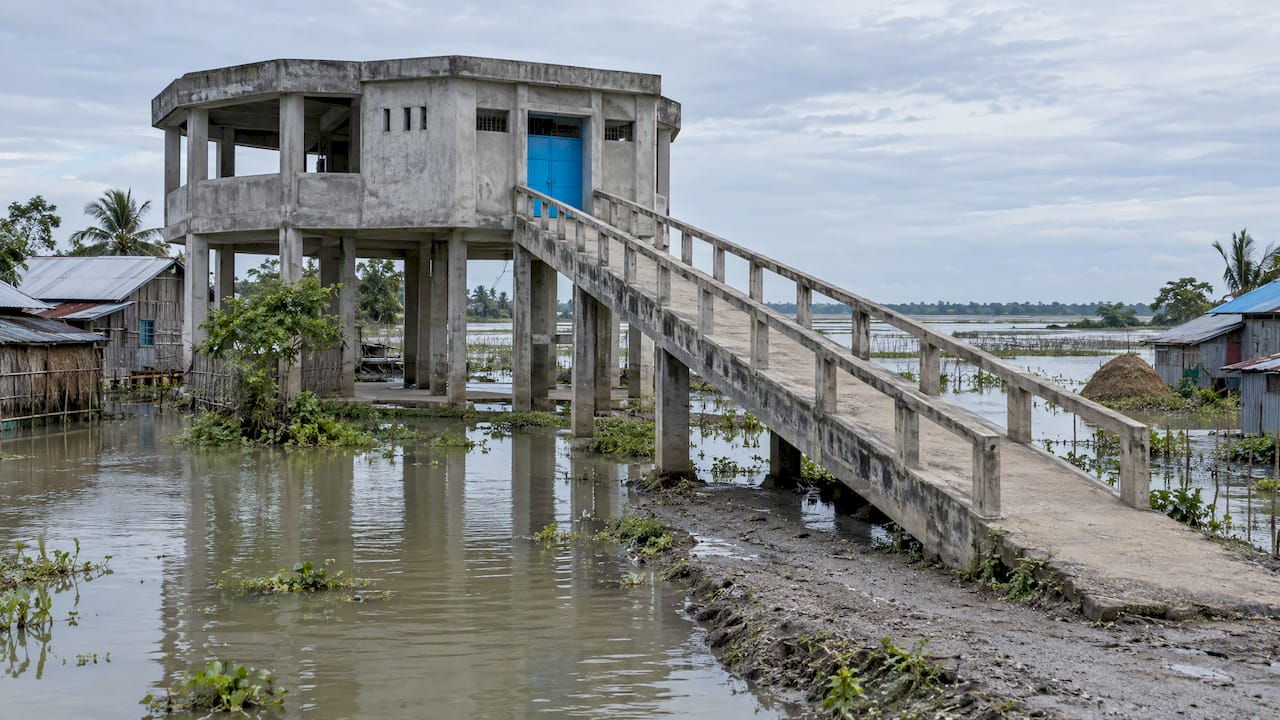
- Bangladesh, exposure and sea-level risk. Low-lying delta geography leaves the country highly exposed to coastal flooding and storm surges, and projections for Bangladesh show a marked rise in extreme heat-index days alongside continued coastal flood risk. High population density along flood-prone rivers raises sensitivity, since millions depend on agriculture vulnerable to salinity intrusion.
- Bangladesh, adaptive response. Investment in cyclone shelters, raised embankments and community-based early-warning systems has measurably reduced death tolls from major storms over recent decades. Adaptive capacity here is improving but remains uneven across rural and urban areas, which is the kind of nuance an evaluative answer should flag.
- Ghana, exposure and sensitivity. Northern Ghana faces recurring drought while southern coastal zones face flooding and erosion, and Ghana’s climate profile links these patterns to threats against food security and coastal livelihoods. Heavy reliance on rain-fed smallholder farming raises sensitivity to rainfall variability.
- Ghana, adaptive capacity and planning. National adaptation planning has become a central government response, and Ghana’s position within ND-GAIN vulnerability and readiness comparisons helps frame how institutional capacity is tracked alongside exposure. Adaptive capacity is constrained by limited rural infrastructure, even where national policy is well developed.
4. Resilience and Adaptation: Definitions and Examples
Resilience means more than bouncing back. In IB terms, it is the capacity to absorb a shock, recover function and adapt structurally so the same shock causes less harm next time, a framing consistent with IBO’s academic resilience research.
Adaptation strategies generally fall into three categories:
- Ecosystem-based adaptation: mangrove restoration along coastlines, agroforestry on vulnerable farmland.
- Engineered or structural adaptation: sea walls, raised embankments, flood-resistant housing design.
- Policy and behavioral adaptation: crop insurance schemes, early-warning communication systems, drought-resistant seed subsidies.
Pro Tip: When evaluating an adaptation strategy, always ask who it reaches, how long it lasts, and what evidence shows it reduced harm, rather than simply describing what it is.
5. Exam Practice: Command Terms, Structure and a Model Paragraph
Command terms tell you exactly how much analytical depth an answer needs, and missing that signal costs marks even when content is strong.
- “Describe” asks for a factual account, no judgement required.
- “Explain” asks for causes and mechanisms, the “why” behind a pattern.
- “Evaluate” asks for a balanced judgement weighing strengths and limitations, always with a concluding stance.
- “To what extent” asks you to argue a position using evidence on both sides before settling on a conclusion.
For medium and long answers, structure each paragraph as point, evidence, evaluation: state the claim, back it with a named case fact, then judge its significance.
A model paragraph: “Bangladesh demonstrates how exposure and adaptive capacity interact to shape outcomes. Despite severe coastal flood exposure, investment in early-warning systems and cyclone shelters has reduced storm-related deaths over recent decades. This suggests adaptive capacity can partially offset high physical exposure. However, rural areas still show weaker infrastructure coverage than cities, meaning vulnerability remains unevenly distributed within the same country. This supports the IB framing that vulnerability is socially and spatially variable, not a fixed national trait.”
6. Methods and Indicators for Measuring Climate Vulnerability
Assessing vulnerability in exam answers and real research relies on combining hazard data with social indicators, since neither alone tells the full story.
For ecosystems, common indicators include species range shifts, coral bleaching extent and changes in ecosystem productivity, each signaling sensitivity to warming or altered rainfall. For human communities, researchers combine exposure data such as flood frequency maps with sensitivity indicators like poverty rates, health access and housing quality, then layer in adaptive capacity measures such as governance effectiveness and infrastructure spending.
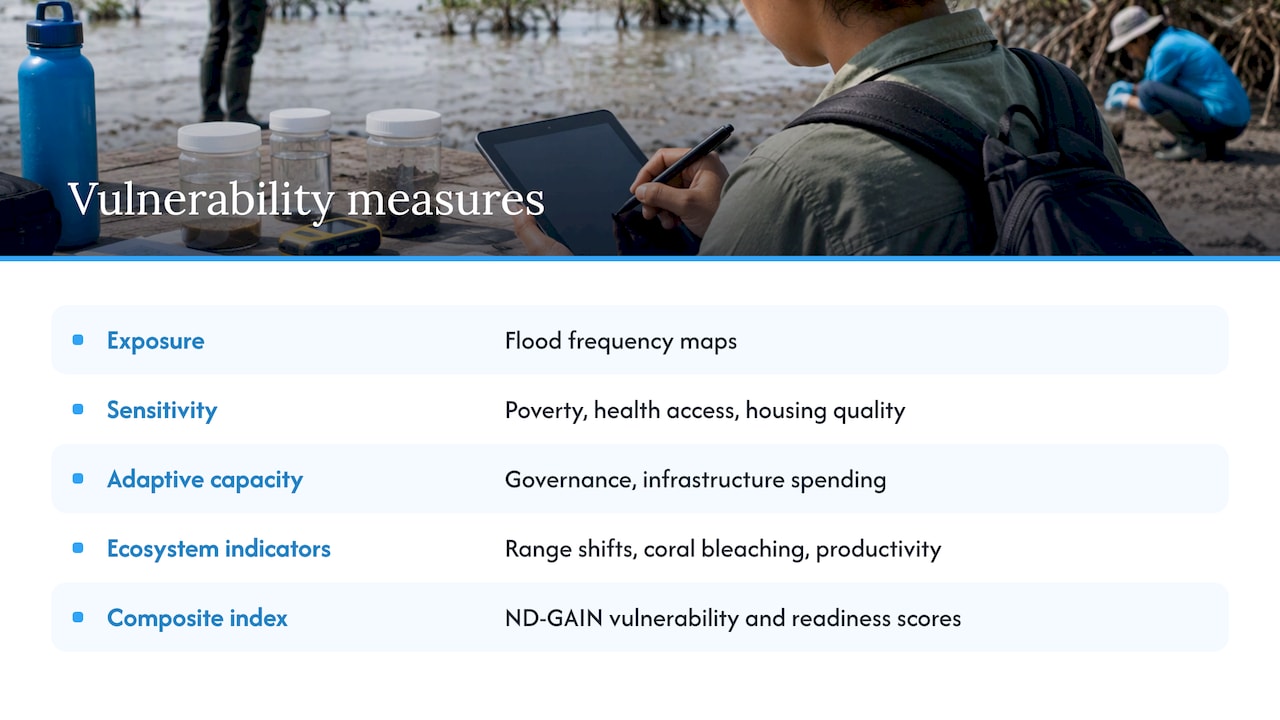
Composite indices can help compare climate vulnerability, but check which indicators they include, the period covered and how values are combined. Name the index and explain its limitations rather than treating a country ranking as a complete description of every community.
When writing an IB answer on measurement, name the index or indicator you are using, state what it measures, and briefly note a limitation, such as a composite score masking regional differences within a single country.
7. Climate Vulnerability, Sustainable Development and Global Policy
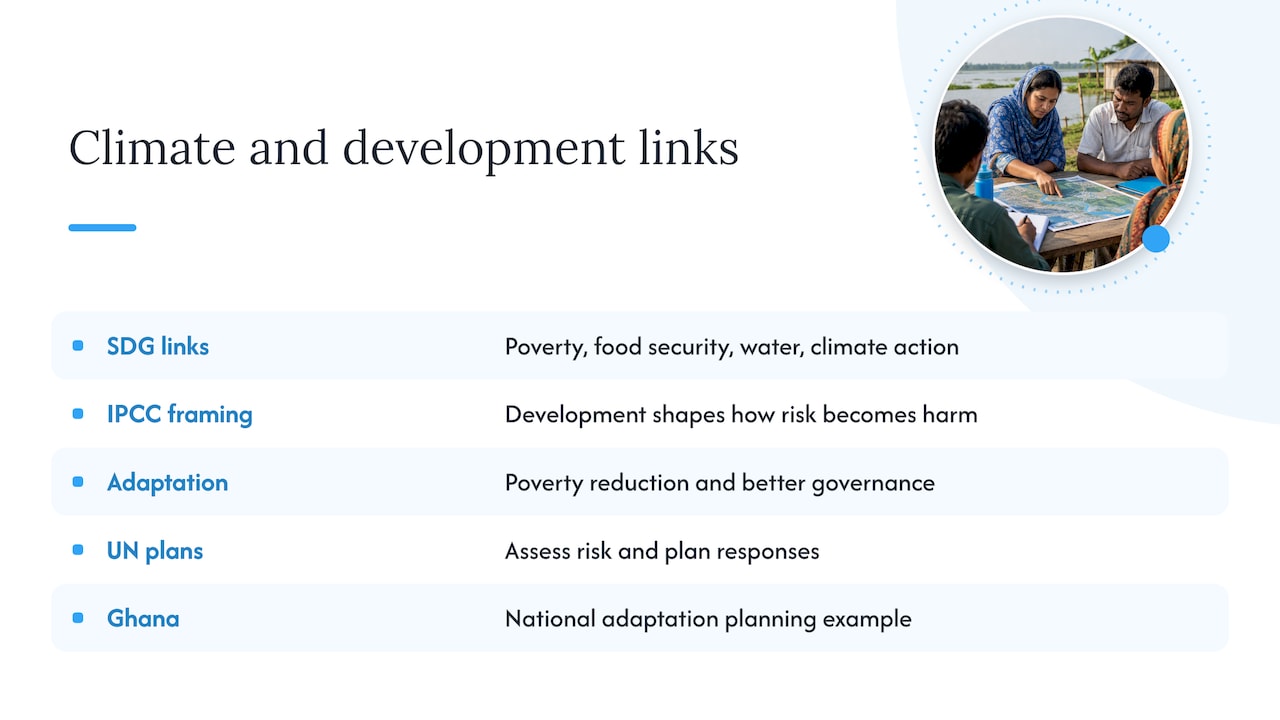
Climate vulnerability connects directly to several Sustainable Development Goals, particularly those on poverty, food security, clean water and climate action, since the communities most exposed to climate hazards are often the same ones furthest from meeting those targets.
The IPCC’s framing treats vulnerability as inseparable from development pathways: a country’s socioeconomic development level strongly influences how climate risk translates into real harm, which is why reducing poverty and improving governance count as climate adaptation in themselves, not just development side effects. This is a useful link for IB essays asking how environmental and development goals intersect.
Global policy frameworks, including national adaptation plans encouraged under the UN climate process, formalize this connection by requiring vulnerable countries to assess risk and plan responses as part of broader development strategy. Ghana’s national adaptation planning process is a direct example of this integration in practice. For an IB answer, naming the policy mechanism alongside the development goal it supports shows you understand vulnerability as a cross-cutting issue rather than a standalone environmental topic.
Common Mistakes Examiners See and What Actually Earns Marks
Three mistakes show up constantly: confusing mitigation with adaptation, offering vague claims without a named case fact, and writing evaluation that never reaches a judgement. Examiners reward precise terminology, specific sourced evidence and a clear stance. Targeted practice on exactly these gaps, rather than general revision, is where most grade improvements happen.
— Marija
How We Help You Master Climate Vulnerability for IB
We work one-on-one with IB ESS and Geography students to turn exactly this kind of topic from a vague memory of case studies into exam-ready material. Lessons with us are personalized around your syllabus gaps, whether that means building a tight Bangladesh and Ghana dossier, practicing command-term decoding under timed conditions, or getting detailed feedback on an IA or EE draft tied to vulnerability and resilience.
Marija reviews your model paragraphs line by line and shows you exactly where evaluation is missing or evidence is too generic. You can start with the Trial Plan for a 20 minute session, or book a full Basic Plan lesson to work through past paper questions on vulnerability and resilience together.
FAQ
What is the difference between vulnerability and risk in IB ESS?
Vulnerability describes how susceptible a community or system is to harm, based on exposure, sensitivity and adaptive capacity. Risk combines that vulnerability with the likelihood and magnitude of a hazard occurring, so a highly vulnerable area only becomes high risk once a hazard is actually probable.
How many people live in highly vulnerable climate contexts?
Roughly 3.3 to 3.6 billion people live in contexts classified as highly vulnerable to climate change. This figure varies by region mainly due to differences in socioeconomic development and governance rather than hazard exposure alone.
Is Bangladesh or Ghana more useful as an IB case study?
Both work well, but for different angles: Bangladesh is strongest for exposure and engineered adaptation like embankments and flood shelters, while Ghana’s profile is stronger for discussing drought, food security and national adaptation planning. Pairing them lets you contrast hazard types and policy responses in one answer.
How do I avoid confusing mitigation and adaptation in exam answers?
Mitigation reduces the causes of climate change, such as cutting emissions, while adaptation responds to its effects, such as building flood defenses. Always state which one you are discussing before giving an example, since examiners specifically check for this distinction.
Can esstutor.net help with internal assessments on climate vulnerability topics?
Yes, our IA and EE feedback service reviews drafts built around vulnerability, resilience or adaptation data and checks that your analysis meets IB assessment criteria. Pricing for IA and EE feedback is available on request through our pricing page.
Sources
- Summary for Policymakers | IPCC AR6 WGII
- Bangladesh country profile | World Bank Climate Knowledge Portal
- Ghana country profile | World Bank Climate Knowledge Portal
Request a FREE 20-minute trial lesson
Share your IB year, SL or HL level, main question, availability and time zone. Parents are welcome to enquire about their child’s ESS needs.
No Comments