


18 Sep 45–60 Minutes: Tutor Tested Tutoring Session Rules for IB Students
Most tutoring sessions run 45 to 60 minutes, with 90-minute blocks reserved for deep work like essay drafting or exam simulations. The real rule isn’t a fixed number, though: match the length to the student’s age, the subject, and the actual goal, then favor regular, spaced sessions over the occasional marathon. Online sessions tend to run shorter than in-person ones simply because screens wear attention down faster.
TL;DR:
- Shorter sessions of 30 to 45 minutes are ideal for elementary students or quick review tasks, especially when attention spans are limited.
- A 60-minute session generally balances teaching and practice for K-12 students, with longer sessions suitable for intensive exam or essay work.
- Online tutoring sessions should be capped at 60 minutes to counter screen fatigue, while in-person sessions can extend to 90 minutes based on the student’s endurance.
- Spaced practice of two shorter weekly sessions tends to improve retention more than a single long session, especially for steady learning progress.
- Trial lessons of 20 minutes are recommended to test the appropriate session length before committing to longer scheduled tutoring.
Table of Contents
- Dauer Nachhilfestunde: What 45, 60, and 90 Minutes Are Good For
- Factors That Determine the Right Length for a Student
- Turning Session Length Into a Weekly Study Plan
- Age and Subject Starter Recommendations
- Online vs In-Person: Why Format Changes the Ideal Length
- A Tutor-Tested Structure for a 60-Minute Session
- Why Flexibility Beats a Fixed Formula
- Test Your Ideal Session Length With a Trial Lesson
- Sources
- FAQ
Dauer Nachhilfestunde: What 45, 60, and 90 Minutes Are Good For
The length you pick should follow the task, not the other way around. Here’s how the three standard blocks tend to break down in practice:
- Shorter sessions often work best for younger learners and narrow, focused tasks, like reviewing a single grammar rule or checking last night’s math homework. A tutoring center like Hauslehrer reports 45 minutes as its typical single session, often stacked into double blocks for older students who need more.
- 60 minutes is the default many tutors and platforms settle on for K-12 students. It gives enough room for a quick check-in, real teaching, and guided practice without pushing past the point where focus starts to slip.
- Longer sessions, around 90 minutes, suit deeper work such as full-length practice tests, multi-step problem sets, or essay outlining. The Austrian tutoring provider LernQuadrat notes this duration can be useful for sustained work, but stresses that duration should always track the student’s goal and age rather than a blanket rule.
Providers often schedule double blocks when travel time makes a single 45-minute visit inefficient, or when a subject genuinely needs the extra runway. The tradeoff is fatigue: past the 60-minute mark, concentration starts to dip unless the session actively changes pace.
Factors That Determine the Right Length for a Student
Before locking in a duration, run through what actually shapes it for the specific learner in front of you:
- Age and attention span. Younger children hold focus for shorter stretches, so 30 to 45 minutes usually beats a full hour. Teens and adults can sustain 60 to 90 minutes if the material stays engaging.
- Subject complexity and task type. Problem-solving subjects like math or physics tolerate longer blocks because progress builds step by step. Essay drafting or IA work often needs even more room since feedback and revision take time.
- The actual learning goal. A one-off homework rescue calls for a short, targeted session. Long-term mastery, like building toward an IB final exam, benefits from consistent, moderate-length sessions repeated over months.
- Stamina and independent study habits. A student who reviews material between sessions can get more out of a shorter, sharper lesson than one who relies entirely on tutoring time to absorb everything.
- Logistics. In-person tutoring that involves travel often justifies a longer session to make the trip worthwhile. Online tutoring removes that constraint, so shorter, more frequent sessions become practical again.
Turning Session Length Into a Weekly Study Plan
A single session length means little without a frequency attached to it. Research on the spacing effect consistently favors distributing practice across time. Emergent Tutoring notes that two shorter weekly sessions typically outperform one long session for retention, because the brain consolidates information better between exposures than during one extended sitting.
Here’s how that plays out in practice:
- Short-term goal (a quiz next week): one or two 45-minute sessions can be enough.
- Steady coursework support: two 45 to 60-minute sessions per week, spaced a few days apart.
- Long-term mastery or IB-level exam prep: one 60-minute session plus one 90-minute session weekly, adjusted as the exam date approaches.
- Adjust up when homework starts piling up unaddressed or a test date is close. Adjust down once the student shows steady independent progress.
- Book sessions when energy is naturally higher. Late afternoon, right after a full school day, is rarely the best slot for anything longer than 45 minutes.
Age and Subject Starter Recommendations
Starting points make the decision easier, even though they’re not fixed rules.
- Elementary students: 30 to 45 minutes, once or twice a week.
- Middle school: 45 to 60 minutes, one to two times weekly depending on subject load.
- High school: 60 minutes as a baseline, moving to 90 minutes for exam prep or IA/EE support closer to deadlines.
- Adult learners: 60 to 90 minutes, often less frequent but more intensive.
- STEM subjects tend to work well in tighter, more frequent blocks built around practice problems. Essay-heavy or language subjects often need the longer 90-minute format so drafting and feedback don’t get rushed.
If a task clearly needs more than 90 minutes of focused work, split it into two separate sessions instead of stretching one lesson past the point of usefulness. After two to four sessions at a chosen length, check progress: steady improvement and manageable homework mean the length is working; consistent overrun or restlessness means it’s time to adjust.
Online vs In-Person: Why Format Changes the Ideal Length
Screen fatigue is real, and it shortens the effective length of an online session compared to one in a living room or library. Attention research summarized by Presto Lees CITT points to peak productive concentration around 45 to 60 minutes for complex tasks, with even shorter windows for young children, and that ceiling arrives faster on a video call than face-to-face.
- Cap most online sessions at 60 minutes unless the plan includes built-in variety.
- In-person sessions can reasonably stretch to 90 minutes since there’s no travel overhead to repeat twice a week.
- For anything past 60 minutes, break the block into segments: explanation, then practice, then a timed exercise, so the brain resets instead of coasting.
- A 30-minute online slot works well for quick, targeted help, like reviewing one confusing concept before a test.
Pro Tip: If a student starts staring past the screen around the 40-minute mark, that’s the moment to switch activities, not push through. A short change of pace resets focus faster than a break does.
A Tutor-Tested Structure for a 60-Minute Session
A well-built 60-minute session usually follows a rhythm: a quick diagnostic check for 5 to 10 minutes, 20 minutes of targeted teaching, 20 minutes of guided practice, then 5 to 10 minutes to recap and set homework. For IA or extended essay work, that balance shifts, with more time given to drafting and feedback and less to timed practice. Exam-focused sessions flip the other way, weighting the block toward timed questions under real test conditions, an approach reflected in how Esstutor structures IB ESS sessions.
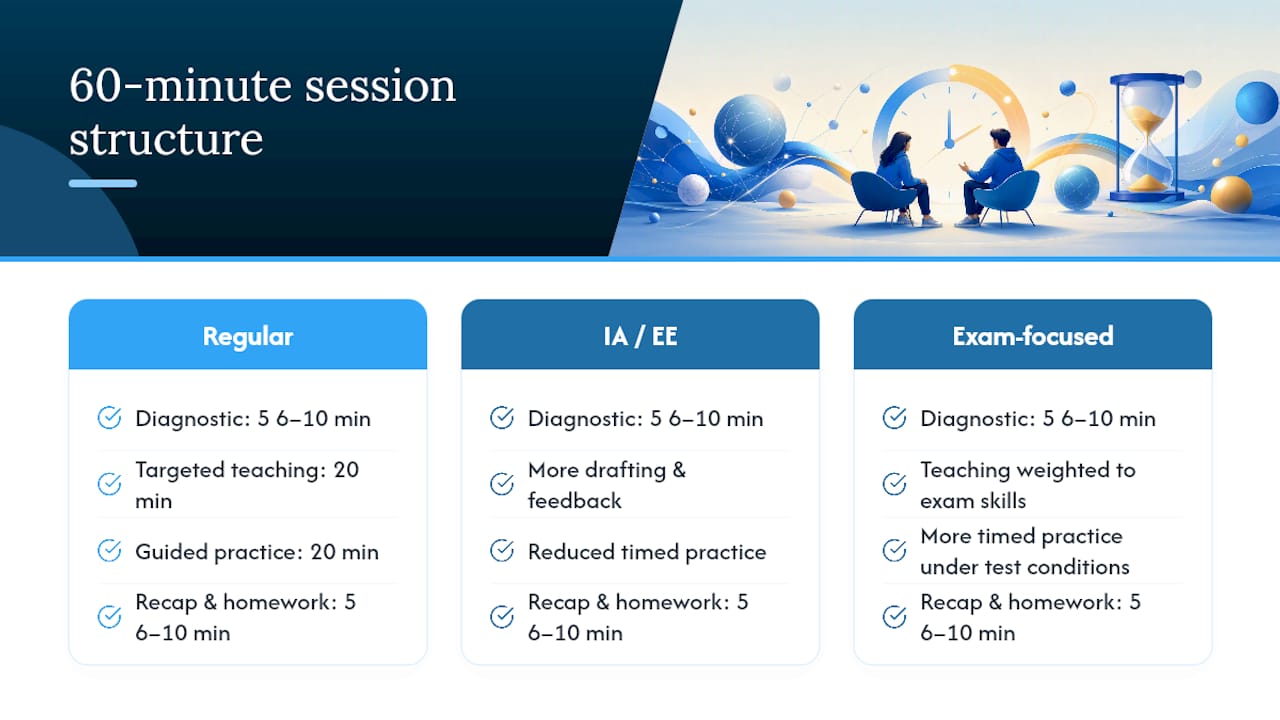
Signs the length is working: steady progress between sessions, homework that feels manageable rather than overwhelming, and a student who stays engaged through the full block instead of fading halfway through.
Why Flexibility Beats a Fixed Formula
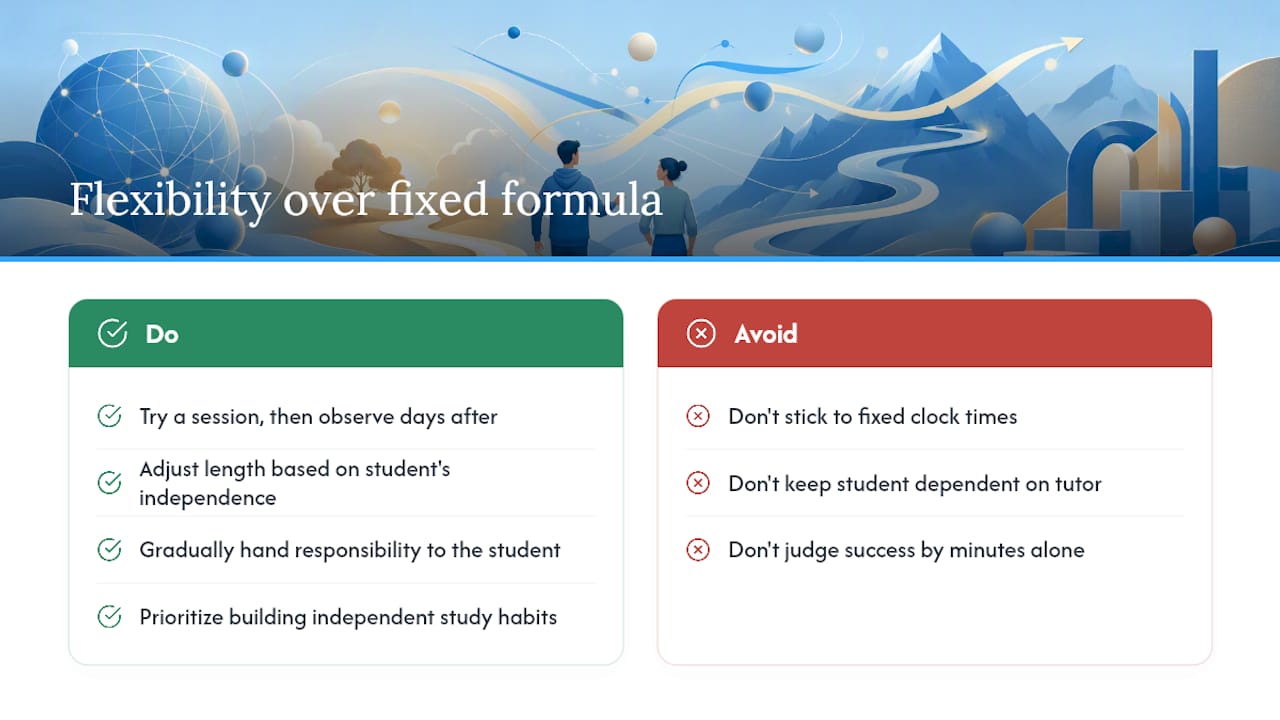
Rigid rules about session length rarely survive contact with an actual student. One IB student might thrive on two crisp 45-minute sessions a week; another preparing an extended essay might need a full 90 minutes just to get through a single round of feedback without feeling rushed. The number matters less than whether the student leaves each session able to work on their own until the next one.
The best sign a length is right isn’t the clock. It’s whether the student needs the tutor less over time, not more. A structure that slowly hands over responsibility, rather than one that keeps a student dependent on the next scheduled hour, is doing its job. Building that kind of independent study habit alongside tutoring, the same principle behind autonomous learning strategies for language study, tends to matter more long term than the exact minute count on any given week. Try a session, watch how the student handles the days after it, and adjust from there.
— Marija
Test Your Ideal Session Length With a Trial Lesson
The fastest way to find the right length isn’t guessing. It’s testing one. Esstutor’s Trial Plan runs 34€ for a 20-minute lesson, giving you a low-cost way to see how a student responds to focused, one-on-one time before committing to a longer schedule.
From there, the Basic Plan offers a full 60-minute session at 120€, suited to steady exam prep or subject review once you know the rhythm that works. Students working on IA or extended essay drafts often need that longer, feedback-heavy format described earlier, and Esstutor’s IA and EE support is built around exactly that kind of session. The tutoring is delivered by a certified IB examiner and experienced teacher with many years of teaching ESS and Geography; sessions are shaped around what actually improves scoring, rather than a generic template. Check current pricing and book a trial to see which length fits before committing to a full package.
Sources
- Wie lange sollte Nachhilfe dauern?
- How Long Should a Tutoring Session Last? The Ideal Duration by Age and Subject
FAQ
How long is a typical tutoring session?
Most tutoring sessions run 45 to 60 minutes, with 90-minute blocks used for exam prep, essay drafting, or other deep, sustained work.
How long is a school class period in Austria?
A standard class period in Austrian schools typically lasts around the length of common tutoring session blocks, though this varies slightly by school type and is separate from private tutoring session lengths, which providers set independently.
Is it legal to offer private tutoring as self-employment in Austria?
Yes, tutoring can be offered as a freelance or self-employed activity in Austria, though specific registration and tax obligations depend on income level and structure, so checking current requirements with Austria’s tax authority or a local business advisor is worthwhile before starting.
What’s the best session length for IB exam prep versus long-term mastery?
Short-term exam prep benefits from 90-minute sessions with timed practice questions closer to the test date, while long-term mastery works better with consistent 60-minute sessions spread across the week. Esstutor structures both formats differently depending on whether a student needs exam simulation or steady subject-building support.
How much does a tutoring session with Esstutor cost?
Esstutor’s Trial Plan is 34€ for a 20-minute session, and the Basic Plan is 120€ for a 60-minute session, with full pricing details available on the pricing page.
No Comments