


25 Aug ESS Extended Essay Timeline: Plan Around School Deadlines
An ESS Extended Essay timeline should start from your school’s deadlines, your assessment session and the work still needed. Coordinate research and writing with ESS revision and IA tasks, but keep their requirements distinct. The example schedules below are planning options, not promises that an unfinished investigation can be completed safely in a fixed number of weeks.
Here’s what to do in the next 24 to 48 hours:
- Block your study sessions into your calendar now, before the week gets away from you.
- Email your EE or IA supervisor to lock in your first check-in.
- If you’re unsure where you stand, book a trial tutoring session to get a second set of eyes on your plan.
Marija Maletz has 13 years of teaching experience and more than 10 years as an IB ESS examiner. A written plan can make priorities visible, but it should be adjusted to the student’s evidence, progress and school guidance rather than treated as a predictor of grades.
Key Takeaways
Plan separate time for the EE, IA and exam preparation. The EE is an independent research project with a maximum 4,000-word essay; its criteria and reflection arrangements depend on the assessment session. A redesigned EE is first assessed in May 2027, so confirm the applicable guide with your coordinator.
| Point | Details |
|---|---|
| Pick a timeline that fits your weeks | Choose compressed (6 to 8 weeks), standard (10 to 14 weeks), or extended (20+ weeks) based on time left, not ambition. |
| Budget EE hours by phase | Spread the recommended 40 EE hours across topic refinement, data collection, and drafting rather than one big push. |
| Protect supervisor meetings | Agree meetings with your school, prepare focused questions and bring relevant evidence. Follow the permitted draft-feedback arrangements. |
| Use short deep-work blocks | Run 60 to 120 minute focused sessions with brief daily reviews instead of long unfocused study marathons. |
| Get a personalized plan built | A FREE 20-minute trial discusses needs and a starting point. A full personalised schedule is not promised within the introduction. |
Table of Contents
- Which ESS EE Zeitplan Fits Your Timeline?
- How Do You Line Up EE Deadlines With ESS Revision?
- What Does an ESS Internal Assessment Timeline Look Like?
- What Should a Weekly ESS Study Planner Look Like?
- Use Your Plan to Guide ESS and EE Work
- Get a Personalized ESS Timeline Built Around Your Deadlines
- Sources
Which ESS EE Zeitplan Fits Your Timeline?
Not every student has the same runway before exams, so the right ESS and EE coordination plan depends entirely on how many weeks you actually have left. Pick the option that matches your calendar, not the one that sounds most thorough.
Short lead time: List unfinished tasks and confirm what is feasible with your supervisor. Prioritise essential research, analysis and school deadlines. A six- to eight-week calendar is only an example, not assurance that a new EE can be completed in that time. Do not omit syllabus topics merely because they appeared rarely in previous exams.
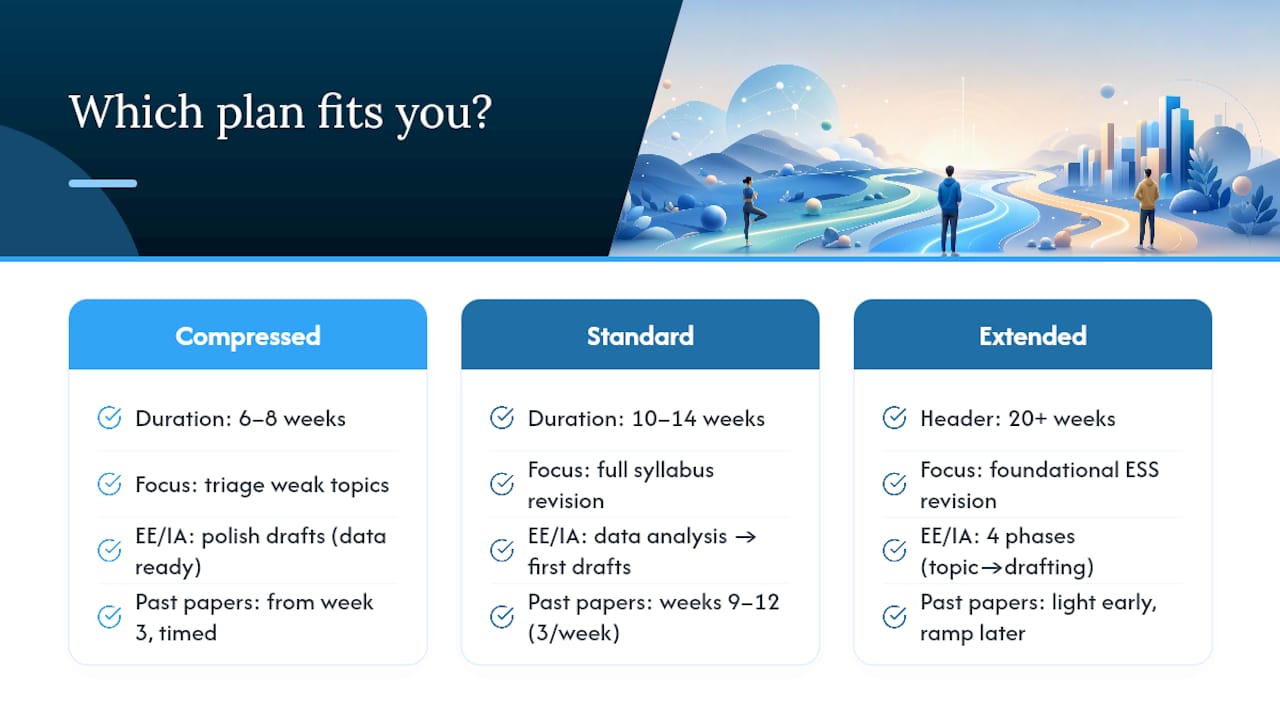
Medium lead time: Work backwards from submission and feedback dates. Allow separate time for checking sources, collecting or selecting evidence, analysis, drafting and revision. Fit exam practice around those commitments rather than requiring three full papers every week.
Longer lead time: Use early weeks to refine the question, check feasibility and obtain approval. Stage the research, analysis and writing with room for setbacks. There is no universal weekly hour target; agree a manageable workload alongside other subjects and rest.
Pro Tip: Whichever plan you choose, write your checkpoint dates on a physical or digital calendar you check daily. A plan that lives only in your head gets quietly abandoned by week three.
How Do You Line Up EE Deadlines With ESS Revision?
The biggest scheduling mistake ESS students make is letting EE data collection collide with the weeks they should be revising for Paper 1 and Paper 2. Coordinating the two means mapping your EE’s phases onto your revision calendar instead of treating them as two separate to-do lists.
The IB describes the EE as approximately 40 hours of student work. Use this as a broad planning reference, not a guaranteed completion time. Divide work among question development, research, analysis, drafting and review, using the guide for your assessment session.
By the numbers: Plan for about 40 hours total on your Extended Essay, distributed across five phases, with each phase getting a proportional share of your weekly study hours rather than one marathon session.
A few coordination rules that actually hold up under exam pressure:
- Where feasible, avoid clustering major research tasks with mocks. Seasonal fieldwork or other constraints may make overlap necessary; discuss the trade-off and allow contingency time.
- Protect supervisor meetings on your calendar the same way you’d protect a test date. They get moved for almost nothing.
- Agree supervisor meetings and reflection checkpoints according to your school’s process and assessment-session requirements. A meeting before every holiday is not a universal IB rule.
- Use small deadlines for concrete tasks, such as checking a source, completing a pilot or interpreting one result. Keep the EE plan tied to your own research; a particle-accelerator construction schedule is not ESS assessment guidance.
What Does an ESS Internal Assessment Timeline Look Like?
Your IA runs on a shorter clock than your EE, but it follows the same logic: small deadlines beat one big deadline. Here’s a checkpoint sequence that works for most ESS students:
- Proposal and pilot study (week 1 to 2): confirm your research question and run a small-scale test of your method.
- Main data collection (week 3 to 5): gather your full data set, adjusting method notes as issues come up.
- Analysis (week 5 to 6): process data, build tables and graphs, and identify patterns worth discussing.
- First full draft (week 7 to 8): write a complete draft, even a rough one, for supervisor review.
- Supervisor feedback and revision (week 9): incorporate comments and tighten weak sections.
- Final submission (week 10): proofread, format, and submit.
Prepare focused questions and relevant evidence for supervisor meetings. Check what feedback is permitted at each stage; do not assume repeated comments on draft extracts or multiple full drafts are available.
Pro Tip: Book your supervisor meetings around school holidays and exam weeks, not after them. Teachers get harder to reach once report cards and staff meetings pile up, so lock in dates early rather than hoping a slot opens later.
For a full IA planning walkthrough, ESS IA planning resources can help you build out your evidence log and criteria checklist.
What Should a Weekly ESS Study Planner Look Like?
A schedule only works if it survives contact with a real week. Two sample weeks show how the hours actually split.
| Day | Exam-focused week | IA/EE-focused week |
|---|---|---|
| Monday | 60 min ESS topic review | 2 hr IA data analysis |
| Tuesday | 60 min past paper (timed) | 60 min EE draft writing |
| Wednesday | 60 min ESS topic review | 60 min supervisor prep |
| Thursday | 60 min past paper (timed) | 2 hr IA writing |
| Friday | 10 min flashcard review | 60 min EE reading/sources |
| Saturday | 2 hr full past paper + review | 2 hr EE or IA catch-up |
| Sunday | Rest or light review | Rest or light review |
Choose work blocks you can sustain, with breaks and room for other subjects. The sample durations are examples, not evidence that one block length maintains everyone’s attention better.
When commitments change, choose the next task from actual deadlines and learning needs. A full past paper is not always more urgent than an essential research task or rest. Adjust the example week rather than protecting one slot at all costs.
Use Your Plan to Guide ESS and EE Work
Most students think the schedule itself is the hard part. It isn’t. The habits you run inside that schedule decide whether it turns into a higher score or just a busy calendar.
Plan time to draft, review and revise your own work. Follow the school’s supervisor meeting and feedback arrangements. Use feedback to identify concrete next steps rather than assuming a fixed number of revisions guarantees a higher score.

Keep a short, dated log of your decisions: what you tried, why you changed method, what your supervisor said. This single habit does more for your reflection sections than any amount of extra reading, because it gives you specific, dated evidence to draw on instead of vague memory.
Ask for help while there is still time to act on it. A teacher or supervisor can confirm research and assessment requirements; a tutor can help you understand concepts and planning choices within the permitted scope. No particular week guarantees that advice will be most effective.
— Marija
Get a Personalized ESS Timeline Built Around Your Deadlines
A template is a starting point. The free 20-minute trial can help identify your main ESS needs and discuss an appropriate next step; it does not include a promised complete week-by-week plan.
The free trial lasts 20 minutes and is an introduction to discuss your ESS needs and a starting point for support. Bring your main concern and relevant deadlines. A complete personalised timeline, IA checklist and detailed review are not promised within this short introduction. Request a FREE 20-minute trial lesson.
Before a trial, note your level, assessment session, relevant deadlines and main difficulty. Request the introduction through the ESS enquiry form. Bring only material needed for that discussion; a detailed draft review belongs to separately agreed support.
Sources
- IB DP EE Planning: A Calm, Powerful Week-by-Week Roadmap for DP1 and DP2 – Sparkl
- IBDP Extended Essay Timeline – Sessions & Deadlines for Students
- IB Extended Essay curriculum update: first assessment May 2027
No Comments