

11 Aug Choosing an ESS IA Topic: Questions, Data and Feasibility
Choose an environmental issue, a focused question and evidence you can realistically obtain and analyse. A local field site can be useful, but it is not compulsory; suitable secondary data may also support an investigation. Consider feasibility, safety and the relevant strategy discussion.
The examples below are planning ideas. Check available data, site conditions, safety and school approval before choosing one. A named local site can help focus fieldwork, but a suitable secondary-data investigation need not be local.
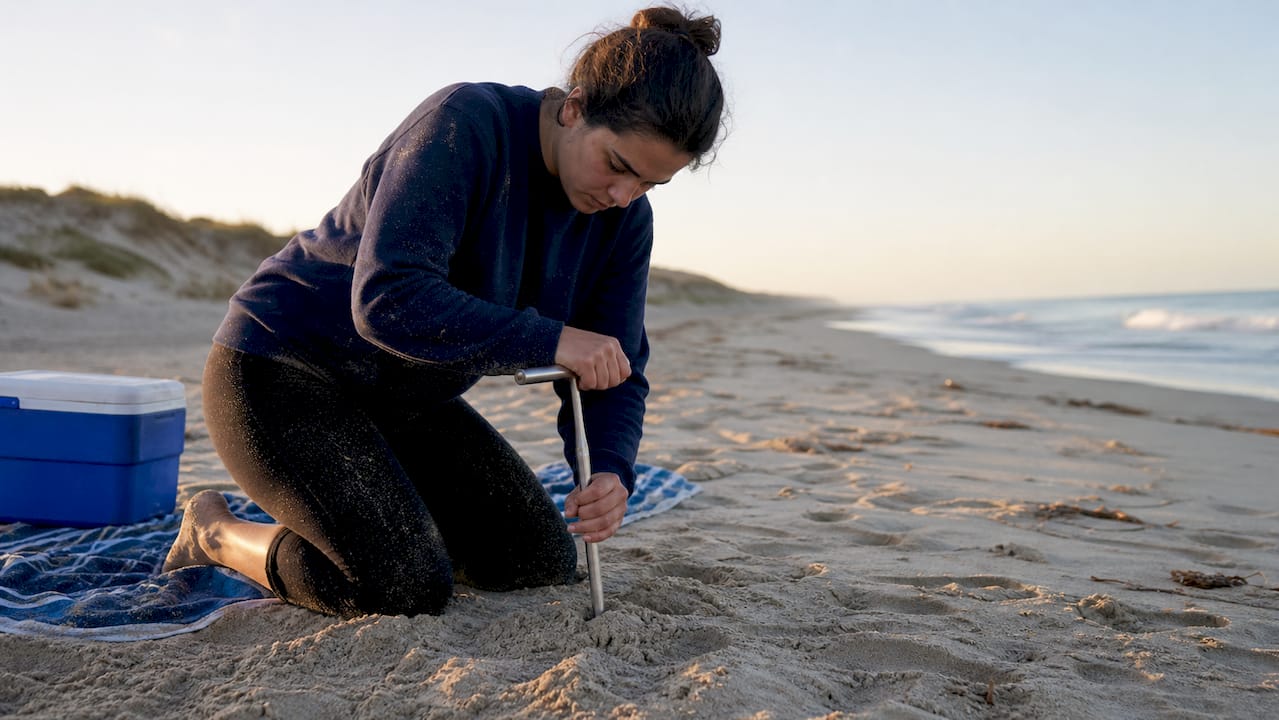
- Fieldwork idea: Investigate the relationship between distance from a road and vegetation species richness using a justified sampling design. Do not assume roadside access is safe; obtain teacher approval and check traffic, site rules and relevant permissions.
- Secondary-data idea: Compare impervious-surface coverage in a defined area using suitable satellite-derived data. Check actual coverage, dates, resolution, classification and reuse terms. A dataset’s existence does not guarantee it covers any city or requested year.
Why either choice earns full IA potential:
- Specific location named, so Criterion A (introduction) is grounded immediately
- Measurable variables, so Criteria C and D (method and data) are achievable
- A named strategy with competing perspectives, so Criterion B (strategy and tensions) can be addressed directly
- Feasible within a U.S. school schedule and safe to execute
Key Takeaways
Choosing a focused, local ESS topic with measurable variables and a named strategy is the single most reliable path to a high-scoring IB IA.
| Point | Details |
|---|---|
| Keep the scope local and tight | Choose a focused question and evidence suitable for its scale; local fieldwork and secondary-data investigations can both be appropriate. |
| Meet the tensions requirement | Criterion B requires you to name competing perspectives for your strategy, not just describe it. |
| Pilot before full collection | A 20-minute mini-pilot reveals method problems before they cost you hours of wasted fieldwork. |
| Prioritize D, E, and F | These three criteria carry 18 of 30 marks; invest most of your effort in data quality and analysis. |
| Esstutor IA support | One-on-one tutoring with an IB examiner helps you refine your RQ and method before data collection begins. |
Table of Contents
- What IB ESS IA constraints must you meet?
- Is your case study idea actually doable? A quick checklist
- How do you narrow a broad interest into a focused research question?
- U.S.-relevant ESS case study ideas with sample research questions
- How do you design methods and analysis that satisfy IB criteria?
- Common IA pitfalls and how to fix them fast
- How does your investigation map to IB ESS IA criteria A–F?
- Practical tips from an experienced IB examiner
- What choosing a good ESS topic really comes down to
- Esstutor supports your IA from first idea to final draft
- Sources
What IB ESS IA constraints must you meet?
For the course first assessed in 2026, the individual report has a 3,000-word maximum. Small-group collaboration may be permitted, but each student must meet the requirements for a distinct investigation, evidence and independent analysis and report. Agree the proposed arrangement with your teacher; do not merely change a shared table to make it look different.
The updated IA adds an explicit requirement to explore tensions between perspectives (economic, social, political, and environmental) when describing a management strategy in Criterion B. This is new and examiners are looking for it. A student who describes a strategy without naming who benefits and who bears the cost will lose marks in that criterion.
Weighting: The ESS IA counts for 25% of the SL grade and 20% of the HL grade, so a well-executed investigation can meaningfully lift your final score.
Check feasibility, safety, ethics, access and the school’s investigation schedule. A formal university-style IRB process is not a universal requirement for every school IA. Human-participant work needs the school’s appropriate approval and consent arrangements; avoid unnecessary sensitive information.
Is your case study idea actually doable? A quick checklist
Run every topic idea through these six checks before you invest time in it. If two or more answers are “no,” narrow the scope or switch topics.
- Specific location named? “A local park” is not enough. “Riverside Park, Austin, TX” is.
- Measurable independent and dependent variables? You need one thing you change or compare (IV) and one thing you measure (DV).
- Primary data available, or downloadable raw secondary data? Can you physically collect it, or access a public dataset (USGS, EPA, NOAA)?
- Safety and permissions manageable? School grounds and public parks are usually straightforward. Private land needs written permission.
- No overlap with your EE or another IA? Student guidance explicitly warns against double-dipping class practicals or reusing Extended Essay research.
- Fits within 3,000 words? A topic with five sub-questions will not.
Before a pilot or full collection, follow the school’s risk, consent and permission procedures. Requirements depend on the site, activity, participant group and jurisdiction; do not assume one automatic rule covers all public land or all surveys.
How do you narrow a broad interest into a focused research question?
Follow this four-step process:
- Start from location or issue. List 2–3 places you can reach within 30 minutes (school grounds, a nearby stream, a local park) or 2–3 environmental issues you care about (air quality, soil compaction, water clarity). These become your shortlist.
- Define your variables. For each shortlisted idea, write one sentence naming the IV and DV. If you cannot do this in one sentence, the topic is still too broad.
- Draft a research question using this template: “How does [IV] affect [DV] in [specific location] over [timeframe]?” For example: “How does soil compaction level affect earthworm density in the athletic fields of Lincoln High School, measured in May 2026?”
- Run a mini-pilot. Spend 20 minutes collecting a tiny sample (3–5 data points) before committing. A pilot reveals whether your equipment works, whether the effect is detectable, and whether the site is accessible. Piloting a small dataset early prevents the most common collection errors and saves hours later.
Simple, well-executed local investigations consistently score better than ambitious projects with weak data. Keep the scope tight.
U.S.-relevant ESS case study ideas with sample research questions
These eight ideas work in typical U.S. school settings. Browse the full IA ideas list for more options with equipment notes.
| Planning idea | Evidence to consider | Check before committing |
|---|---|---|
| Vegetation and path or road distance | Consistent quadrat observations at independently selected locations | Safe access, site permissions and confounding habitat factors |
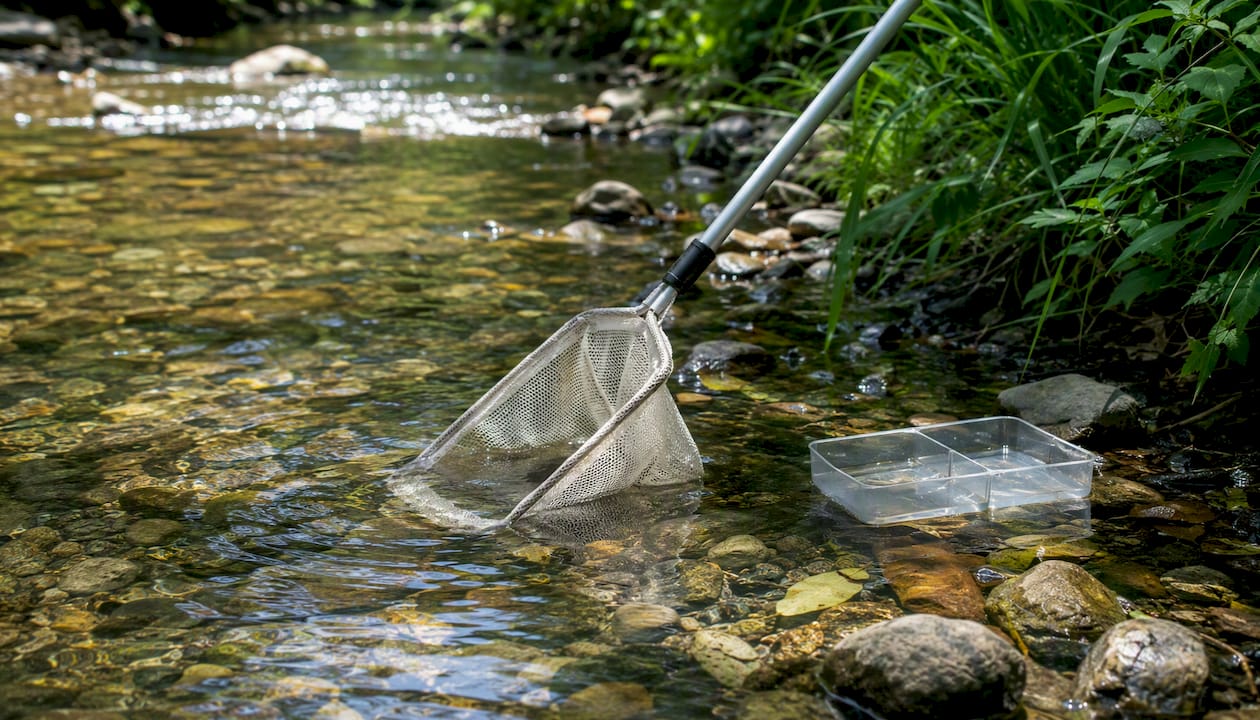
| Local water conditions | School-approved measurements or existing monitoring data | Water safety, sampling permissions, comparable methods and time coverage |
| Urban land cover | Suitable satellite-derived observations for a defined area and period | Actual dataset coverage, classifications, spatial resolution and licence |
| School waste management | Non-identifying, safely collected waste or activity records | School approval, safe handling, valid denominators and privacy |
Secondary data topics (rows 5 and 6) are especially strong for the tensions requirement: urban development versus stormwater management, or economic growth versus ecological corridor preservation, both generate clear multi-perspective conflict.
How do you design methods and analysis that satisfy IB criteria?
Your method section needs to be repeatable by someone who has never visited your site. That means naming every piece of equipment, stating sample sizes, and describing exactly how you randomized or systematically placed your sampling units.
Sampling choices at a glance:
- Random sampling suits species diversity studies where you want to avoid bias in quadrat placement.
- Systematic sampling (e.g., every 2 m along a transect) suits gradient studies like roadside distance or stream distance.
- Stratified sampling suits studies where the site has distinct zones (shaded vs. sunny, compacted vs. uncompacted).
Choose descriptive or inferential analysis from the question, variable types and sampling units. No Mann–Whitney or Spearman test is automatically suitable for most fieldwork, and no fitted line or mean bar chart is compulsory. Use methods you can justify and explain.
Pro Tip: Run your pilot with just three quadrats or five data points. If you cannot calculate a mean and draw a rough graph from that tiny set, your method or variables need adjusting before full collection.
Common IA pitfalls and how to fix them fast
Avoid these before you invest hours in data collection:
- Vague RQ (“How does pollution affect biodiversity?”) — Fix: add a specific pollutant, a specific organism group, and a named location.
- Sensitive human data: Check subject suitability, ethics and access with the teacher before using health or identifiable participant information. A topic should not be automatically assigned to another subject solely because it mentions health.
- Scope: Specify the relevant context, population or dataset. A field-site name is useful for local work but is not compulsory for every secondary-data question.
- Sampling: Plan adequate independent units and distinguish these from repeat readings. Five or ten replicates is not a universal minimum that makes every statistical test valid.
- Class practical recycled as IA — Fix: your IA must be your own independent investigation, not a repeat of a teacher-led practical.
- Strategy section with no tensions — Fix: for every management strategy you describe, ask “who gains?” and “who bears the cost?” and write one sentence for each perspective.
Timeline milestones to keep you on track: finalize your RQ by week 2, complete your pilot by week 4, collect full data by week 7, complete analysis by week 9, and submit a draft for teacher feedback by week 11.
How does your investigation map to IB ESS IA criteria A–F?
| Current ESS IA criterion | Focus |
|---|---|
| A: Research question and inquiry | Focused question and relevant environmental context |
| B: Strategy | Relevant strategy and tensions between perspectives |
| C: Method | Reproducible, suitable evidence collection or selection |
| D: Treatment of data | Appropriate processing and presentation |
| E: Analysis and conclusion | Interpretation and a supported answer with uncertainty considered |
| F: Evaluation | Specific methodological limitations, improvements and unresolved questions |
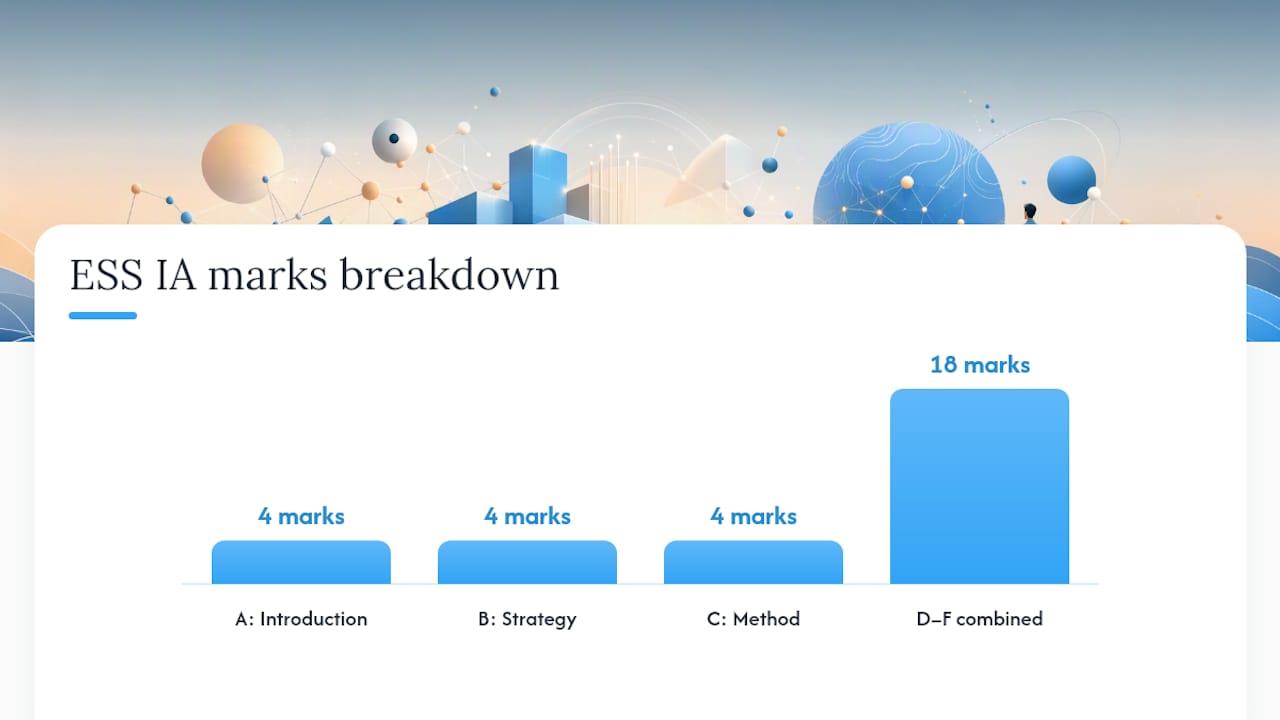
Criteria D, E, and F carry 18 of the 30 available marks. Spend the most preparation time on data quality and analysis depth. The ESS assessment criteria guide explains what unique data collection means when you share a methodology with classmates.
Practical tips from an experienced IB examiner
After reviewing hundreds of ESS IAs, these patterns separate strong submissions from average ones:
- Criterion B: Students who name a real, local strategy (a city stormwater ordinance, a school composting program, a county wetland restoration plan) and then articulate who benefits and who bears the cost score consistently higher than those who describe a generic global strategy.
- Criterion D: Raw data tables with clearly stated units and instrument uncertainty (e.g., ±0.1 cm for a ruler) signal to examiners that you understand measurement, not just data recording.
- Criterion E: A graph with labeled axes, units, and a caption earns more credit than a paragraph of numbers. One well-chosen statistical test, correctly interpreted, is worth more than three tests applied without explanation.
Early feedback can identify a planning issue, but does not guarantee that data collection will not need revision. Check feasibility and school approval before committing, and keep the investigation and writing your own.
What choosing a good ESS topic really comes down to
Most students spend too long searching for an impressive topic and not enough time testing whether their chosen topic is actually workable. The students whose IAs score well are not the ones with the most ambitious questions. They are the ones who picked something local, kept the variables tight, ran a pilot, and gave themselves enough time to analyze carefully.
The tensions requirement in Criterion B is the part students most often underestimate. A strategy section that only describes what a policy does, without naming who it disadvantages or what competing values it overrides, will not earn full marks. Build that thinking into your topic selection from the start, not as an afterthought when you are writing up.
Esstutor supports your IA from first idea to final draft
Marija Maletz has 13 years of teaching experience and more than 10 years as an IB ESS examiner. Tutoring can help you understand planning choices, while the school approves the investigation and your assessed research, analysis and writing remain your own.
Early discussion can reveal a feasibility issue, but it cannot guarantee clean data or prevent every mistake. A FREE 20-minute trial lesson is available to discuss your needs and a suitable starting point.
Book a trial IA tutoring session and get your research question reviewed by an IB examiner before you collect a single data point.
No Comments