


03 Oct Examiner Backed ESS IA Examples From a Tutor With 13 Years’ Experience
This page gives you ready-to-adapt ESS IA examples, a rubric breakdown, and a full worked walkthrough so you can see exactly what a high-scoring investigation looks like. Every example here is paired with examiner-aligned guidance, but IA requirements shift, so always check the latest Environmental systems and societies updates with your teacher before you commit to a topic. This guide is designed to help you plan, not to replace that check.
TL;DR:
- A good ESS IA must have a feasible research question that is local, measurable, and directly related to a syllabus concept, not too broad.
- Clear, detailed methodology including sample size, control variables, and replicates is essential to allow others to repeat the investigation accurately.
- Data must be processed correctly, presented clearly, and directly linked to the research question, with an evaluation that discusses multiple stakeholder perspectives and limitations honestly.
- Including an uncertainty discussion and naming specific stakeholders in the evaluation significantly enhances the quality and marks of the investigation.
- Prioritizing questions you can realistically execute with your available time and equipment yields a stronger, more credible IA than pursuing overly ambitious topics.
Table of Contents
- ESS IA examples you can adapt for your own investigation
- What examiners actually look for in your IA
- A worked exemplar walkthrough you can learn from
- Fieldwork and data collection methods that actually work
- Choosing a topic and sharpening your research question
- Using public exemplars without crossing into misconduct
- Pitfalls that cost marks, and a quick pre-submission checklist
- An examiner’s view on what separates a good IA from a great one
- Why curated examples still need a second opinion
- Get feedback on your IA before you submit it
- Where to check the rules and find reliable data
- Sources
- FAQ
ESS IA examples you can adapt for your own investigation
Good ESS IA topics are local, measurable, and tied to a syllabus concept you actually understand. Here are examples that fit those criteria, each with the method type, variables, and a quick tip on what made it work.
- Riverbank vegetation and erosion: A field transect study comparing plant cover density (quantitative) against bank erosion rate at three sites. Tip: check for landowner permission before you set foot on private riverside land.
- Noise pollution near traffic intersections: A survey using a sound-level meter at increasing distances from a road (quantitative). Tip: take readings at the same time of day to control for traffic flow.
- Microplastics in local sediment samples: A lab-based sieving and counting method comparing two beach or riverbank sites (quantitative). Tip: a simple density-separation step improves accuracy.
- Species diversity in managed versus unmanaged green spaces: A quadrat survey comparing a mown park area with an unmanaged lot (quantitative and qualitative). Tip: use a recognized diversity index so your analysis has a defensible structure.
- Public attitudes toward composting: A structured questionnaire measuring willingness to compost against demographic variables (qualitative, coded for analysis). Tip: pilot the questionnaire on five people first to catch confusing wording.
- Soil pH and plant growth near an agricultural runoff source: A field and lab combination testing pH and ground cover at increasing distance from the source (quantitative). Tip: test equipment calibration is essential here.
- Urban heat island effect across a small city transect: Temperature readings at set intervals using handheld thermometers or data loggers (quantitative). Tip: readings need to be simultaneous or very close in time to be comparable.
- Water quality in a local stream using biotic index scoring: A kick-sample survey identifying indicator species (quantitative and qualitative). Tip: this method needs a reliable identification key and practice before data collection day.
- Packaging waste audit in a school cafeteria: A waste-sorting and weighing study tracking biodegradable versus non-biodegradable plastics over one week (quantitative). Tip: feasible with minimal equipment, which makes it a strong backup topic.
Each of these appears in more detail, with full write-ups, in Esstutor’s environmental systems and societies internal assessment examples collection and in the additional in-house exemplars. Before choosing any of these, run a quick feasibility check: can you actually access the site, get the equipment, and finish data collection with the time you have left this term?
What examiners actually look for in your IA
Examiners mark against a fixed set of assessment criteria, and students lose the most marks not from bad ideas but from write-ups that never show the thinking behind them. Here is how the sections map to what gets credit.
- Focus and context: A research question that is specific, localized, and clearly linked to an ESS syllabus topic, not a restated textbook definition.
- Methodology: A method detailed enough that another student could repeat it, including sample size, replication, and control of variables.
- Results, analysis, and conclusion: Data that is processed correctly, presented clearly, and tied back to the original question, with a conclusion that does not overreach what the data shows.
- Discussion and evaluation: A critical look at limitations, including measurement uncertainty, and increasingly, an examination of how different stakeholders view the issue.
That last point matters more than many students realize. The current subject updates require students to explore tensions between perspectives when proposing or evaluating strategies, which means a strong evaluation names the stakeholders affected by your findings and shows where their interests conflict, not just whether a policy “works.”
The ESS subject guide sets a word limit for the internal assessment, generally recommending not to exceed a few thousand words, and examiners read against that ceiling expecting every section to earn its place rather than pad the count.
A worked exemplar walkthrough you can learn from
Here is a short exemplar, broken into decision points, so you can see how a research question becomes a finished investigation.
- Research question: “To what extent does distance from a wastewater outflow affect macroinvertebrate biotic index scores in a local stream?”
- Method summary: Kick-sampling at four points moving upstream from the outflow, three replicates per point, identified using a regional key.
- Sample description: Twelve total samples across four sites, collected over two consecutive weekends to control for recent rainfall.
- Key results: Biotic index scores rose steadily with distance from the outflow, with the two closest sites showing notably lower species richness.
Annotated write-up fragment: “The biotic index score at Site 1 (closest to outflow) was 3.2, compared to 7.8 at Site 4 (furthest), suggesting reduced water quality near the discharge point.” This sentence earns marks because it states the comparison directly and ties it to the research question. A weaker version might have said water quality “seemed worse,” which gives the examiner nothing concrete to credit.
Where this student could improve: the write-up never quantifies measurement uncertainty. A short table showing the range across the three replicates at each site, with a sentence on how that range affects confidence in the conclusion, would have strengthened the discussion section considerably. The ESS subject guide notes that even a brief uncertainty paragraph with propagated errors demonstrates methodological rigor, and examiners notice when it is missing.
Pro Tip: Always ask whether a stranger could repeat your method using only your write-up. If the answer is no, your methodology section needs more detail, not more words.
Fieldwork and data collection methods that actually work
Your method choice depends on what you are measuring and what you can access. A few reliable options:
- Transects and quadrats: Good for vegetation or species diversity studies; aim for at least ten sampling points per site to get a usable spread.
- Water quality testing kits: Useful for pH, turbidity, or dissolved oxygen; calibrate against a known standard before you start.
- Questionnaires: Best for attitude or behavior studies; pilot test the wording and aim for a sample large enough to show patterns, not just anecdotes.
- Sound and temperature data loggers: Practical for urban environment studies; take simultaneous readings across sites whenever possible.
Always check permissions before working on private land, near protected species, or on school property outside normal hours, and never handle unknown chemicals or waste without a safety plan your supervisor has approved.
Choosing a topic and sharpening your research question
A broad interest only becomes a good IA once it is scoped tightly enough to measure in the time you have.
- Keep it local and measurable: “Deforestation” is too broad; “canopy cover change in a 200-meter strip over five years using satellite images” is testable.
- Tie it to a syllabus topic: Pick a question that clearly sits under a unit you have studied, like freshwater systems or soil systems.
- Check viability early: Confirm you have access to the site, the right equipment, any needed permissions, and enough time before data collection becomes urgent.
- Convert vague ideas into sharp questions: “Pollution in my local river” becomes “How does macroinvertebrate diversity change with distance from a stormwater drain outflow?”
For a deeper walkthrough of this process, Esstutor’s guide to researching an ESS IA covers question development step by step.
Using public exemplars without crossing into misconduct
Exemplars are meant to teach you structure, not to hand you content. It is fine to borrow the shape of a methodology section or the phrasing pattern of a results paragraph. It is never acceptable to copy data, lift sentences, or reuse someone else’s research question without collecting your own evidence.
- Cite any exemplar or source you reference directly, and keep a record of exactly when and how you collected your own data.
- Two students can share fieldwork logistics or even equipment, but each must have a distinct question and an independent dataset.
- Always cross-check an older exemplar against the current subject guide and your teacher’s advice, since rubric language changes over time.
Pitfalls that cost marks, and a quick pre-submission checklist
The same mistakes show up year after year: a question too broad to answer cleanly, replication too thin to trust, and an evaluation that never names who is actually affected by the findings. Fixes are usually small: narrow the question, add a second or third replicate, and write one paragraph naming stakeholders and their competing interests.
- Run through this in 10 to 20 minutes before you submit: does your question match your data, is your sample size defensible, have you included an uncertainty discussion, and does your evaluation mention more than one perspective?
Pro Tip: When writing your evaluation, phrase limitations as trade-offs rather than confessions: “a larger sample would have strengthened confidence in this trend” reads stronger than “my sample was too small.”
An examiner’s view on what separates a good IA from a great one
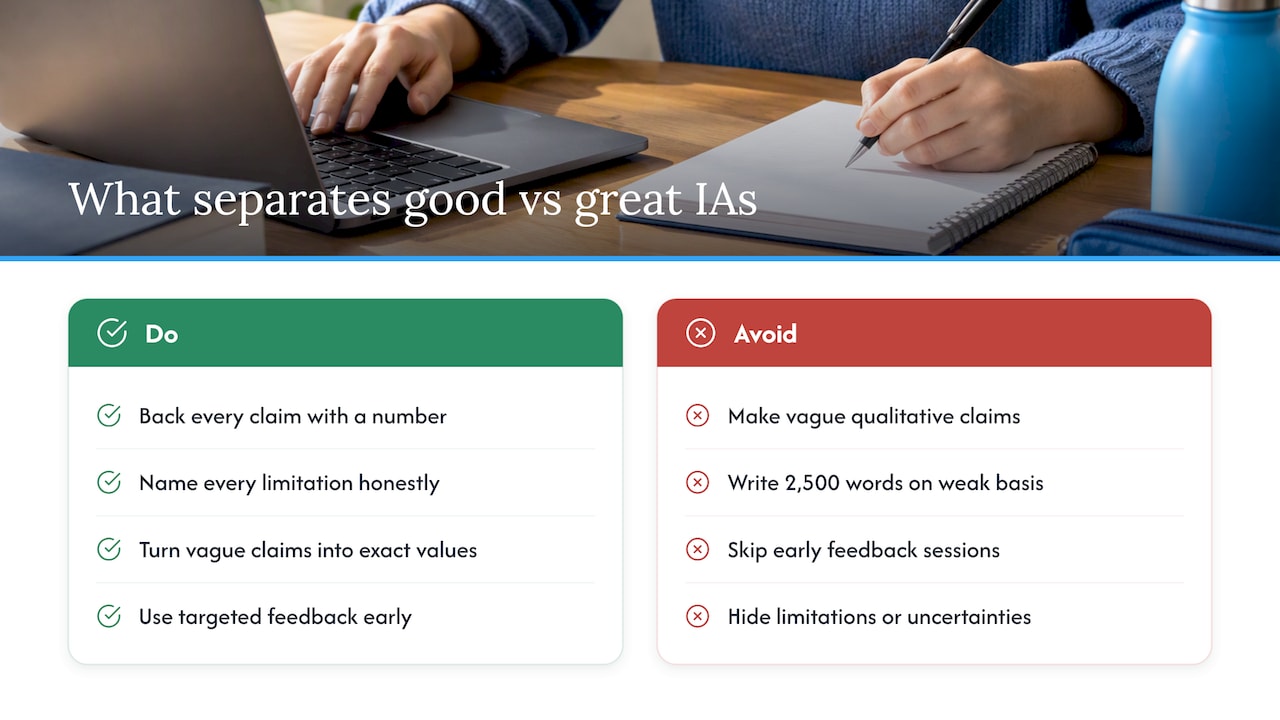
Years of marking IAs and teaching ESS and Geography make one pattern obvious: the IAs that score highest are not the ones with the most ambitious topics, they are the ones where every claim is backed by a number and every limitation is named honestly. A red-flag sentence like “pollution levels were very high” gets rewritten as “mean nitrate concentration was 4.2 mg/L higher at the downstream site than upstream.” That single rewrite shows the difference between description and analysis. Targeted feedback sessions tend to catch exactly this kind of gap early, before a student has written 2,500 words around a weak foundation.
Why curated examples still need a second opinion
Exemplars are genuinely useful, but treating them as templates rather than reference points is where most students go wrong. The conventional advice to “find a good example and follow its structure” undersells how much the best IAs depend on choices unique to the student’s own data and site access. A transect study that works beautifully for one river may be unworkable for another because of access, timing, or simple measurement noise. What matters most is not which topic you pick but whether you can defend every number in your write-up when someone questions it. Prioritize a question you can actually execute with the time and equipment you have, over one that sounds impressive on paper. That is the judgment this guide keeps coming back to: feasibility and honest evaluation beat ambition every time.
— Marija
Get feedback on your IA before you submit it
A strong exemplar shows you the shape of a good IA, but it cannot tell you whether your own question, data, and analysis will hold up under examiner scrutiny. That is where a second set of trained eyes helps.
- A Trial Plan session (20 minutes) is a low-commitment way to get a first read on your topic or draft.
- A Basic Plan session (60 minutes) gives enough time for a full methodology or results review.
- Dedicated IA feedback sessions focus specifically on rubric alignment and where your evaluation needs more depth.
Esstutor’s tutoring is delivered by a certified IB examiner with over 13 years of experience in ESS and Geography, which means feedback is grounded in what actually earns marks. Check pricing and plans or go straight to the IA tutoring page to book a session.
Where to check the rules and find reliable data
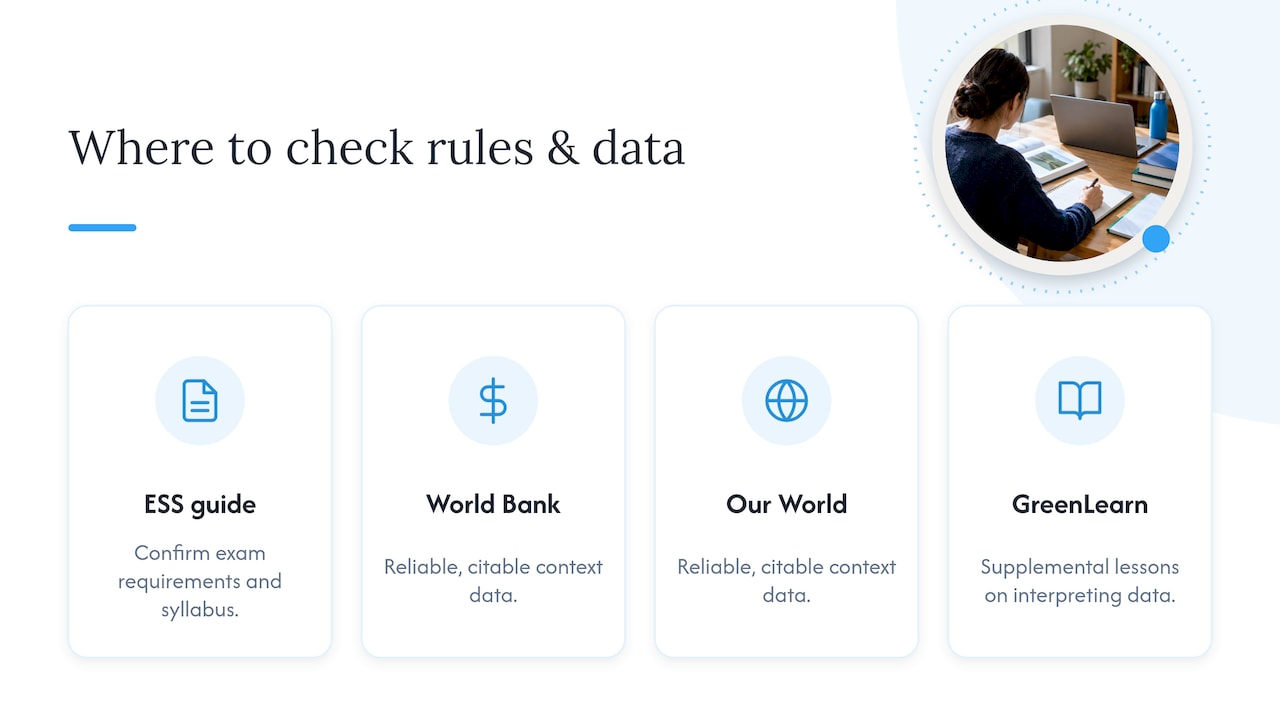
Confirm requirements against the ESS subject guide. For context data, World Bank and Our World in Data are reliable, citable sources. GreenLearn offers supplemental lessons on interpreting environmental data.
Sources
FAQ
Can you provide some examples of ESS IA topics?
Strong examples include riverbank erosion versus vegetation cover, microplastic counts in sediment, noise pollution near roads, and species diversity in managed versus unmanaged green spaces. Each works because it is local, measurable, and tied to a specific syllabus topic rather than a broad environmental theme.
Is it hard to get a 7 in ESS?
A top score requires a tightly focused research question, rigorous data collection with real replication, and an evaluation that names stakeholders and examines tensions between their perspectives. It is achievable with careful planning, but it does demand more precision than most students expect on their first draft.
What is an example of ESS?
Environmental systems and societies covers topics like ecosystems, biodiversity, water and soil systems, and human population dynamics, studied through both scientific and social lenses. A typical classroom example is comparing species diversity between a natural wetland and a drained agricultural field nearby.
How many words should an ESS IA be?
The ESS subject guide sets a word limit for the internal assessment, generally recommended to not exceed a few thousand words. Staying within that limit while covering every required section, from research question through evaluation, matters more than reaching the ceiling.
No Comments