


21 Sep 13 Years of Examiner Insight: ESS TOK Connections for IB Students
Systems thinking is the main bridge between ESS and TOK, and it works best in three concrete moves: turning ESS topics into open knowledge questions, mapping ways of knowing (WOKs) and areas of knowledge (AOKs) onto your evidence, and writing explicit bridge sentences that connect your analysis back to the title. Get those three habits right, and your essays, IAs, and EE start reading like an examiner wants them to read. Below, you’ll find the exact mapping method, a paragraph template, and worked examples you can adapt today.
TL;DR:
- Systems thinking in ESS emphasizes evaluating how evidence is constructed, not just listing variables or facts found through systems analysis.
- Narrowing broad TOK questions about science trustworthiness by including specific conditions or populations is essential for meaningful analysis.
- Effective TOK paragraphs integrate a real-life situation, analysis of the WOKs and AOKs involved, and explicit evaluation of evidence limits with a clear bridge to the question.
- Conflating systems analysis with systems thinking weakens TOK responses; the focus should be on interpreting the interconnections that reveal knowledge processes.
- Practice with targeted feedback—especially adding evaluation sentences and explicit bridges—significantly improves ESS-TOK integration and marks.
Table of Contents
- Turning ESS Topics Into TOK Knowledge Questions
- How to Structure TOK Paragraphs That Integrate ESS Evidence
- Systems Thinking vs. Systems Analysis: Don’t Mix Them Up
- Worked Examples You Can Adapt for Essays, IAs, and the EE
- Quick Checklist Before You Submit
- What an IB Examiner Actually Looks for in ESS-TOK Links
- Get Feedback That Targets Your ESS-TOK Links Directly
- Where to Check the Official Guidance
- Sources
- FAQ
Turning ESS Topics Into TOK Knowledge Questions
The move from ESS content to a usable TOK knowledge question follows a simple chain: topic → real-life situation (RLS) → knowledge question → scoped knowledge question. You start with something concrete from your syllabus, find a real example that illustrates it, then ask an open question about how we know what we claim to know about it. The IBO’s own ESS subject guide recommends exactly this kind of knowledge-question integration and gives sample prompts teachers can use in lessons.
Here’s how that mapping looks across four common ESS subtopics:
- Climate change models → RLS: IPCC projections → KQ: “How much can we trust predictive models as knowledge about the future?” → WOK: reason and imagination; AOK: natural sciences.
- Biodiversity loss → RLS: species extinction data → KQ: “Can numerical indicators fully capture the value of a species or ecosystem?” → WOK: sense perception and language; AOK: natural sciences and ethics.
- Environmental value systems → RLS: a mining dispute → KQ: “To what extent does personal or cultural bias shape what counts as environmental harm?” → WOK: emotion and reason; AOK: human sciences.
- Pollution management → RLS: a local water-quality investigation → KQ: “How do we decide when scientific uncertainty is ‘acceptable’ for policy action?” → WOK: reason; AOK: natural sciences and ethics.
Once you have a raw KQ, narrow it. A question like “Can we trust science?” is too broad for a 1,600 word TOK essay or a tight IA paragraph. Add a scope: which science, whose trust, under what conditions. “How much can we trust predictive climate models when their assumptions about human behavior remain untested?” gives you something you can actually argue in 300 words.
How to Structure TOK Paragraphs That Integrate ESS Evidence
A paragraph that jumps straight from a fact to a conclusion, with no reflection on how that fact was produced, reads as description, not TOK reasoning. Examiners want to see the thinking behind the evidence, not just the evidence itself.
Use this five-step skeleton for every TOK paragraph tied to ESS content:
- Claim — state the point you’re making about knowledge (not just about the environment).
- RLS — give a specific, named real-life situation as your evidence.
- Analysis — apply a WOK or AOK to explain how that evidence was constructed or interpreted.
- Evaluation — name a limit of that evidence: sample size, measurement error, cultural bias, model assumptions.
- Bridge — tie the paragraph explicitly back to your title or knowledge question.
That last step is the one students skip most often, and it’s the one TOK essay guidance from Sparkl identifies as what separates a mid-band essay from a top-band one. A bridge sentence doesn’t need to be clever. It needs to be explicit: “This suggests that scientific knowledge, in this case, is provisional rather than certain, which speaks directly to the claim in the title.”
Pro Tip: Read your paragraph out loud and stop after the evidence sentence. If you can’t finish the thought with “and this matters for the knowledge question because…”, your bridge is missing, not just weak.
Qualify your ESS evidence honestly. Fieldwork data has small sample sizes. Case studies carry regional bias. Models rest on assumptions. Naming that limit is not a weakness in your argument, it’s the TOK move itself.
Systems Thinking vs. Systems Analysis: Don’t Mix Them Up
Systems analysis breaks a system into parts: variables, inputs, outputs, feedback loops you can graph. Systems thinking asks what those interconnections reveal about how knowledge is built, tested, and revised across disciplines. Confusing the two is one of the most common ways students lose TOK marks in ESS work, because listing variables feels rigorous but doesn’t answer a knowledge question.
A weak response describes a nutrient cycle diagram and stops there. A strong response uses that same diagram to ask how ecological models simplify reality, and what gets lost when a system is reduced to boxes and arrows.
- Weak: “The carbon cycle involves inputs, outputs, and storage in oceans, soil, and atmosphere.”
- Strong: “Modeling the carbon cycle as discrete storage compartments simplifies feedback loops scientists still debate, raising the question of whether a model built for prediction can also count as accurate knowledge.”
Descriptive, technical-only answers plateau in the lower bands even when the science is correct. Holistic, interconnection-focused reasoning is what TOK actually rewards.
Worked Examples You Can Adapt for Essays, IAs, and the EE
Three compact RLS examples, each built on the claim → evidence → analysis → bridge sequence:
- Urban air-quality study (essay or IA): Claim: air-quality sensors produce knowledge that feels objective but is shaped by placement choices. Evidence: a city’s monitoring network under-samples low-income neighborhoods. Analysis: this is a sense-perception and measurement issue as much as a technical one, tied to the natural sciences AOK. Bridge: “This shows that even quantitative environmental knowledge carries the fingerprints of who chose where to look.”
- Freshwater ecosystem IA: Claim: fieldwork data on macroinvertebrate counts is treated as objective, but sampling method shapes the result. Evidence: your own IA data, collected under time and access constraints, as ESS IA examples often illustrate. Analysis: reason and inference bridge a small dataset to a general claim about ecosystem health. Bridge: “This raises the question of how much generalization a single fieldwork investigation can support.”
- Community sustainability EE: Claim: sustainability indicators used by local governments reflect value judgments, not neutral measurement. Evidence: a real municipal sustainability index that weights economic growth over ecological indicators. Analysis: this sits in the human sciences and ethics AOKs, where emotion and reason both shape what gets measured. Bridge: “This suggests that defining ‘sustainable’ is itself an act of knowledge construction, not a settled fact.”
For an essay, expand each step into a full paragraph. For an IA, compress the same logic into a discussion-section sentence or two. For the EE, this sequence works well in your evaluation section, where you’re expected to reflect on the limits of your own research question and methodology.
Quick Checklist Before You Submit
Before you hand in an essay, IA, or EE section, run it against these three checks:
- Does every paragraph end with an explicit bridge sentence back to the title or KQ, not just a summary of the evidence?
- Have you named at least one limit of your evidence (sample size, bias, model assumption) rather than presenting it as settled fact?
- Have you avoided conflating systems analysis (listing parts) with systems thinking (interpreting knowledge construction)?
Study-guide analysis of common ESS-TOK submissions consistently flags descriptive-only answers and absent evaluation as the two biggest reasons strong content still scores in the middle bands. Fixing both is often a rewriting task, not a research task.
What an IB Examiner Actually Looks for in ESS-TOK Links
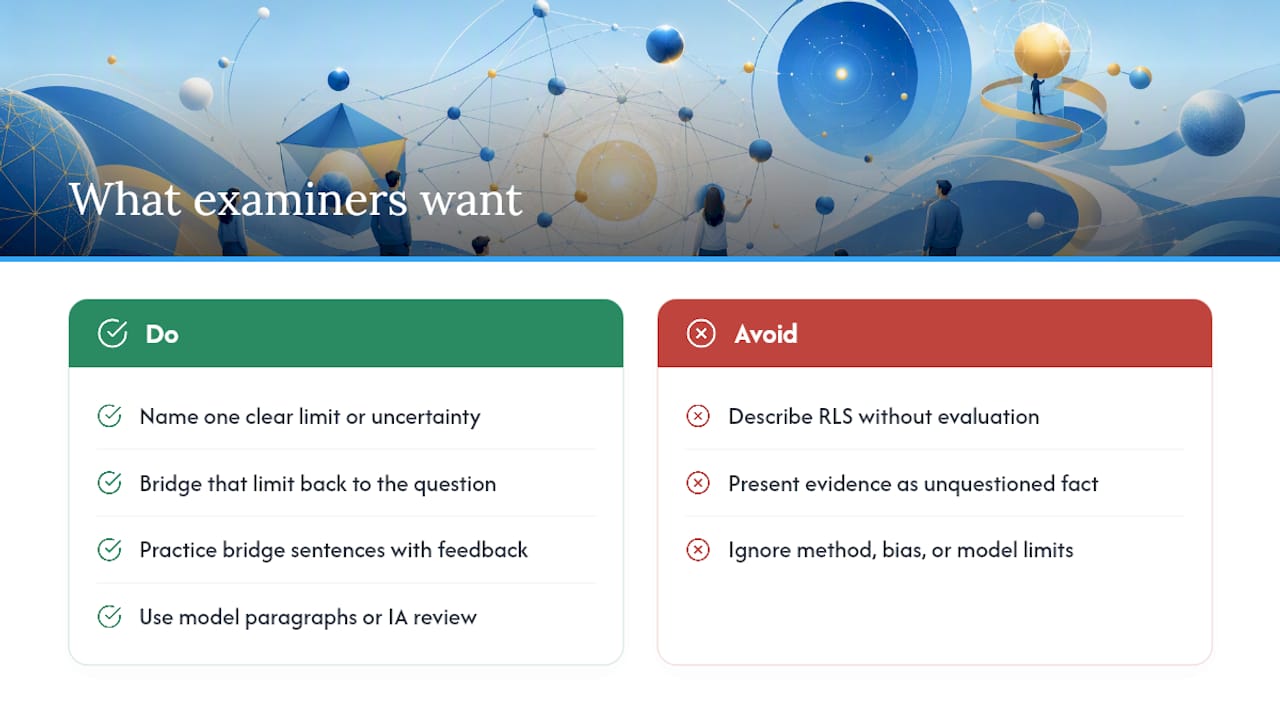
Marking hundreds of ESS papers over 13 years teaches you to spot the same gap almost every time: students understand the science, but they describe it instead of interrogating it. The paragraphs that score highest aren’t the ones with the most sophisticated environmental content. They’re the ones where a student pauses to ask how that content came to be known, and admits where the knowledge is shaky.
The most frequent mistake I see is a strong RLS with zero evaluation attached, evidence presented as fact rather than as something constructed through method, bias, or model choice. The fix is almost always the same: add one sentence naming a limit, then bridge it back to the question. Students who practice bridge sentences with feedback, whether through model paragraphs or targeted IA review, close that gap faster than students who just read more content.
— Marija
Get Feedback That Targets Your ESS-TOK Links Directly
Reading about bridge sentences is one thing. Getting an examiner to mark your actual paragraph and tell you exactly where the evaluation is missing is another. Esstutor’s tutoring is built around that gap: personalized sessions with an IB examiner who reviews your specific essay, IA, or EE draft and shows you where systems thinking slips into systems analysis, line by line.

A Trial Plan session runs 34 € one-off for 20 min if you want to test the fit before committing further. The Basic Plan covers a full 60-minute lesson at 120 € one-off, enough time to work through a complete paragraph rewrite or a knowledge-question mapping exercise. If your IA is the priority, the dedicated IA tutoring support page walks through what examiner-style IA feedback actually covers, from methodology framing to TOK evaluation depth. Book a session and bring your draft. That’s the fastest way to find out whether your bridge sentences are doing their job.
Where to Check the Official Guidance
- Environmental systems and societies guide (IBO) for official TOK integration guidance.
- Theoryofknowledge for adaptable TOK lesson prompts and mini-lessons.
FAQ
How do I turn an ESS topic into a TOK knowledge question?
Start with a specific ESS subtopic, attach a real-life situation, then ask an open question about how that knowledge was produced or justified. Narrow the question with a scope word (which science, whose bias, under what conditions) so it fits your word count.
What’s the difference between systems thinking and systems analysis in TOK terms?
Systems analysis breaks a system into measurable parts like inputs and feedback loops. Systems thinking asks what those interconnections reveal about how knowledge itself gets built and tested, and TOK marks favor the latter.
Can I use my ESS IA data as TOK evidence?
Yes. Your own fieldwork or investigation data works well as an RLS, especially when you evaluate its limits, such as sample size or measurement conditions, rather than presenting it as settled fact. ESS IA examples show this approach in practice.
How much does ESS tutoring with Esstutor cost?
A Trial Plan session is a $34 one-off for 20 minutes, and the Basic Plan runs a $120 one-off per 60-minute lesson. Pricing for the full ESS and Geography HL and SL tutoring services is available on the pricing page.
What’s the single biggest mistake students make linking ESS and TOK?
Describing evidence without evaluating how it was produced, then skipping the bridge sentence back to the knowledge question. Adding one evaluative sentence per paragraph, followed by an explicit bridge, fixes most of the gap.
No Comments