


25 Jul Positive Feedback in ESS: A Clear Guide for IB Students
Positive feedback in ESS is a process where an initial change in a system triggers further change in the same direction, amplifying the original disturbance rather than correcting it. Unlike negative feedback, which pulls a system back toward equilibrium, positive feedback pushes systems away from stability and can lead to rapid, sometimes irreversible shifts. For IB Environmental Systems and Societies students, understanding this distinction is not just useful background knowledge. It shows up directly in exam questions, internal assessments, and Paper 2 case studies.
Here are the key traits of positive feedback you need to know for your ESS assessments:
- Amplifying: the output reinforces the original input, making the change grow larger over time
- Destabilizing: it moves systems away from equilibrium rather than restoring balance
- Self-reinforcing: once started, the loop feeds itself without an external push
- Linked to tipping points: strong positive feedback can push a system past a threshold into a new, often very different state
- Not inherently “good”: the word “positive” refers to amplification, not a beneficial outcome
Table of Contents
- Biological examples of positive feedback loops you should know
- Ecological positive feedback loops and climate-related cases
- How a positive feedback loop is structured
- How positive and negative feedback compare in ESS
- How positive feedback affects ecosystem stability and change
- How positive feedback shapes population dynamics
- Common misconceptions about positive feedback in ESS
- How to identify positive feedback loops in ESS exam questions
- Key Takeaways
Biological examples of positive feedback loops you should know
Population growth acceleration
Population growth is one of the clearest biological examples of positive feedback. As population size increases, the number of reproducing individuals rises, which produces even more offspring, which raises the population further. The loop keeps reinforcing itself as long as resources allow.
Key features of this loop:
- Larger population → higher reproductive output → even larger population
- Can produce rapid growth in favorable conditions
- Seen in bacteria, invasive species, and human populations under favorable conditions
Population decline as a feedback loop
Positive feedback also drives population collapse. A drop in population reduces the number of breeding individuals, which lowers reproductive output, which shrinks the population further. The same amplifying logic applies, just in the opposite direction.
Key features of this loop:
- Smaller population → fewer breeding pairs → even smaller population
- Can accelerate species extinction once numbers fall below a critical threshold
- Relevant to conservation biology and ESS discussions of biodiversity loss
Blood clotting
Blood clotting is a classic biological positive feedback example outside ecology. When a vessel is damaged, platelets release chemicals that attract more platelets to the site, rapidly building a clot. The process amplifies until the wound is sealed, then external signals stop the loop. This shows that positive feedback does not always lead to runaway collapse; sometimes it serves a specific, bounded function.
Pro Tip: In ESS exams, always state the direction of amplification when explaining a feedback loop. Say “an increase in X leads to a further increase in X” rather than just “X feeds back on itself.” Examiners reward precise causal language.
Ecological positive feedback loops and climate-related cases
The ice-albedo effect
The ice-albedo feedback is the most frequently cited ecological example in ESS, and for good reason. When ice melts, it exposes darker ocean or land surfaces beneath. These darker surfaces absorb more solar energy than reflective ice does, which warms the surrounding area further, melting more ice. The cycle keeps reinforcing itself.
Why this matters for your exam:
- It helps explain Arctic warming accelerating relative to other regions
- It links directly to IB ESS topics on climate change and tipping points
- Examiners often ask students to trace the causal chain step by step
Thawing permafrost and greenhouse gas release
Thawing permafrost releases methane and carbon dioxide, both potent greenhouse gases. Those gases trap additional heat in the atmosphere, raising temperatures further, which thaws more permafrost. This is a textbook self-reinforcing loop with real-world consequences for global climate stability.
Key points for ESS:
- Methane is a potent greenhouse gas contributing to warming
- This loop is considered one of the most concerning climate tipping points
- It connects ESS topics on biogeochemical cycles, climate, and ecosystem change
Water vapor feedback
As the atmosphere warms, it holds more water vapor, which is itself a greenhouse gas. That extra water vapor traps more heat, warming the atmosphere further, which allows it to hold even more water vapor. The loop accelerates warming beyond what CO2 alone would produce.
Eutrophication in aquatic systems
Eutrophication offers a different angle on ecological positive feedback. Excess nutrients entering a river or lake trigger algal blooms. As algae die and decompose, oxygen levels drop. Low oxygen kills aquatic organisms, whose decomposition consumes even more oxygen, deepening the imbalance. The system spirals away from its original state rather than recovering.
Other ecological positive feedback examples worth knowing:
- Deforestation reducing rainfall, which causes further forest die-off
- Soil erosion exposing bare ground, which increases runoff and further erosion
- Coral bleaching weakening reef structures, making them more vulnerable to future stress events
How a positive feedback loop is structured
Every positive feedback loop shares the same basic architecture. Understanding the components helps you draw and label them correctly in exam diagrams.
| Component | Role in the loop |
|---|---|
| Initial disturbance | A change that triggers the feedback process (e.g., a rise in temperature) |
| System variable | The measurable quantity being affected (e.g., ice cover, population size) |
| Output | The result of the change in the system variable (e.g., reduced albedo) |
| Feedback signal | The output that loops back to reinforce the original disturbance |
| Amplification | The net effect: the disturbance grows larger with each cycle |
The loop is circular. The output does not just leave the system; it feeds back in and intensifies the input that produced it. This is what separates a feedback loop from a simple linear cause-and-effect chain.
Key structural points to remember:
- A positive feedback loop has no built-in correction mechanism
- It continues amplifying until an external limit is reached (resource depletion, physical boundary, or a competing negative feedback)
- Tipping points occur when positive feedback overwhelms the stabilizing negative feedbacks that normally keep a system in check
You can explore how these feedback loop concepts fit into the broader ESS curriculum framework to build a stronger conceptual foundation.
How positive and negative feedback compare in ESS
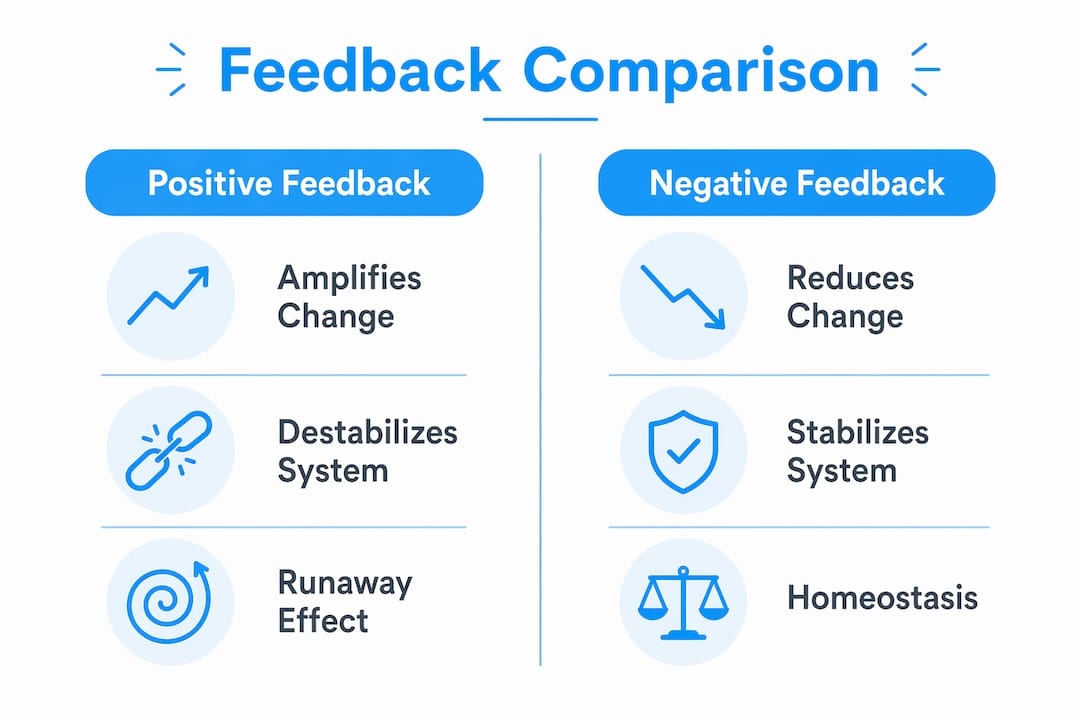
Students often confuse these two mechanisms, and that confusion costs marks. The table below lays out the core differences clearly.
| Feature | Positive feedback | Negative feedback |
|---|---|---|
| Effect on system | Amplifies the original change | Reduces or reverses the original change |
| Direction | Change continues in the same direction | Change is counteracted |
| System stability | Destabilizing | Stabilizing |
| Outcome | Can lead to tipping points or collapse | Maintains equilibrium |
| ESS example | Ice-albedo effect, population growth | Predator-prey regulation, thermostat |
Negative feedback is the mechanism that keeps most healthy ecosystems in balance. When a prey population grows, predator numbers rise in response, which brings prey numbers back down. The system corrects itself. Positive feedback does the opposite: it pushes the system further from where it started.
Both types of feedback operate simultaneously in most real ecosystems. The question is which one dominates. When positive feedback overwhelms the stabilizing negative feedbacks, the system can shift rapidly into a new state that may be very difficult to reverse.
Key comparison points for exam answers:
- Negative feedback = goal-seeking, corrective, stabilizing
- Positive feedback = amplifying, reinforcing, destabilizing
- Neither type is inherently “good” or “bad” in ecological terms; context determines the outcome
How positive feedback affects ecosystem stability and change
Ecosystems are not static. They exist in a state of dynamic equilibrium, where multiple negative feedbacks keep key variables within a workable range. Positive feedback disrupts that balance by amplifying disturbances rather than absorbing them.
When a positive feedback loop gains strength, it can push an ecosystem past a tipping point, a threshold beyond which the system reorganizes into a fundamentally different state. The NOAA climate education materials describe this as similar to a wine glass tipping over: once it falls, standing it back up does not restore the wine. The original state is gone. In ecological terms, a coral reef degraded by bleaching and nutrient runoff may shift permanently to an algae-dominated system, even if the stressors are removed.
Positive feedback also explains why some environmental problems accelerate unexpectedly. A forest experiencing drought stress loses trees, which reduces transpiration, which lowers local rainfall, which stresses more trees. The degradation compounds. Understanding this dynamic helps you explain in ESS exams why environmental problems often worsen faster than linear models predict.
Reviewing ESS feedback concepts regularly is one of the most effective ways to build the kind of systems thinking that IB examiners look for.
How positive feedback shapes population dynamics
Population dynamics offer some of the most accessible examples of positive feedback in action. As noted earlier, both rapid growth and accelerating decline can be driven by the same amplifying logic.

In growth scenarios, a population with abundant resources and few predators reproduces faster than it loses members. More individuals mean more reproduction, which adds even more individuals. This is the exponential growth phase you see on a J-shaped population curve. Positive feedback drives that steep upward climb.
Decline works the same way in reverse. Once a population drops below a certain size, finding mates becomes harder, genetic diversity narrows, and the group becomes more vulnerable to disease and environmental stress. Each of these pressures reduces reproduction further, shrinking the population more. Conservation biologists call this the extinction vortex, and it is a direct consequence of positive feedback dynamics.
For ESS exam purposes, you should be able to:
- Identify whether a population scenario describes growth or decline feedback
- Explain the causal chain step by step
- Connect the feedback to broader ecosystem effects (food web disruption, habitat change)
Common misconceptions about positive feedback in ESS
Misconception 1: “Positive” means beneficial.
This is the most common error. The word “positive” in positive feedback refers to amplification, not a good outcome. Positive feedback simply means the output reinforces the input. Melting Arctic ice, accelerating climate change, and collapsing fish populations are all positive feedback loops, and none of them are beneficial.
Misconception 2: Positive feedback always leads to runaway collapse.
Not always. Blood clotting is a positive feedback loop that stops naturally when the wound is sealed. The key is whether an external limit or a competing negative feedback eventually halts the amplification. In many biological systems, positive feedback serves a useful, bounded function.
Misconception 3: Negative feedback is “bad” because it sounds negative.
Negative feedback is what keeps ecosystems stable. It is the corrective mechanism that prevents small disturbances from spiraling out of control. In ESS, negative feedback is generally associated with resilience and stability.
Misconception 4: Feedback loops only apply to climate topics.
Positive feedback appears across the entire ESS curriculum: population dynamics, nutrient cycles, soil degradation, and even social-environmental systems. Any time a change reinforces itself, you are looking at positive feedback.
Misconception 5: Positive and negative feedback cannot coexist.
They almost always coexist. Real ecosystems involve multiple overlapping feedback loops. The outcome depends on which type dominates at a given time and scale.
How to identify positive feedback loops in ESS exam questions
Exam questions on feedback loops tend to follow recognizable patterns. Knowing what to look for saves time and helps you structure a clear, mark-worthy answer.
Step 1: Look for amplifying language.
Words like “accelerates,” “reinforces,” “compounds,” “further increases,” and “spirals” are signals that a positive feedback loop is being described. If the scenario describes a change that makes itself worse (or bigger), that is positive feedback.
Step 2: Trace the causal chain.
Write out the loop explicitly: A increases → B increases → A increases further. If you can complete that sentence with the information given, you have identified a positive feedback loop. If the chain ends with A decreasing, it is negative feedback.
Step 3: Check for tipping point language.
Phrases like “irreversible change,” “threshold,” “new equilibrium,” or “collapse” often accompany positive feedback scenarios in ESS questions. These are cues to discuss how amplifying loops can push systems past critical thresholds.
Step 4: Connect to a named example.
Examiners award marks for specific, accurate examples. The ice-albedo effect, permafrost methane release, and eutrophication are all well-documented and directly relevant to the IB ESS syllabus. Name the example, describe the loop, and explain the ecological consequence.

Step 5: Distinguish from negative feedback if the question asks.
If a question asks you to compare feedback types, use the stabilizing versus destabilizing framing. Negative feedback corrects; positive feedback amplifies. Keep the language precise and the causal direction clear.
Pairing these strategies with strong IB ESS exam preparation habits gives you the best chance of scoring full marks on systems-based questions.
If you want personalized support working through feedback loops, tipping points, and other ESS systems concepts, Esstutor offers one-on-one tutoring with an experienced IB examiner who has guided students for over 13 years. Whether you are preparing for Paper 2 or working on your internal assessment, targeted sessions can make these concepts click faster than self-study alone.

Get started with a trial lesson at Esstutor’s IB ESS tutoring and see how focused, exam-specific guidance changes your results.
Key Takeaways
Positive feedback in ESS amplifies change rather than correcting it, making it one of the most destabilizing forces in ecological and biological systems.
| Point | Details |
|---|---|
| Positive means amplifying, not beneficial | The term refers to reinforcement of change, not a good outcome for the system. |
| Loops drive both growth and decline | Population growth and population collapse are both driven by positive feedback amplification. |
| Climate examples are exam favorites | The ice-albedo effect, permafrost methane release, and water vapor feedback are core IB ESS cases. |
| Tipping points follow strong positive feedback | When amplifying loops overpower stabilizing negative feedbacks, systems can shift irreversibly. |
| Causal chain language earns marks | Tracing “A increases → B increases → A increases further” precisely is what examiners reward. |
No Comments