


31 Aug IB Geography Paper 3 Case Studies: Build Useful Revision Dossiers
Geography Paper 3 HL is the one hour, 28 mark Global Interactions paper where you answer one 12 mark and one 16 mark question from a single combination. The 12 mark part rewards focused analysis; the 16 mark part demands evaluation and synthesis across case studies. Score well here and it comes down to tight introductions, transferable evidence, and disciplined timing, not raw content volume.
TL;DR:
- Build a manageable case-study portfolio across Units 4 to 6, then check coverage against the syllabus. Four to six dossiers is a possible starting point, not a required or sufficient number.
- Use a short planning period to choose the question and organise both answers. Practise an overall allocation that fits the full 60-minute paper; spending 15 minutes planning each answer would leave too little writing time.
- Prioritize timed full practice papers and detailed self-marking with examiner reports in the final month to identify and improve on specific weaknesses.
- Ensure your introductions define key terms clearly and your conclusions directly answer the question, avoiding disconnected evidence and unlabelled figures.
- Use exam-style templates to structure layered analysis for 12 mark questions and evaluations with syntheses for 16 mark responses, avoiding description-only answers.
Table of Contents
- Understanding the Geography Paper 3 HL Format and Mark Scheme
- What to Study for Global Interactions: Units and Case Dossiers
- Answer Templates for the 12-Mark and 16-Mark Questions
- Exam-Room Technique: Planning, Figures, and Avoiding Traps
- Building a Study Schedule: Past Papers and Practice Resources
- Examiner-Level Fixes for Common Paper 3 Weaknesses
- My Five Priorities for Your Final Month
- Get Exam-Ready Faster With Focused Paper 3 Support
- Sources
Understanding the Geography Paper 3 HL Format and Mark Scheme
Paper 3 sits apart from Papers 1 and 2 because only HL students sit it, and it tests exactly one syllabus strand: Global Interactions. The paper gives you three combination questions, each pairing a 12 mark part with a 16 mark part. You choose one combination and answer both parts within it. Total marks are 28, and you get one hour to complete the paper.
That hour splits unevenly if you want to score well. A reasonable split looks like this:
- 5 minutes reading and choosing your combination
- 15 to 18 minutes on the 12 mark answer
- 25 to 30 minutes on the 16 mark answer
- 5 minutes checking figures, labels, and case names
Read the command term and consult the official Paper 3 markbands and question-specific markscheme. Evaluation requires a supported judgment, but there is no general rule assigning half the marks to a conclusion.
What to Study for Global Interactions: Units and Case Dossiers
Global Interactions draws on Units 4, 5, and 6 of the HL syllabus, and the official IBO syllabus defines exactly which subtopics are fair game. Rather than re-reading all three units cover to cover, build your revision around a small set of reusable case studies.
- Cover the full HL extension: Unit 4, Power, Places and Networks; Unit 5, Human Development and Diversity; and Unit 6, Global Risks and Resilience. Do not leave gaps based on predictions about recurring exam topics.
- Choose 4 to 6 case studies that span different scales and income contexts. A city-level example, a national policy case, and a global network case together cover far more question angles than six similar national examples.
- Build a one-page dossier for each case. Include context (where, when, who), a short timeline, two or three key data points, and one critical evaluation line you can adapt to different prompts.
- Resist over-specializing in one region. Examiners reward transferable evidence, and a compact portfolio of diverse cases beats a deep dive into a dozen near-identical examples.
Check every dossier against actual syllabus statements and practice questions. Add or revise cases when they leave gaps; no small set guarantees that you can answer almost any examination question.
Answer Templates for the 12-Mark and 16-Mark Questions
Command terms guide the kind of reasoning required. Use a flexible plan rather than a compulsory mini-template: relevant explanation, analysis, evidence and evaluation must answer the question actually set.
For the 12 mark answer, keep the introduction to one or two lines: define the key term, rephrase the question, and state your structure. Follow with three short analytic paragraphs, each built as claim, evidence, explanation, then a two-line micro-conclusion that answers the question directly.
The 16 mark answer needs more scaffolding:
- A thesis-style introduction that signals your overall judgment early
- Two to three evaluation paragraphs organized around clear criteria, not just case order
- At least one paragraph that synthesizes evidence across two different case studies
- A concluding judgment that commits to a position rather than sitting on the fence
Pro Tip: Write your micro-conclusion for the 12 mark answer before you finish the paragraphs above it. Knowing your endpoint keeps every sentence pulling toward the same argument instead of drifting into description.
Budget roughly 15 minutes for the 12 mark part and 28 to 30 for the 16 mark part, leaving a few spare minutes to check every figure and case name against the mark scheme’s expectations.
Exam-Room Technique: Planning, Figures, and Avoiding Traps
A five minute planning routine before you write anything saves far more time than it costs. Jot your thesis, list two or three criteria for the 16 mark answer, and assign one case study to each paragraph before your pen hits the main script.
- Turn your plan into paragraph checkpoints. Write “para 1: urbanization pace, case = Lagos” in the margin so you never lose the thread mid-answer.
- Use informative figures: Label relevant features and explain their significance. Add numerical values only from checked evidence; a schematic does not necessarily require a true map scale.
- Watch for the three most common traps: overlong description with no argument, unlabeled statistics, and evaluation paragraphs that list opinions without weighing them against each other.
- Drill pace deliberately. Practice five minute plans on their own, then 20 minute timed 12 mark answers, then full one hour runs once both feel automatic.
Use a figure only where it helps explain your argument, with relevant labels and checked data. A schematic does not always need a numerical scale, and a caption does not automatically earn marks.
Building a Study Schedule: Past Papers and Practice Resources
Start with official IBO past papers and examiner reports before touching any third-party question bank. Examiner reports tell you exactly where real students lost marks last cycle, which is more useful than any generic revision guide.
- Read two to three years of past papers and their examiner reports first
- Layer in reputable timed-practice question banks for specific command terms you find weak
- Follow a six week schedule that alternates micro-skill drills (figure labeling, single paragraph writing) with full timed papers
- Self-mark against the published mark scheme line by line, then escalate to a tutor or examiner for feedback once you plateau
A schedule that mixes small drills with full runs across four to six weeks produces steadier gains than cramming full papers every session.
Examiner-Level Fixes for Common Paper 3 Weaknesses
Introductions and conclusions get more scrutiny than most students expect. An examiner wants your introduction to define terms and state a clear plan in two lines, and your conclusion to answer the question directly rather than summarize what you already wrote.
The recurring weaknesses examiners flag are predictable: evidence floating disconnected from any claim, figures mentioned without labels, and evaluation that lists both sides without ever choosing one. Fix each by forcing a link sentence after every piece of evidence, and never citing a graph without a captioned trend.
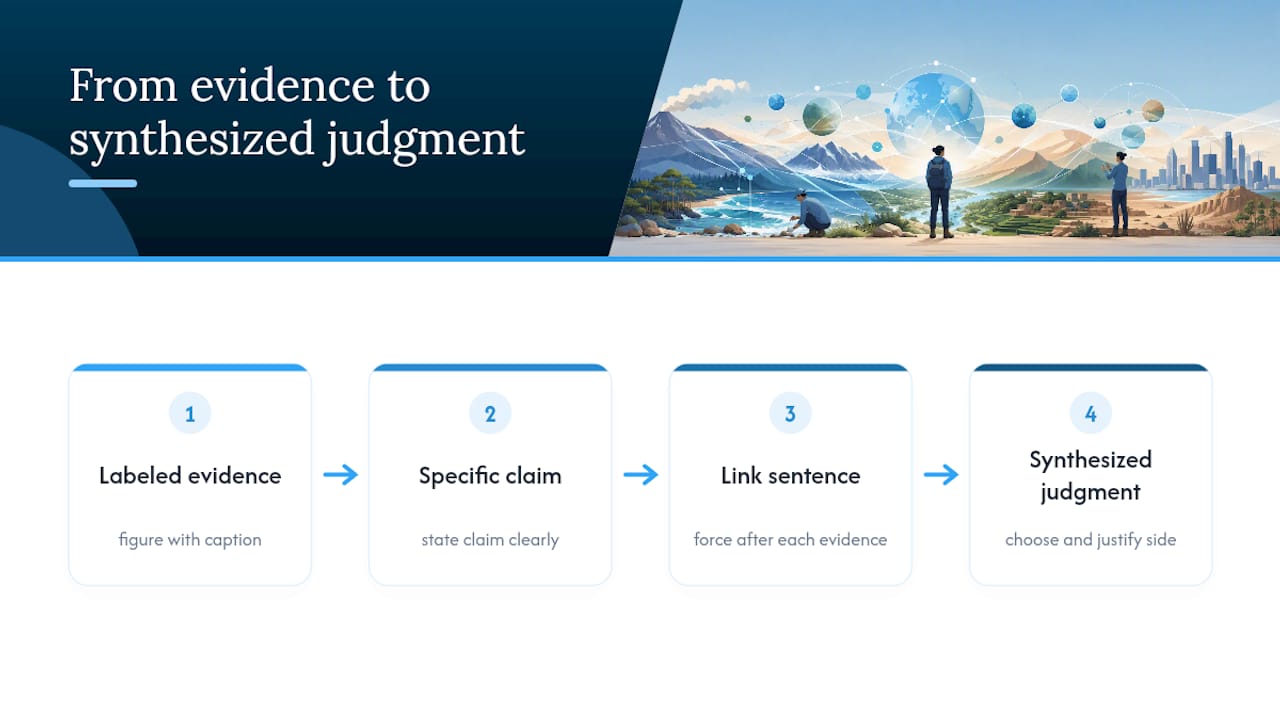
Pro Tip: Send a tutor or examiner one full 16 mark answer written under timed conditions, plus the mark scheme you used to self-mark it. Ask specifically where your evaluation paragraph lost synthesis marks, not just “how did I do overall.” Specific questions get specific, usable feedback.
My Five Priorities for Your Final Month
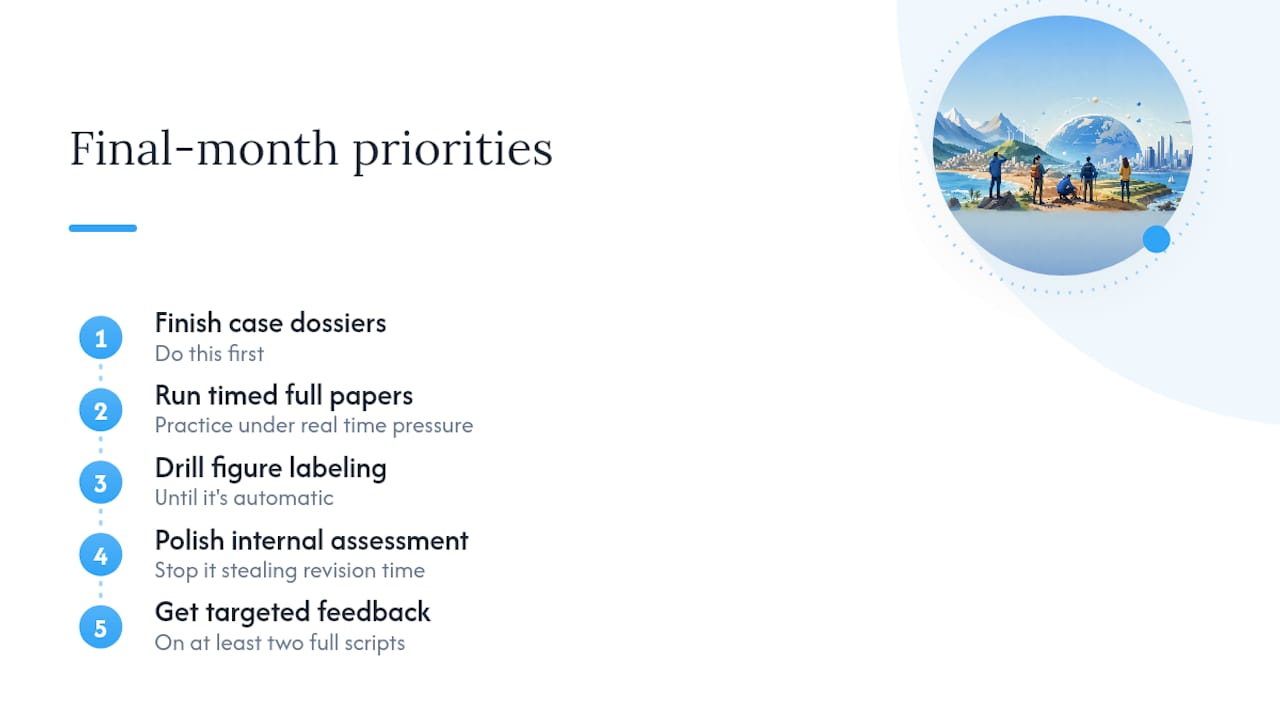
If you have one month left, spend it on five things in this order: finishing your case dossiers, running timed full papers, drilling figure labeling until it’s automatic, polishing your internal assessment so it stops stealing revision time, and getting targeted feedback on at least two full scripts.
After practice, identify one concrete improvement and try a related question again. This can reveal progress, but a fixed feedback cycle cannot promise a change between particular grades.
— Marija
Get Exam-Ready Faster With Focused Paper 3 Support
Marija Maletz is an ESS teacher, examiner and tutor. For Geography, discuss which topics and exam skills you need help with. Regular tutoring can focus on understanding and practice within the agreed scope; it should not imply official IB approval or guaranteed results.
The FREE 20-minute trial is a short discussion of needs and suitability. It does not promise a complete timed-paper clinic, dossier review or marked script. Explain your Geography goals before booking so the scope of any regular support can be agreed.
Sources
Read these in order: the official Geography syllabus to confirm topic scope, the IB subject brief for a quick overview, then recent examiner reports and past papers for the marking patterns that matter most right now.
- Geography SL & HL syllabus (IBO)
- Revision – IB DP GEOGRAPHY
- IBDP Geography Paper 3 – Global Interactions (HL Only): The One That Separates the 6s from the 7s – Mr James Geography
- IB DP Subject Mastery: How to Score a 7 in IB Geography HL – Sparkl
No Comments