


18 Jul How to Review ESS Feedback for Better IB Scores
TL;DR:
- Reviewing ESS feedback involves systematically interpreting comments to enhance IB Environmental Systems and Societies assignments. Students should categorize feedback by priority, decode vague comments into specific actions, and create personal checklists to track progress. Taking a break before reviewing criticism helps maintain motivation and improves revision effectiveness.
Reviewing ESS feedback is the process of systematically interpreting assessment comments to improve your academic performance in IB Environmental Systems and Societies. Most students read their grade, feel disappointed or relieved, and move on. That response wastes one of the most useful tools available to you. Feedback functions as a roadmap, not a judgment, and learning how to review ESS feedback with structure turns every marked assignment into a clear improvement plan. This guide walks you through the full process, from reading comments without panic to building a personal revision checklist that compounds your progress over time.
How to review ESS feedback: the best practices for understanding and categorizing comments

The most effective way to start is to read all feedback once without stopping to react. Your first pass is for awareness, not action. Resist the urge to defend your choices or dismiss a comment as unfair. That emotional response is normal, but it blocks you from seeing what the comment actually says.
After that first read, categorize every comment into one of three priority tiers. Feedback prioritized by tiers puts argument and structure issues first, evidence and citation errors second, and grammar and style concerns last. This order matters because fixing a weak thesis produces far more grade improvement than correcting a comma splice.
For ESS essays specifically, common feedback categories include:
- Argument and structure: “Your claim about biodiversity loss lacks a clear line of reasoning” or “The essay does not connect ecological footprint data to your conclusion.”
- Evidence and citation: “You need a peer-reviewed source here” or “Species diversity statistics are not cited.”
- Analysis depth: “You describe the issue but do not evaluate it” or “No reference to IB assessment criteria for this point.”
- Grammar and style: “Sentence is unclear” or “Passive voice throughout.”
Sorting comments this way stops you from spending 40 minutes fixing sentence flow when your argument structure still needs a complete rewrite.
Pro Tip: Before you read feedback on any ESS assignment, write down two things you already suspected were weak. Then check whether the comments confirm your instincts. This habit builds self-assessment skills that pay off directly in exam conditions.
How do you decode vague professor comments into concrete revision steps?
Vague comments like “Unclear” or “Expand” have specific meanings that translate into concrete revision actions. The table below maps the most common shorthand to what your teacher actually wants you to do.
| Comment | What it means | Revision action |
|---|---|---|
| “Unclear” | The sentence or argument cannot be followed | Rewrite the sentence with one subject and one verb. State your claim directly. |
| “Expand” | The point is present but underdeveloped | Add a specific example, data point, or explanation of why the evidence matters. |
| “Cite” | A claim needs a source | Find a peer-reviewed source or IB-approved reference and add an in-text citation. |
| “Flow” | Paragraphs do not connect logically | Add a transition sentence that links the previous idea to the next. |
| “Weak thesis” | Your central argument is too vague or broad | Rewrite the thesis to include a specific claim, the reason it is true, and the scope of the essay. |
| “So what?” | Analysis is missing | Add a sentence explaining the significance of your evidence to the ESS topic. |
Decoding comments this way removes guesswork. You stop staring at a margin note and start writing.
Pro Tip: If a comment still makes no sense after consulting this framework, write the exact comment on a piece of paper and bring it to your next office hours session. Showing the teacher their own words is far more productive than paraphrasing from memory.
Scheduling a meeting to clarify ambiguous feedback demonstrates engagement and often reveals the intent behind shorthand notes. Teachers write comments quickly. What reads as harsh in isolation is usually a compressed instruction that takes 30 seconds to explain in person.
How to create a personal ESS feedback revision checklist
A personalized revision checklist is the single most effective tool for turning one-time feedback into lasting improvement. Maintaining a feedback log that records your assignment title, grade, top comments, your interpretation, and the changes you made creates structured reflection that improves every subsequent essay. That log becomes the raw material for your checklist.
Build your checklist by following these steps:
- Collect feedback from your last three ESS assignments. Look for comments that appear more than once. Recurring patterns reveal your actual weak points, not just one-off errors.
- Write each recurring issue as a yes/no checklist item. For example: “Does my thesis state a specific environmental claim with a reason?” or “Have I cited every statistic with a peer-reviewed source?”
- Add ESS-specific criteria items. Include checks for IB assessment criteria language, such as: “Have I used systems thinking to connect causes and effects?” or “Does my conclusion reference species diversity or ecosystem services where relevant?”
- Order the checklist by priority tier. Argument and structure checks come first, evidence checks second, grammar last. This mirrors the feedback prioritization method from the previous section.
- Review and update the checklist after every marked assignment. If a new comment appears twice, add it. If an old issue disappears from your feedback, move it to a “resolved” section rather than deleting it. Seeing your resolved items builds confidence.
- Use the checklist before you submit, not after. Run through every item on your next ESS essay draft before handing it in. This closes the feedback loop before the teacher even reads your work.
You can find additional structure for this process in the ESS essay writing workflow guide on Esstutor, which breaks down each stage of an IB ESS essay from planning to submission. Pairing that workflow with your personal checklist gives you a repeatable system rather than a one-time fix.
Consistent use of structured feedback leads to measurable improvement in ESS essay scores and confidence over time. The checklist is what makes that consistency possible.
What strategies help you clarify feedback and schedule productive follow-ups?
Ambiguous feedback left unresolved is wasted feedback. The goal of a follow-up meeting is not to argue about your grade. It is to understand exactly what the teacher expected so you can deliver it next time.
Prepare before every follow-up session using these steps:
- Print or write out the specific comments you do not understand.
- Write one question per comment. “When you wrote ‘expand,’ did you want more data, more analysis, or both?” is a precise question. “Can you explain your feedback?” is not.
- Bring your revised draft if you have already started revisions. Showing that you acted on feedback before the meeting signals seriousness and often prompts more detailed guidance.
- Ask whether your interpretation of a comment is correct before asking what to do next. This confirms understanding before you invest time in the wrong revision.
Office hours clarify ambiguous comments and help you resolve shorthand notes that would otherwise stall your revision. Most teachers respond well to students who arrive with specific, written questions rather than general confusion.
After the meeting, update your feedback log with what you learned. Note the original comment, the teacher’s clarification, and the revision you plan to make. This record becomes part of your checklist for the next assignment.
Pro Tip: End every follow-up meeting by asking one forward-looking question: “What would a strong response to this prompt look like?” That question shifts the conversation from past mistakes to future performance.
How to handle critical feedback without losing motivation
Critical feedback on an ESS assignment does not mean you lack ability. It means the assignment did not yet meet the standard, and the teacher has told you exactly where the gap is.
Taking a cooling-off period before reacting to tough feedback separates your emotional response from the substantive content of the comments. A gap of a few hours, or even one night, is enough. Read the feedback again the next morning and you will find it reads differently.
“Feedback is not a verdict on your intelligence. It is a description of where your work stands today and a set of directions for where it needs to go. Every comment is information, and information is useful.”
View each piece of feedback as one data point in a longer series. IB ESS students who treat feedback as a roadmap rather than a judgment make targeted progress without the paralysis that comes from taking every comment personally. Your goal is cumulative improvement across multiple assignments, not perfection on a single one.
The ESS academic improvement strategies resource on Esstutor reinforces this mindset with practical frameworks for building resilience alongside academic skill.
Key Takeaways
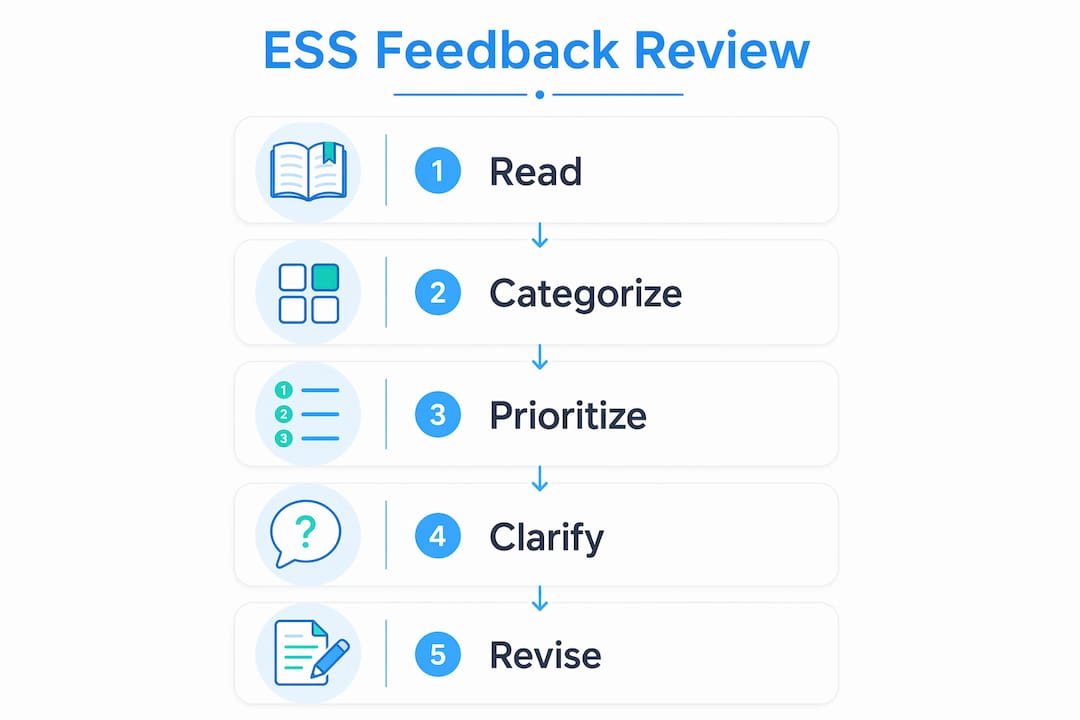
Reviewing ESS feedback effectively requires a structured five-step process: read without reacting, categorize by priority, decode vague comments, build a personal checklist, and clarify ambiguities through direct follow-up.
| Point | Details |
|---|---|
| Prioritize by tier | Fix argument and structure first, evidence second, and grammar last for maximum grade impact. |
| Decode vague comments | Translate shorthand like “Unclear” or “Expand” into specific revision actions before starting rewrites. |
| Build a feedback log | Record every assignment’s top comments and your changes to track patterns and measure progress. |
| Schedule follow-ups | Bring written questions to office hours to resolve ambiguous comments and confirm your interpretations. |
| Separate emotion from critique | Take a cooling-off period before acting on critical feedback to focus on content, not feelings. |
What I have learned from years of watching students review feedback
The students who improve fastest are not the ones who get the best initial feedback. They are the ones who treat every comment as a specific instruction and act on it before the next assignment lands. I have seen students go from a 4 to a 6 in ESS not because they suddenly understood ecosystems better, but because they finally stopped skimming their feedback and started building a checklist.
The pattern I notice most often is that students read feedback once, feel bad, and then write the next essay from scratch without referencing what the teacher said. That resets the cycle. The students who keep a feedback log break that cycle. They walk into each new assignment knowing their three recurring weaknesses and checking for them before submission.
One thing I will say directly: the emotional part is real, and it does not disappear with experience. What changes is how quickly you move through it. A cooling-off period is not avoidance. It is a practical tool that lets you read the same comment with clearer eyes. Use it without guilt.
If you are working on your IB ESS internal assessment and finding the feedback cycle particularly hard to manage, structured tutoring makes a measurable difference. Having someone walk through your feedback with you, comment by comment, is faster and more accurate than working through it alone.
— Marija
How Esstutor can support your ESS feedback review process
Esstutor offers personalized IB ESS tutoring with a tutor who has over 13 years of experience as an IB examiner and educator. That background means feedback interpretation is not guesswork. Sessions focus on exactly what IB examiners look for, so you can align your revisions to the criteria that actually determine your score.
Whether you are working on your ESS extended essay or preparing internal assessments, Esstutor provides targeted support for each stage. The platform covers essay structure, evidence use, systems thinking, and exam technique in flexible online sessions. If you want expert guidance on applying feedback to your next ESS assignment, a trial lesson is a practical first step.
FAQ
What does “how to review ESS feedback” mean for IB students?
Reviewing ESS feedback is the structured process of reading, categorizing, and acting on assessment comments to improve future IB Environmental Systems and Societies assignments. It goes beyond reading your grade and involves translating every comment into a specific revision action.
What is the best order to address feedback comments?
Fix argument and structure issues first, then address evidence and citation errors, and handle grammar and style last. This priority order produces the greatest grade improvement per hour of revision time.
How do I handle feedback I do not understand?
Write the exact comment as a specific question and bring it to your teacher’s office hours. Direct communication reveals the intent behind shorthand notes and gives you a clear revision direction.
How often should I update my ESS revision checklist?
Update your checklist after every marked assignment. Add any new recurring comment and move resolved issues to a separate “resolved” section to track your progress over time.
Does taking a break before reading feedback actually help?
Yes. A cooling-off period of a few hours separates your emotional reaction from the content of the comments. Students who wait before reviewing critical feedback engage more constructively with the revision process.
No Comments