

17 Apr ESS IA Structure for SL & HL: Criteria and Writing Plan
Reviewed 5 October 2026 · Current ESS SL and HL course, first assessment 2026.
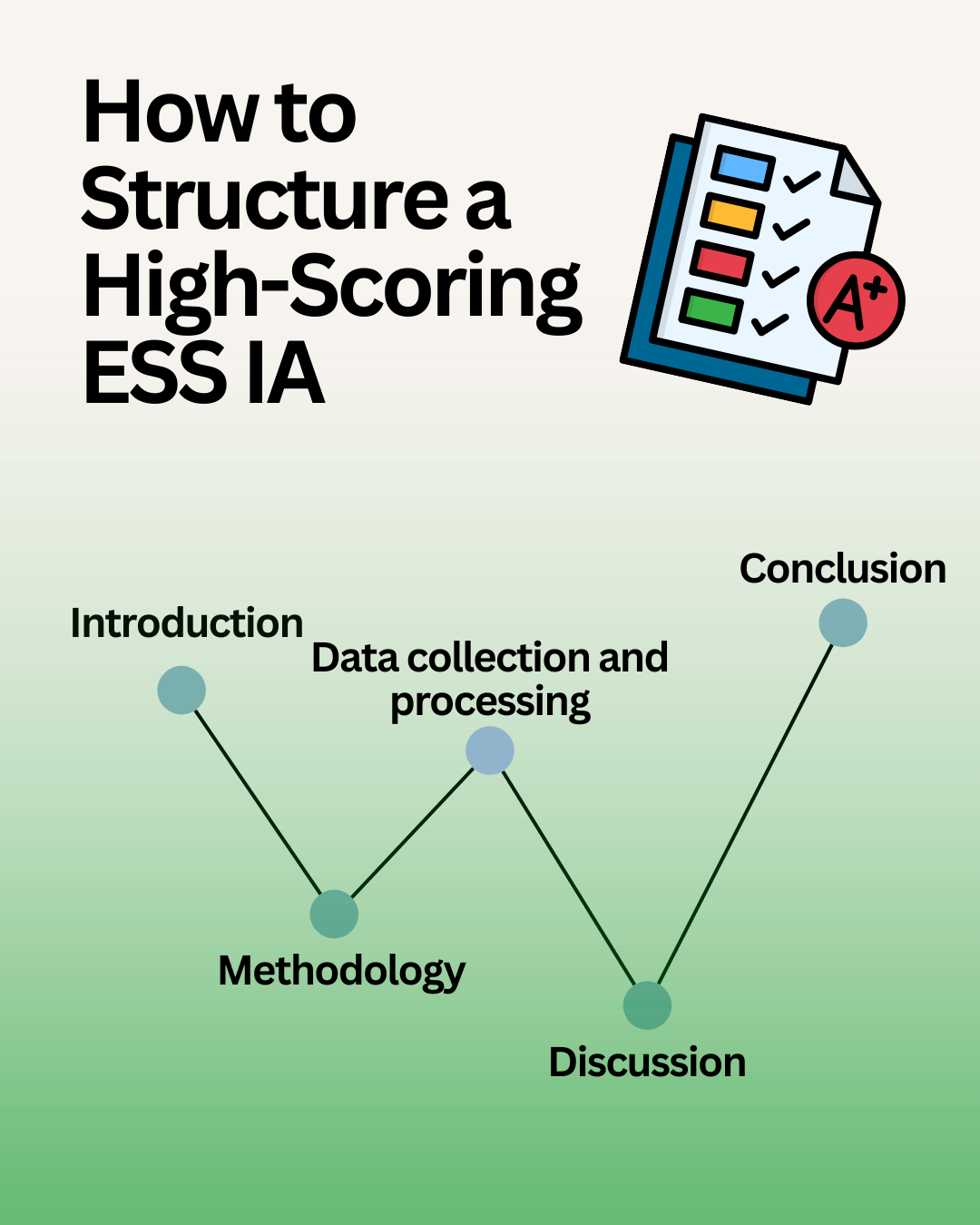
A useful ESS IA structure makes your investigation easy to follow: the reader should see what you asked, how you gathered and processed evidence, and how that evidence supports your answer. Headings help organise the report, but a template alone does not determine a mark.
The individual investigation is marked out of 30 using the same six criteria at SL and HL. It contributes 25% of the SL grade and 20% of the HL grade. The report has a maximum of 3,000 words.
ESS IA structure: six criteria to cover
The official criteria are A: Research question and inquiry (4 marks); B: Strategy (4); C: Method (4); D: Treatment of data (6); E: Analysis and conclusion (6); and F: Evaluation (6). The following section order is a suggested writing plan, not a compulsory IB template.
1. Introduce the issue and research question
Explain a focused environmental issue and the background needed to understand your question. Specify the scope so that you can investigate it with the resources available. Avoid an introduction that becomes a broad essay about the whole topic.
2. Explain a strategy and a tension
Include an existing or developing response to the issue central to your investigation. Explain a tension between perspectives associated with that strategy and consider how it could affect environmental or societal outcomes. This is the Strategy criterion; it is different from evaluating weaknesses in your research method.
As an original planning prompt, ask: who might benefit from the response, who might face costs, and why might their priorities differ? Use evidence about the actual strategy instead of inventing stakeholder views.
3. Describe a reproducible method
Explain your sampling, measurements or data selection clearly enough for another reader to follow. Justify choices that affect the quality of your evidence. Consider safety, ethics and environmental impacts where relevant.
Secondary-data investigations are possible: the IA does not universally require your own field measurements. If you use a database, explain your source, selection rules, period, units and processing. A summary of published opinions alone does not replace gathering and analysing data to answer your own question. For further planning help, read our ESS survey and secondary-data guide.
4. Present and process the data
Use readable tables and graphs with informative titles, labels and units. Show how your processing addresses the question. Choose calculations or statistical methods because they suit your data and purpose; adding a complex test without understanding it is unlikely to clarify the investigation.
5. Analyse the evidence and answer the question
Interpret the patterns rather than repeating every value. Use specific evidence when explaining your conclusion, and acknowledge uncertainty or alternative explanations. Check that the scope of your answer matches the scope of your data.
6. Evaluate the investigation
Identify specific methodological limitations, explain their effect on your findings, and suggest realistic improvements. For each point, ask: what is the limitation, why does it matter here, and how would the proposed change help? Avoid a list of generic comments such as “more time” or “human error”.
Report details and word count
State the investigation title, your IB candidate code, group members’ candidate codes if applicable, and word count at the start. A cover page and contents page are not required.
IB excludes charts and diagrams, data tables, equations and calculations, citations, bibliography and headers from the word count. Keep the reasoning needed to assess your work in the main report; do not treat figures or appendices as a way to hide analysis or evaluation.
Check your draft before submission
- Can you trace each major claim back to data or a source?
- Do your question, method and conclusion address the same issue?
- Have you included both strategy and methodological evaluation?
- Can the reader understand your figures without guessing what the units or categories mean?
- Have you written and understood the investigation yourself?
Compare this plan with the official IB ESS guide and your teacher’s current instructions. For a concise companion checklist, see ESS IA format and structure.
Plan your ESS IA with Marija
In individual online IB ESS lessons for SL and HL, Marija can help you understand the criteria, assess whether your question and method fit together, and practise interpreting data. Your investigation and submitted writing remain your own work.
Request a free 20-minute trial lesson and share your level, deadline and the part of the IA you need help understanding.
No Comments