


03 Aug IB Chemistry Exam Plan and Tutor Checklist
TL;DR:
- IB Chemistry emphasizes structure and reactivity, requiring early IA completion and timed practice with the Data Booklet. Mastering foundational concepts and command terms, along with active exam-oriented revision, significantly improves performance. HL students extend SL topics, and thorough planning enhances success in the integrated course and assessments.
IB Chemistry is a two-year Diploma Programme science built around two organizing concepts: Structure and Reactivity. Structure covers particulate models, bonding, and classification of matter. Reactivity covers what drives reactions, how fast and far they go, and the mechanisms behind them. Both SL and HL students study the same framework, with HL going deeper and requiring more teaching hours.

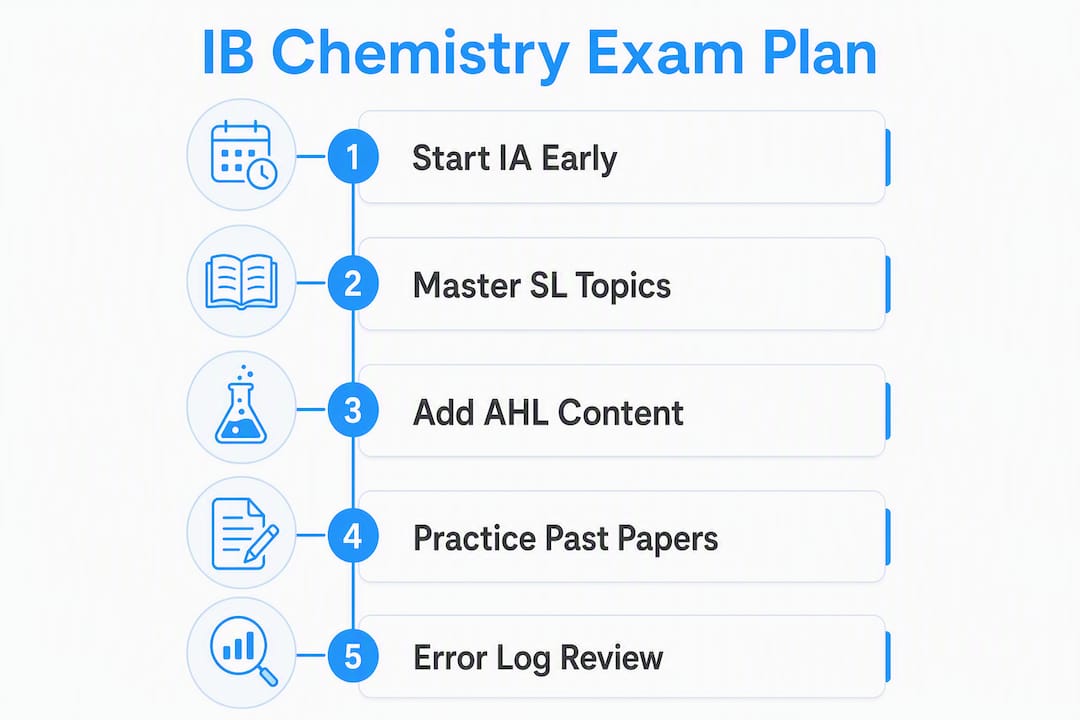
Your single most important first action: start your Internal Assessment early. The IA counts for 20% of your final grade, and leaving it to the final term almost always cuts into paper revision time you cannot afford to lose.
Quick orientation before you plan your study schedule:
- SL vs HL: HL includes Additional Higher Level (AHL) content integrated throughout both strands, not as a separate block. HL students also sit more demanding paper questions.
- Written papers: Papers 1A, 1B, and 2 make up the majority of your grade. They deserve the majority of your revision time.
- Data Booklet: You must practice finding values in it quickly. Fluency with the Data Booklet under timed conditions is a real exam skill.
Table of Contents
- What does the IB Chemistry course actually cover?
- How is IB Chemistry assessed, and what are the rules for each paper?
- Why does the IA matter so much, and how do you plan it well?
- What exam strategies do IB examiners actually reward?
- What does a realistic study timeline look like?
- Where can you find the best IB Chemistry study resources?
- How do you choose an IB Chemistry tutor who actually helps?
- How should HL students balance SL and AHL content?
- How do command terms affect your exam marks?
- How can lab work beyond the IA strengthen your exam performance?
- Key Takeaways
- Useful sources and where to find them
What does the IB Chemistry course actually cover?
The 2025 syllabus reorganized the course away from the old 11-topic model into six broad areas under the two strands.
Structure strand:
- Structure 1: Models of the particulate nature of matter
- Structure 2: Models of bonding and structure (ionic, covalent, metallic, and materials)
- Structure 3: Classification of matter
Reactivity strand:
- Reactivity 1: What drives chemical reactions? (enthalpy, entropy, spontaneity)
- Reactivity 2: How much, how fast, how far? (stoichiometry, kinetics, equilibrium)
- Reactivity 3: What are the mechanisms of chemical change? (proton transfer, electron transfer, electron sharing)
SL students cover the core content in a standard number of teaching hours. HL students add AHL material, leading to significantly more total teaching hours. The AHL content extends SL concepts rather than sitting separately. For example, Reactivity 1.4 (Entropy and spontaneity) is AHL only. This integration means weak SL foundations create real problems at HL.
One important change from the previous syllabus is that the four optional topics have been removed, with some of their content integrated into the core syllabus. Students preparing for the 2025 first-assessment cycle should use specimen papers from 2025 rather than older legacy papers, which reflect a different structure.
How is IB Chemistry assessed, and what are the rules for each paper?
Written papers account for 80% of your final grade. The IA accounts for the remaining 20%.
| Paper | Content | Calculator | Data Booklet | Weighting |
|---|---|---|---|---|
| Paper 1A | Multiple-choice questions | No | No | Part of external 80% |
| Paper 1B | Data-based questions | Yes | Yes | Part of external 80% |
| Paper 2 | Short-answer and extended-response | Yes | Yes | Part of external 80% |
| Internal Assessment | Scientific investigation | N/A | N/A | 20% |
The Data Booklet contains the periodic table, thermodynamic values, spectroscopy tables, and relevant constants. You are not expected to memorize all of it. You are expected to find values fast. Students who have never practiced with it under timed conditions consistently lose time in Paper 1B and Paper 2. Build Data Booklet fluency by using it in every timed practice session from the start.
Paper 1A is the one paper where you get no aids at all. That means mental arithmetic, conceptual reasoning, and pattern recognition carry the full load. Practice it without a calculator from day one.
20% of your IB Chemistry grade comes from the Internal Assessment alone. Starting it early is not optional advice. It is the single highest-leverage scheduling decision you will make.
Why does the IA matter so much, and how do you plan it well?
The IA is a scientific investigation worth 20% of your final mark. Examiners consistently advise completing it early, before the final term, so it does not crowd out paper revision. Under the 2025 assessment model, 50% of IA marks are allocated to Conclusion and Evaluation, which means weak analysis and rushed evaluation are the fastest ways to lose marks.
A practical IA schedule looks like this:
- Choose your research question early. Pick an investigation that directly links to a syllabus concept and uses repeatable, low-cost measurements. This reduces experimental error and the need to redo data collection.
- Draft your research design before touching equipment. Identify your independent and dependent variables, controls, and how you will handle uncertainty.
- Collect data with uncertainty in mind. Record absolute uncertainties for every instrument. Uncertainty propagation is tested in both the IA and Paper 1B, and many students are underprepared for it.
- Analyze and iterate. Calculate percentage uncertainties, draw graphs with error bars, and discuss whether your results support your hypothesis.
- Write your Conclusion and Evaluation last, but give it the most time. This is where half your IA marks live.
Common pitfalls: a weak or missing link to syllabus theory, poorly treated uncertainties, and a rushed evaluation that lists limitations without explaining their impact. A tutor who understands IB marking criteria can catch these before you submit. For a step-by-step workflow you can adapt, the IB ESS IA guide at Esstutor covers documentation standards and experimental design principles that transfer directly to chemistry investigations.
Pro Tip: Pick an IA topic where you can collect at least five data points per trial and repeat trials three times. Repeatability is what gives your uncertainty analysis something real to work with.
What exam strategies do IB examiners actually reward?
Past papers are your most powerful revision tool, but only when you mark them ruthlessly against official mark schemes. Passive re-reading of notes does not build the precision examiners reward.
Three study methods that consistently raise marks:
- Active recall: Use flashcards that force you to rephrase a concept, not just recognize a definition. IB Chemistry demands interconnected understanding across Structure and Reactivity, and active recall builds that network far faster than re-reading.
- Spaced repetition: Review material at increasing intervals. Concepts from Structure 1 will appear in Reactivity questions, so keeping early material fresh matters throughout the two years.
- Timed past-paper practice with mark-scheme review: Sit a full paper under exam conditions, then mark it as an examiner would. Note every mark you lost and why.
For Paper 1A specifically, practice without any aids. For Paper 1B and Paper 2, always have the Data Booklet open and practice navigating it quickly. You can find useful exam practice routines that translate well from IB ESS to chemistry paper training.
Pro Tip: After each timed paper, build a one-page error log. Categorize every lost mark as concept error, calculation error, or command-term error. Review the log weekly. Patterns become obvious fast.
What does a realistic study timeline look like?
Early stage (first year, months 1–8):
- Master SL core content topic by topic before moving to AHL.
- Select your IA research question and draft your research design.
- Begin weekly Data Booklet practice.
Mid stage (months 9–16):
- Complete IA data collection and analysis.
- Start timed past-paper practice (one paper per week minimum).
- Run spaced-repetition reviews of Structure 1 and 2 content.
Final 12 weeks before exams:
- Weeks 12–9: Submit or finalize IA. Begin full-paper timed mocks.
- Weeks 8–5: Two timed mocks per week. Update error log after each.
- Weeks 4–3: Targeted weak-spot revision based on error log patterns.
- Weeks 2–1: At least two full mock sessions under exam conditions. Focus on pacing and mark-scheme language.
- Final week: Light review of Data Booklet layout, key equations, and command-term responses.
A tutor can help you adapt this checklist to your specific weak areas and hold you accountable to the timeline.
Where can you find the best IB Chemistry study resources?
Start with official IB materials, then layer in high-quality practice tools.
- IB syllabus and subject brief: Available on the IB website. Download the Chemistry SL and HL subject brief for a two-page course overview.
- 2025 specimen papers: Use these before any legacy papers. The structure is different enough that older papers can mislead your preparation.
- Official Data Booklet: Download it from the IB and keep a printed copy at your desk for every practice session.
- Past papers with mark schemes: Available through your school’s IB coordinator or through revision platforms that carry examiner-marked materials.
- Flashcard tools: Anki works well for active-recall practice across Structure and Reactivity topics.
- Spreadsheet templates: Build a simple spreadsheet for uncertainty propagation practice. Doing it by hand first, then checking with a spreadsheet, builds speed.
For broader study-skill frameworks that support better academic performance, pairing strong subject knowledge with proven learning habits makes a measurable difference.
How do you choose an IB Chemistry tutor who actually helps?
Consider hiring a tutor when your mock scores are inconsistent, your IA draft is stalling, or you are losing marks on command-term questions without understanding why.
What to look for:
- IB marking experience: A tutor who has marked IB papers understands exactly what earns and loses marks. This is different from general chemistry knowledge.
- Familiarity with the 2025 syllabus: The Structure + Reactivity framework is new. A tutor still teaching the old 11-topic model will not prepare you for current papers.
- IA support: Can they review your research design, uncertainty treatment, and Conclusion and Evaluation against the actual criteria?
- Session format: Live problem-solving sessions beat passive lectures. You want a tutor who works through past-paper questions with you, not one who re-explains theory you already read.
- Measurable impact: Track your mock scores before and after tutoring. If scores are not improving within four to six sessions, discuss a different approach.
Pro Tip: Ask any prospective tutor to spend the first 30 minutes on a past-paper question and a quick review of your IA outline. That single session tells you more about fit than any introductory conversation.
How should HL students balance SL and AHL content?
HL students often make the mistake of treating AHL content as a separate subject to tackle after SL. It is not. AHL extends SL concepts rather than replacing them, so a shaky SL foundation makes AHL genuinely difficult.
The practical approach: master each SL topic before adding its AHL extension. For example, work through Reactivity 1.1–1.3 (enthalpy, energy cycles, fuels) before tackling Reactivity 1.4 (entropy and spontaneity, AHL only). This keeps your understanding connected rather than fragmented.
HL students also face more demanding quantitative questions in Paper 2. Build calculation fluency at SL first, then extend to the more complex AHL scenarios. Spaced repetition of SL material throughout the HL year prevents the common problem of forgetting core content while focusing on AHL.
How do command terms affect your exam marks?
Command terms are the verbs in exam questions: define, explain, deduce, evaluate, justify, predict. Each one signals a specific type of response, and using the wrong type loses marks even when your chemistry knowledge is correct.
The most commonly misused terms:
- State requires a brief, factual answer with no explanation.
- Explain requires a mechanism or reason, not just a description.
- Deduce means use given data to reach a conclusion. Show your reasoning.
- Evaluate means weigh evidence and reach a judgment. A list of pros and cons without a conclusion does not satisfy this term.
Practice by pulling command-term questions from past papers and writing responses that match the term exactly. Then check against the mark scheme to see whether your response structure earned full marks. Precise domain-specific vocabulary paired with the correct command-term response is what separates a 5 from a 7.
How can lab work beyond the IA strengthen your exam performance?
Practical work in class is not just preparation for the IA. It builds the experimental reasoning skills tested directly in Paper 1B and Paper 2. Questions on data analysis, uncertainty, and experimental design appear on every paper, and students who have done real lab work answer them more confidently.
After any class experiment, ask yourself: What were the sources of error? How would I reduce them? What does the uncertainty in my measurements mean for my conclusion? These are exactly the questions Paper 1B data-based questions ask. Treating every lab session as IA and exam practice, not just a required activity, builds the analytical habits that show up in your marks.
Key Takeaways
IB Chemistry rewards students who start the IA early, practice with the Data Booklet in every timed session, and use active recall rather than passive review.
| Point | Details |
|---|---|
| Start the IA early | The IA is worth 20% of your final grade; completing it before the final term protects paper revision time. |
| Master SL before AHL | HL students who solidify SL foundations first find AHL extensions far more manageable. |
| Practice with the Data Booklet | Fluency with the Data Booklet under timed conditions is a distinct exam skill, not a given. |
| Use active recall daily | Flashcards that force rephrasing build the interconnected understanding IB Chemistry demands. |
| Run at least two full mocks | Complete at least two timed mock sessions in the final month to build stamina and pacing. |
What an experienced IB tutor sees in chemistry students
Students who struggle most in IB Chemistry are rarely the ones who lack ability. They are the ones who underestimate the IA’s time cost and overestimate how much passive review will carry them through the written papers. The same pattern shows up in IB ESS: students who treat the IA as a final-term task and rely on re-reading notes consistently underperform relative to their potential. Focused tutor support changes this by making the IA a structured, early-stage project and by replacing passive review with active, examiner-aligned practice. If you are preparing for IB Chemistry and want that kind of structured support, IA tutoring with Esstutor brings the same examiner-informed approach to your investigation and paper preparation.
Useful sources and where to find them
Use these resources alongside your tutor or independently, depending on the task.
Official IB materials (use with tutor and independently):
- IB Chemistry course page: syllabus overview, subject brief downloads, and course philosophy.
- IB Chemistry updates page: official notes on the 2025 first-assessment changes and removed option topics.
High-quality practice resources (use independently for daily revision):
- 2025 specimen papers: download through your school’s IB coordinator or the IB’s Programme Resource Centre.
- Examiner-marked past papers with mark schemes: the most direct way to calibrate your answers to what earns marks.
- Anki or similar spaced-repetition tools: build decks organized by Structure and Reactivity subtopics.
Tools for IA and data work (use with tutor for best results):
- A simple spreadsheet for uncertainty propagation practice.
- Graphing tools (Google Sheets or Desmos) for plotting data with error bars.
“The IB chemistry program design provides a smooth transition to a Bachelor of Science degree… The emphasis of scientific inquiry, understanding of global problems, exposure to real-world scenarios and developing techniques in the chemistry laboratory are important skills for an undergraduate student.” — IB Chemistry subject brief
No Comments