


17 Sep Manage IB Deadlines: 15 Practical Tactics to Keep Weekends Free
Use one master calendar, reverse-plan every deadline, and break big projects into mini-deadlines with buffer days between drafts and submission. Start with three things this week: build your master calendar, block a 20 to 30 minute weekly triage, and schedule one deep-work sprint. This is the same reverse-planning logic the IBO expects from your Extended Essay and CAS timelines, built into a Task Ladder you can run yourself.
TL;DR:
- Prioritize scheduling buffer days and weekly triage sessions to identify and resolve deadline conflicts before they escalate into emergencies.
- Break large assessments into mini-deadlines spaced evenly with clear checkpoints, especially for extended essays and internal assessments, to avoid last-minute pressure.
- Focus on mark impact and proximity when managing tasks, giving higher priority to deadlines with greater weight or sooner due dates over those causing anxiety.
- Keep all deadline, task, and feedback information in one unified system to prevent missed dates and ensure quick updates when changes occur.
- Use targeted tutoring sessions aligned with specific steps in your task ladder to accelerate progress and receive precise examiner-level feedback on drafts.
Table of Contents
- How Do You Manage IB Deadlines With a Master Calendar?
- 15 Practical Time-Management Tactics You Can Start This Week
- What Is a Task Ladder for the EE and IAs?
- Weekly Triage and What to Do When Deadlines Start Piling Up
- How to Build an IB Revision Timetable Around Internal Deadlines
- Which Tools Actually Help You Track IB Deadlines?
- How Does IB Tutoring Fit Into a Task Ladder?
- How Do You Handle a Deadline Change or an Unexpected Extension?
- What Time-Management Techniques Work Best During IB Assessment Periods?
- Can You Keep Extracurriculars While Managing IB Deadlines?
- Quick Perspective: Systems Beat Panic
- Turn Your Task Ladder Into Scheduled Tutoring Sessions
- Where to Verify Official Dates and Find Templates
- Sources
- FAQ
How Do You Manage IB Deadlines With a Master Calendar?
A master calendar is the single place where every IB deadline lives, and it has to go in a specific order. Import your coordinator’s official dates first, then teacher-set internal deadlines, then mock exam dates, then your own personal checkpoints. Building it backward, personal plans first, is how deadline collisions happen in October and get discovered in April.
School-adoption research on IB scheduling backs this up directly: cohorts that standardize on one color-coded, centrally maintained calendar report fewer deadline pile-ups and smoother internal moderation, according to ManageBac’s analysis of IBDP deadline management. The calendar isn’t just a place to dump dates. It’s the tool that exposes conflicts before they become emergencies.
Your master calendar needs these fields for every entry:
- Subject and assessment type (EE draft 2, ESS IA data collection, TOK exhibition commentary)
- Official due date pulled straight from your coordinator’s published list
- Draft checkpoint and feedback checkpoint, each dated separately from the final submission
- Color code by subject so a glance at the week shows where the pressure sits
- Buffer day, marked explicitly, sitting between your personal draft deadline and the real one
Color-coding matters more than it sounds. When Biology is blue, ESS is green, and TOK is orange, you can spot a three-subject collision in a single week just from the visual pattern, without reading a single date.
Reserve one unscheduled evening every week, no exceptions. It’s not free time in the loose sense. It’s the shock absorber that catches whatever slipped, so Tuesday’s overrun doesn’t eat into Thursday’s IA session. Review the whole calendar every Sunday for ten minutes and update it as teachers add or shift dates.
15 Practical Time-Management Tactics You Can Start This Week
Big systems fail when the daily habits underneath them are weak. These are the specific moves that make a master calendar actually function.
- Run a Weekly Triage every Sunday. Scan the coming two weeks, pick three wins you must land, and assign each one a concrete microtask.
- Schedule focus sprints, not vague “study time.” Block 90-minute windows named for a task (“ESS IA data analysis”), not a subject.
- Set personal deadlines two to four days ahead of official ones. That gap is your buffer, and it exists so a bad day doesn’t become a missed deadline.
- Prioritize by mark impact and proximity, not by anxiety. The IA due in nine days beats the homework due tomorrow if the IA carries more weight and less flexibility.
- Batch small admin tasks (formatting citations, checking word counts) into one 20-minute block instead of scattering them across the week.
- Protect your first sprint of the day for the task you’re most likely to avoid.
- Write down the next physical action, not the whole project, at the end of every session, so tomorrow starts moving instead of thinking.
- Cap open tabs and notifications during sprints. A single distraction blocker beats three half-installed apps.
- Review teacher feedback within 48 hours while it’s still fresh, instead of letting it sit for a week.
- Track completed microtasks visibly, even with a paper checklist, since visible progress is what keeps momentum alive during a six-week IA stretch.
- Build in a recovery slot each week for whatever fell behind, rather than assuming everything will go to plan.
- Say no to one nonessential commitment per busy week, and mean it.
- Ask one specific question per teacher check-in, not five vague ones, so feedback turns into action fast.
- Do the hardest task before checking messages, not after.
- Close each week by naming next week’s three wins, before you close your laptop on Friday.
Pro Tip: Prioritizing by mark weighting instead of by which task feels most urgent will save you more grief than any calendar app. A ten-minute Biology quiz feels loud in your head, but a stalled Extended Essay draft costs far more in the long run.
These are the exact tactics practical IB guides point to when explaining why some students avoid the late-submission spiral entirely, according to Sparkl’s breakdown of the DP1 deadline system. None of them require new software. They require fifteen minutes of setup and a Sunday habit.
What Is a Task Ladder for the EE and IAs?
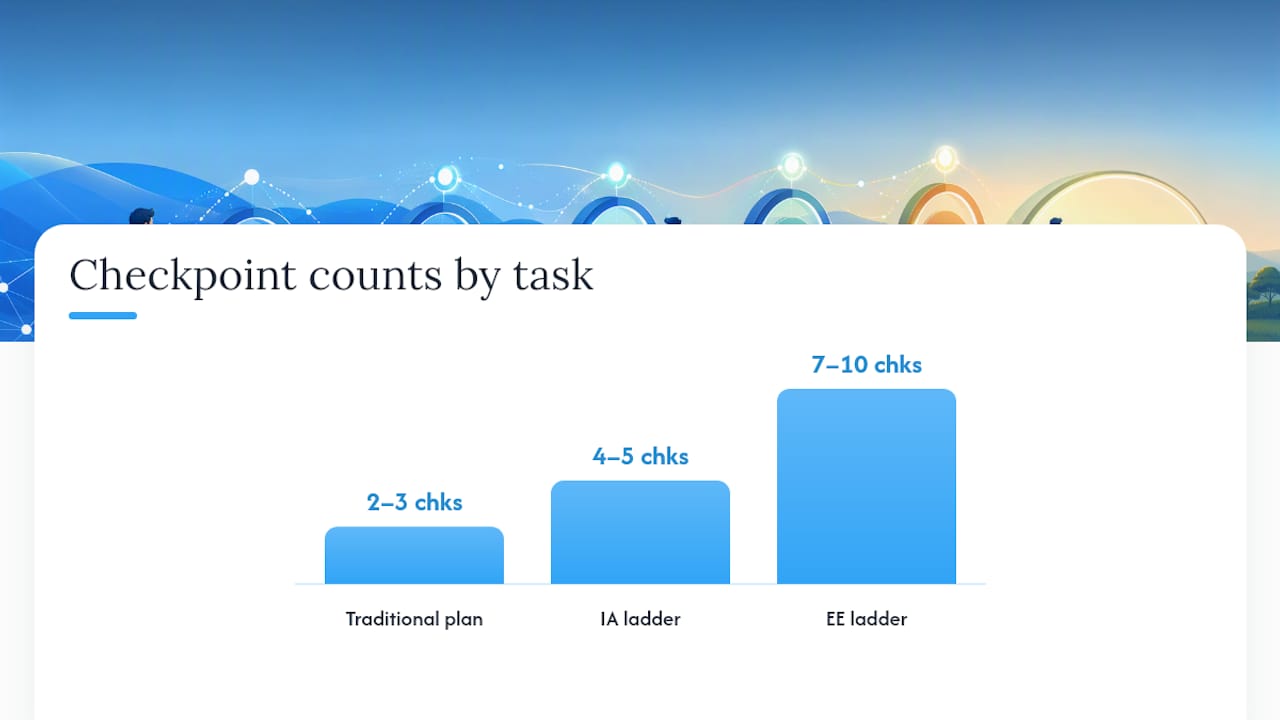
A Task Ladder breaks one large deliverable into a sequence of small, verifiable steps, each with its own date. A Deadline Ladder does the same thing but works backward from the official due date, spacing checkpoints so no single step is ever more than a few days of work.
For the Extended Essay, frameworks built around this idea recommend splitting the essay into seven to ten mini-deadlines rather than the usual two or three, according to Sparkl’s guide to EE mini-deadlines. A workable ladder for an ESS Extended Essay might look like this:
- Research question finalized and approved by supervisor
- Literature review draft, 400 words, with three citations
- Methodology section drafted and data collection plan confirmed
- Raw data collected and organized
- Analysis draft with at least one graph or table
- Full draft one submitted for supervisor feedback
- Feedback review meeting, three specific questions ready
- Revised draft two
- Final formatting and citation check
- Submission, with a buffer day sitting before the real deadline
Our guide to planning an ESS Extended Essay walks through how to adapt this sequence to your own research question. An IA ladder runs shorter, usually four to five rungs: design, data collection, analysis, draft, and final polish.
Where you place teacher feedback matters as much as the ladder itself. Schedule the feedback checkpoint at least four days before your personal draft deadline, never the official one, so there’s room to actually revise. When you sit down with a teacher, bring one specific question (“does my methodology section justify the sample size I used?”) instead of “can you check this over?” Specific questions get specific, fast answers. Vague ones get a full rewrite request three days before submission.
Weekly Triage and What to Do When Deadlines Start Piling Up
Run this checklist every week, same day, same time, until it’s automatic:
- Scan the next fourteen days on your master calendar and flag anything within five days.
- Pick three wins, the tasks that matter most by mark weight and proximity.
- Break each win into one microtask you can finish in under an hour.
- Check for collisions, two deadlines landing in the same 48-hour window, and move something now.
- Confirm your buffer days are still intact and haven’t quietly been eaten by other commitments.
When several deadlines collide anyway, and they will at some point in DP2, run this five-step recovery protocol instead of panicking:
- List everything due in the next ten days, in order.
- Mark which items are truly must-submit versus flexible.
- Schedule immediate sprints for the must-submit items first, today, not tomorrow.
- Drop or delay one nonessential commitment to free real hours.
- Contact the relevant teacher early, with a short plan: what’s done, what’s left, and a realistic new date.
That last step matters more than students expect. Early communication paired with a concrete plan tends to produce far better outcomes than silence followed by a missed deadline. Keep one unscheduled evening and a consistent sleep window even during the worst weeks. A recovery sprint at midnight rarely produces work worth submitting.
Pro Tip: If two deadlines collide, the task with the bigger IB mark weighting almost always wins, even if the smaller task feels more urgent right now.
How to Build an IB Revision Timetable Around Internal Deadlines
Start earlier than instinct tells you to. Effective IB revision windows typically run eight to twelve weeks before the May session and six to ten weeks before November, and they need to be built around your existing internal deadlines, not stacked on top of them.
Structure the window in two phases:
- Weeks one through four (roughly): content review, organized by topic weakness rather than syllabus order.
- Remaining weeks: shift almost entirely to timed past papers, since exam technique under time pressure is what separates a 5 from a 6 more often than raw content knowledge.
Protect your EE and IA slots as fixed appointments during this window, not as tasks you’ll “get to” between revision sessions. If your Extended Essay draft is due in week three of your revision window, that slot stays locked regardless of how the revision plan feels.
Allocate Higher Level subject time proportionally to weighting and difficulty, not evenly across six subjects. If HL Biology and HL Geography carry more of your predicted grade risk than SL French, they get more hours, plainly.
A rough DP2 month-by-month shape, adaptable to your own coordinator’s dates: October and November settle EE drafts and IA data collection; December and January push IA analysis and first full drafts; February handles TOK exhibition and revision planning; March and April run the heavy revision window; May is exam execution with light maintenance only. Our ESS revision workflow guide breaks this down week by week for ESS specifically.
Which Tools Actually Help You Track IB Deadlines?
Keep the stack small. One calendar, one task list, one notes location. Every extra app is another place a deadline can get lost.
- Use your master calendar for dates only, nothing else, so it stays scannable.
- Use a single task list (a simple app or even a notebook) for the microtasks your Weekly Triage generates.
- Keep one notes location per subject for feedback, questions for teachers, and draft ideas.
- Sync your calendar across phone and laptop so a change made in one place shows everywhere.
- Run focus sprints with a simple timer, 90 minutes on, short break, and pair it with a basic distraction blocker during sprint time.
- Use explicit file versioning (something like
EE_draft_v20260315) so you and your supervisor never confuse which version is current. - For structuring drafts and organizing research honestly, a tool like AmmarAI’s study support can help with planning without doing the thinking for you.
The goal isn’t more tools. It’s fewer places where a deadline can hide.
How Does IB Tutoring Fit Into a Task Ladder?
A tutoring session scheduled against a specific rung of your Task Ladder, rather than requested open-ended, produces faster revision cycles because the feedback targets exactly what’s stuck. That’s the model an IB examiner with over 13 years of teaching and examining experience uses when working through ESS and Geography drafts with students.
Bring three things to make a session count: the specific draft version, three targeted questions (not “can you check this?”), and any data or evidence you’re unsure how to interpret. The tutor slots into your ladder at the feedback checkpoint. Your ownership of the timeline stays intact.
How Do You Handle a Deadline Change or an Unexpected Extension?
Deadlines shift. Coordinators adjust internal dates, teachers grant extensions, and occasionally the IBO issues broader scheduling updates that ripple down through your school’s calendar. Treat every change the same way: update your master calendar immediately, the same day you hear about it, not the next time you happen to open it.
An extension is not extra room to relax. It’s extra room to strengthen the work, and the students who use it that way are usually the ones who asked for it with a plan attached rather than a vague “I need more time.” If you request an extension, name exactly what’s done, what’s left, and the specific date you’re proposing. Teachers respond faster to a concrete plan than an open-ended request.
When a deadline gets pulled earlier, which happens more often around mock exam periods, run your Weekly Triage immediately rather than waiting for Sunday. Check whether the new date collides with anything else on your calendar, and if it does, apply the five-step recovery protocol right away instead of hoping it resolves itself.
Confirm any change through your coordinator, not through classroom rumor. Secondhand deadline information is one of the more common sources of real deadline pile-ups, and it’s entirely avoidable with one email.
What Time-Management Techniques Work Best During IB Assessment Periods?
Assessment periods, mocks, internal deadline clusters, and the exam session itself each demand a slightly different rhythm than a normal school week.
During mock exam weeks, shrink your task list to the absolute essentials and lean harder on the buffer days you’ve already built in. This isn’t the week to start a new IA data set. It’s the week to protect the sprints you already scheduled and skip anything flexible.
During internal deadline clusters, when two or three IAs land in the same fortnight, your Weekly Triage becomes daily instead of weekly for that stretch. Ten minutes each morning naming the day’s one non-negotiable task keeps you from freezing when three things feel equally urgent.
During the exam session itself, shift entirely from production mode to retrieval mode. Past papers, timed and under real conditions, matter more now than any content review. Keep your sleep schedule steady even if it means finishing a review session earlier than you’d like. A tired brain doesn’t retrieve well no matter how many hours you put in the night before.
The common thread across all three periods: your buffer days and unscheduled evening don’t get canceled just because the pressure is higher. They matter more precisely when the pressure is higher, since that’s exactly when something is likely to slip.
Can You Keep Extracurriculars While Managing IB Deadlines?
Yes, but only if extracurriculars get the same calendar treatment as coursework instead of living in a separate mental space. Put CAS hours, sports commitments, and club meetings directly on your master calendar in their own color, alongside your academic deadlines.
The mistake most DP students make isn’t doing too many activities. It’s treating academic deadlines as fixed and extracurricular time as infinitely flexible, which means the activity always loses when a collision happens, and burnout creeps in from the other direction when nothing ever gets protected. Pick two or three activities that genuinely matter to you and protect their time slots the same way you protect an IA sprint.
When a genuine collision hits, say a tournament falls the same week as an EE draft deadline, that’s exactly what your buffer days exist for. Use one now instead of saving it for a crisis that never comes. If the collision is severe enough that a buffer won’t cover it, that’s the moment to request an extension with a specific plan attached, the same script covered above for unexpected deadline changes.
Quick Perspective: Systems Beat Panic
The students who struggle least with IB deadlines aren’t the ones with the most willpower. They’re the ones running the smallest, most boring habit consistently: a ten-minute Sunday triage, a buffer day nobody skips. Heroic all-nighters don’t scale across two years of coursework. Pick one habit, the Weekly Triage or a personal early deadline, and test it for two weeks before adding anything else.
— Marija
Turn Your Task Ladder Into Scheduled Tutoring Sessions
Tutoring gives you what a generic study group or a stack of past papers can’t: direct, examiner-level feedback slotted into your own Task Ladder, so every session targets the exact rung you’re stuck on instead of a generic review. A session can cover timeline planning for your IA or EE, focused feedback on a specific draft, or line-by-line edits when you’re close to a deadline and need precision, not a full rewrite.
If you’ve never worked with an ESS or Geography tutor before, the Trial Plan runs €34 for a 20 minute session, a low-risk way to see how a targeted check-in fits into your ladder. For a full working session, the Basic Plan is €120 for 60 minutes. Students working specifically on internal assessments can book through the ESS IA tutoring page, where sessions are built around exactly the kind of draft feedback checkpoint your Deadline Ladder already has scheduled.
Bring your draft, your three questions, and your calendar. Book a short planning session this week and turn one of those ladder rungs into a date that’s actually locked in.
Where to Verify Official Dates and Find Templates
Always confirm formal rules and dates through the IBO’s own Diploma Programme core pages, never secondhand. For school-wide calendar systems, ManageBac’s deadline management guidance is worth a look, and our ESS coursework workflow guide includes adaptable Task Ladder and Weekly Triage templates.
Sources
- Diploma Programme core: creativity, activity, service (IBO)
- Unleashing the power of deadline management for the IBDP – ManageBac
- IB DP time management: the DP1 system that prevents deadline pile-ups – Sparkl
FAQ
Is a 26 a Bad IB Score?
A score below the global average can limit options at more selective universities, but many programs worldwide still accept it depending on the course and country.
Are IB Exams Being Canceled for 2026?
No official IBO cancellation applies to the current exam session. Always confirm current-year scheduling directly through your school coordinator, since the IBO periodically issues updates that affect specific regions or sessions.
Is a 3 in IB a Failing Grade?
A 3 is a low score but not an automatic fail on its own. The IB diploma has separate failing conditions tied to total points and specific grade combinations across subjects, so one 3 rarely fails a diploma outright.
Is a 37 a Good IB Score?
A high score is considered strong and competitive for most university programs outside the most selective tier. Students aiming for such scores typically need the kind of structured revision timetable and mid-window shift to timed papers covered above.
How Much Does Esstutor’s Tutoring Cost?
The Trial Plan is €34 for a 20 minute session, and the Basic Plan is €120 for a full 60 minute session. Current pricing for ongoing ESS and Geography tutoring packages is listed on the pricing page.
No Comments