


09 Oct Exam Ready IB ESS Command Terms: Examiner Tested Micro Answers
Command terms are the instruction words in IB Environmental Systems and Societies questions that tell you exactly what kind of thinking and response is expected. The one rule that matters more than any other: match the depth of your answer to the term itself, since a “describe” question answered like an “evaluate” question, or the reverse, loses marks regardless of content knowledge. The official IB glossary is the authoritative source for what each term requires.
TL;DR:
- For explain, trace cause, mechanism, and effect with linked evidence; for evaluate, name a strength and limitation, weigh them against a criterion, then judge.
- Compare asks for similarities, while contrast asks for differences; discuss presents multiple viewpoints, whereas evaluate requires a supported conclusion based on stated criteria.
- In ESS IAs, the 2024 update calls for exploring tensions between perspectives, so discuss or evaluate answers should identify whose views conflict and why.
- Budget roughly twice as much time for discuss and evaluate as for describe or state, then reread the command term and check your response matches.
Table of Contents
- The official glossary of ESS command terms
- How to answer each command term: model micro-answers
- Where students mix up similar command terms
- What examiners actually look for
- A one-paragraph cheat sheet for exam day
- How I coach students to use command terms
- Practice command terms with guided feedback
- FAQ
- Sources
The official glossary of ESS command terms
The Environmental systems and societies subject outline places the command-terms glossary in its appendices, and it is the language every exam question draws from. We have grouped the terms you will meet most often in ESS papers and IAs, roughly from simple recall to higher-order reasoning.
- Define: give the precise meaning of a term, no extra explanation needed.
- State: give a short answer with no justification or supporting argument.
- List: give a sequence of brief answers with no explanation.
- Identify: pick out and name a feature from given material.
- Outline: give a brief account or summary of the main points.
- Describe: give a detailed account of a process, pattern, or feature as it is, without reasons why.
- Explain: give a detailed account including reasons or causes. In ESS, this usually means tracing a cause, its effect, and the evidence that links them, for example explaining why deforestation increases surface runoff.
- Interpret: use knowledge to recognize trends and draw conclusions from given information.
- Sketch / Draw: represent information through a diagram or graph, labeled appropriately.
- Calculate: obtain a numerical answer, showing the working.
- Suggest: propose a solution, hypothesis, or explanation when there is no single definitive answer.
- Predict: give an expected outcome based on available information, often of a future trend.
- Compare: give the similarities between two or more items.
- Contrast: give the differences between two or more items.
- Analyze: break material into its parts to reveal patterns or relationships, for example analyzing a population pyramid to identify demographic transition stage.
- Discuss: offer a balanced review that includes a range of arguments, factors, or hypotheses, for example discussing the social and ecological trade-offs of a marine protected area.
- Evaluate: weigh strengths and limitations to reach a supported judgment, for example evaluating the effectiveness of a national park policy using named criteria.
- Justify: give valid reasons to support a conclusion or argument.
- Annotate: add short notes to a diagram, graph, or figure to highlight key features.
- Present: show information in a clear, appropriate format, often visual.
Lower-tier terms like define, state, and list sit closer to straightforward recall, while discuss, evaluate, and justify sit at the reasoning end that higher-level IA and exam questions tend to favor.
How to answer each command term: model micro-answers
Seeing a term defined is one thing. Writing to it under exam pressure is another, so here are short models you can adapt.
- Explain (cause and effect): “Explain why eutrophication reduces species diversity in a lake.” A strong answer states the cause (excess nutrient input), the mechanism (algal bloom blocks light, oxygen depletion follows), and the effect (fish and invertebrate die-off), each step linked with “because” or “as a result.”
- Analyze (break into parts): “Analyze the age-sex pyramid of a post-industrial nation.” Identify each structural feature (narrow base, bulging middle, wide top), then connect each one to a demographic cause such as falling birth rate or rising life expectancy.
- Evaluate (balanced judgment): “Evaluate the success of a reforestation program as a climate mitigation strategy.” State at least one strength and one limitation, weigh them against a named criterion such as cost or carbon sequestration rate, and end with a supported verdict.
- Discuss (range of views): “Discuss the ethical tensions in setting fishing quotas.” Present more than one stakeholder perspective, such as conservationists versus local fishing communities, without necessarily settling on a single answer.
As a rule of thumb, allow more words and time for discuss and evaluate responses than for describe or explain ones, since markers expect a fuller range of ideas.
Where students mix up similar command terms
A few pairs cause most of the lost marks we see in practice.
- Compare versus contrast: compare wants similarities, contrast wants differences; many students blend both when only one was asked.
- Describe versus explain: describe reports what is happening, explain adds why it happens; a purely descriptive answer to an explain question stalls at the lowest mark band.
- Discuss versus evaluate: discuss surveys multiple viewpoints without necessarily judging them, evaluate requires a final, justified stance.
- Quick heuristic: underline the command term first, write one phrase next to it naming what it demands, then check your answer against that phrase before moving on.
What examiners actually look for
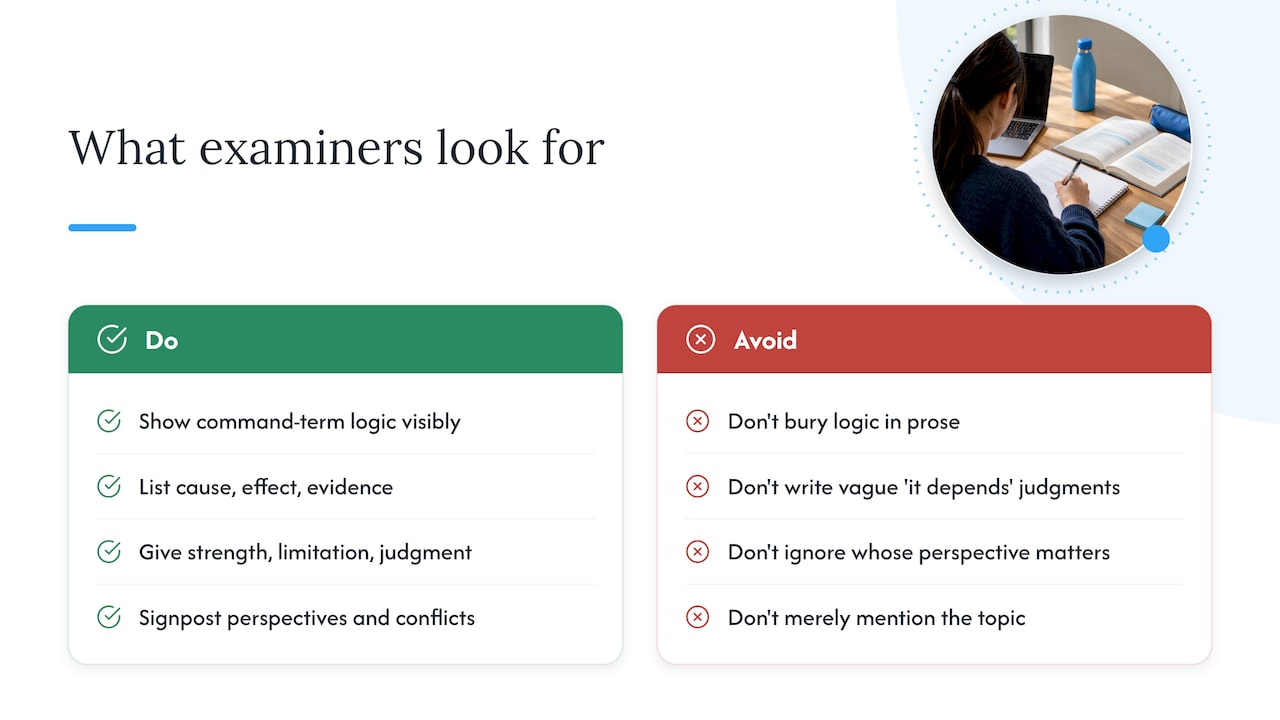
Markers reward answers that make the command term’s logic visible on the page rather than buried in prose. When a question says “explain,” a marker expects to see cause, effect, and evidence named in that order; when it says “evaluate,” a marker looks for at least one named strength, one named limitation, and a judgment tied to a stated criterion, not a vague “it depends.” In IAs specifically, the 2024 curriculum updates call for students to explore tensions between perspectives, so IA wording that leans on “discuss” or “evaluate” now needs to signpost whose perspective is being weighed and why it conflicts with another.
Pro Tip: Before submitting any IA section, circle every command term in your research question and sub-questions, then check each paragraph actually performs that verb rather than just mentioning the topic.
A one-paragraph cheat sheet for exam day
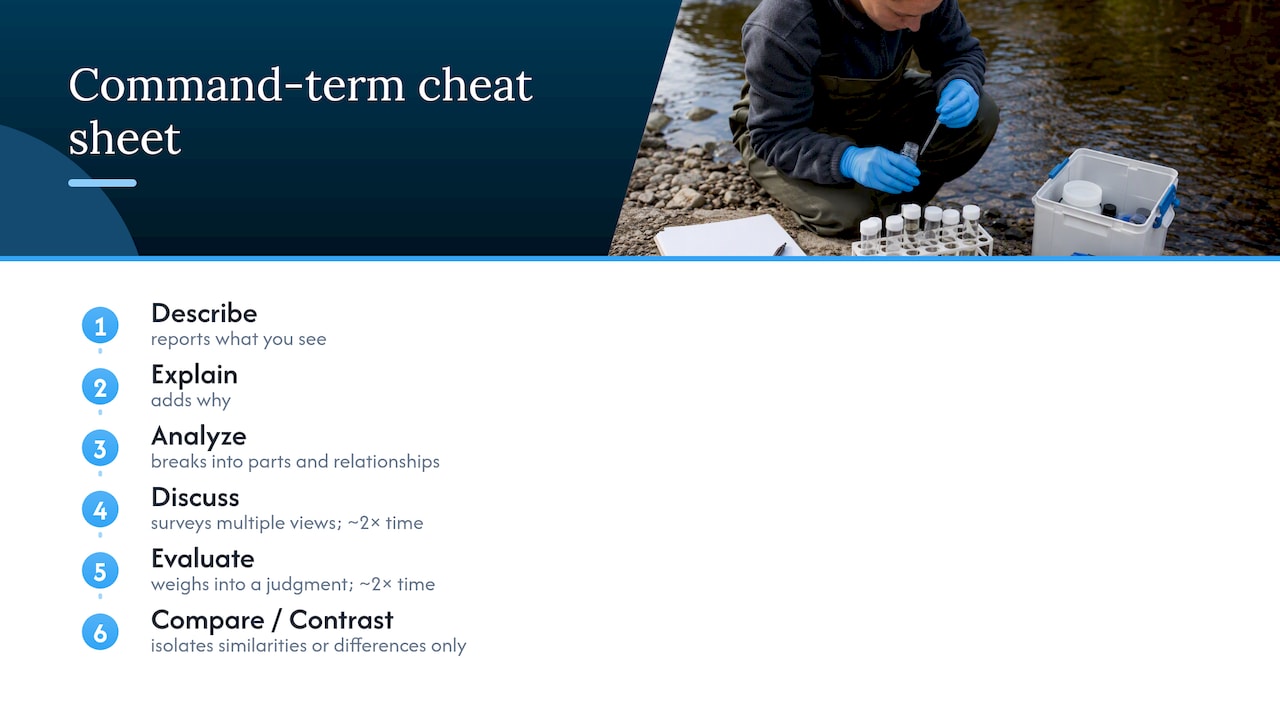
Keep this nearby during revision: describe reports what you see, explain adds why, analyze breaks into parts and relationships, discuss surveys multiple views, evaluate weighs them into a judgment, and compare or contrast isolates similarities or differences only. Two reminders for exam day: reread the command term after drafting your answer to confirm the structure matches, and budget roughly twice the time for evaluate or discuss responses compared to describe or state ones. For the complete official wording, the command terms with definitions in ESS page keeps the full ESS-specific list in one place, and students working across the sciences may also find the IB command terms guide from Tiber Tutor useful for cross-subject practice questions.
How I coach students to use command terms
My rule of thumb is simple: name the command term out loud before you start writing, then name it again when you finish to check your answer still matches. One student I tutored kept losing marks on evaluate questions because every answer stopped at description. Once we rehearsed naming the term before and after each paragraph, the judgments started showing up on the page. Try it on your next three IA paragraphs and see what shifts.
— Marija
Practice command terms with guided feedback
Reading definitions gets you halfway there. Writing to them under real exam conditions, with someone checking whether your “evaluate” actually evaluates, closes the gap faster than any glossary alone. That is the part we focus on in our one-on-one sessions, built around your actual IA drafts and past paper responses rather than generic worksheets.

- A Trial Plan session lets you test how command-term coaching works before committing to more.
- Our IA feedback service reviews your draft specifically for command-term alignment and the 2024+ perspectives requirement.
- Targeted exam-practice sessions walk through past paper command terms one by one until the pattern sticks.
The tutor brings examiner experience in IB ESS and Geography to every session, so feedback reflects what markers are actually trained to look for. If you want a straight answer on where your IA or exam technique stands, book a session through our pricing page and bring your next draft.
FAQ
Is it hard to get a 7 in ESS?
ESS is often seen as more accessible than lab-heavy sciences, but reaching the top grade still depends on precise command-term use, especially in IA sections scored against discuss and evaluate criteria. Students who consistently match answer structure to the command term tend to improve grades faster than those who focus on content alone.
How many words should my ESS IA be?
Word count rules for IB assessments follow the structure and criteria set out in the extended essay presentation guidance, and the same principle of aligning length to task applies to the ESS IA. Check your specific IA task sheet for the exact limit since this is set at the school or course level rather than being one fixed number across all ESS assessments.
Is ESS in IB hard?
ESS combines science and social science content, which some students find more approachable than a single-discipline science, though it still demands precise use of command terms across both exam papers and the IA. The main difficulty students report is less about content and more about matching answer depth to what each command term actually asks for.
How do I structure an ESS IA?
A strong ESS IA structure follows your research question through a clear method, results, and discussion that explicitly addresses command terms like evaluate or discuss where the task calls for them, with particular attention to the 2024 curriculum update on exploring tensions between perspectives. Our guide to writing an effective ESS IA breaks this down section by section.
Sources
- Environmental systems and societies updates
- Environmental systems and societies subject outline
- Extended essay: presentation and word counts (IB publishing)
No Comments