


13 May IB ESS IA explained: your essential guide for top scores
TL;DR:
- Your IB ESS IA accounts for 25% of your SL grade and 20% of your HL grade, making it highly impactful.
- The 2026 syllabus update emphasizes analyzing tensions between perspectives and conducting in-depth evaluations.
Your IB ESS IA carries more weight than most students realize. It accounts for 25% of your SL grade and 20% of your HL grade, making it one of the most impactful pieces of work you will complete in the IB Diploma Program. The 2026 syllabus update adds new criteria that catch many students off guard, especially the requirement to analyze tensions between environmental perspectives. If you are preparing your IB ESS IA right now, this guide breaks down every stage clearly so you can approach it with confidence and aim for the highest marks possible.
Table of Contents
- Understanding the IB ESS IA: weight, structure, and independence
- Mastering the new 2026 criteria: exploring tensions between perspectives and evaluation depth
- Choosing and planning your IB ESS IA investigation for maximum impact
- Collecting, analyzing, and presenting your IA data effectively
- Evaluating and reflecting: critical steps to finalize a high-scoring IA
- My honest take on what separates a 6 from a 7
- Ready to take your IB ESS IA to the next level?
- Frequently asked questions
Key Takeaways
| Point | Details |
|---|---|
| IA weight and importance | Your Internal Assessment makes up about 25% of your final IB ESS grade, so it deserves careful attention. |
| Strict independence | The IA report must be written entirely by you, even if you share some data collection steps. |
| New perspectives criterion | Analyzing conflicting environmental viewpoints is now required to show interdisciplinary understanding. |
| Focused research question | Choose a narrow and testable question relevant to local environmental issues for best results. |
| Critical evaluation | Honest, specific evaluation of limitations and improvements boosts your IA marks significantly. |
Understanding the IB ESS IA: weight, structure, and independence
The IB ESS IA is not just a school project. It is a formally assessed investigation that examiners mark against a detailed rubric, and it can genuinely move your final grade up or down. Understanding what it is before you start writing saves you from costly mistakes.
The IA is a 3,000-word individual report with a strict word limit and no exceptions. Examiners stop reading at 3,000 words, so going over does not help you. Going significantly under usually means you have not developed your analysis or evaluation enough.
Here is what the structure rules mean in practice:
- Word limit: 3,000 words maximum, not including figures, tables, references, or appendices
- Individual work: Your written report must be entirely your own, even if you collected data with classmates
- Shared data: You may share raw data with others in your class, but your analysis, interpretation, and conclusions must be written independently
- Academic integrity: Copying another student’s analysis, even partially, is treated as academic misconduct and can result in a zero
“Collaboration is allowed during fieldwork, but the moment you sit down to write, the report is yours alone. Examiners are trained to spot similarities between submissions from the same school.”
One thing I see students get wrong repeatedly is treating the IA like a group project. You can go out to the field together, measure soil pH together, count species together. But every sentence you write afterward must reflect your own thinking. If you want to boost your IA score, this independence is where it starts.
Mastering the new 2026 criteria: exploring tensions between perspectives and evaluation depth
The 2026 syllabus update changed what examiners expect from your IA in a meaningful way. The biggest shift is the new requirement to explore tensions between perspectives. This is not just listing what an ecocentrist or anthropocentrist might think. It means showing how those worldviews create real conflict in environmental decision-making.
The tensions between perspectives criterion requires you to go beyond describing different viewpoints and actually analyze where they clash. For example, if your IA investigates water quality in a local river, you could explore how a technocentric perspective might favor engineering solutions like filtration plants, while an ecocentrist would argue for restoring natural riparian vegetation. The tension is the disagreement itself, and your job is to unpack why it exists and what it means for environmental management.
Here is what strong perspective analysis looks like in practice:
- Identify at least two contrasting perspectives relevant to your specific investigation topic
- Explain the values and assumptions behind each perspective, not just the surface-level position
- Show where and why they conflict, using evidence from your own data or the literature
- Avoid false balance, where both sides seem equally valid without any critical analysis
For HL students, the bar is higher. HL students must include ethical, economic, and legal viewpoints, analyzing how a resource management issue plays out across multiple years and stakeholder groups. This is genuinely challenging, but it is also where HL students can separate themselves from the pack.
“Examiners reward students who treat environmental issues as genuinely complex. If your perspectives section reads like a simple pros-and-cons list, you are leaving marks on the table.”
The other major area examiners focus on is evaluation depth. Specific, honest evaluation of your methodology’s reliability and validity is critical. A step-by-step IA guide can help you structure this section so nothing gets missed.
Choosing and planning your IB ESS IA investigation for maximum impact
A well-chosen research question makes every other part of the IA easier. A vague or overly broad question makes even good data hard to analyze. Start narrow and specific.
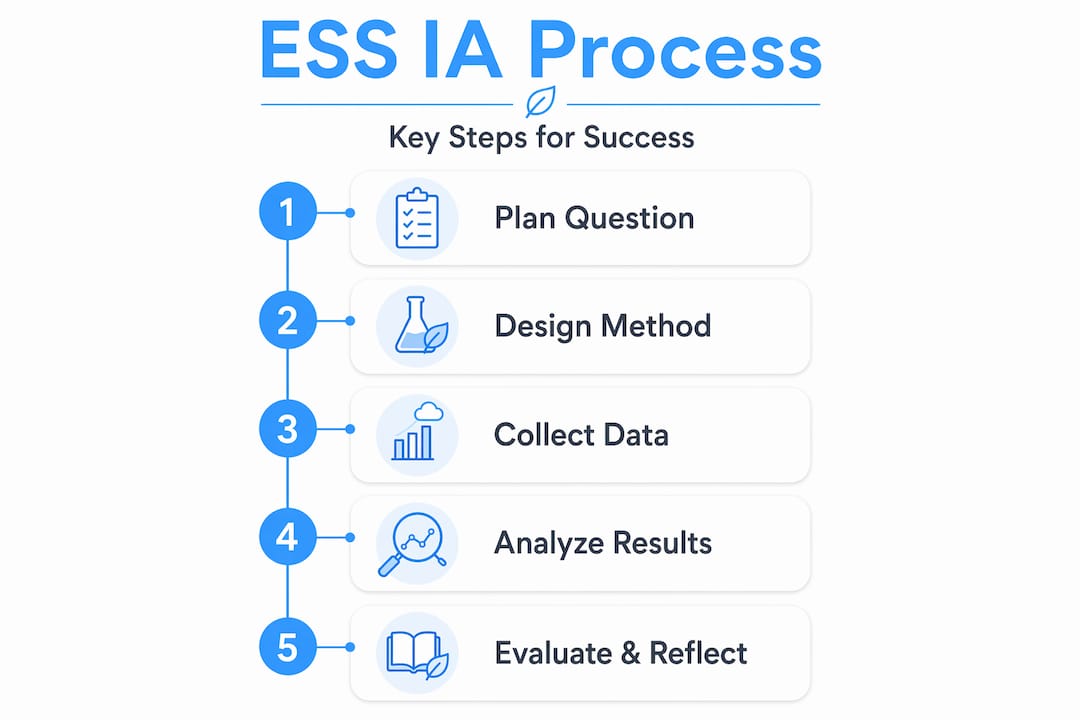
Follow these steps when planning your investigation:
- Start with what is accessible. Choose a local environmental issue you can actually investigate, such as species diversity in a nearby park, water quality in a local stream, or light pollution levels across your neighborhood.
- Write a testable research question. It should name the independent variable, the dependent variable, and the context. For example: “How does distance from the urban center affect macroinvertebrate diversity in [local river name]?”
- Justify your methodology. Explain why you chose your data collection method and why it suits your research question. Examiners want to see that you thought this through, not that you copied a standard protocol.
- Plan your variables and controls. Document your independent variable, dependent variable, and all controlled variables clearly. This is essential for the Exploration criterion.
- Use a system diagram or timeline. High-scoring students plan a timeline or system diagram showing investigation boundaries and feedback loops, which directly supports your Exploration marks.
Pro Tip: Before finalizing your research question, check whether you can realistically collect at least 30 data points under consistent conditions. If the answer is no, revise the question until it is feasible. Insufficient data is one of the most common reasons students lose marks in analysis.
If you want to score a 7 in your IA, your planning stage is where that grade is won or lost. Students who rush into data collection without a clear plan almost always struggle to write a coherent analysis later.
Collecting, analyzing, and presenting your IA data effectively
After planning, the next critical stage is gathering and transforming your data into clear, analyzable evidence. Systematic data collection is not optional. It is what makes your results credible.
Follow these best practices:
- Log exact conditions for every data point: date, time, location, weather, and any variables you could not fully control
- Use the same method every time to reduce procedural variability across your sample
- Aim for at least 30 data points to support meaningful statistical analysis
- Record raw data in clearly labeled tables before processing it
Once you have your raw data, processing it correctly is what earns you analysis marks. Students must use consistent data collection methods and present processed data with appropriate graphs and statistical tests. Here is a quick reference for matching your data type to the right analysis:
| Data type | Recommended visualization | Recommended statistical test |
|---|---|---|
| Continuous vs. continuous | Scatterplot | Pearson correlation or linear regression |
| Categorical groups | Bar chart | t-test or Mann-Whitney U |
| Frequency counts | Bar chart or pie chart | Chi-square test |
| Change over time | Line graph | Trend analysis or regression |

Pro Tip: Every graph needs a title, labeled axes with units, and a brief written interpretation directly below it. Do not assume the examiner will draw conclusions from your graph on their own. State what the graph shows and connect it explicitly to your research question.
Interpreting your results is just as important as presenting them. Discuss patterns, anomalies, and unexpected findings. Link them back to your research question and to ESS theory, such as the species-area relationship, nutrient cycling, or ecological footprint concepts. This is where your understanding of the IB environmental systems guide really shows.
Evaluating and reflecting: critical steps to finalize a high-scoring IA
With data analyzed, your critical evaluation and reflection will distinguish your IA as scientifically mature and high quality. This section is where many students lose marks they should not lose.
Evaluation is a common mark-loser; top IAs discuss limitations, uncertainties, and practical improvements tied directly to the specific investigation. Generic statements like “my sample size could have been larger” without explaining why it matters for your particular results will not earn full marks.
Here is what strong evaluation includes:
- Specific limitations tied to your methodology, such as uncontrolled temperature variation during sampling or observer bias in species identification
- Discussion of reliability, including whether repeating the experiment would likely produce similar results and why or why not
- Discussion of validity, including whether your method actually measured what you intended to measure
- Uncertainty in measurements, especially for any instruments you used
For your improvements, follow this structure:
- Name the specific weakness in your investigation
- Explain how it affected your results or conclusions
- Propose a realistic, concrete improvement that directly addresses that weakness
For example: “Species identification was conducted visually by a single observer, which may have introduced misidentification errors. To improve this, future investigations could use two independent observers and calculate an inter-rater reliability score.”
Finally, reflect on how your findings connect to real-world environmental issues. This is not just a nice addition. It shows examiners that you understand the broader significance of your work within ESS. Connect your results to concepts like biodiversity loss, resource management, or sustainability frameworks covered in the IB ESS study resources you have been using throughout the course.
My honest take on what separates a 6 from a 7
After working with IB ESS students for over 13 years, I have noticed one consistent pattern. The students who score a 7 on their IA are not necessarily the ones who collected the most impressive data or chose the most complex topic. They are the ones who understood the rubric deeply and wrote to it deliberately.
Most students treat the evaluation section as an afterthought. They spend weeks on data collection and then rush through evaluation in an afternoon. That is backwards. Examiners spend a significant portion of their marking time on evaluation because it reveals whether you actually understand your own investigation’s strengths and weaknesses.
The tensions between perspectives criterion is another area where I see students underperform not because they lack knowledge, but because they misread what is being asked. They list perspectives instead of analyzing the tension between them. There is a real difference. Listing is describing what each side thinks. Analyzing tension means explaining why those positions are fundamentally incompatible and what that means for environmental decision-making in your specific context.
One more thing worth saying plainly: the 3,000-word limit is a design feature, not a punishment. It forces you to be precise. Students who write clearly and concisely within the limit almost always score higher than students who try to cram in every piece of information they collected. Edit ruthlessly. Every sentence should be doing real work.
Ready to take your IB ESS IA to the next level?
If you have read this far, you are clearly serious about your IA. That kind of focus is exactly what leads to high scores.
Working through the IB ESS IA alone can feel overwhelming, especially with the 2026 syllabus changes. At ESS Tutor, I offer personalized one-on-one online tutoring sessions designed specifically for IB ESS students worldwide. Whether you need help choosing your research question, structuring your methodology, or writing a strong evaluation, I can guide you through every stage. With over 13 years of experience as an IB examiner and educator, I know exactly what examiners look for. Book a trial lesson today and let’s work on your IA together.
Frequently asked questions
What is the maximum word count for the IB ESS IA?
The IB ESS IA has a strict maximum of 3,000 words; examiners will not mark any content beyond that limit, so going over does not help you.
Can I collaborate with classmates on my IB ESS IA?
You may collaborate during fieldwork and share raw data, but the written report must remain entirely individual to avoid academic misconduct.
How important is evaluating different perspectives in the IA?
It is now a required criterion under the 2026 syllabus. The tensions between perspectives criterion requires you to analyze how differing worldviews create real conflict in environmental decisions, not just list different opinions.
What statistical methods are recommended for the ESS IA?
Use appropriate statistical methods such as mean, standard deviation, correlation analysis, or inferential tests like t-tests and chi-square, depending on your data type and research question.
No Comments