


10 Oct IB ESS Topic 2: What 2.1–2.5 Demand, and How to Practice
Topic 2 covers species and populations, communities and ecosystems, energy and matter flows, biomes and succession, and ecosystem investigations. If you tackle only one thing first, make it energy and biomass interpretation paired with timed unseen-data practice, since this is where most marks slip away. Follow the study sequence below and you will turn scattered notes into exam-ready skills.
TL;DR:
- An inverted aquatic biomass pyramid reflects phytoplankton’s rapid turnover, not greater standing mass; identify the measure, name the unusual trophic level, and explain rapid reproduction.
- For data responses, read the full stimulus first, then state the trend, quote a specific value with units, and explain its cause using accurate terminology.
- Apply the 10% energy transfer rule where relevant; NPP, unlike GPP, is the producer energy available to the next trophic level.
- Over two to three weeks, review systems and core concepts first, then biomes and sampling; finish with timed papers and three data responses weekly.
- HL students face additional breadth and depth in Topic 2, so they should check their own syllabus outline for the extension material required.
Table of Contents
- Syllabus breakdown: 2.1 to 2.5 explained in exam terms
- Energy, biomass and pyramid interpretation with worked examples
- Typical Topic 2 exam question types to target
- Step-by-step study and revision sequence for Topic 2
- Practice resources and how to use each type effectively
- Examiner tips and a checklist for scoring data questions
- What most Topic 2 revision advice gets wrong
- How Esstutor supports your Topic 2 revision
- FAQ
- Sources
Syllabus breakdown: 2.1 to 2.5 explained in exam terms
Each subtopic in Topic 2 has its own exam personality, and knowing what examiners actually test saves you hours of unfocused reading.
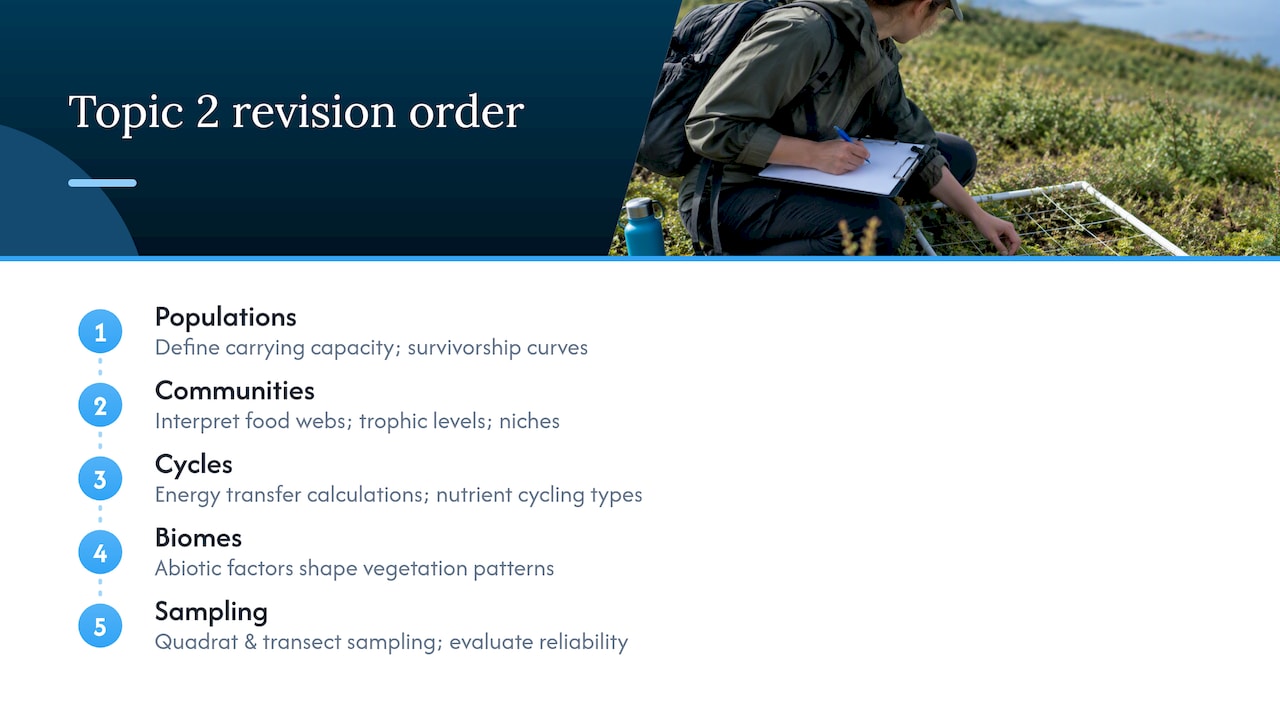
2.1 Species and populations asks you to define carrying capacity, limiting factors, and survivorship curves, often through short-answer recall. 2.2 Communities and ecosystems tests food webs, trophic levels, and niche concepts, usually through diagram interpretation. 2.3 Flows of energy and matter is calculation-heavy: expect questions on energy transfer and the difference between open and closed nutrient cycling. 2.4 Biomes, zonation, and succession rewards students who can describe how abiotic factors shape vegetation patterns over space and time, often through case-study application. 2.5 Investigating ecosystems covers field sampling, including quadrats and transects, and expects you to evaluate data reliability.
A quick anchor for revision order: Populations, Communities, Cycles, Biomes, Sampling. Keep that sequence pinned above your desk and work through each subtopic’s past paper questions before moving to the next. The subject guide confirms that investigation design is a formal learning outcome, so field sampling knowledge is not optional background, it is examinable content. For a deeper look at how these subtopics connect to broader assessment success, our page on why studying ecosystems matters for IB ESS success is worth a read.
Energy, biomass and pyramid interpretation with worked examples
Gross primary productivity (GPP) is the total energy captured by producers through photosynthesis. Net primary productivity (NPP) is what remains after producers use some of that energy for respiration, and it is NPP that feeds the rest of the food chain. Biomass is the total mass of organic matter at a trophic level, usually measured per unit area.
Pyramids of numbers, biomass, and energy all represent trophic levels, but only the energy pyramid is always upright, because energy is lost as heat at every transfer. Biomass pyramids can invert in aquatic systems: phytoplankton have low standing biomass but reproduce so quickly that their productivity still supports larger-bodied zooplankton above them. A student explaining this should mention turnover rate, not just producer size, since that is the detail examiners look for.
To interpret a pyramid well in three sentences: identify the trophic level that looks unusual, state whether the measure is biomass, number, or energy, and explain the inversion using producer turnover rate rather than appearance alone. Markers typically check for:
- Correct labeling of trophic levels and units
- Recognition of the 10% energy transfer rule where relevant
- A clear cause, not just a description of the inversion
For a readable refresher on how producers capture and convert energy in the first place, this explainer on photosynthesis breaks the process down simply.
Pro Tip: Use the phrase “despite lower standing biomass, high turnover rate sustains the trophic level above it” when explaining an inverted pyramid. That exact reasoning pattern tends to score full marks.
Typical Topic 2 exam question types to target
Topic 2 questions appear across Paper 1 (data-response and short-answer) and Paper 2 (structured essays), and knowing the format in advance changes how you prepare.
- Short-answer recall tests definitions like carrying capacity or NPP, worth one or two marks each.
- Data-response questions give you an unfamiliar graph or table and ask you to calculate, describe, and explain, drawing on AO2 and AO3 skills.
- Structured essays in Paper 2 ask you to apply ecosystem concepts to real-world case studies, rewarding AO4 evaluation.
- Diagram-based questions test pyramid or food web interpretation directly.
Across all formats, examiners reward precise terminology, correct units, and answers that link cause to effect rather than just describing a trend. For data-response sections, spend the first minute reading the entire stimulus before answering, since later questions often depend on details from earlier parts of the data set.
Step-by-step study and revision sequence for Topic 2
A good revision sequence moves from vocabulary to application, and the subject guide supports exactly this order: revise core systems vocabulary from Topic 1, then build up through Topic 2’s content before practicing unseen data.
- Revise Topic 1 systems vocabulary (inputs, outputs, flows, storages).
- Master species, populations, and communities with definitions and examples.
- Build food chains into food webs and trophic level diagrams.
- Explain energy and matter flows, including GPP, NPP, and nutrient cycling.
- Practice biomass, productivity, and pyramid interpretation.
- Study biomes, zonation, and succession through named case studies.
- Review investigation design, including sampling methods and data reliability.
- Finish with timed unseen-data and structured-response practice.
For a two to three week revision window, spend the first week on steps one through four, the second week on steps five through seven, and the final days entirely on timed practice papers. Active recall works better than rereading notes, so test yourself on definitions out loud, space your review sessions across several days rather than cramming, and complete at least one full unseen-data question under timed conditions every few days.
Pro Tip: Keep a running list of every term you hesitate on during self-testing. Review that list the night before your exam instead of rereading entire chapters.
Our guide on key concepts in environmental systems pairs well with this sequence if you want extra depth on the energy and matter flow steps.
Practice resources and how to use each type effectively
Different resource types build different skills, so match the tool to the task rather than using everything at once.
- Flashcards work best for definitions and quick recall, like NPP or carrying capacity.
- Timed quizzes build exam pacing, especially for short-answer sections.
- Explainer videos help when a concept like pyramid inversion needs a visual worked example.
- Revision bundles condense an entire topic into a single review session before the exam.
To turn a flashcard set into real practice, do not just read through it. Sort cards into “confident” and “shaky” piles, then spend a focused 30-minute session only on the shaky pile, testing yourself twice before moving on. For biome and zonation content specifically, our types of ecosystems guide offers a condensed overview worth pairing with your flashcard review.
Examiner tips and a checklist for scoring data questions
Thirteen or more years of grading IB ESS papers teaches you exactly where students lose marks, and it is rarely about knowledge gaps. It is about missing structure. A strong data-response answer names the trend, quotes a specific value from the data, and explains the cause using correct terminology, in that order. One small change that reliably lifts scores: always state units when quoting a figure from a graph or table, since examiners mark this separately from the trend description itself.
What most Topic 2 revision advice gets wrong
Most study advice treats Topic 2 as a memorization exercise: learn the definitions, learn the diagrams, move on. That approach misses where marks are actually lost, which is in application and interpretation under time pressure. A student who can define NPP perfectly but freezes on an unfamiliar pyramid diagram will still underperform.
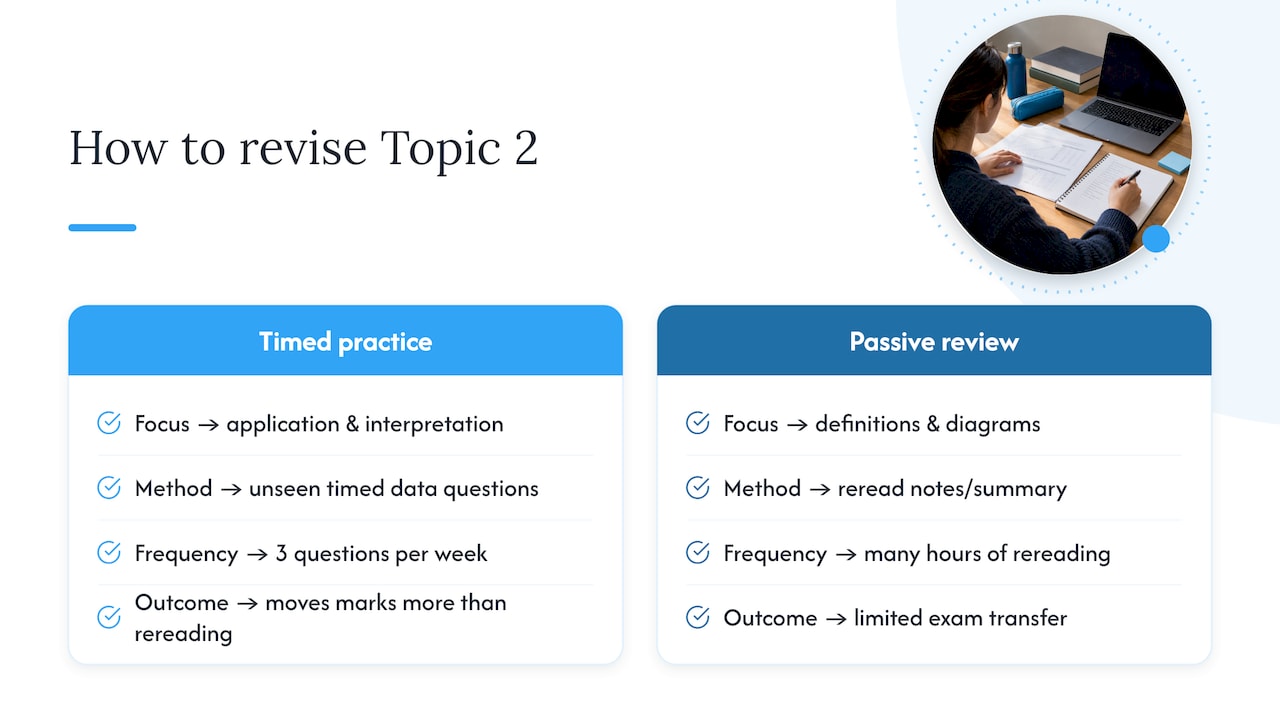
The bigger gap is between knowing a concept and explaining it in exam language. Students often understand why a biomass pyramid inverts but write a vague description instead of naming the turnover rate mechanism examiners want to see. That gap closes only through repeated timed practice on unfamiliar data, not through rereading notes one more time.
If you prioritize one thing differently after reading this, make it unseen-data practice over passive review. Three timed data-response questions a week will move your marks further than ten hours of rereading the same chapter summary.
— Marija
How Esstutor supports your Topic 2 revision
Self-study gets you far, but a guided session can catch the gaps you cannot see on your own, especially on pyramid interpretation and data-response technique. We offer a Trial Plan at 34 € for a 20-minute session, designed to show you exactly how personalized Topic 2 tutoring works before committing further.

- A trial lesson lets us identify your specific weak points in energy flow or biome content.
- Our basic plan provides a 60-minute session focused on the areas you need most.
- We also offer dedicated IA feedback if your internal assessment touches ecosystem investigation methods.
Every session is shaped around your syllabus gaps rather than a fixed script, drawing on more than 13 years of IB examining and teaching experience. If Topic 2 is the section holding back your target grade, booking a trial is the fastest way to find out exactly what to fix.
FAQ
What is the hardest part of IB ESS Topic 2?
Most students find pyramid interpretation and explaining inverted biomass pyramids the hardest part, since it requires linking turnover rate to standing biomass rather than just describing shapes. Timed unseen-data questions on this topic also catch students off guard if they have only memorized definitions.
How do I explain an inverted pyramid in an exam?
State which trophic level looks unusual, confirm whether the pyramid measures biomass, numbers, or energy, and explain the inversion using producer turnover rate rather than physical size. This three-step structure matches what examiners look for in scored answers.
What is the difference between GPP and NPP?
GPP is the total energy producers capture through photosynthesis, while NPP is what remains after producers use some of that energy for their own respiration. NPP is the energy actually available to the next trophic level.
How should I structure my Topic 2 revision schedule?
A practical sequence moves from vocabulary and populations through food webs, energy flows, biomes, and investigation design, finishing with timed practice papers, as outlined in the subject guide. Spreading this across two to three weeks with daily self-testing works better than last-minute cramming.
Does HL require more depth in Topic 2?
Yes, HL students cover additional breadth and depth within Topic 2 compared to SL, according to IBO’s curriculum updates. Check your syllabus outline to confirm which extension material applies to your course.
Sources
- Environmental Systems & Societies Subject Guide (Topic 2: Ecosystems and ecology)
- Environmental systems and societies updates — IBO
No Comments