


04 Sep IB Geography Paper 3: Format, Case Studies and Timed Practice
Geography Paper 3 is the HL-only Global Interactions paper: one hour, one question chosen from three, with a 12-mark part (a) and a 16-mark part (b), totalling 28 marks. Prepare across Units 4 to 6 and practise applying evidence to the exact question. A set of case-study dossiers can help organise revision, but four to six cases is not an IB requirement or a guarantee of sufficient syllabus coverage.
TL;DR:
- Read both parts before choosing one of the three questions. Plan a response to each part of your chosen question; do not combine parts from different questions.
- Build a varied set of case-study notes covering relevant scales and contexts across Units 4 to 6. Check coverage against the syllabus rather than assuming a fixed number will fit every question.
- Strong answers require explicit application of concepts to specific evidence, clear evaluation with a point of view, and accurate labeling of figures and maps.
- Practicing timed responses weekly helps develop pacing, with more time allocated to the 16-mark answer to emphasize analysis and evaluation.
- Feedback on practice answers can help identify gaps in knowledge, evidence and evaluation. Use a teacher, study partner or tutor where appropriate; improvement depends on how you apply the feedback.
Table of Contents
- What Is IB Geography Paper 3 Format, Timing, and Marks?
- What Does Paper 3 Test? Global Interactions Mapped to Exam Skills
- How Do You Write for the Markscheme? 12-Mark vs. 16-Mark Answers
- Case Dossier Strategy: A One-Page Template for 4 to 6 Studies
- How Should You Plan and Use Maps or Figures in Your Answers?
- Where Can You Find Reliable Practice Materials for Paper 3?
- What Do Examiners Actually Look for on Paper 3?
- How Should You Structure a Six-Week Paper 3 Revision Plan?
- What Documents and Resources Should You Have on Hand?
- A Coaching Note on What Actually Moves the Needle
- Get Targeted Paper 3 Coaching Before Your Exam
- Sources
What Is IB Geography Paper 3 Format, Timing, and Marks?
Paper 3 hands you three combination questions, and you answer just one of them in full. Each question splits into two parts: part (a) and part (b), and both parts must be answered from the same question. You cannot mix and match between questions, so the choice you make in the first two minutes of the exam matters more than almost anything else you do that hour.
Paper 3 is worth 20% of the HL Geography assessment; the HL IA is also worth 20%. Check the current subject guide and your exam session’s instructions. Both parts of your selected question must be answered.
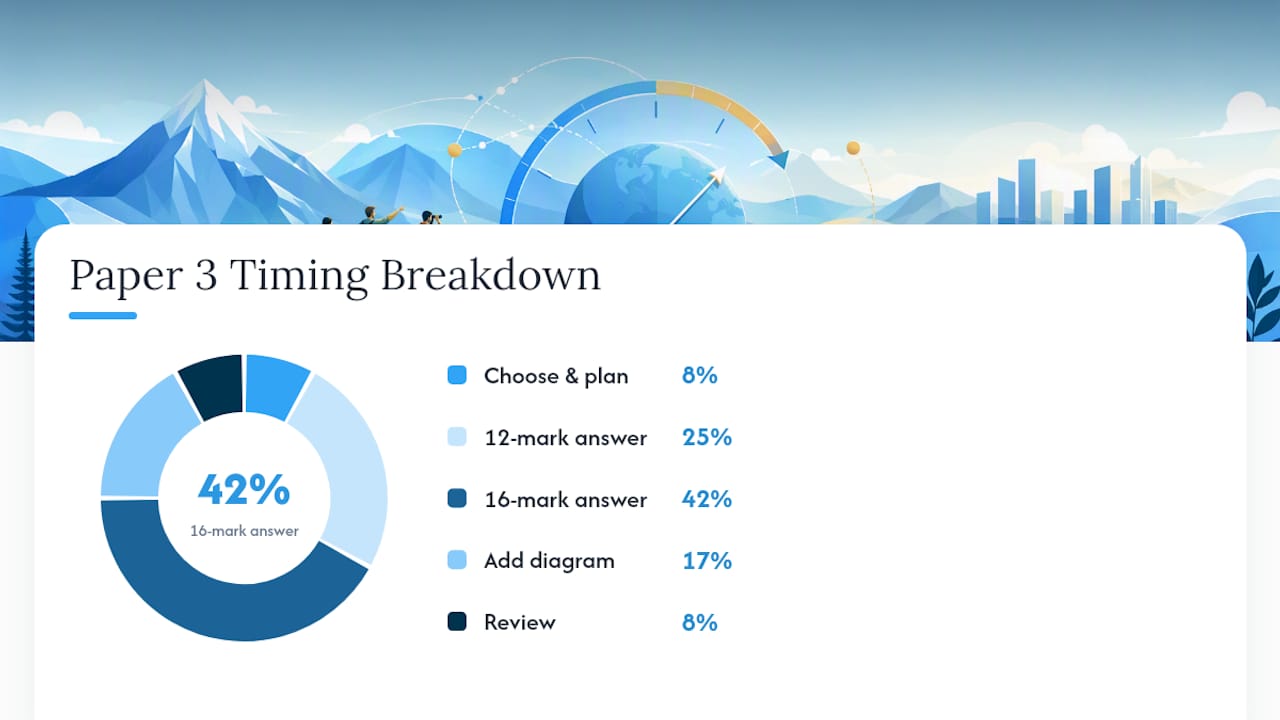
Here’s a workable minute-by-minute split that leaves room to actually think:
- Minutes 0 to 5: Read all three combination questions, pick one, and sketch a quick plan for both parts.
- Minutes 5 to 20: Write the 12-mark answer using two or three tightly linked pieces of evidence.
- Minutes 20 to 45: Write the 16-mark answer with a clear thesis, comparative depth, and explicit evaluation.
- Minutes 45 to 55: Add labels, arrows, or a quick diagram if it strengthens either answer.
- Minutes 55 to 60: Reread both parts against the question wording and fix anything vague.
The sample timings allocate more writing time to the 16-mark answer, while leaving time to check both responses. They are practice suggestions rather than official timings. Adjust the split after a full timed attempt; do not reserve a long separate block for decorative diagrams.
What Does Paper 3 Test? Global Interactions Mapped to Exam Skills
Paper 3 draws entirely from the HL extension content, which the IB Geography guide organizes into Units 4, 5, and 6 under the umbrella of Global Interactions. Knowing exactly what each unit covers helps you decide which case studies to prepare and which combination question to pick on exam day.
Unit 4: Power, Places, and Networks deals with how goods, capital, people, and information flow across the globe, and who benefits from those flows. You’ll need command of digital and economic networks, governance structures that regulate them, and the inequalities those networks create or reinforce. Think trade blocs, tech infrastructure, transnational corporations, and the uneven geography of connectivity.
Unit 5: Human Development and Diversity centers on how we measure development, why those measurements matter, and how social identity intersects with geography. This unit expects you to move beyond GDP and talk about composite indicators, gender and ethnic disparities, migration’s effect on cultural identity, and the political geography of rights.
Unit 6: Global Risks and Resilience is where hazards, climate vulnerability, and governance responses collide. You should be ready to discuss how different scales of government (local, national, international) respond to shared risks, and why resilience looks different in a wealthy coastal city than in a low-income delta region.
Across all three units, examiners are testing the same core skills regardless of which combination question you pick:
- Apply relevant knowledge and evidence to the question. Do not assume Paper 3 supplies an unseen-data booklet: check the actual paper’s instructions and practise the essay format.
- Synthesizing information across scales, connecting a local case to a global pattern or vice versa.
- Evaluating explicitly, meaning you state a judgment and defend it rather than just describing both sides and stopping.
The skill that trips up the most students is that last one. It’s tempting to write a balanced, encyclopedic answer that never actually lands anywhere. Examiners consistently reward candidates who apply concepts to evidence and then commit to a stance, according to examiner guidance summarized by BACC Education. Description without judgment caps your mark no matter how much content you pile on.
How Do You Write for the Markscheme? 12-Mark vs. 16-Mark Answers
Command terms tell you exactly what kind of answer the examiner expects, and misreading one is a fast way to lose marks even when your content is strong. Here’s how the most common command terms at HL translate into what you actually need to write:
- Explain asks for a clear cause-and-effect chain. State the mechanism, back it with a specific example, then show the outcome. Skip the debate; this term wants clarity, not balance.
- Analyse asks you to break a process into its components and show how they interact. A strong analyse answer identifies at least two interacting factors and traces their relationship using data.
- Evaluate asks you to weigh evidence and reach a defensible conclusion. You need at least one counterpoint acknowledged before you state your final judgment, or the answer reads as one-sided rather than evaluated.
- Compare asks for similarities and differences stated explicitly, not two separate descriptions placed side by side. Use connecting phrases like “in contrast” or “similarly” to make the comparison visible to the marker.
The 12-mark question usually pairs an “explain” or “analyse” term with a narrower geographic scope. The strongest structure here is a concise explanation, one or two pieces of quantified evidence, and a short sentence linking the answer back to the exact wording of the question. Three well-developed points almost always beat five thin ones.
The 16-mark question typically carries “evaluate,” “discuss,” or “to what extent,” and it wants a genuine argument. Open with a thesis statement that previews your judgment. Build two or three paragraphs, each anchored in a different case study or scale, and each closing with a mini-evaluation. Finish with a synthesis paragraph that pulls the threads together and restates your position with more nuance than your opening line.
Use the official Paper 3 markbands alongside the question-specific markscheme. The assessment considers relevant knowledge, examples, analysis and, particularly in part (b), synthesis and evaluation. These are not four separate automatic scoring boxes.
Pro Tip: Write your thesis sentence for the 16-mark answer before you write anything else. If you can’t state your judgment in one sentence at minute five, you don’t have a plan yet, you have a topic.
Case Dossier Strategy: A One-Page Template for 4 to 6 Studies
Start with a manageable set of case-study notes, then check which syllabus areas each supports. Four to six dossiers may be a useful starting point for revision, but there is no evidence here that this number predicts top grades.
The right number of cases depends on their breadth and your syllabus coverage. Add or revise notes when practice questions expose a gap; no fixed set guarantees that you can answer nearly every combination question.
Each dossier should fit on one page and cover the same five fields every time:
- Context and scale: where the case sits geographically and at what scale (local, national, regional, global).
- Three key data points: specific figures, dates, or named indicators you can cite from memory.
- One annotated mini-figure or map: a sketch you can reproduce quickly, with labels already planned.
- A short timeline: two or three dated milestones showing how the situation developed.
- One critical evaluation point: a built-in judgment, such as a limitation, a trade-off, or an unequal outcome.
Choose examples spanning relevant scales, sectors and income contexts. Check that each case addresses specific syllabus content, and avoid forcing a familiar example into an unrelated question.
The real test of a dossier isn’t whether you can recite it. It’s whether you can bend the same case to fit an “explain,” an “analyse,” and an “evaluate” prompt without rewriting it from scratch. Practice this deliberately: take one dossier and write three different one-paragraph responses to three different command terms using the exact same evidence. If the evidence flexes, the dossier is exam-ready. If it only works for one type of question, it needs another data point or a sharper evaluation angle.

How Should You Plan and Use Maps or Figures in Your Answers?
A five-minute planning routine before you write anything pays for itself many times over on Paper 3. Read the question twice, underline the command term, jot down which dossier fits best, and rough out a one-line thesis if the question calls for evaluation. Skipping this step to “save time” is how students end up rewriting their opening paragraph halfway through the answer.
Figures and diagrams belong inside the body of your answer, right next to the point they support, not tacked onto the end as decoration. A quick sketch map with three labeled flows placed alongside your paragraph on trade networks does more work than the same sketch stranded on a separate page.
Use a diagram or sketch map only when it helps the argument. Add relevant place names, directions or process labels and identify any data you use. A schematic sketch is not necessarily to scale, so do not add an invented scale or unsupported measurements.
- Weak: “Migration flows into the region.”
- Stronger illustrative caption: “Migration towards the metropolitan area; relate the flow to documented employment opportunities in the named case.” Add figures only from a checked source, rather than copying invented numbers from a template.
The second version gives the marker something concrete to credit. Numbers, direction arrows, and a one-line link back to your argument turn a sketch into evidence.
Build your timing instincts with short, repeated drills rather than one long mock every few weeks:
- Practice writing a full 12-mark answer in exactly 15 minutes, timed, at least once a week.
- Practice a 16-mark answer in 25 minutes, timed, at least once a week.
- Once a fortnight, run the full combination question in 60 minutes to rehearse the transition between parts.
Pro Tip: Set a phone timer for 5 minutes at the start of every practice essay, no exceptions. The habit of stopping to plan feels slow in week one and automatic by week four.
Where Can You Find Reliable Practice Materials for Paper 3?
Use official specimen and past-paper materials supplied through your school to confirm the format. Paper 3 is an extended-response paper; do not assume the resource booklet used for other Geography papers accompanies it. Practise answering both parts of the same question.
Past papers and their markschemes give you the second half of the equation: a way to check your work against real grading standards. A useful self-marking method looks like this:
- Write the answer under timed conditions first, with no notes open.
- Mark it against the official criteria the next day, once you’ve lost the emotional attachment to what you wrote.
- Highlight where you lost marks: was it missing evidence, thin evaluation, or a command term mismatch?
- Rewrite just the weak paragraph, not the whole answer, and compare the improvement.
Beyond the official IB materials, a study guide like the Oxford University Press Geography guide by Nagle and Cooke maps closely to the syllabus and offers additional exam-style questions when you’ve worked through the available past papers.
After a timed attempt, use the markscheme and, where available, feedback to identify a specific revision task. Repeat a relevant task later to check whether your explanation or evaluation is clearer; no practice format guarantees a score gain.
What Do Examiners Actually Look for on Paper 3?
Three priorities show up again and again when examiners talk about what separates a 5 from a 7: applying the concept to the specific evidence in front of them, surfacing evidence rather than gesturing at it, and evaluating with an actual point of view. Students who write generically about “globalization” or “climate risk” without anchoring it to a named place, a specific figure, or a dated event lose marks even when their theory is technically correct.
Certain mistakes show up in the same form year after year, and most of them have quick fixes once you know to look for them:
- Unclear figures: Label features that matter to your argument and explain the figure in the prose. Use axes and units for graphs; do not impose a map scale on every schematic diagram.
- Vague evaluation: phrases like “this has both positive and negative effects” without stating which outweighs the other. Fix it by forcing yourself to write a one-sentence verdict at the end of every evaluative paragraph.
- Poor paragraph structure: cramming three ideas into one paragraph with no clear claim. Fix it by starting each paragraph with a topic sentence that states the point before the evidence arrives.
- Command term mismatch: writing an “explain” answer when the question asks you to “evaluate.” Fix it by underlining the command term before you write a single word.
In the final minutes of your answer, run through a short editing checklist rather than rereading from the top:
- Does every paragraph open with a clear claim?
- Is there at least one quantified piece of evidence per paragraph?
- Does the 16-mark answer end with an explicit judgment, not just a summary?
- Have you referred back to the exact wording of the question at least twice?
Pro Tip: If you only have two minutes left, don’t reread your whole answer. Jump straight to your final paragraph and check that it states a judgment. That’s the sentence markers remember most.
How Should You Structure a Six-Week Paper 3 Revision Plan?
The following six-week plan is an example. Adapt it to your starting knowledge, school deadlines and time available; it cannot guarantee exam fluency within a fixed period.
- Weeks 1 and 2: Choose your 4 to 6 case studies and build the one-page dossiers. Map each dossier against Units 4, 5, and 6 so you know its likely uses.
- Weeks 3 and 4: Shift to timed practice. Write one 12-mark and one 16-mark answer weekly, and start deliberately annotating figures under time pressure.
- Week 5: Sit a full 60-minute mock combination question under real exam conditions, then get feedback from a teacher, peer, or tutor within a few days.
- Week 6: Polish. Revisit the weakest dossier from your mock, tighten your thesis statements, and do one final timed run to confirm pacing.
Balance Paper 3 practice with other papers, IA deadlines and rest. Short, regular sessions may be easier to sustain than occasional long sessions, but choose a pattern that works for you and review what you actually learn.
Use checkpoints to identify what to practise next: can you recall relevant evidence, apply it to a new prompt and complete both parts within one hour? Adjust the plan if you need more content knowledge or writing practice rather than treating one weekly target as a pass-or-fail threshold.
What Documents and Resources Should You Have on Hand?
Keep this short list within reach for the rest of your revision cycle rather than hunting for it every session:
- Official Paper 3 materials: Use school-authorised specimen or past papers and their markschemes to practise the two-part essay format. Do not assume a resource booklet accompanies this paper.
- IB Geography guide: the subject guide lays out exactly what Units 4 through 6 require. Check it whenever you’re unsure if a case study fits the syllabus.
- Dossier and examiner-tip page: Esstutor’s guide on building case dossiers with examiner tips walks through the one-page template in more depth.
- Essay structure page: the essay structure guide gives paragraph templates that transfer directly to the 16-mark answer format.
- Microcard examples: the ready-made microcards show what a finished dossier looks like if you want a model to work from.
Pull up the specimen paper first, then move to the dossier template, then the essay structure guide once you’re ready to write full answers.
A Coaching Note on What Actually Moves the Needle
Short coaching blocks work best when they target three things: dossier quality, exam routines, and honest feedback on practice answers. Students often arrive with plenty of content memorized and no real structure for deploying it under time pressure, which is a coaching problem, not a knowledge problem.
The biggest shift usually happens when a student stops trying to write everything they know and starts writing only what answers the question in front of them. That’s less about intelligence and more about repetition: doing the timed 12- and 16-mark drills enough times that the structure becomes automatic rather than something you’re inventing mid-exam.
If you’re considering a short paid session, come with your dossiers already drafted, even roughly. A session spent building content from zero is far less valuable than one spent stress-testing content you’ve already prepared against real command terms and real time limits. Bring a recent timed answer, even an imperfect one, and the feedback will land faster and stick longer.
— Marija
Get Targeted Paper 3 Coaching Before Your Exam
Some tutoring services offer direct, examiner-style feedback on the dossiers and timed answers you’ve already written as an alternative to generic revision courses for Paper 3 prep. A focused tutoring block typically works through dossier review, a timed mock combination question, and paragraph-by-paragraph feedback mapped to the actual markbands, not generic advice.
Marija Maletz is an ESS teacher, examiner and tutor. For Geography support, explain your question and exam goals before booking to agree the scope. A FREE 20-minute trial lesson can help establish a suitable focus; examiner experience does not imply IB endorsement or guarantee a grade.
If you want to see how a session works before committing, start with a trial lesson and bring your most recent timed practice answer. Explore personalized IB tutoring options to book a session and get feedback on your dossiers before your next mock exam.
Sources
- Geography higher and standard level — specimen papers 1, 2 and 3 (IBO)
- IB Geography guide (IB publishing)
- IB DP subject mastery: how to score a 7 in IB Geography HL (Sparkl)
No Comments