


28 Aug How to Create a Realistic IB Study Plan
Start by listing fixed deadlines and the study time actually available. Then choose manageable tasks and leave space for schoolwork, rest and unexpected changes. The steps and example grid below can help you build your own plan.
TL;DR:
- Prioritize topics based on their exam weight, deadline proximity, and whether they are higher or standard level to allocate study hours effectively.
- Use flexible tools like spreadsheets or online generators while ensuring your actual available study time aligns with fixed deadlines and commitments.
- Include buffers and weekly review sessions to adapt your plan to life’s unpredictability and track your actual progress versus initial goals.
- Focus on timed past-paper practice over passive note rereading, as exam simulation reveals practical understanding and application weaknesses.
- Regularly update your study plan, especially after practice exams, with human feedback to identify gaps and refine your approach continuously.
Table of Contents
- How Do You Create an IB Study Plan Step by Step?
- What Does a Sample Weekly IB Study Grid Look Like?
- Which Tools Work Best for Building Your Plan?
- What Do IB Examiners Actually Prioritize?
- What Should Go on Your One-Page Study Plan Checklist?
- Ready to Turn Your Plan Into Real Results?
- Why Most IB Study Advice Misses the Point
- Sources
How Do You Create an IB Study Plan Step by Step?
Building an IB study plan isn’t about filling a calendar with color-coded blocks and hoping for the best. It’s about working backward from fixed dates and forward from where you actually stand in each subject. Here’s the method, broken into six steps you can start today.
- Map fixed dates and weekly non-negotiables. Write down every exam date, IA deadline, EE checkpoint, and mock exam. Then block out school hours, your job if you have one, sports, music, or any recurring commitment. What’s left is your real study time, not your imagined study time.
- Build a topic inventory per subject. List every unit in each subject and break large topics into smaller tasks. “Ecosystems and biodiversity” becomes “food webs,” “biomes,” and “conservation strategies.” Small tasks feel achievable; giant units just feel heavy.
- Estimate realistic time per topic. Some topics take 25 minutes to review. Others need a full 90-minute block with notes, practice questions, and a recap. Match session length to task difficulty rather than defaulting to one-hour slots for everything.
- Prioritize by exam weight, HL versus SL, and deadline pressure. A weak topic in an HL subject due in three weeks outranks a strong topic in an SL subject due in three months. According to Sparkl’s guide to weekly IB DP planning, HL subjects cover additional material, but the balance of study time should reflect the student’s needs and deadlines rather than a fixed rule.
- Distribute topics across days using spaced repetition and active recall. Revisit a topic two or three times over separate days rather than cramming it once. Slot in timed past-paper sections regularly, not just in the final weeks before exams.
- Add buffers and a short weekly review. Life happens. Build slack into your week, and spend 15 to 30 minutes reviewing what you actually completed, then adjust the coming week. This single habit is what turns a rigid schedule into one you’ll actually follow.
Pro Tip: Don’t schedule your hardest topic for your lowest-energy time slot. If you’re foggy after a full school day, use that window for lighter review tasks and save deep focus work for whenever your brain is sharpest, even if that’s early morning or Sunday afternoon.
What Does a Sample Weekly IB Study Grid Look Like?
Use a small weekly grid and adapt it to your subjects, commitments and energy. For example, include a concept task, a practice task and time to revisit errors. The entries below are illustrative, not a required weekly workload.
| Slot | Example ESS task | Check |
|---|---|---|
| Early week | Explain one difficult concept, then check notes | Can I explain it independently? |
| Midweek | Answer a short data-based question | Have I used the correct units and evidence? |
| Later week | Reattempt a question from the error log | Has the original misunderstanding changed? |
| Weekly review | Compare completed tasks with the plan | What should be reduced or prioritised? |
Leave space for school deadlines, other subjects and rest.
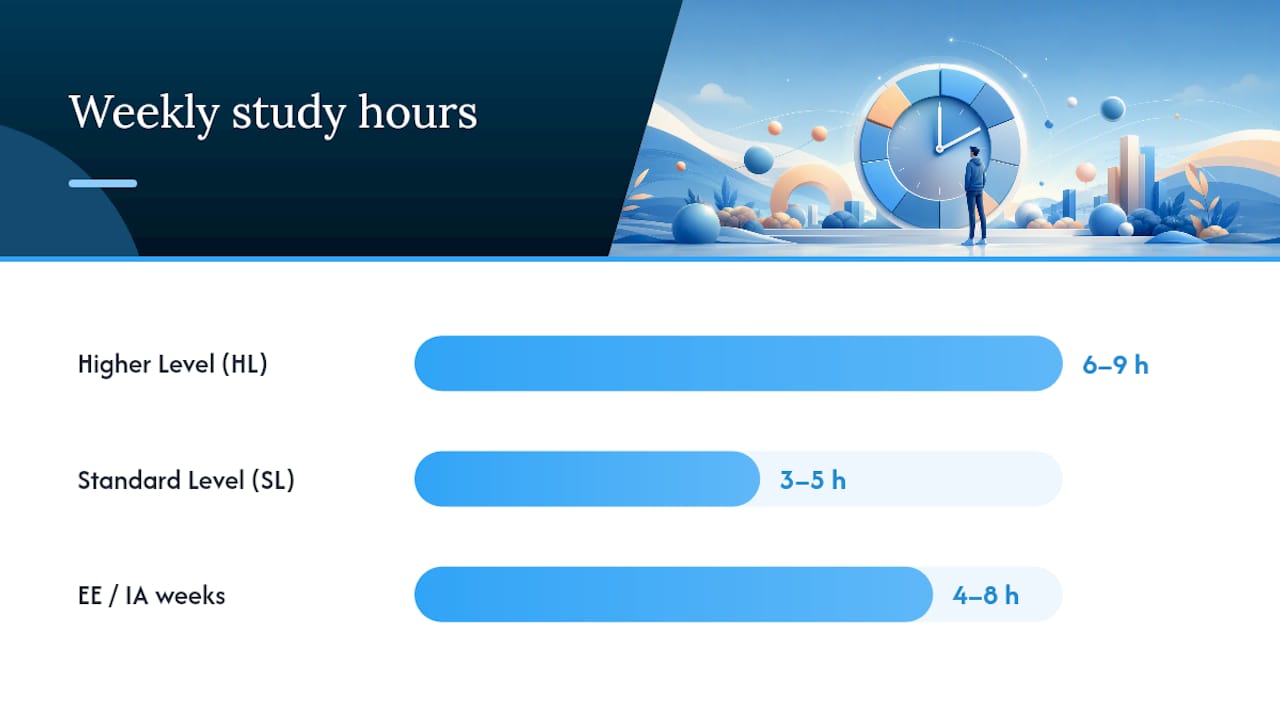
There is no universal weekly self-study total for HL or SL. Start with your actual available time, school guidance and demonstrated gaps; revise the allocation when the plan is not manageable.
Which Tools Work Best for Building Your Plan?
A printable grid is easy to see on your wall but hard to adjust once life shifts. A spreadsheet in Excel or Google Sheets gives you flexibility and lets you build simple formulas to track hours per subject. A calendar app syncs across devices, but can bury your priorities among other notifications. A generator or AI tool builds a rough draft fast, but it only works well if you feed it the right information.
- Printable grid: great for visibility, poor for quick edits.
- Spreadsheet: flexible and easy to color-code by subject, takes a bit more setup time.
- Calendar app: syncs everywhere, but priorities can get lost in the noise.
- AI generator: fast first draft, needs your correction afterward.
A planning tool can help organise dates and tasks, but check its current features and privacy policy before entering school or personal information. Do not assume data remain only in the browser. A simple local spreadsheet can work without uploading detailed schedules.
What Do IB Examiners Actually Prioritize?
Anchor your school-set deadlines first. IA and EE checkpoints are not “soft” dates you can push around; they’re fixed points your entire plan should orbit. Skip past-paper practice in favor of endless rereading, and you’re training the wrong skill. Rereading notes feels productive, but timed, marked past-paper practice is what reveals whether you can actually apply what you know under exam pressure.

A teacher or tutor can help identify whether a difficulty involves subject knowledge, interpretation, command terms or timing. Relevant examiner experience may help discussion, but it does not mean knowing exactly which future questions will appear or guarantee a top-band answer.
Practice tip: Include timed practice when appropriate, then review mistakes. Balance it with learning the underlying concepts; no fixed practice frequency is best for every student.
What Should Go on Your One-Page Study Plan Checklist?
You don’t need a perfect system before you start. You need a working one today. Here’s a checklist to get from a blank page to a functioning plan in one sitting.
- Write down every fixed deadline: exams, IA submissions, EE checkpoints, mocks.
- List your true weekly available hours, subtracting school, work, and commitments.
- Build a topic inventory for each subject and mark your weak spots honestly.
- Choose your format: printable grid, spreadsheet, calendar app, or generator draft.
- Fill in a manageable first week using school deadlines and your current priorities; include appropriate question practice.
- Add at least one buffer day and a 15 to 30 minute weekly review slot.
- Print or export your plan so it’s visible, not buried in a folder you forget about.
Useful planning formats include a weekly grid, a daily task list, a topic inventory and a progress log. These are formats you can create, rather than a claim that four downloadable files are provided here. Use the example grid above as a starting point and adapt it to your subjects.
Ready to Turn Your Plan Into Real Results?
Review your study plan against evidence from actual practice answers. Identify whether difficulties involve knowledge, command terms, data use or timing, then choose a focused next task. Individual ESS support can help you discuss that task; a fixed plan does not guarantee a particular grade.
Why Most IB Study Advice Misses the Point
Most study plan advice treats the IB Diploma like a single long race. It isn’t. It’s a series of sprints, six or more subjects, each with its own rhythm of coursework, mocks, and finals, stacked on top of each other for two years. That’s why a static plan written in September rarely survives to May. The plan has to be a living document, rebuilt weekly around what actually happened, not what you hoped would happen.
The other blind spot is treating AI generators as finished products rather than rough drafts. They’re genuinely useful for structural work, sequencing weak topics and spacing out repetition, but they can’t know your school’s actual IA deadline or judge whether your practice essay would hit a markband 6 or a markband 4. That judgment call is where human expertise, not automation, still wins. If I had to name the single highest-leverage habit in this entire method, it’s the weekly 15 minute review. Everything else is scaffolding; that habit is what keeps the scaffolding standing.
— Marija
Sources
- Den Lernplan mit KI erstellen … und diesmal bleibst du dran — Bildungssprache
- Lernplan erstellen → StudySmarter
- How to build a weekly IB DP study plan that works — Sparkl
No Comments