


19 Aug International Baccalaureate: A Guide for Students and Parents
The International Baccalaureate (IB) is an educational foundation offering the Primary Years Programme, Middle Years Programme, Diploma Programme and Career-related Programme. Schools offer specific authorised programmes, so check the official IB school directory and the school’s current provision rather than assuming every school offers the whole continuum.
Here’s the quick version of what the IB actually offers:
- Four programmes, one continuum — PYP, MYP, DP, and CP build on each other from early childhood through the last year of secondary school.
- A university-facing credential — the DP culminates in a 45-point score that admissions offices around the world can interpret consistently.
- A specific philosophy — inquiry-based learning, intercultural understanding, and independent research sit at the center of every IB programme.
Key Takeaways
The International Baccalaureate succeeds by combining breadth across six subjects with a demanding core of independent research, reflection, and service that most single-subject curricula don’t require.
| Point | Details |
|---|---|
| Four programmes, one path | PYP, MYP, DP, and CP form a continuum from age 3 to 19, though most students join at the DP stage. |
| The core isn’t optional | TOK, EE, and CAS completion can block the diploma even when subject scores are strong. |
| The 45-point scale is precise | Passing requires at least 24 points, HL/SL minimums, and no more than two grades of 2. |
| Authorization matters | Confirm a school’s IB World School status through the official directory, not marketing materials. |
| Plan a manageable workload | Plan core and subject deadlines together, while allowing for the student’s needs, school guidance and available support. |
Table of Contents
- What Is the International Baccalaureate Made Up Of?
- How Is the Diploma Programme Structured?
- How Does IB Assessment and Grading Actually Work?
- How Do Schools Become Authorized to Teach the IB?
- Who Benefits Most From the IB, and What Should Families Weigh?
- How Do You Choose the Right IB Programme or School?
- Is the IB Harder Than Other Curricula?
- What Study Strategies Actually Move the Needle in the DP?
- An Honest Read on What the IB Actually Rewards
- Frequently Asked Questions
- Sources
What Is the International Baccalaureate Made Up Of?
The four programmes have different structures. The summaries below are starting points; consult the programme’s official pages and the school’s current implementation.
PYP, ages 3–12: An inquiry-based primary framework with assessment embedded in learning. It does not culminate in IB external examinations; schools use a range of classroom assessment practices.
Middle Years Programme (MYP), ages 11–16 (sometimes 12–16, depending on the school’s structure). The MYP organizes learning into eight subject groups and expects at least 50 hours of teaching time per subject group each year, which keeps the curriculum broad rather than letting students specialize too early. This is where the IB starts introducing structured concepts like criterion-based assessment, a system students will see again, in more intense form, during the DP.
Diploma Programme (DP), ages 16–19. This is the flagship two-year program most people mean when they say “IB.” Students choose six subjects, complete a core of independent research and reflection, and sit external exams that produce a score out of 45. Universities weigh this score heavily, and it’s the reason the DP gets the lion’s share of attention from parents researching the International Baccalaureate curriculum.

CP, ages 16–19: Combines DP courses, career-related study and the CP core. The core first taught from August 2025 and first assessed in May 2027 includes personal and professional skills, language and cultural studies, community engagement and the reflective project. Check the requirements for the student’s cohort.
The programmes serve different age ranges, and students may join at different stages. Ask the school about its entry points, programme model, transition support and subject availability; completing PYP or MYP is not a universal prerequisite for entry to the DP.
How Is the Diploma Programme Structured?
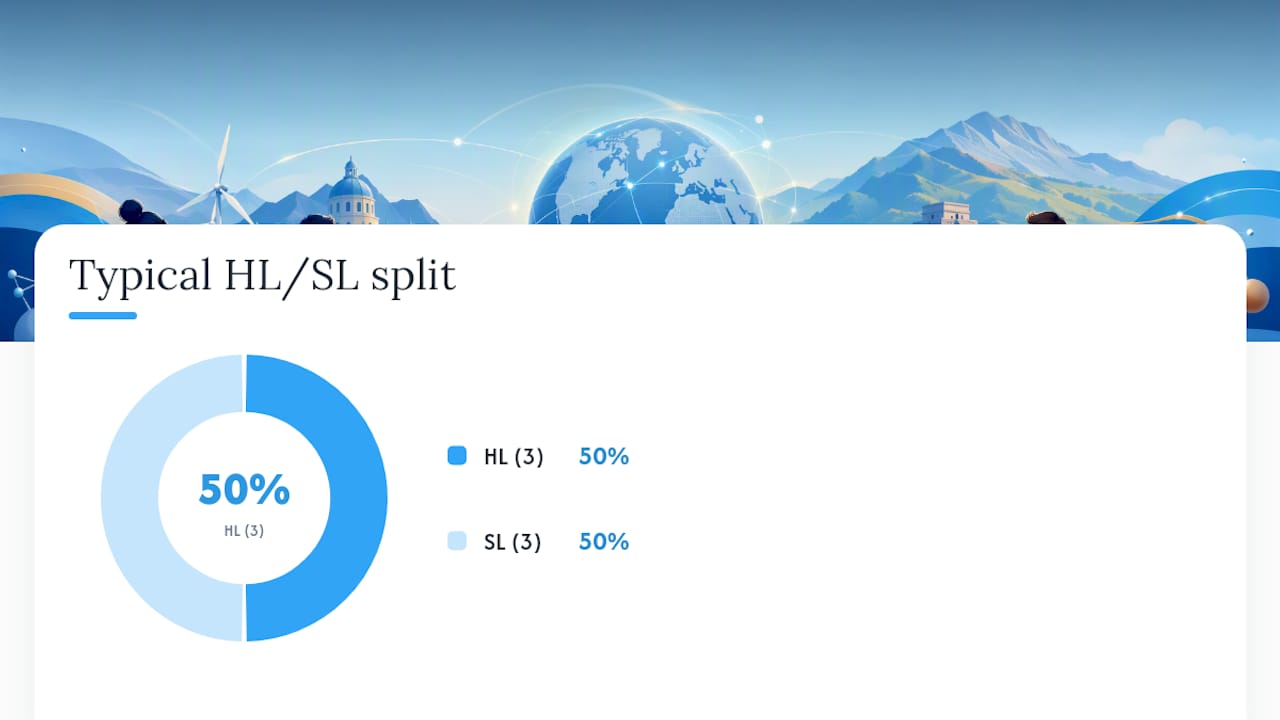
The DP asks students to pick one subject from each of six groups: studies in language and literature, language acquisition, individuals and societies, sciences, mathematics, and the arts (or a second subject from another group instead of the arts). Each subject is studied either at Higher Level (HL) or Standard Level (SL), and students must take three or four subjects at HL, with the rest at SL.
| DP subject group | Examples and considerations |
|---|---|
| Studies in language and literature | Check the specific language course and its SL/HL requirements. |
| Language acquisition | Course level depends on prior language learning; some courses are offered only at SL. |
| Individuals and societies | Examples include Geography, History and Economics. IA requirements are subject-specific, not universally longer at HL. |
| Sciences | Check the chosen subject’s content, practical work and assessment model. ESS can also satisfy the individuals and societies requirement. |
| Mathematics | Analysis and approaches and applications and interpretation have different emphases; verify university prerequisites. |
| The arts | Availability and assessment vary by subject. Discuss permitted alternatives with your coordinator. |
HL courses aren’t just “SL plus extra homework.” They typically run around 240 teaching hours compared to roughly 150 for SL, which is a real time commitment once you multiply it across three or four subjects.
Alongside the six subjects sits the DP core, and this is where a lot of families underestimate the workload:
- Theory of Knowledge: TOK explores how knowledge is developed and justified. Current assessment is an exhibition and a 1,600-word essay, rather than the presentation used in an older course.
- Extended Essay (EE) is a 4,000 word independent research paper on a topic of the student’s choosing, supervised loosely by a teacher. It’s the closest thing most 17 year olds will do to an undergraduate thesis.
- Creativity, Activity, Service (CAS) requires students to engage in activities outside the classroom over the two years, documented through a reflective journal rather than a written exam.
Most diploma students take three HL and three SL subjects; four HL subjects are permitted under DP rules. Discuss the extra workload and actual university prerequisites with your coordinator. A fourth HL is not automatically necessary for a competitive application.
How Does IB Assessment and Grading Actually Work?
IB assessment is built to measure achievement directly against defined criteria rather than reward memorization, and DP assessment blends external exams with internally assessed coursework that the IB moderates to keep grading consistent across thousands of schools. In practice, that mix looks like this:
- External exams, sat at the end of the second year, typically make up the bulk of a subject’s final grade.
- Internal assessment (IA), work completed and marked by the student’s own teacher, then sample-checked by an IB moderator to correct for grading drift.
- Coursework components, such as lab reports in the sciences or oral assessments in languages, submitted throughout the two years.
- Moderation, the IB’s quality-control layer that adjusts a school’s marks if they run consistently too high or too low compared to the global standard.
The numbers that matter most: each of the six subjects is graded on a 1 to 7 scale, for a maximum of 42 points, and up to three additional points come from combined EE and TOK performance, bringing the total possible score to 45. To actually earn the diploma, a candidate needs to meet minimum point thresholds overall and across HL and SL subjects, and cannot have excessive low grades. Critically, failing to complete CAS, TOK, or the EE can block the diploma from being awarded even if subject scores are sufficient, which is the single most misunderstood rule in the entire program.
Universities set their own entry and recognition requirements. The DP can support applications, but a score or programme label does not guarantee admission, and comparisons between student groups do not prove that the programme caused an enrolment advantage.
How Do Schools Become Authorized to Teach the IB?
A school can’t just decide to “offer the IB.” Becoming an IB World School is a multi-year process, and understanding it helps parents tell the difference between a school that’s genuinely equipped to teach the DP and one that’s still finding its footing.
- Candidacy: A school works through the IB’s programme-specific preparation and review process. Candidate status and authorisation are different; check the exact programme and what the school is permitted to offer.
- Authorization. After a formal site visit and review, the IB grants authorization, meaning the school can officially call itself an IB World School and enroll students for assessment.
- Ongoing evaluation. Authorized schools undergo periodic reviews to confirm they’re maintaining teaching standards, resourcing, and assessment practices consistent with IB requirements.
Before enrolling, it’s worth confirming a few specifics directly with the school:
- How long has the school held DP authorization, and when was its last evaluation?
- What subjects are actually offered at HL, not just listed as theoretically available?
- How is IA support structured, and do teachers have IB examiner experience?
- What’s the school’s average diploma point score, and what percentage of students are awarded the diploma?
The IB maintains an official “Find an IB World School” directory, and that’s the only reliable way to confirm authorization status. A glossy brochure mentioning “IB curriculum” without a verifiable authorization listing is a red flag worth chasing down before you commit.
Who Benefits Most From the IB, and What Should Families Weigh?
The DP tends to suit students who like breadth. If a teenager wants to keep studying a language, a science, math, and the humanities simultaneously rather than narrowing down early, the IB rewards that instinct in a way many single-subject exam systems don’t.
What works in the IB’s favor:
- Broad subject exposure that delays premature specialization.
- A research and writing skillset (via the EE and TOK) that maps well onto university coursework.
- Check university recognition and entry requirements directly. Do not treat reports of group-level enrolment differences as a personal admission guarantee.
- A consistent global grading standard, useful for international students applying across multiple countries, including through university admission pathways that map IB scores to local systems.
What deserves real thought before committing:
- The core (TOK, EE, CAS) adds workload on top of six full subjects, which is more demanding than curricula built around subject depth alone.
- Language acquisition requirements can be tough for students who arrived at their school mid-secondary and haven’t built up years of second-language exposure.
- Students who thrive on deep specialization in one or two subjects, rather than breadth across six, sometimes find single-subject-focused curricula, like A-Levels, a more natural fit.
- Students needing significant learning accommodations should confirm early what inclusive access arrangements a specific IB World School actually supports, since implementation varies by school.
How Do You Choose the Right IB Programme or School?
Start with the student, not the brand name. Run through this checklist before locking in a programme or school:
- What are the student’s university and career goals, and does a country’s admissions system favor DP scores?
- Does the student prefer breadth across many subjects or deep focus on one or two?
- How strong is the student’s second-language background, given the DP’s language acquisition requirement?
- Does the school provide appropriately trained subject teachers, clear IA guidance, reasonable feedback arrangements and support for students who need help?
- What resources, tutoring, or revision support are available if the student needs extra help mid-year?
Watch for these warning signs when evaluating a school:
- Ask about teacher preparation, relevant subject experience and the school’s support arrangements. Teachers do not need to be IB examiners to teach the programme well; lack of examiner status alone is not a warning sign.
- Vague or nonexistent guidance on how internal assessments are supported and moderated internally.
- A narrow subject list that doesn’t match the student’s intended university path.
Generally, the DP suits students aiming at research-heavy university programs, while the CP fits students who want career-relevant training without the full six-subject academic load.
Is the IB Harder Than Other Curricula?
Students frequently ask whether the IB is harder than Cambridge International (A-Levels) or Advanced Placement (AP). The honest answer: it depends on what “hard” means to that student.
- Breadth and depth: Compare the actual timetable and qualification requirements at each school. AP course choices and A-level programmes do not follow one universal three- to five-subject model.
- Assessment style — the DP blends internal assessment, coursework, and exams; AP leans almost entirely on a single end-of-year exam per subject.
- University recognition — all three are well recognized internationally, though the DP’s standardized global moderation makes cross-country comparison somewhat more consistent.
Students who prefer depth in one or two subjects often find AP or A-Levels more comfortable. Students who want a wide academic profile and don’t mind research-heavy tasks tend to prefer the DP. What actually makes the DP feel harder isn’t the individual subjects. It’s the core requirements running in parallel with six full courses, which demands time management most 16 year olds haven’t had to build yet.
What Study Strategies Actually Move the Needle in the DP?
The students who come out of the DP with strong scores aren’t necessarily the most naturally talented ones. They’re the ones who plan CAS, TOK, and EE timelines a full year in advance instead of scrambling in the final term, and who choose their HL/SL split strategically rather than based on which friends are in which class.
Pro Tip: Treat your Extended Essay research question like a mini thesis proposal from day one. Students who lock in a focused, answerable question by the start of year two consistently submit stronger essays than those still refining their topic three months before the deadline.
A few habits worth building early:
- Block out fixed weekly time for IA drafts rather than treating them as homework that gets squeezed in.
- Log CAS activities as they happen; reconstructing two years of reflection from memory in the final term is a common cause of last-minute stress.
- Get subject-specific feedback on IA drafts well before the school’s internal deadline, not just before the IB’s final submission date.
If you’re navigating environmental systems and societies internal assessments or a subject where feedback from an experienced examiner would help, working with a tutor who has actually graded IB papers, not just taught the syllabus, tends to close gaps faster than generic revision guides.
An Honest Read on What the IB Actually Rewards
The DP provides opportunities for independent research and reflection through the EE and TOK. Other curricula also develop these skills; the best choice depends on the student’s goals, interests and available support.
Where the standard advice falls short is workload planning. Parents hear “six subjects” and assume that’s the whole picture, then get blindsided by how much CAS and EE deadlines collide with HL exam prep in the second year. The programme doesn’t fail students who plan poorly. It just doesn’t forgive them the way a single-exam system might.
Treat core deadlines as real commitments alongside subject work, while adapting the workload to the student. Organisation can help, but it does not establish that one planning habit outweighs ability or determines results.
Frequently Asked Questions
What is the International Baccalaureate, in one sentence?
The IB is a global education foundation running four programmes, PYP, MYP, DP, and CP, for students aged 3 to 19, with the Diploma Programme being the most widely recognized by universities.
What is the IB program most people mean when they say “IB”?
Almost always the Diploma Programme (DP), the two-year, pre-university curriculum for students aged 16 to 19 that produces the 45-point score universities evaluate.
The DP is recognised by many universities worldwide, but institutions and individual courses decide entry requirements, subject prerequisites and any credit awarded. Check the destinations relevant to the student.
How many points do you need to pass the IB Diploma?
A minimum of 24 out of 45, along with specific grade thresholds and full completion of TOK, EE, and CAS, as set out in the official passing criteria.
The DP is a programme with six subjects and a core. A-level and AP arrangements differ, and AP can be taken within a wider school curriculum rather than replacing it. Compare the actual subjects, assessment methods and university requirements available to you, rather than treating all three as identical types of qualification.
Struggling with a specific IB subject, particularly environmental systems and societies, often comes down to needing examiner-level feedback on IAs and exam technique rather than more generic revision. Esstutor’s ESS tutoring built around exam strategy and IA support is built for exactly that gap, with sessions shaped around what a student is actually struggling with rather than a one-size-fits-all syllabus review.
Sources
- About the International Baccalaureate (IB) – International Baccalaureate®
Looking for support with IB ESS?
If your child takes Environmental Systems and Societies, start with their SL or HL level and the topic or assessment they find difficult. Explore individual ESS lessons or request a FREE 20-minute trial lesson.
No Comments