

14 Sep IB Students: 7 Checks to Avoid Plagiarism With Examiner Insight
To avoid plagiarism in IB work, always acknowledge your sources and write in your own academic voice. That single habit prevents most violations. Beyond that, you need organized source records, a consistent citation style, careful paraphrasing that avoids patchwriting, and a final similarity check before you submit anything to your supervisor or the IB.
TL;DR:
- Proper source tracking involves building an annotated bibliography from the start, ensuring each fact or idea has a corresponding citation before writing.
- Omitting quotation marks or citations for direct quotes, patchwriting, or uncredited paraphrases increases the risk of accidental plagiarism, which examiners can detect through vocabulary shifts.
- High similarity report percentages are not automatically violations; examiners review whether flagged sections are properly quoted, cited, or genuinely uncredited.
- Consistent use of one citation style and thorough paraphrasing with source comparison help prevent accidental plagiarism and ensure academic integrity.
- Incorporating examiner feedback early, including draft reviews focusing on citations and paraphrasing, enhances submission quality and reduces risk of plagiarism issues.
Table of Contents
- Your Pre-Submission Plagiarism Checklist
- What Actually Counts as Plagiarism?
- The Five Types of Plagiarism You’re Most Likely to Commit
- How Do You Cite Sources Correctly in IB Work?
- How to Paraphrase Without Copying the Original Structure
- Building a Source-Tracking System That Prevents Accidental Plagiarism
- What Happens When a Similarity Report Flags Your Work?
- What an IB Examiner Wants You to Know
- A Tutor’s Note on Citation and Confidence
- Get Examiner-Informed Feedback on Your IA or EE
- Sources
- FAQ
Your Pre-Submission Plagiarism Checklist
Run this checklist the night before you submit your IA, EE, or any written coursework. It takes fifteen minutes and catches most avoidable mistakes.
- Every claim that isn’t your own idea has a citation. If you paused while writing to think “where did I read this?”, it needs a source.
- Quotation marks appear around any copied phrase of more than a few words. No exceptions, even for short phrases you like.
- Your in-text citations match your bibliography exactly. A source cited in the text but missing from the reference list is a common, avoidable flag.
- Every paraphrase has been checked against the original. Read your version and the source side by side. If the sentence structure matches, rewrite it.
- Read the whole paper aloud. Sudden shifts in tone, vocabulary, or sentence complexity are the fastest way to spot a passage that slipped in unedited from a source.
- Confirm you followed your subject’s specific referencing rules, since IA and EE requirements sometimes differ slightly from general IB guidance.
- Run a similarity check through whatever tool your school provides, then actually read the report instead of just checking the percentage.
Pro Tip: Save your checklist as a document you reuse for every assignment. Ticking the same seven boxes each time turns plagiarism prevention into a habit, not a last-minute panic.
What Actually Counts as Plagiarism?
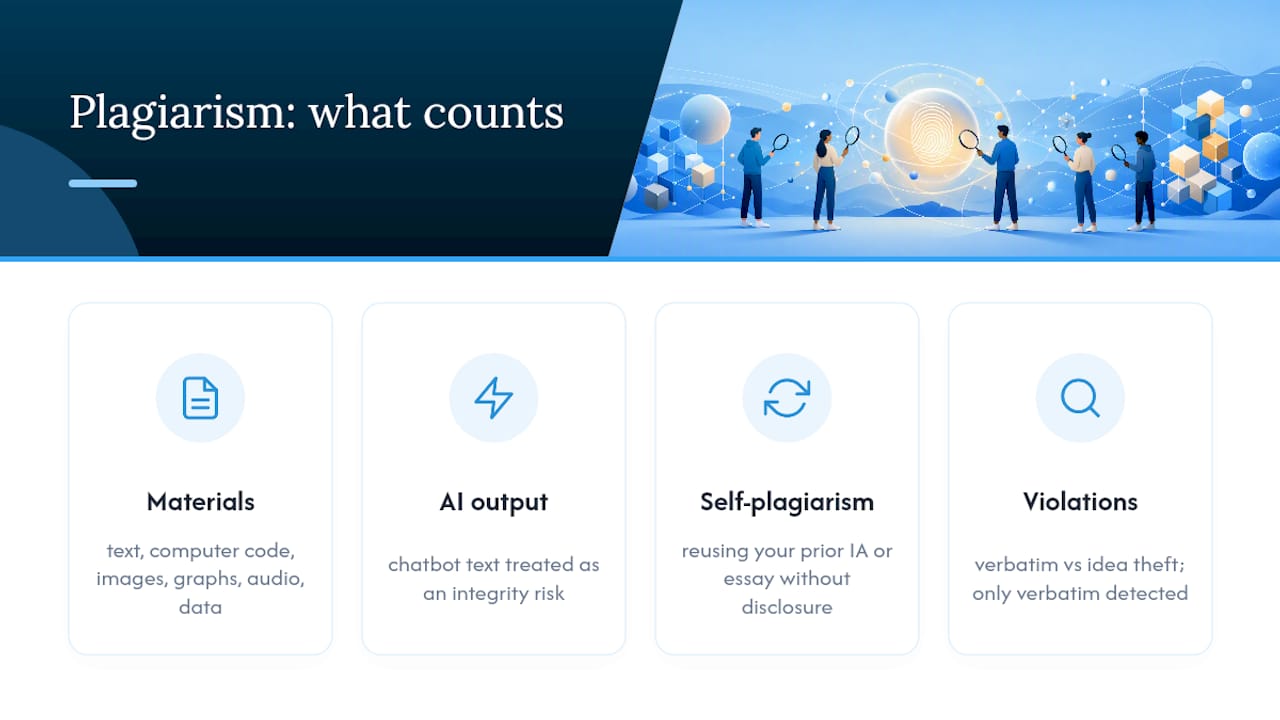
Plagiarism means presenting someone else’s work or ideas as your own without full acknowledgment, and the definition is broader than most students assume. It covers text, computer code, illustrations, graphs, audio, and data, whether the material was formally published or not. A diagram you copied from a classmate’s notebook counts just as much as a paragraph lifted from a journal article.
The scope also includes AI-generated text. Submitting output from a chatbot as your own writing is generally treated as an academic-integrity risk, because AI text lacks stable, citable authorship and presenting it as your own work often amounts to a deception issue rather than a simple citation gap. Reusing your own prior IA or essay word for word without disclosure, known as self-plagiarism, falls under the same umbrella.
It helps to separate two related problems: copying someone’s exact wording without quotation marks, and copying someone’s idea or argument structure without credit even when every word is your own. Both are violations. Only one leaves a trace a similarity checker can find.
The Five Types of Plagiarism You’re Most Likely to Commit
Most plagiarism in IB coursework isn’t deliberate theft. It’s a rushed paraphrase, a forgotten citation, or a quote that lost its marks somewhere between your notes and your draft.
- Direct plagiarism: Copying a sentence or passage word for word without quotation marks or a citation, even if you meant to add one later.
- Patchwriting: Swapping a few words in a source sentence while keeping its original structure. Changing “biodiversity loss threatens ecosystem stability” to “loss of biodiversity puts ecosystem stability at risk” is still patchwriting if the citation is missing.
- Idea plagiarism: Presenting someone else’s argument, framework, or conclusion as your own insight, even when none of the original wording survives.
- Self-plagiarism: Recycling text from a previous assignment, another IA, or even a draft your supervisor already graded, without disclosure.
- Mosaic plagiarism: Stitching together phrases from several sources into one paragraph, creating something that reads as original but isn’t.
A single missing citation or a quotation mark that got deleted during editing can flip an acceptable paraphrase into a violation. Examiners are trained to notice when a paragraph’s vocabulary or sentence complexity suddenly jumps, which is often the first sign that unauthorized material has crept in.
How Do You Cite Sources Correctly in IB Work?
The safest rule for citation is simple: when in doubt, cite. Over-citing rarely causes problems, but under-citing can trigger an integrity investigation, especially in a specialized subject like ESS where what counts as “common knowledge” is genuinely ambiguous. A fact you learned in class might still need a source if it isn’t broadly known outside your subject.
- In-text citations go directly after the claim, quote, or data point they support, not at the end of the paragraph.
- Every in-text citation must have a matching entry in your bibliography. If the two don’t line up, that’s an immediate red flag for a reader.
- Pick one citation style, whether APA, MLA, or Chicago, and use it consistently across the whole paper. Mixing styles within a single IA looks careless even when every source is properly credited.
- Quote verbatim only when the exact wording matters, such as a striking phrase from an interview or a precise legal or scientific definition. Otherwise, paraphrase and cite.
- For subject-specific referencing conventions in ESS internal assessments, a dedicated student guide to referencing walks through examples that match what examiners expect.
Pro Tip: Think of citations as a map of your position in an academic conversation, not a defensive shield. Framing your paper this way transforms writing from reporting facts into active scholarly engagement, which is exactly what IB assessment criteria reward at the higher grade bands.
How to Paraphrase Without Copying the Original Structure
A reliable paraphrasing method has five steps: read the source passage fully, set it aside, write the idea from memory in your own words, compare your version to the original, then add the citation. This sequence works because it forces you to reconstruct the idea rather than edit the original sentence.
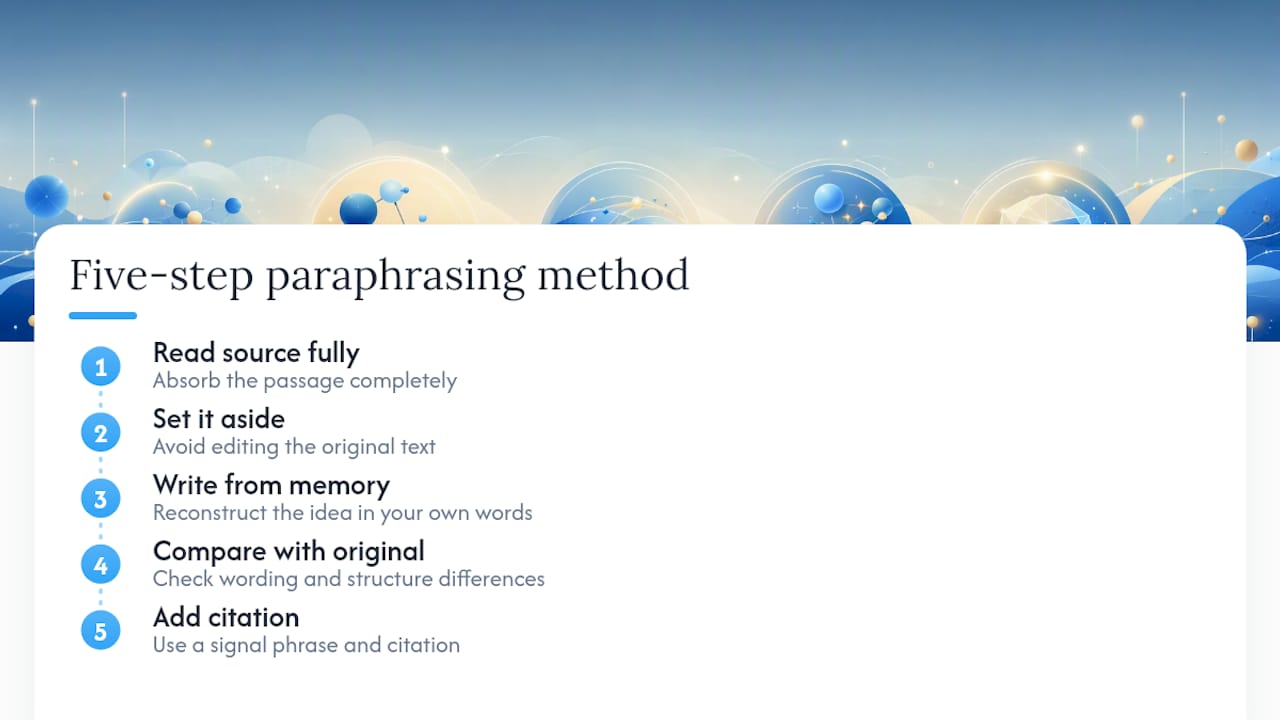
Patchwriting happens when you skip the “set it aside” step and edit in place, swapping synonyms while keeping the source’s sentence order intact. A genuine paraphrase changes both the wording and the structure. If the original reads “rising sea temperatures accelerate coral bleaching events,” a real paraphrase might restructure it entirely: “Coral bleaching becomes more frequent as ocean temperatures climb, according to [Author].” Compare that to a patchwrite: “Increasing ocean temperatures speed up coral bleaching occurrences,” which just swaps words in the same order.
Use signal phrases like “According to…” or “[Author] argues that…” to mark clearly where a source’s idea ends and your analysis begins. That boundary matters as much to examiners as the citation itself.
Building a Source-Tracking System That Prevents Accidental Plagiarism
The single most effective habit for avoiding accidental plagiarism is creating a working bibliography before you start writing, not after. A sources-first approach means every fact you write down already has a home in your reference list.
- Build your working bibliography as you research, adding each source the moment you open it, not when you think you might use it.
- Try annotated excerption for each source: note what it says, how it answers your research question, and the exact page number for any quote you might use later.
- Color-code or tag notes by theme so you can trace every paragraph in your draft back to its origin in seconds.
- Name files consistently (author, year, topic) so you’re never guessing which PDF a quote came from.
- A reference manager such as Zotero or Mendeley can automate citation formatting, but it won’t catch a bad paraphrase. The tool organizes; you still have to write carefully.
Plagiarism-detection software confirms text overlap. It cannot confirm whether you understood or properly attributed an idea, which is a judgment only you and your supervisor can make.
What Happens When a Similarity Report Flags Your Work?
Similarity checkers compare your text against databases and web content, but a high match percentage is not automatic proof of plagiarism. Quoted material, properly cited passages, and even your bibliography itself can trigger matches. Instructors are trained to open the report and read the flagged sections in context rather than reacting to a single number.
There is no universally fixed “acceptable” similarity percentage across institutions. What matters more than the number is whether flagged text is properly quoted and cited, or whether it represents uncredited copying.
If your report comes back with flagged sections, don’t panic before checking what’s actually highlighted. A properly quoted and cited passage flagged as a match is a false positive, not a violation. But if the flags reveal genuine uncredited overlap, consequences in IB coursework can range from a warning and required revision to zero marks on the assessment or referral to the IB’s academic misconduct process, depending on severity and intent.
What an IB Examiner Wants You to Know
Reducing plagiarism risk comes down to a few concrete habits examiners consistently notice in strong submissions. Annotated excerption for every source, a chronological log of when and where you found each piece of evidence, and a bibliography started in week one rather than the night before the deadline all show up as cleaner, more consistent papers.
Examiner red flags rarely look like obvious theft. They look like a sudden vocabulary jump in the middle of a paragraph, a reference list that doesn’t quite match the in-text citations, or a section that reads like a different person wrote it. If you’re using AI tools for brainstorming or grammar checks, ask your supervisor directly what’s permitted for your subject and document, since policies on AI use vary and unauthorized use is treated as a serious integrity issue. Reviewing a few strong IA examples side by side with their reference lists is one of the fastest ways to see what proper acknowledgment actually looks like in practice.
A Tutor’s Note on Citation and Confidence
Plan your sources before you write a single sentence, and don’t be afraid to ask your supervisor for feedback early and often. Citation isn’t a punishment waiting to happen. It’s how scholars show their work.
— Marija
Get Examiner-Informed Feedback on Your IA or EE
You can get direct, examiner-informed feedback on your actual draft, from someone experienced with grading IB ESS papers who knows what triggers a citation flag versus what earns marks for strong source engagement.
Instead of guessing whether your paraphrase is too close to the original or whether your bibliography formatting will cost you points, you get a second set of trained eyes on your internal assessment or extended essay before you submit it. Sessions cover everything from structuring a working bibliography early in the process to checking your voice stays consistent across drafts, the exact habits this guide has walked through. If you’re working on an IA right now, book a session focused on internal assessment support and get feedback on citations and paraphrasing before your deadline, not after.
Sources
- Copied and caught? This is how plagiarism checks work | University of Vienna blog
- Maintaining independence: AI-supported or AI-generated academic work | University of Vienna
FAQ
How can you prevent plagiarism in IB coursework?
Build a working bibliography before you start writing, cite every claim that isn’t your own original idea, paraphrase using the read-set aside-write-compare method, and run a similarity check before submission.
Does ChatGPT get flagged as plagiarism?
AI-generated text can trigger academic-integrity concerns because it lacks stable, citable authorship, and presenting it as your own unauthorized work is treated as a serious violation rather than a simple citation gap.
What similarity percentage counts as plagiarism?
There’s no fixed universal threshold, since quoted and cited material can still generate high matches. Instructors review the flagged content itself to judge whether it’s properly credited or genuinely uncredited copying.
Is incorrect citation still considered plagiarism?
Yes. A citation that’s missing, mismatched with the bibliography, or improperly formatted can count as plagiarism if it fails to properly credit the original source, even without intent to deceive.
No Comments