


31 Jul Role of NGOs in ESS: Exam-Ready Guide for IB Students
TL;DR:
- NGOs are independent, non-profit organizations that influence environmental policy through advocacy, monitoring, and legal actions. They often combine inside lobbying with outside campaigns to maximize policy impact but lack formal enforcement power and rely on public pressure. Effective NGOs integrate multiple strategies and partnerships, yet face limitations such as funding constraints and limited scale.
In ESS, NGOs identify environmental problems, gather evidence, mobilize communities, and push for policy change at local-to-global scales. For your IB exams, the key definition is this: an NGO (non-governmental organization) is a private, non-profit, self-governed body that works to address environmental or social issues independently of state control. Major examples include the Natural Resources Defense Council (NRDC), Sierra Club, The Nature Conservancy (TNC), WWF US, and Greenpeace US. These differ from intergovernmental organizations (IGOs) like UNEP or the UN, which are formed by treaties between member states and hold formal authority.
Table of Contents
- What is an NGO and how does it differ from an IGO?
- Core functional roles NGOs play in environmental systems
- How NGOs influence policy and environmental outcomes
- Limits and criticisms of NGOs you should evaluate in essays
- Three US-focused case studies you can cite in ESS answers
- How to answer IB ESS questions about NGOs
- Key Takeaways
- Why mastering NGO roles gives you an edge in ESS
- Sharpen your NGO answers with personalized ESS tutoring
- Useful sources for your IA, EE, and exam prep
What is an NGO and how does it differ from an IGO?
Understanding this distinction often earns marks in 4- to 6-mark questions. Here is the comparison you need:
| Feature | NGO | IGO |
|---|---|---|
| Membership | Private citizens, donors, volunteers | Member states (governments) |
| Authority | No formal legal enforcement power | Treaty-based, can set binding agreements |
| Scale | Local to international, often specialized | Global, broad mandate |
| Funding | Donations, grants, fundraising | Member state contributions |
| Speed of response | Flexible, can act quickly | Slower due to diplomatic protocols |
| Examples | NRDC, Sierra Club, TNC, WWF US, Greenpeace US | UNEP, UN, World Bank |
NGOs are not constrained by diplomatic protocols that often slow IGOs, which means they can take more radical or controversial positions when needed. Their flexible structures let them respond quickly to emerging threats, but their scale and geographic reach are often smaller than IGOs, and they rely heavily on donations and fundraising. Use this distinction whenever a question asks you to “evaluate the effectiveness” of different actors in environmental governance.
Core functional roles NGOs play in environmental systems
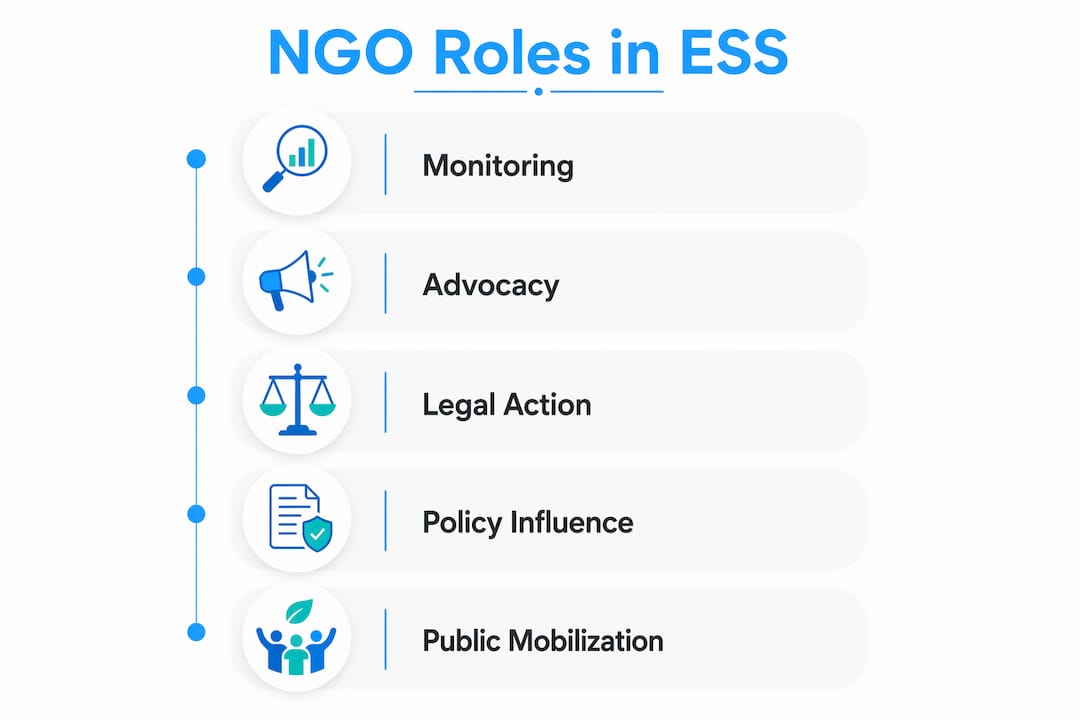
These eight roles are your paragraph topic sentences. Memorize them and pair each with a US example.
-
Advocacy and agenda-setting: NGOs campaign to raise public and political awareness of environmental issues. The Sierra Club’s Beyond Coal campaign is a strong US example of agenda-setting that shifted energy policy conversations nationally.
-
Monitoring and compliance pressure: NGOs track whether governments and corporations meet their commitments. The NRDC monitors US federal agencies and publishes reports exposing regulatory rollbacks, creating public accountability without holding formal enforcement power.
-
Research and data collection: Many NGOs produce peer-reviewed or policy-relevant data. WWF US publishes biodiversity assessments that feed directly into conservation planning and government decision-making.
-
Education and awareness: NGOs translate complex science into public knowledge. Greenpeace US uses media campaigns and school outreach to build environmental literacy among citizens and students.
-
Service delivery and community projects: TNC implements on-the-ground habitat restoration projects, often in partnership with local communities and landowners across the US.
-
Capacity building: NGOs train community organizations, local officials, and civil society groups. This multiplies their reach well beyond what their own staff can accomplish directly.
-
Litigation and legal advocacy: The NRDC has filed lawsuits against the EPA and other federal bodies to enforce existing environmental law, making courts a key venue for NGO influence.
-
Partnerships and funding: NGOs broker funding relationships between donors, governments, and local projects. TNC’s conservation easements, for example, connect private landowners with public conservation goals.
Exam phrase template: “One role of NGOs in ESS is [role], which leads to [outcome]. For example, [NGO] [specific action], resulting in [measurable or observable change].”
Pro Tip: To convert any role into evaluation, state the strength first (“This is effective because…”), then immediately follow with a limitation (“However, this is limited because NGOs lack formal enforcement power, meaning compliance depends on public pressure rather than legal obligation.”).
How NGOs influence policy and environmental outcomes
NGOs use two broad categories of strategy: inside tactics and outside tactics. Inside strategies include lobbying legislators, providing technical data to government agencies, and sitting on advisory committees. Outside strategies include public campaigns, media pressure, protests, and coalition-building with other civil society groups.

The most effective NGOs combine both inside and outside tactics. Research using configurational analysis shows that NGO influence on environmental policy depends on combining resources (staff, membership) with both inside and outside lobbying across multiple venues, rather than relying on any single tactic. The Sierra Club, for instance, pairs legal action (inside) with mass membership mobilization (outside) to maximize pressure on policymakers.
At the international level, INGOs that position their secretariats close to IGO headquarters are more effective at mainstreaming environmental issues into international organizations. They also draw on domestic NGOs for credible local data, which gives their arguments moral authority and empirical weight. A clear example is the World Bank “greening” campaign, where INGOs combined inside lobbying, media pressure, and technical information provision to shift institutional priorities.
Pro Tip: In a 9-mark “evaluate” answer, mention the configurational nature of NGO influence: state that effectiveness is not from one strategy alone but from combining resources, inside access, and outside pressure. This shows higher-order analysis and earns AO3 marks.
Limits and criticisms of NGOs you should evaluate in essays
Use these bullets as evaluation sentence starters in balanced answers:
- No formal enforcement power. NGOs can expose violations but cannot compel compliance. “However, this is limited because NGOs have no legal authority to enforce the policies they advocate for, meaning outcomes depend on government willingness to act.”
- Funding constraints. Reliance on donations creates instability. “A further limitation is that NGO activities are constrained by fundraising cycles, which can interrupt long-term projects.”
- Scale limits. Local NGOs often lack the reach to address global problems. “While effective locally, many NGOs cannot match the geographic scope of IGOs like UNEP.”
- Representativeness concerns. NGOs may not represent the communities most affected by environmental issues. “Critics argue that some NGOs reflect the priorities of wealthy donors rather than frontline communities.”
- Risk of elite co-option. As ENGOs professionalize, questions arise about downward accountability and whether an “NGO elite” becomes disconnected from local constituencies.
- Uneven implementation. NGO engagement in policy implementation and long-term monitoring is uneven across contexts, meaning their influence is stronger in early policy stages than in execution.
Three US-focused case studies you can cite in ESS answers
Case 1: NRDC and the Clean Air Act
The NRDC has used litigation and technical advocacy to defend and strengthen the Clean Air Act. When the EPA proposed weakening air quality standards, the NRDC filed legal challenges and published independent air quality data to counter the rollback. Use this case to illustrate legal advocacy and monitoring roles in a 6-mark “explain” question.
Case 2: Sierra Club’s Beyond Coal campaign
The Sierra Club coordinated public mobilization, legal filings, and legislative lobbying to accelerate the retirement of coal-fired power plants across the US. The campaign combined outside pressure (public campaigns, local organizing) with inside tactics (legal action, regulatory comments). Use this to demonstrate configurational strategy in a 9-mark “evaluate” answer.
Case 3: The Nature Conservancy and habitat restoration
TNC has protected millions of acres of US land through conservation easements and direct land purchases, partnering with private landowners, state agencies, and federal bodies. This case illustrates service delivery, partnerships, and the importance of NGOs in ecosystem management. For an IA or EE, cite TNC’s published annual reports or peer-reviewed evaluations of specific restoration projects.
For IAs and EEs, always cite the NGO’s own published reports alongside a peer-reviewed secondary source to show triangulation of evidence.
How to answer IB ESS questions about NGOs
Structure every NGO answer using this four-step frame: Claim → Role/Mechanism → Example → Evaluation.
Command-term cheatsheet:
- Outline: List the roles briefly with one example each. No evaluation needed.
- Explain: State a role, describe how it works, and link it to an environmental outcome.
- Discuss: Present strengths and limitations with evidence on both sides.
- Evaluate: Make a judgment about effectiveness, supported by evidence and a clear conclusion.
Model paragraph (6-mark “explain” question):
“One role of NGOs in ESS is monitoring and compliance pressure. The NRDC publishes independent assessments of US federal environmental regulations, identifying gaps between policy commitments and actual implementation. This matters because governments may lack the political will to self-report failures, so NGO watchdog functions create external accountability. Without this pressure, regulatory rollbacks could go unchallenged by the public.”
Pro Tip: The most common mistake Marija sees in exam scripts is listing NGO roles without linking them to outcomes. Every role must connect to a change in the environment or policy. Write “which leads to…” after every role you name.
Key Takeaways
NGOs are most effective in ESS when they combine advocacy, monitoring, and legal pressure with credible data and both inside and outside strategies.
| Point | Details |
|---|---|
| NGO definition | Private, non-profit, self-governed bodies working independently of state control on environmental issues. |
| Top three roles | Advocacy, monitoring/compliance pressure, and research/data collection are the most exam-relevant roles. |
| Influence mechanisms | Effectiveness comes from combining inside tactics (lobbying, data provision) with outside tactics (media, campaigns). |
| Key limitation | NGOs lack formal enforcement power, so their influence depends on public pressure and government willingness. |
| Esstutor support | Esstutor offers examiner-guided mock answers and IA support to help you apply NGO case studies in real exam conditions. |
Why mastering NGO roles gives you an edge in ESS
Most students can name an NGO. Fewer can explain how it influences policy, and fewer still can evaluate why that influence has limits. That gap is exactly where marks are won or lost in 6- and 9-mark questions.
From my experience as an IB examiner, the scripts that score highest on NGO questions do three things consistently: they name a specific NGO action (not just the organization), they link that action to a measurable or observable outcome, and they offer a genuine evaluation rather than a list. The NRDC’s litigation record, the Sierra Club’s multi-tactic campaigns, and TNC’s land conservation data all give you the specificity examiners reward.
For practice, try writing a timed paragraph on one NGO role without notes, then check it against the four-step frame above. If you want to use an NGO topic for your IA or EE, the ESS extended essay guide on Esstutor walks you through how to frame a focused research question around NGO effectiveness.
Sharpen your NGO answers with personalized ESS tutoring
Knowing the content is one thing. Turning it into a top-mark exam response under timed conditions is another. Esstutor gives you direct, one-on-one sessions with Marija, an IB examiner with over 13 years of ESS experience, focused on exactly the skills that move your score.

Sessions cover mock paragraph practice on NGO roles, IA support using real NGO case studies, command-term drills, and EE topic development. If you are preparing an extended essay on environmental governance or NGO effectiveness, the ESS Extended Essay guide on Esstutor is a strong starting point. Book a trial session to practice your NGO answers with examiner feedback before your next assessment.
Useful sources for your IA, EE, and exam prep
| Source | What it contains | How to use it in an IA or EE |
|---|---|---|
| NRDC.org | Policy reports, legal filings, air/water quality data | Cite as a primary NGO source; cross-reference with EPA data |
| Sierra Club Annual Reports | Campaign outcomes, membership data, litigation results | Use for evidence of outside strategy effectiveness |
| The Nature Conservancy | Habitat restoration data, conservation easement records | Strong for service delivery and ecosystem management cases |
| WWF US Living Planet Report | Biodiversity trends, species data, habitat loss figures | Cite for research/data collection role; high reliability |
| UNEP Reports | Global environmental assessments, policy frameworks | Use to contrast IGO vs NGO roles; authoritative primary source |
| Frontiers in Political Science — NGO climate governance review | Systematic review of NGO roles in climate governance | Peer-reviewed; cite for academic credibility in EE bibliography |
| Frontiers in Environmental Science — ENGO roles review | Evolving ENGO roles, professionalization, accountability | Use in evaluation sections on NGO limitations |
| Esstutor ESS Extended Essay guide | EE structure, topic selection, examiner guidance | Use to frame your research question and methodology |
This article provides general educational information for IB ESS students. For official IB assessment criteria and current syllabus requirements, always confirm details with the IBO or your school’s ESS coordinator.
No Comments