


15 Jul Role of Photosynthesis in ESS: IB Student Guide
TL;DR:
- Photosynthesis is the process by which autotrophs convert sunlight into chemical energy and produce oxygen.
- It forms the foundation for energy flow, biomass, and carbon cycling in ecosystems, supporting biodiversity.
Photosynthesis is defined as the biological process by which autotrophs convert solar energy into chemical energy stored as glucose, releasing oxygen as a byproduct. The role of photosynthesis in ESS sits at the center of nearly every major topic you will study, from energy flow and biomass production to carbon cycling and climate change. Autotrophs like plants, algae, and cyanobacteria form the energy base for all heterotrophs on Earth. Without photosynthesis, food webs collapse, atmospheric oxygen drops, and carbon cycles break down. Grasping this process is not optional for IB ESS. It is foundational.
How does photosynthesis work?
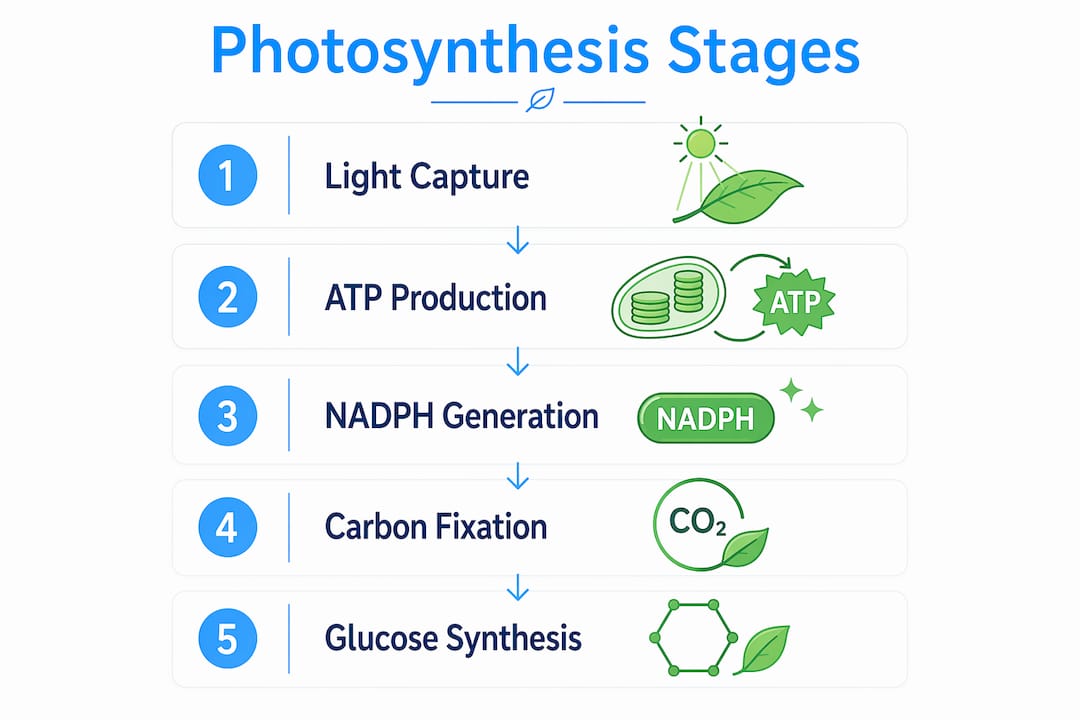
Photosynthesis operates in two main stages, and knowing both is non-negotiable for your IB ESS exams. The first stage is the light-dependent reactions. The second is the Calvin cycle.
Here is how the process unfolds, step by step:
- Light absorption. Chlorophyll in the thylakoid membranes of chloroplasts absorbs sunlight, primarily in the red and blue wavelengths.
- ATP and NADPH production. The absorbed light energy drives the splitting of water molecules, releasing oxygen and producing ATP and NADPH as energy carriers.
- Oxygen release. Oxygen exits the leaf through stomata as a byproduct of water splitting. This is where atmospheric O2 at 21% originates, a level critical for aerobic respiration and ozone layer formation.
- Carbon fixation in the Calvin cycle. ATP and NADPH power the Calvin cycle in the stroma, where CO2 from the atmosphere is fixed into glucose through a series of enzyme-driven reactions.
- Glucose storage. Glucose becomes the primary energy source for plant growth, reproduction, and ecosystem biomass accumulation.
The relationship between photosynthesis and cellular respiration is also worth noting here. Plants use some of the glucose they produce through respiration to fuel their own metabolic processes. The energy not consumed by the plant becomes available to herbivores and, further up the food chain, to carnivores and decomposers.
Pro Tip: When answering ESS exam questions about energy flow, always distinguish between the energy captured during photosynthesis and the energy actually available to the next trophic level. These are not the same number.

What is the ecological significance of photosynthesis in ecosystems?
Photosynthesis is the entry point for all energy in most ecosystems. Every calorie a lion consumes traces back, through multiple trophic levels, to a plant fixing sunlight into sugar.
The ecological roles of photosynthesis include:
- Primary production. Autotrophs build biomass through photosynthesis, creating the physical material that supports all consumer organisms.
- Food web support. All animal energy ultimately traces back to autotrophic photosynthesis, directly through herbivory or indirectly through predation and decomposition.
- Oxygen maintenance. Photosynthetic organisms maintain the atmospheric oxygen balance that aerobic life depends on.
- Carbon sequestration. Forests, grasslands, and phytoplankton absorb CO2 during photosynthesis, acting as carbon sinks that slow atmospheric carbon accumulation.
- Habitat creation. Plant biomass built through photosynthesis creates physical structure, from rainforest canopies to kelp forests, that other species rely on for shelter and reproduction.
The scale of photosynthesis across ecosystems is worth appreciating through a direct comparison:
| Ecosystem type | Primary producers | Key photosynthetic contribution |
|---|---|---|
| Tropical rainforest | Vascular plants, epiphytes | High biomass production, major carbon sink |
| Open ocean | Phytoplankton, cyanobacteria | Roughly half of global oxygen production |
| Freshwater wetland | Aquatic macrophytes, algae | Nutrient cycling, carbon storage in sediments |
| Temperate grassland | Grasses, forbs | Soil carbon accumulation, grazing food webs |
Phytoplankton deserve special attention here. These microscopic photosynthesizers in the ocean produce a substantial share of Earth’s oxygen and form the base of marine food webs. Their productivity directly affects fish populations, which in turn affect human food security. Understanding photosynthesis effects on ecosystems at this scale is exactly the kind of systems thinking IB ESS rewards.
How do environmental factors regulate photosynthesis?
Photosynthesis does not operate at a fixed rate. Light intensity, temperature, water availability, and atmospheric conditions all push the rate up or down, and these variables connect directly to ecosystem productivity.
Recent research published in Nature Communications highlights a finding that surprises many students: photosynthesis is constrained more by atmospheric dryness than by soil moisture under warming conditions. The measure used is vapor pressure deficit (VPD), which describes the difference between the amount of moisture in the air and the maximum moisture air can hold at a given temperature. When VPD rises, plants close their stomata to prevent water loss. Closed stomata block CO2 entry, which directly limits carbon fixation and reduces gross primary productivity (GPP).
Key environmental regulators of photosynthesis include:
- Light intensity. Photosynthesis increases with light up to a saturation point, beyond which additional light does not increase the rate.
- Temperature. Enzyme activity in the Calvin cycle peaks within an optimal range. Too hot or too cold, and the rate drops.
- CO2 concentration. Higher atmospheric CO2 generally increases photosynthesis rates, but this effect is moderated by temperature and water stress.
- Water availability. Water is a direct reactant in the light-dependent reactions. Drought reduces photosynthesis by limiting both the raw material and stomatal opening.
- Vapor pressure deficit. Stomatal regulation under high VPD creates a trade-off between carbon gain and water loss that constrains carbon fixation globally under warming conditions.
The distinction between gross primary productivity and net primary productivity (NPP) is critical for your ESS coursework. GPP is the total carbon fixed via photosynthesis, while NPP subtracts the carbon the plant uses for its own respiration. NPP is what remains available to the rest of the ecosystem. When environmental stress reduces GPP, NPP falls even faster because respiration costs stay relatively constant.
Pro Tip: For your Internal Assessment or Paper 2 responses, always specify whether you are discussing GPP or NPP. Examiners notice the difference, and using the correct term signals strong conceptual understanding.
Plant adaptations also shape how much photosynthesis occurs under stress. C4 plants like corn and sugarcane use a modified carbon fixation pathway that reduces water loss under high temperatures. CAM plants like cacti open their stomata only at night, fixing CO2 when VPD is low. These adaptations are excellent examples for ESS exam responses on ecosystem productivity and climate.
What role does photosynthesis play in IB ESS studies?
Photosynthesis sits at the intersection of nearly every major ESS theme. Understanding it deeply gives you a framework for analyzing energy flow, biogeochemical cycles, biodiversity, and sustainability all at once.
Here is how photosynthesis connects to specific ESS topics:
- Energy flow and trophic levels. Photosynthesis determines how much energy enters an ecosystem. Every trophic level analysis starts with the productivity of autotrophs.
- Carbon and oxygen cycles. Photosynthesis is the primary mechanism by which carbon moves from the atmosphere into living biomass. It also produces the oxygen that drives aerobic decomposition and respiration throughout the biosphere.
- Biodiversity and ecosystem stability. High photosynthetic productivity supports greater species diversity by creating more biomass and habitat complexity. The photosynthesis contribution to biodiversity operates through this productivity link.
- Human impacts and climate change. Deforestation reduces photosynthetic capacity, releasing stored carbon and reducing future carbon uptake. Pollution, including particulate matter and acid rain, reduces photosynthetic efficiency in affected ecosystems.
- Chemosynthesis as a contrast. Rare ecosystems like hydrothermal vents rely on chemosynthesis rather than photosynthesis as their primary energy input. IB ESS HL students need to recognize this distinction when analyzing energy pathways in diverse ecosystems.
Photosynthesis in environmental science also connects to sustainability debates. Carbon sequestration by forests and oceans is a natural service that human activities are actively reducing. Reforestation and ocean health initiatives are, at their core, efforts to restore photosynthetic capacity at scale. When you frame these policy discussions in your ESS essays, grounding them in the biochemistry of photosynthesis makes your arguments far more precise.
Key Takeaways
Photosynthesis drives ecosystem energy flow, carbon cycling, and atmospheric oxygen balance, making it the single most important biological process for IB ESS students to master.
| Point | Details |
|---|---|
| Two-stage process | Light-dependent reactions produce ATP and NADPH; the Calvin cycle fixes CO2 into glucose. |
| Ecosystem energy base | All food web energy traces back to autotrophic photosynthesis in most ecosystems. |
| GPP vs. NPP distinction | GPP is total carbon fixed; NPP subtracts plant respiration and is what feeds the ecosystem. |
| Climate regulation | Vapor pressure deficit, not just soil moisture, limits photosynthesis under warming conditions. |
| ESS exam relevance | Photosynthesis connects energy flow, carbon cycling, biodiversity, and human impact topics. |
What I’ve learned from teaching photosynthesis in ESS
After more than a decade of working with IB ESS students, I can tell you the most common mistake I see: students treat photosynthesis as a biology topic rather than an environmental systems topic. They memorize the equation and move on. That approach costs marks.
The real exam value comes from connecting photosynthesis to ecosystem-level consequences. When a student can explain why rising vapor pressure deficit under climate warming reduces net primary productivity in temperate forests, they are demonstrating the kind of systems thinking that earns top marks. That connection requires understanding the biochemistry, the environmental regulation, and the ecosystem outcome all at once.
I also see students consistently confuse GPP and NPP in their Internal Assessments. These are not interchangeable terms. GPP is what the plant captures. NPP is what the ecosystem gets to use. Mixing them up in a carbon cycling analysis is a straightforward way to lose marks that you should not be losing.
One more thing: do not overlook chemosynthesis. It appears in IB ESS HL content as a contrast to photosynthesis, and examiners do ask about it. Knowing that hydrothermal vent ecosystems run on chemical energy rather than solar energy shows you understand that photosynthesis, while dominant, is not the only energy pathway in nature.
Photosynthesis is not just a topic to check off your revision list. It is the lens through which most of ESS makes sense.
— Marija
Photosynthesis mastery starts with the right ESS support
Photosynthesis connects to almost every ESS exam question you will face, from energy flow diagrams to carbon cycle essays and Internal Assessment design. Getting these concepts right matters for your final score.

At Esstutor, I work with IB ESS students one-on-one to build exactly this kind of connected understanding. Whether you need help structuring your IB ESS Internal Assessment around a photosynthesis-related investigation or want to sharpen your exam responses on energy flow and carbon cycling, personalized sessions make the difference. You can also access IB ESS notes and study materials that cover photosynthesis and every other core topic in the syllabus. Sessions are flexible, remote, and built around what you actually need.
FAQ
What is the role of photosynthesis in ESS?
Photosynthesis is the process by which autotrophs convert solar energy into glucose, forming the energy base for all food webs and driving carbon and oxygen cycling in ecosystems. In IB ESS, it connects energy flow, biomass production, biogeochemical cycles, and climate change topics.
What is the difference between GPP and NPP in photosynthesis?
Gross primary productivity (GPP) is the total carbon fixed by photosynthesis, while net primary productivity (NPP) subtracts the carbon the plant uses for its own respiration. NPP represents the energy available to the rest of the ecosystem and is the more relevant measure for analyzing food webs and carbon budgets.
How does climate change affect photosynthesis rates?
Rising temperatures increase vapor pressure deficit, which causes plants to close their stomata to conserve water. Closed stomata reduce CO2 uptake, limiting carbon fixation and lowering gross primary productivity across terrestrial ecosystems.
Why is the distinction between photosynthesis and chemosynthesis important for IB ESS?
Most ecosystems rely on photosynthesis as their primary energy input, but rare ecosystems like deep-sea hydrothermal vents use chemosynthesis instead. IB ESS HL students need to recognize this distinction when analyzing energy pathways in diverse or extreme environments.
How does photosynthesis support biodiversity?
Photosynthesis builds the biomass and habitat structure that other species depend on. Higher photosynthetic productivity creates more food, more physical habitat complexity, and greater opportunities for species to occupy different ecological niches, all of which support greater species diversity.
No Comments