


05 Aug Best Sciencesauceonline.com Alternatives for IB ESS Students
TL;DR:
- A specialist IB ESS tutor with examiner experience offers targeted IA feedback and exam support online.
- Their structured approach helps students improve by diagnosing gaps, providing rubric-aligned advice, and building practice plans.
For US IB ESS students who need paid one-to-one tutoring, IA support, and exam preparation, the best alternative is a specialist IB ESS tutor working through a dedicated platform. A specialist tutor with IB examiner experience can diagnose your specific gaps, give rubric-aligned IA feedback, and build a deliberate-practice plan around your actual weaknesses — things a free resource site simply cannot do. Targeted one-to-one tutoring is especially strong for IA and EE support, where personalized feedback matters most.
Quick actions to take right now:
- Book a trial lesson with a specialist IB ESS tutor to get a diagnostic of your current level.
- Check the tutor’s credentials: IB examiner status, IA/EE experience, and evidence of past student progress.
- Gather your current IA draft or a past paper question before your first session.
Table of Contents
- What are the best sciencesauceonline.com alternatives for IB ESS tutoring?
- How do you choose the right IB ESS tutoring alternative?
- What does strong IB ESS one-to-one tutoring actually look like?
- Why Esstutor is a strong alternative for IB ESS one-to-one support
- How to compare finalists and book a trial lesson
- Key Takeaways
- What I look for in a successful student-tutor relationship
- Ready to try a dedicated IB ESS tutor?
- Useful sources and further reading
What are the best sciencesauceonline.com alternatives for IB ESS tutoring?
Not all tutors solve the same problems. Some specialize in concept explanation, others in exam technique, and others in IA/EE feedback — so the right provider type depends on what you actually need. Here is how the main options compare.
| Dimension | Specialist 1:1 tutor (niche platform) | Tutoring marketplace | Small-group exam course | School/teacher coaching |
|---|---|---|---|---|
| Best for | IA/EE feedback, exam technique, individual gaps | Finding multiple tutor options | Common content review | Curriculum basics |
| Typical pricing | Mid-to-high per session; packages available | Varies widely by tutor | Lower per-session cost | Often free or school-funded |
| IA/EE support | Structured, rubric-aligned, within IB honesty rules | Depends on individual tutor | Limited; group focus | Limited by teacher workload |
| Tutor credentials | IB examiner or experienced IB teacher | Mixed; verify individually | Course instructor varies | Classroom teacher |
| Format | 1:1 online | 1:1 online | Small group, scheduled | In-person or school hours |
| Trial availability | Usually yes | Varies | Rarely | No |
| US timezone coverage | Yes, flexible scheduling | Yes | Fixed schedule | School hours only |
Specialist 1:1 tutor via a niche platform
- Pros: Personalized sessions, IB examiner insight, IA/EE boundary clarity, flexible scheduling for US time zones.
- Cons: Higher per-session cost than group options.
- Best for: Students with specific IA deadlines, exam gaps, or EE topics to develop.
Tutoring marketplace
- Pros: Wide tutor selection, competitive pricing.
- Cons: Credential quality varies; you must vet each tutor yourself.
- Best for: Students who want to compare multiple tutors before committing.
Small-group exam course
- Pros: Cost-effective for reviewing common ESS content and exam technique.
- Cons: No individual IA feedback; fixed schedule may not suit US students.
- Best for: Students who need broad content review rather than targeted IA support.
School/teacher-led coaching
- Pros: Free, curriculum-aligned.
- Cons: Teachers have limited time for individual IA feedback; no trial lesson structure.
- Best for: Students who are on track and need only light support.
Pro Tip: One-to-one tutoring is the strongest format for IA remediation and EE feedback; group lessons work well for content exposure but rarely give you the individual diagnostic you need before an IA deadline.
How do you choose the right IB ESS tutoring alternative?
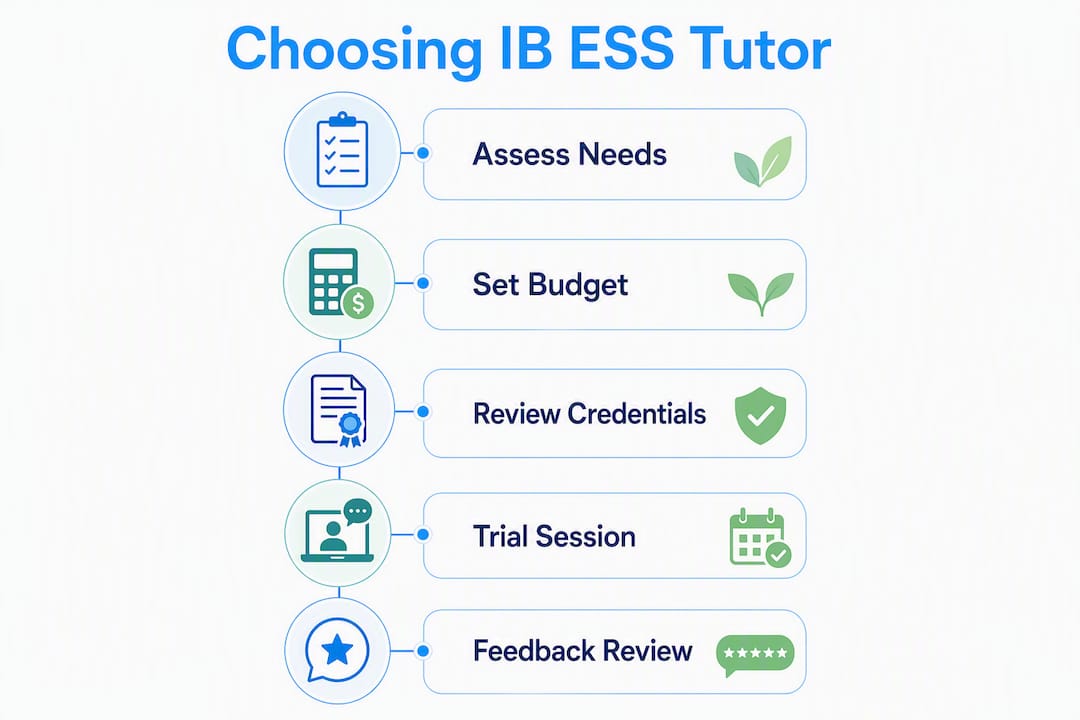
The decision comes down to five criteria: examiner experience, IA/EE boundary clarity, a deliberate-practice approach, measurable progress tracking, and scheduling fit for your US time zone. What makes a great IB ESS tutor is a combination of subject expertise, coaching skill, and accountability — not just a strong CV.
Ten questions to ask before or during a trial lesson:
- Are you a current or former IB ESS examiner? How recently?
- Can you share a sample lesson plan or session outline?
- What evidence do you have of past student progress (scores, IA grades)?
- How do you structure IA feedback without crossing academic honesty boundaries?
- Do you use a diagnostic at the start of each engagement?
- How do you track progress between sessions?
- What does a typical homework or deliberate-practice task look like?
- What platform do you use, and does it work across US time zones?
- Is there a trial lesson, and what does it cover?
- What is your refund or rescheduling policy?
Red flags to watch for:
- Vague promises about IA help with no mention of IB academic honesty rules.
- Guaranteed score claims — no tutor can guarantee an IB grade.
- No trial lesson or diagnostic offered.
- Unclear refund or cancellation policy.
- No sample lesson plan or evidence of past student results.
On pricing: specialist IB ESS tutors typically charge more per session than a general science tutor, but the gap narrows quickly when you factor in the time saved on IA revisions and the targeted nature of each session. Pay-per-session works well for short-term exam prep; a package of sessions is usually more cost-effective for full IA or EE support over several weeks.
What does strong IB ESS one-to-one tutoring actually look like?

A well-structured tutoring program follows an improvement loop: diagnose root causes, prescribe deliberate practice, set measurable targets, and track both scores and growing independence with the help of study resources and guides. High-ROI tutors categorize errors by criteria, content, and technique — then assign practice that directly addresses each category.
Typical session deliverables you should expect:
- Annotated draft feedback aligned to IB ESS rubric descriptors.
- Mark-scheme mapping for past paper answers.
- A short deliberate-practice task to complete before the next session.
- Written or recorded session notes summarizing what was covered and what to do next.
IA and EE boundaries: A tutor can review your methodology for logical consistency, check that your method is repeatable, map your draft to the marking criteria, and give written feedback on structure and clarity. A tutor cannot write sections for you, choose your research question, or submit work on your behalf. Step-by-step IA preparation should always stay within these boundaries — if a tutor offers to do more, that is a red flag.
Sample 60-minute IA session plan:
- Minutes 1–10: Diagnostic review of your current draft or specific IA section.
- Minutes 10–45: Focused teaching on the weak area (methodology, data analysis, or evaluation).
- Minutes 45–60: Feedback summary, rubric mapping, and a deliberate-practice task assigned for next time.
Pro Tip: Record your sessions (with the tutor’s agreement) and review the feedback within 24 hours. Students who complete the assigned deliberate-practice task before the next session make measurably faster progress than those who review notes passively.
Why Esstutor is a strong alternative for IB ESS one-to-one support
Esstutor offers dedicated one-to-one IB ESS tutoring that covers exactly what most students searching for paid alternatives need: IA and EE support, past-paper practice, exam-technique sessions, and coursework guidance. Sessions are delivered online and scheduled flexibly to suit US time zones.
Core services and trust signals to check on the site:
- IB examiner experience with over 13 years in IB ESS education.
- Testimonials from past students describing specific score improvements.
- A trial lesson available for prospective students.
- Structured IA feedback within IB academic honesty guidelines.
- Past-paper and mock exam practice integrated into exam-prep sessions.
The trial lesson path is straightforward: contact the site, describe your current stage (IA draft, exam timeline, specific topic), and book a session. Bring your IA draft or a past paper question you found difficult. By the end of the trial, you should have annotated feedback, a clearer picture of your gaps, and a proposed session plan if you decide to continue.
How to compare finalists and book a trial lesson
Once you have a shortlist of two or three tutors or platforms, use this checklist to move from research to booking.
Booking checklist:
- Confirm the tutor holds IB examiner or IB teaching credentials — ask for specifics.
- Check that sessions are available in your US time zone at times that work for your schedule.
- Review the trial lesson structure: does it include a diagnostic and a practice segment?
- Ask for one sample lesson plan or a past student progress example.
- Clarify the IA/EE feedback policy and academic honesty boundaries in writing.
- Confirm the pricing structure: pay-per-session or package, and the refund/rescheduling policy.
- Have your IA draft, a specific ESS topic, or a past paper question ready before the trial.
- Set a decision deadline: give yourself no more than one week after the trial to decide.
Simple decision rubric:
- Credentials and examiner experience: 30%
- Deliberate-practice approach and session structure: 30%
- Evidence of past student progress and testimonials: 20%
- Trial lesson fit and communication style: 20%
A tutor who scores well across all four areas — not just on credentials — is the one worth booking for a full package.
Key Takeaways
For US IB ESS students, a specialist one-to-one tutor with IB examiner experience and a structured deliberate-practice approach is the most effective paid alternative for IA, EE, and exam support.
| Point | Details |
|---|---|
| Specialist 1:1 is the strongest format | One-to-one tutoring with an IB examiner delivers targeted IA feedback and exam-technique coaching that group courses cannot match. |
| Verify credentials before booking | Ask for IB examiner status, a sample lesson plan, and evidence of past student progress — not just a CV. |
| IA/EE boundaries matter | A good tutor gives rubric-aligned feedback and methodology checks without crossing IB academic honesty lines. |
| Use the trial as a diagnostic | Insist on a short diagnostic task at the start of your trial lesson so you leave with a concrete next step. |
| Esstutor offers a bookable trial | Esstutor provides one-to-one IB ESS tutoring with IB examiner experience, flexible US timezone scheduling, and a trial lesson to assess fit. |
What I look for in a successful student-tutor relationship
The tutors who get the best results from their students are not the ones who explain the most in a single session. They are the ones who ask the right diagnostic questions first, then step back and let the student do the work. My focus with every IB ESS student is on building independence — because on exam day and during the IA, you are on your own. Measurable progress and IA integrity are non-negotiable priorities. If you are unsure whether a tutor is the right fit, the trial lesson will tell you more than any credential list.
Ready to try a dedicated IB ESS tutor?
Esstutor gives you something most free resources and general tutoring platforms cannot: a tutor with direct IB ESS examiner experience who knows exactly what markers look for in an IA and on exam papers. The trial lesson covers a short diagnostic and a focused IA or exam-prep segment, so you walk away with real feedback and a clear plan — not a sales pitch.

To book your trial, visit the IB ESS IA tutoring page and send a message describing your current stage: IA draft, exam timeline, or the specific ESS topic you need help with. Sessions are scheduled online and available across US time zones. If the trial is not the right fit, there is no obligation to continue.
Useful sources and further reading
- Score High IB ESS Internal Assessment (IA) with a Tutor — Esstutor’s IA tutoring service page, including trial lesson details and session structure.
- Step by Step IA Preparation: Your IB ESS Guide — Stepwise IA preparation guidance and a clear explanation of what tutors can and cannot do within IB academic honesty rules.
- What Makes a Great IB ESS Tutor? — A practical checklist of credentials and skills to verify during a trial lesson.
- How to Use Past Papers for ESS Exam Success — Practical guidance on integrating past papers and mock exams into your preparation, with links to bookable coaching sessions.
No Comments