


30 Jun The Role of Human Population in ESS Explained
TL;DR:
- Human population growth drives environmental change by increasing demand for land, water, and energy. This leads to deforestation, pollution, and biodiversity loss, exceeding Earth’s ecological limits. Managing both population size and consumption is essential for sustainability and ecosystem health.
Human population size is the single most powerful driver of environmental change in Environmental Systems and Societies (ESS). The role of human population in ESS covers how population growth, demographic shifts, and resource consumption combine to push ecosystems beyond their natural limits. As of may 2026, the global population reached 8.3 billion, far exceeding the estimated sustainable long-term carrying capacity of approximately 2.5 billion. That gap is not just a number. It represents real pressure on forests, freshwater, soils, and the climate systems that support all life on Earth.
How does human population growth affect environmental systems?
Population growth increases the total demand for land, water, energy, and food at a rate ecosystems cannot absorb. Each additional person requires shelter, calories, and energy. Multiply that by billions, and the cumulative pressure on natural systems becomes severe. Deforestation, desertification, water scarcity, and rising carbon emissions all scale with population size.

Research shows that population size predicts environmental stress more accurately than per-capita consumption alone. This finding challenges the common assumption that changing individual behavior is enough to solve environmental problems. Total population numbers matter just as much as how much each person consumes.
The specific pressures are worth naming clearly:
- Freshwater demand: Rapid population growth intensifies demand for freshwater and energy, pushing river systems and aquifers past recovery rates.
- Land use change: Growing populations require more agricultural land, driving deforestation and habitat loss that reduce biodiversity.
- Carbon emissions: More people burning fossil fuels for transport, heating, and food production accelerates global temperature rise.
- Waste generation: Higher population density increases solid waste, wastewater, and chemical pollution in both urban and rural environments.
- Food systems: Demand for resource-intensive foods like meat rises with population, requiring far more land and water per calorie than plant-based diets.
Understanding the ecological footprint concept helps students quantify exactly how much land and water each population requires to sustain its lifestyle.
Pro Tip: When writing an ESS essay on population and environment, always connect population size to a specific resource or ecosystem service. Vague claims about “more people causing more damage” earn fewer marks than precise links between population growth and, for example, aquifer depletion in South Asia.
What are population dynamics and demographic trends influencing ESS?
Population dynamics in ESS refers to how birth rates, death rates, immigration, and emigration combine to change population size over time. These four variables are the foundation of any demographic analysis. Understanding them helps you predict future population trajectories and their environmental consequences.
Key demographic trends shaping current ESS discussions include:
- Declining growth rates since 1962. Human populations shifted from a facilitation phase, where conditions supported rapid growth, to a negative phase around 1962. Growth rates fell, but total population and its environmental impacts kept rising.
- Rising international migration. International migration increased by 49% from 2000 to 2017, reaching nearly 260 million migrants. Migration redistributes population pressure across regions, affecting local carrying capacities.
- Population momentum. Even if birth rates drop today, existing age structures mean population will keep growing for decades. This momentum makes early action on sustainability critical.
- Projected peak population. Current trends point to a global population peak between 11.7 and 12.4 billion by 2067–2076. That projection defines the upper boundary of environmental pressure humanity must prepare for.
- Urbanization. As populations concentrate in cities, local ecosystems face intense pressure while rural areas may partially recover. Urban growth also changes consumption patterns, typically increasing energy and water use per person.
The role of demographics in ecological studies goes beyond counting heads. Age structure, fertility rates, and migration patterns all shape how quickly a population grows and how much it consumes. Population pyramids are a standard ESS tool for visualizing these dynamics across different countries and development stages.
What is carrying capacity and biocapacity, and how do they relate to population in ESS?
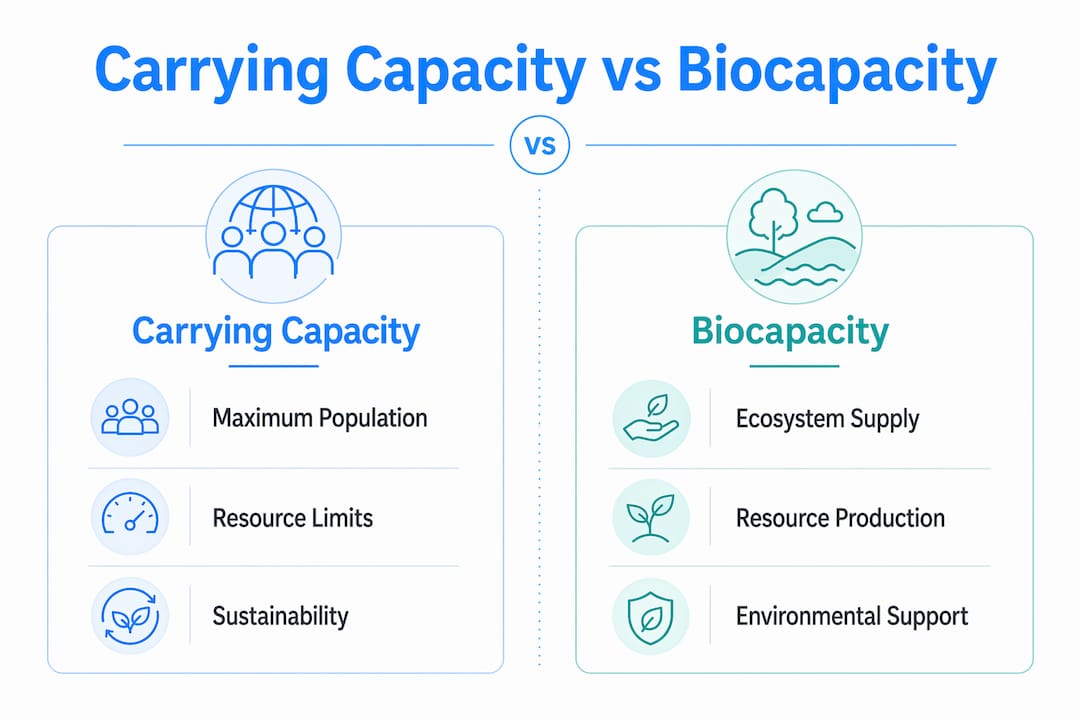
Carrying capacity is not a fixed number. It reflects a dynamic interaction between population size and per-capita resource use, shaped heavily by technology and fossil fuel availability. A region’s carrying capacity rises when technology improves food yields or water efficiency, and falls when soils degrade or aquifers empty.
Biocapacity measures something more specific. It represents the total capacity of Earth’s ecosystems to provide goods and services, from food and timber to carbon absorption. Biocapacity is a finite resource. As population grows, biocapacity per person shrinks, even if the total ecosystem area stays the same.
| Concept | Definition | ESS relevance |
|---|---|---|
| Carrying capacity | Maximum population an environment can support sustainably | Sets the upper limit for human population in a given region |
| Biocapacity | Ecosystem’s ability to produce resources and absorb waste | Measures whether current population and consumption are sustainable |
| Ecological overshoot | Consuming resources faster than ecosystems regenerate them | Indicates unsustainable population-consumption combinations |
| Ecological footprint | Total land and water area needed to support one person’s lifestyle | Connects individual consumption to population-level environmental impact |
Fossil fuels have played a hidden role in this picture. Fossil fuel reliance has masked ecological overshoot by temporarily boosting food production and energy supply. This masking effect means the true environmental cost of current population levels is larger than most people realize. When fossil fuel availability declines, the gap between population size and biocapacity will become much harder to ignore.
Biocapacity constraints also create negative feedback loops. When populations exceed what ecosystems can support, soil fertility drops, fisheries collapse, and freshwater sources shrink. These changes reduce the environment’s future capacity to support people, creating a self-reinforcing cycle of degradation. Understanding climate change impacts on ecosystems gives students a clearer picture of how these feedback loops operate in real biomes.
Pro Tip: In ESS assessments, distinguish clearly between carrying capacity and biocapacity. Carrying capacity focuses on population limits; biocapacity focuses on ecosystem productivity. Mixing them up is a common exam mistake that costs marks.
How does understanding population impacts guide sustainable practices in ESS?
Sustainability in ESS requires addressing both population size and consumption patterns together. Focusing only on consumption while ignoring population growth produces incomplete solutions. Focusing only on population while ignoring per-capita resource use misses the role wealthy nations play in driving environmental stress.
Linking population numbers with consumption and environmental impact is critical for effective ESS education and sustainable policy. Students who understand this connection can evaluate policies more accurately and propose more realistic mitigation strategies.
Practical approaches that ESS students and educators should know include:
- Family planning and education: Voluntary access to family planning services consistently reduces birth rates and slows population growth in regions where it is implemented. This is one of the most cost-effective sustainability interventions available.
- Resource efficiency: Improving agricultural yields, water recycling, and energy efficiency reduces the per-capita footprint without requiring population decline.
- Consumption shifts: Reducing meat consumption, cutting food waste, and transitioning to renewable energy all lower the total ecological footprint of existing populations.
- Policy integration: National and international sustainability frameworks, including the UN Sustainable Development Goals, explicitly link population health, education, and gender equality to environmental outcomes.
- ESS curriculum design: Teaching population dynamics alongside sustainability concepts helps students see the full picture rather than treating environmental problems as purely technical challenges.
The window to act is narrowing, but meaningful change remains possible through slowing population growth and shifting consumption patterns. That combination, not either approach alone, is what ESS research consistently supports. Students who grasp this nuance are better prepared for both exams and real-world environmental work.
Key takeaways
Human population size, demographic trends, and per-capita consumption together determine whether ecosystems remain stable or collapse, making population dynamics the central variable in ESS environmental analysis.
| Point | Details |
|---|---|
| Population exceeds sustainable limits | The global population of 8.3 billion far surpasses the estimated sustainable carrying capacity of 2.5 billion. |
| Population size drives environmental stress | Total population size predicts environmental damage more accurately than per-capita consumption alone. |
| Biocapacity shrinks as population grows | More people reduce the ecosystem services available per person, increasing ecological strain over time. |
| Fossil fuels mask overshoot | Fossil fuel use temporarily supports excess population by boosting food and energy supply, hiding the true deficit. |
| Sustainability needs a dual approach | Effective ESS policy must address both population growth and consumption patterns simultaneously. |
Why the population conversation in ESS is more urgent than it looks
Teaching ESS for over 13 years, I have noticed that students often arrive with one of two misconceptions. Either they think overpopulation is the only environmental problem that matters, or they dismiss population as irrelevant because wealthy countries have low birth rates. Both views miss the point.
The research is clear that total population size drives environmental stress more than per-capita consumption alone. That does not mean individual behavior is irrelevant. It means the conversation has to hold both variables at once. A student who can explain why a country with low birth rates but very high consumption still contributes to ecological overshoot is demonstrating exactly the kind of systems thinking ESS rewards.
What I find most valuable to teach is the concept of population momentum. Even if every country reached replacement-level fertility tomorrow, population would keep rising for decades due to existing age structures. That fact should not produce despair. It should produce urgency about the mitigation strategies that work now: education, family planning access, resource efficiency, and consumption change.
The Malthusian framing, which treats population growth as inevitably catastrophic, is too simple. So is the techno-optimist view that innovation will always expand carrying capacity. The honest ESS position sits between them: population overshoot is real, measurable, and serious, but it is also addressable through evidence-based policies that respect human rights and ecological limits equally.
— Marija
Esstutor can help you master population and environment topics
Population dynamics, carrying capacity, and biocapacity are topics that appear across IB ESS exams, internal assessments, and extended essays. Getting them right requires more than memorizing definitions. You need to apply these concepts to real data, construct clear arguments, and connect them to broader sustainability frameworks.
Esstutor offers personalized IB ESS tutoring with a tutor who has over 13 years of experience as an IB examiner and educator. Whether you are working on your IB ESS internal assessment or preparing for Paper 2 exams, sessions are tailored to your specific needs and gaps. You can also access curated IB ESS notes and textbooks to support your independent study. Book a trial lesson and see exactly where your understanding of population-environment interactions can improve.
FAQ
What is the role of human population in ESS?
The role of human population in ESS is to explain how population size, growth rate, and consumption patterns drive changes in ecosystems, resource availability, and environmental sustainability. Population dynamics are a core variable in understanding ecological overshoot, biocapacity, and carrying capacity.
How does population growth affect the environment?
Population growth increases total demand for land, water, energy, and food, accelerating deforestation, water scarcity, carbon emissions, and biodiversity loss. Research shows that total population size predicts environmental stress more accurately than per-capita consumption alone.
What is the difference between carrying capacity and biocapacity?
Carrying capacity is the maximum population size an environment can support sustainably, while biocapacity measures the total productive capacity of ecosystems to supply resources and absorb waste. Both concepts are central to evaluating whether current human population levels are sustainable.
Why do fossil fuels matter for carrying capacity in ESS?
Fossil fuels have temporarily expanded Earth’s effective carrying capacity by boosting food production and energy supply, masking the true scale of ecological overshoot. When fossil fuel availability declines, the gap between population size and sustainable biocapacity will become much more visible.
How can ESS students apply population concepts in their assessments?
ESS students can apply population concepts by linking demographic data to specific ecosystem impacts, such as connecting population growth rates to freshwater depletion or land use change. Using tools like population pyramids and ecological footprint calculations strengthens both internal assessments and exam responses.
No Comments