


17 Jul Closed Systems in IB ESS: Matter, Energy and Model Boundaries
TL;DR:
- A closed system allows energy transfer but prevents matter exchange, keeping the mass constant.
- It enables heat and work to cross boundaries while restricting particle movement in or out.
A closed system is defined as a physical system that allows energy transfer but prohibits the exchange of matter with its surroundings. This concept sits at the heart of thermodynamics, environmental science, and systems thinking for IB ESS students. The mass inside a closed system stays constant, which scientists call a “control mass.” Understanding this definition gives you a precise tool for analyzing energy changes without the added complexity of matter moving in or out.
What is a closed system in science?
A closed system is a physical system that allows energy transfer but prohibits matter transfer, maintaining a fixed mass. That fixed mass is the defining feature. It means you can track exactly how energy moves through the system without accounting for any material entering or leaving.
The two main modes of energy transfer in a closed system are heat and work. Heat crosses the boundary due to a temperature difference between the system and its surroundings. Work crosses the boundary through physical movement, such as a piston compressing a gas, or through electrical energy depending on the boundary’s properties. Neither of these transfers involves any movement of matter.
One critical point: “closed” does not mean nothing crosses the boundary. It means only energy crosses, not matter. Students often confuse a closed system with a completely sealed, inert container. That confusion leads to errors when applying the First Law of Thermodynamics, which governs how energy changes within a fixed mass.
The concept applies across multiple scientific fields. Thermodynamics uses it to calculate internal energy changes. Chemistry uses it to measure reaction heat in controlled experiments. Environmental science uses it to model ecosystems or chemical cycles where matter stays contained but energy flows freely.
Key characteristics of closed systems
- Fixed mass (control mass): The total amount of matter inside the system never changes.
- Energy exchange allowed: Heat and work can cross the system boundary in either direction.
- No matter transfer: No particles, molecules, or substances enter or leave the system.
- Defined boundary: The system has a clear, intentional boundary that separates it from its surroundings.
- Useful model: A fixed amount of matter can simplify an energy balance, but does not guarantee equilibrium or make every pressure–volume–temperature problem solvable without further information.
Pro Tip: When you identify a system boundary in an IB ESS question, ask yourself two questions: Can energy cross this boundary? Can matter cross this boundary? Your answers immediately classify the system as closed, open, or isolated.
How does a closed system differ from open and isolated systems?
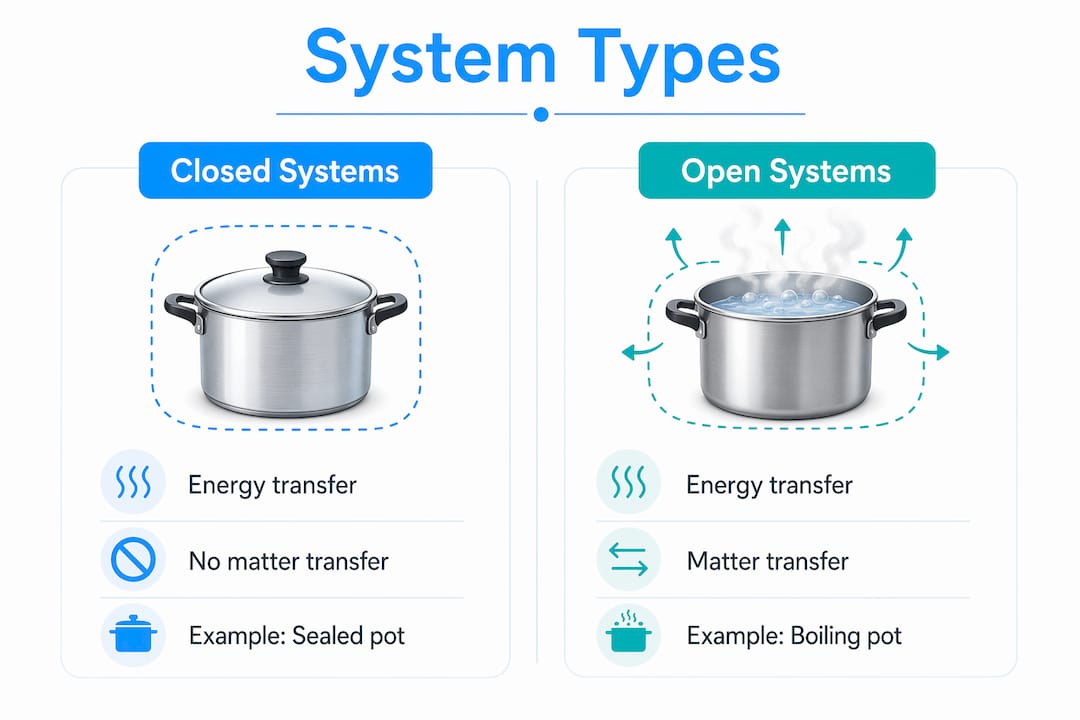
Thermodynamics classifies systems as isolated, closed, or open depending on what they exchange with their surroundings. Each type has a distinct set of rules, and mixing them up is one of the most common mistakes students make.
An open system exchanges both matter and energy with its surroundings. A boiling pot without a lid is a clear example. Steam escapes (matter leaves), and heat transfers from the stove to the water (energy enters). Living organisms are also open systems. They consume food and water, release waste, and exchange heat with the environment continuously.
A genuinely sealed vessel can be modelled as closed to matter while exchanging energy. An ordinary pot lid does not guarantee this: steam can escape, and a pressure cooker’s valve may release matter. State the boundary and assumptions rather than classify every covered pot as closed.

An isolated system exchanges neither energy nor matter with its surroundings. A perfectly insulated thermos approximates this, though no real object achieves true isolation. The universe as a whole is the most commonly cited example of an isolated system in physics.
For IB ESS, use the matter-and-energy classification: open systems exchange both, closed systems exchange energy but not matter, and isolated systems exchange neither. Define the boundary and relevant timescale clearly.
| System type | Matter exchange | Energy exchange | Example |
|---|---|---|---|
| Open | Yes | Yes | Boiling pot without a lid |
| Closed | No | Yes | Sealed piston-cylinder device |
| Isolated | No | No | The universe (theoretical) |
What are common examples of closed systems and how do they work?
Concrete examples make the closed system definition click. Each example below maintains a fixed mass while allowing energy to move across its boundary.
Sealed piston-cylinder device: This is the textbook closed system in engineering. Gas inside the cylinder stays fixed in mass. When heat is added, the gas expands and pushes the piston, doing work on the surroundings. Piston-cylinder assemblies allow precise measurement of internal energy changes due to heat and work, with no mass flow. That precision makes them central to both research and teaching.
Bomb calorimeter: A bomb calorimeter is a sealed metal container used to measure the heat released by chemical reactions. The reactants are placed inside, the container is sealed, and the reaction proceeds. Bomb calorimeters allow energy transfer but not mass transfer, making them ideal for measuring combustion energy in food science, fuel testing, and chemistry labs.
- Sealed vessel: A tightly sealed container at ordinary conditions can approximate a closed system while exchanging heat. A loose lid or a vent means matter can cross; the classification depends on the actual arrangement.
- Thermos: With its lid sealed, it can approximate a closed system. Heat leakage does not stop it being closed to matter; it prevents perfect isolation. Consider the timescale of the model.
- Gas-measurement chamber: A chamber sealed against outside air may still exchange gas with soil or water below it. If the system boundary encloses only the chamber air, that is matter crossing the boundary. Define the whole study system before calling it closed.
Defining a closed boundary simplifies accounting for matter, but the system can still change or remain away from equilibrium while energy crosses. Explain the model’s assumptions and limitations.
How do closed systems support scientific study and systems thinking?
A closed-system model can simplify an energy balance. For the usual sign convention, the internal energy change equals heat added minus work done by the system, when other relevant energy changes are negligible. The model does not automatically make a measurement accurate.
In laboratory settings, closed systems help simplify complex interactions by maintaining fixed matter content. A chemistry student measuring reaction enthalpy in a sealed calorimeter does not need to account for gases escaping or reactants entering. The boundary does that work for them. This is why closed system design is a standard feature of controlled experiments across chemistry, physics, and environmental science.
In environmental science, the closed system concept helps model specific chemical cycles or contained ecosystems. A sealed terrarium, for example, cycles water and nutrients internally while receiving solar energy from outside. Studying it as a closed system lets you analyze energy flow without tracking every molecule of matter. This approach connects directly to how environmental systems are defined in IB ESS coursework.
Systems thinking benefits from the closed system concept because it forces you to define boundaries clearly. Teaching system boundaries as modeling tools rather than physical absolutes gives students the ability to analyze complex environmental and thermodynamic problems. Once you decide what is inside and outside your system, you can trace exactly what crosses the boundary and in what form.
Systems tip: Define relevant boundaries and flows where they help explain the investigation. Naming the system type alone is not an automatic requirement or source of IA marks.
Key Takeaways
A closed system allows energy transfer but never matter transfer, making fixed mass the defining feature that separates it from open and isolated systems.
| Point | Details |
|---|---|
| Core definition | A closed system exchanges energy but not matter, keeping its mass constant throughout. |
| Energy transfer modes | Heat and work cross the boundary; no particles or substances move in or out. |
| Closed vs. open vs. isolated | Open systems exchange both; closed exchange only energy; isolated exchange neither. |
| Real-world examples | Sealed piston-cylinders, bomb calorimeters, and sealed pots all demonstrate closed system behavior. |
| Scientific value | Fixed mass lets scientists apply thermodynamic equations cleanly and control experimental variables. |
Why getting this definition right changes everything
Students often tell me they struggled with thermodynamics or IB ESS systems questions because they thought “closed” meant “nothing moves at all.” That single misunderstanding blocks progress on entire question types. Once you see that “closed” refers specifically to matter, not energy, the concept becomes a tool rather than a source of confusion.
Use the definition appropriate to the question. In ESS, “closed” refers to matter exchange being excluded while energy exchange is possible. It does not mean that internal processes stop or that heat cannot escape.
What I find most useful in teaching this concept is grounding it in everyday examples like a sealed pot or a thermos. Abstract definitions stick when students can picture them. Once a student connects “fixed mass, energy exchange” to a pot on a stove, they rarely forget the definition again.
For educators, I recommend framing system boundaries as deliberate modeling choices rather than descriptions of physical reality. A systems approach to IB ESS teaches students that scientists choose boundaries to make problems solvable. That framing builds scientific literacy far beyond the closed system concept itself.
— Marija
Esstutor can help you apply these concepts in your IB ESS work
Understanding closed systems is one piece of a much larger picture in IB Environmental Systems and Societies. Applying it correctly in your internal assessment, where you define system boundaries, justify your methodology, and analyze energy and matter flows, is where marks are won or lost.
Individual ESS support can help you discuss systems, boundaries and energy or matter transfers. Bring a specific question or your own attempt so the conversation has a clear focus. Request a FREE 20-minute trial lesson and include your SL or HL level, main concern, availability and time zone.
FAQ
What is a closed system in simple terms?
A closed system is a physical system that can exchange energy with its surroundings but cannot exchange matter. The mass inside always stays the same.
What is the difference between a closed system and an open system?
Open versus closed: An open system exchanges matter and energy. A closed system exchanges energy without matter crossing its defined boundary. A covered pot is not necessarily closed if steam escapes.
Can energy leave a closed system?
Yes. Energy in the form of heat or work can cross the boundary of a closed system in either direction. Only matter is restricted from crossing the boundary.
What is an example of a closed system in everyday life?
A genuinely sealed jar can approximate a closed system over a suitable period, exchanging energy while matter exchange is negligible. An ordinary covered pot is not necessarily closed if steam escapes.
How does a closed system differ from an isolated system?
A closed system allows energy transfer but not matter transfer. An isolated system allows neither. A thermos approximates an isolated system, while a sealed piston-cylinder device is a classic closed system.
No Comments