


15 Mar What is environmental monitoring: a guide for IB ESS students
Environmental monitoring isn’t just about recording numbers on a clipboard. It’s a sophisticated process combining cutting-edge sensors, wireless networks, and artificial intelligence to track physical, chemical, and biological parameters in real time. Modern systems can detect pollution spikes, predict ecosystem changes, and alert managers instantly when thresholds are breached. For IB Environmental Systems and Societies students, understanding these technologies and their applications is essential for excelling in internal assessments, coursework, and exams. This guide breaks down the core concepts, technologies, challenges, and real-world applications you need to master.
Table of Contents
- What Is Environmental Monitoring And Why Is It Important?
- Technologies Used In Environmental Monitoring Systems
- Challenges And Innovative Solutions In Environmental Monitoring
- Applications And Real-World Examples Of Environmental Monitoring
- Learn More And Excel In Your IB ESS Assessments
Key takeaways
| Point | Details |
|---|---|
| Environmental monitoring tracks multiple parameters | Physical, chemical, and biological data are collected systematically to assess environmental quality and ecosystem health. |
| Modern systems rely on IoT and AI | Wireless sensor networks, adaptive communication protocols, and machine learning optimize data collection and processing. |
| Energy and security are major challenges | Low power consumption, scalability, and data integrity require innovative solutions like blockchain and edge computing. |
| Applications span air, water, and climate monitoring | Real-time IoT systems improve compliance, safety, and predictive analytics across diverse environments. |
| Mastery supports IB ESS success | Understanding monitoring technologies strengthens internal assessments, coursework analysis, and exam responses. |
What is environmental monitoring and why is it important?
Environmental monitoring involves systematic data collection on environmental parameters to assess and manage environmental quality. This process goes far beyond simple observation. It requires careful planning, consistent methodology, and advanced technology to track changes over time and space. The parameters monitored depend on the specific environmental systems definition and objectives of each study.
Parameters fall into three main categories. Physical parameters include temperature, noise levels, humidity, and light intensity. Chemical parameters cover pH, dissolved oxygen, volatile organic compounds (VOCs), carbon dioxide, and particulate matter concentrations. Biological parameters measure microbial populations, biodiversity indices, and indicator species presence. Each category provides unique insights into ecosystem health and human impacts.
The objectives of environmental monitoring programs are diverse and interconnected:
- Assess pollution levels and identify contamination sources
- Track ecosystem health and detect early warning signs of degradation
- Monitor climate variation and long-term environmental trends
- Ensure regulatory compliance and support enforcement actions
- Inform policy decisions with evidence-based data
Environmental monitoring transforms raw data into actionable knowledge, enabling societies to respond proactively rather than reactively to environmental challenges.
For IB ESS students, environmental monitoring connects directly to multiple topics within the curriculum. Understanding monitoring methodologies strengthens your ability to design and evaluate internal assessments. When you analyze types of environmental studies, you’re essentially examining different monitoring approaches and their applications. This knowledge becomes critical when interpreting data sets, evaluating research quality, and proposing management strategies in exam questions.
Environmental monitoring also bridges the natural and social sciences, a core principle of ESS. The technical aspects involve physics, chemistry, and biology, while the applications touch on policy, ethics, and sustainable development. This interdisciplinary nature makes monitoring a rich topic for coursework and extended response questions.
Pro Tip: When designing your internal assessment, choose monitoring methods that balance feasibility with scientific rigor. Simple equipment can yield valuable data if your methodology is sound and your sampling strategy is well justified.
Technologies used in environmental monitoring systems
Modern environmental monitoring relies on sophisticated sensor networks and communication technologies. Low-power embedded sensor nodes form the foundation of these systems, capable of measuring multiple parameters simultaneously while consuming minimal energy. These nodes integrate physical sensors for temperature and humidity, chemical sensors for gas detection and pH measurement, and sometimes biological sensors for pathogen identification.

The real power emerges when individual sensors connect into wireless sensor networks that collect data on air pollutants, water quality, and climate parameters across wide areas. WSNs face three critical challenges. Energy consumption limits how long sensors can operate in remote locations. Scalability determines whether networks can expand to cover larger areas without performance degradation. Security vulnerabilities threaten data integrity and system reliability.
Advanced technologies address these challenges through multiple approaches. AI and the environment intersect when machine learning algorithms process sensor data in real time, identifying patterns and anomalies faster than human analysts. Blockchain encryption secures data transmission and storage, preventing tampering and ensuring audit trails. Edge-cloud computing distributes processing between local devices and central servers, enabling faster decisions while reducing bandwidth requirements.
Communication protocols determine how sensors transmit data to collection points and control centers. The choice of protocol affects range, power consumption, latency, and security. Here’s how major protocols compare:
| Protocol | Range | Power Use | Latency | Security |
|---|---|---|---|---|
| LoRaWAN | Up to 15 km | Very low | Moderate | AES-128 encryption |
| NB-IoT | Up to 10 km | Low | Low | 3GPP security |
| MQTT | Network dependent | Very low | Very low | TLS/SSL support |
MQTT enables secure, efficient, scalable data transmission in environmental monitoring systems, making it particularly valuable for applications requiring frequent updates and instant alerts. Its publish-subscribe architecture reduces network overhead while maintaining reliable delivery.
Multi-sensing capabilities provide several advantages over single-parameter systems:
- Comprehensive environmental profiles from simultaneous measurements
- Improved reliability through cross-validation between sensors
- Reduced false alarms by correlating multiple data streams
- Lower deployment costs per parameter measured
- Enhanced spatial resolution without proportional cost increases
Understanding environmental systems overview helps you appreciate why multi-parameter monitoring matters. Environmental processes rarely operate in isolation. Temperature affects chemical reaction rates, humidity influences pollutant dispersion, and biological activity responds to multiple physical and chemical factors. Single-parameter monitoring can miss these interactions.
Pro Tip: When evaluating monitoring systems in your coursework, consider the trade-offs between complexity and practicality. More sensors provide richer data but increase power requirements, maintenance needs, and potential failure points. The best system matches technology to specific monitoring objectives.
For students interested in the broader applications of these technologies, exploring how IoT development companies implement environmental monitoring can provide insights into real-world system design and deployment strategies.
Challenges and innovative solutions in environmental monitoring
Environmental monitoring systems face significant obstacles that limit their effectiveness and sustainability. WSNs face challenges such as energy consumption, scalability issues, and security risks that can compromise data quality and system longevity. Energy consumption tops the list because sensors in remote locations often rely on batteries or solar panels with limited capacity. Every data transmission drains power, forcing designers to balance measurement frequency against operational lifespan.
Scalability becomes critical as monitoring programs expand. Adding more sensors to a network increases data volume, communication overhead, and processing demands. Networks designed for dozens of sensors may fail when scaled to hundreds or thousands. Bandwidth limitations, processing bottlenecks, and coordination complexity all grow with network size.
Security vulnerabilities threaten both data integrity and system availability. Wireless transmissions can be intercepted, sensors can be physically tampered with, and malicious actors can inject false data or launch denial-of-service attacks. For environmental monitoring supporting regulatory compliance or emergency response, compromised data can have serious consequences.
Innovative solutions are addressing these challenges through multiple technological approaches. The integration of blockchain, AI, and edge-cloud computing is a proposed solution to address WSN challenges, creating more resilient and efficient systems. Each technology contributes unique capabilities to the overall solution.
Adaptive communication strategies optimize when and how sensors transmit data. Adaptive LoRaWAN communication can reduce data transmissions by approximately 88%, dramatically extending battery life without sacrificing data quality. These systems use algorithms to determine which measurements warrant immediate transmission and which can be batched or compressed. Event-driven transmission sends data only when significant changes occur, while scheduled updates maintain baseline monitoring.
AI-based energy-conscious data aggregation methods increase sensor lifespan by processing data locally before transmission. Machine learning models running on sensor nodes can filter noise, detect anomalies, and summarize trends, sending only meaningful information to central servers. This approach reduces both energy consumption and network congestion while maintaining data value.
Blockchain encryption secures environmental data integrity through distributed ledger technology. Each measurement becomes an immutable record that cannot be altered without detection. This creates trustworthy audit trails for regulatory reporting and scientific research. While blockchain adds computational overhead, edge computing distributes this burden across multiple nodes rather than centralizing it.
Ignoring these challenges leads to predictable failures:
- Premature battery depletion requiring frequent manual replacement
- Data loss during transmission or storage
- False alerts overwhelming operators and reducing response effectiveness
- System crashes under high data volumes
- Compromised data undermining regulatory compliance and research validity
For IB ESS students, understanding these challenges connects monitoring technology to broader sustainability principles. The tension between comprehensive data collection and resource efficiency mirrors larger environmental trade-offs. Your coursework can explore how technological innovation addresses these tensions, examining both successes and limitations.
Pro Tip: When analyzing environmental monitoring case studies, look for how systems balance competing priorities. The most sophisticated technology isn’t always the best solution. Sometimes simpler, more robust approaches better serve specific monitoring objectives and resource constraints.
Exploring AI and environment challenges provides additional context for how artificial intelligence both solves problems and creates new considerations in environmental management.
Applications and real-world examples of environmental monitoring
Environmental monitoring systems translate technology into tangible environmental management outcomes. A layered IoT environmental monitoring system demonstrates how components work together. The sensor layer collects raw environmental data through various instruments. The network layer transmits this data using protocols like MQTT or LoRaWAN. The application layer processes, stores, and presents data to users through dashboards, alerts, and reports.
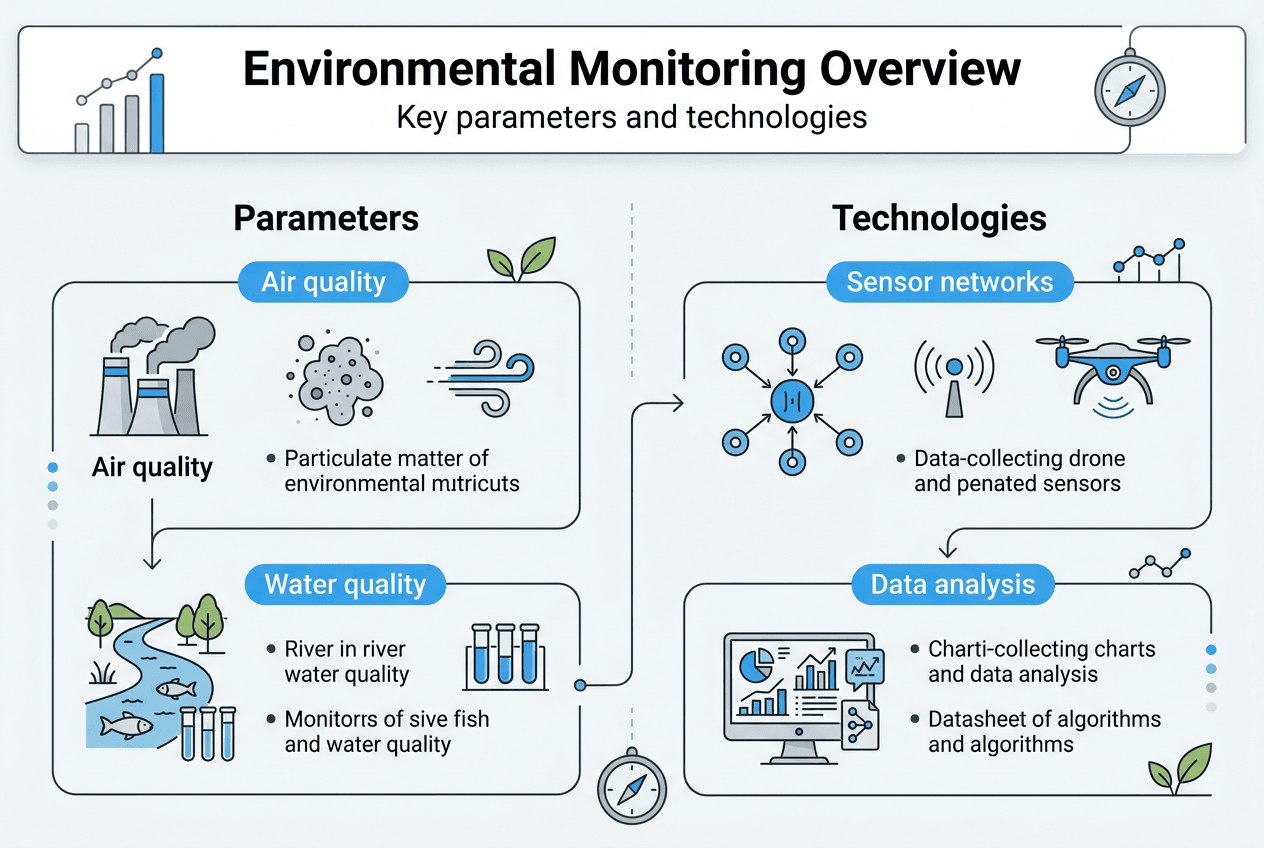
Comprehensive monitoring deployments integrate multiple sensor types to capture environmental conditions holistically. Weather stations measure temperature, humidity, atmospheric pressure, and wind speed. Noise sensors track sound levels in urban environments or near industrial facilities. Gas sensors detect VOCs, carbon dioxide, carbon monoxide, and other airborne pollutants. Particulate matter sensors measure PM2.5 and PM10 concentrations linked to respiratory health impacts.
The real-time monitoring process follows a systematic workflow:
- Sensors continuously measure environmental parameters at predetermined intervals
- Edge processing filters noise and performs preliminary analysis on sensor nodes
- Data transmits wirelessly to gateways and then to central servers or cloud platforms
- Automated algorithms compare measurements against threshold values and trigger alerts when exceedances occur
- Analytics platforms generate visualizations, trends, and predictive models to inform decision making
- Reports compile data for regulatory compliance, stakeholder communication, and continuous improvement
Comparing manual monitoring to automated IoT systems reveals dramatic differences in capability and efficiency:
| Aspect | Manual Monitoring | Automated IoT Systems |
|---|---|---|
| Measurement frequency | Daily to weekly | Continuous (seconds to minutes) |
| Data accuracy | Variable, human error | Consistent, calibrated sensors |
| Labor requirements | High, ongoing personnel costs | Low, minimal site visits |
| Response time | Hours to days | Seconds to minutes |
| Spatial coverage | Limited sampling points | Dense sensor networks |
| Long-term cost | High operational expenses | Lower after initial investment |
Real-time IoT monitoring improved air quality compliance and operational safety in facilities by enabling immediate responses to environmental changes. Organizations can now detect pollution events as they occur, implement corrective actions before impacts escalate, and maintain continuous compliance documentation without manual record keeping.
The benefits extend across multiple dimensions. Regulatory compliance becomes automated through continuous monitoring and instant documentation. Safety improves when workers receive immediate alerts about hazardous conditions. Predictive analytics identify trends before they become problems, enabling proactive management. Regulatory reporting shifts from labor-intensive manual compilation to automated report generation.
Centralized real-time monitoring transformed facility environmental management from reactive firefighting to proactive stewardship, reducing violations by 73% while cutting monitoring costs by 45% over three years.
For IB ESS students, these applications demonstrate how theoretical concepts translate into practical environmental management. When you study tools and apps for monitoring for your internal assessment, you’re engaging with the same technologies professionals use globally. Understanding real-world applications strengthens your ability to evaluate monitoring strategies critically and propose improvements.
Examining ESS internal assessment examples shows how other students have successfully incorporated monitoring technologies into their research. These examples can inspire your own investigations while demonstrating what examiners value in methodology and analysis.
The shift from periodic manual sampling to continuous automated monitoring represents more than technological progress. It reflects a fundamental change in how societies understand and respond to environmental challenges. Real-time data enables adaptive management, where decisions respond to current conditions rather than historical averages. This responsiveness is essential for addressing dynamic environmental issues from air quality to climate change.
Learn more and excel in your IB ESS assessments

Mastering environmental monitoring concepts strengthens your performance across all IB ESS assessments. Whether you’re designing an internal assessment, analyzing case studies, or responding to exam questions about environmental management, understanding these technologies and their applications gives you a competitive advantage. Expert tutoring can help you connect monitoring principles to broader ESS themes, develop stronger analytical skills, and craft more sophisticated responses.
IB ESS internal assessment tutors provide personalized guidance on methodology, data analysis, and evaluation strategies that elevate your work. They help you avoid common pitfalls and maximize the impact of your research. Beyond the IA, comprehensive IB ESS notes and textbook resources ensure you have solid foundations across all curriculum topics. When you’re ready to refine your coursework and exam preparation, top ESS coursework tips offer proven strategies from experienced educators and examiners. Taking these next steps transforms your understanding from basic knowledge to exam-ready mastery.
FAQ
What parameters are commonly monitored in environmental monitoring?
Environmental monitoring commonly tracks physical parameters like temperature, humidity, noise, and light intensity. Chemical parameters include pH, dissolved oxygen, VOCs, CO2, and particulate matter concentrations. Biological parameters measure microbial populations, biodiversity indices, and indicator species presence. The specific parameters monitored depend on the environment being studied and the objectives of the monitoring program.
How do wireless sensor networks improve environmental monitoring?
WSNs enable continuous, remote monitoring of air, water, and climate parameters across wide geographic areas. They improve data quality through frequent measurements, expand spatial coverage beyond what manual sampling can achieve, and provide automated alerts when environmental conditions exceed safe thresholds. This continuous operation captures temporal variations that periodic manual sampling would miss.
What role does AI play in environmental monitoring systems?
AI reduces sensor power consumption by optimizing data aggregation, filtering noise, and determining which measurements require immediate transmission. Machine learning algorithms enhance real-time inference accuracy, detecting environmental events and anomalies faster than traditional threshold-based approaches. AI also enables predictive analytics, forecasting environmental conditions based on historical patterns and current trends.
Why is real-time monitoring important compared to manual methods?
Real-time monitoring allows instant alerts when environmental conditions become hazardous, enabling immediate protective actions. It improves regulatory compliance through continuous documentation and reduces the risk of violations. Predictive analytics become possible with continuous data streams, supporting proactive management. Manual methods are slower, less frequent, more prone to human error, and require significantly more labor for equivalent spatial and temporal coverage.
No Comments