


20 Jul What Is Resource Management? A Guide for Students
TL;DR:
- Effective resource management involves planning, allocating, and adjusting assets to maximize efficiency and meet goals. It requires matching resources to their types, building in buffers, and continuously adapting to changing conditions to prevent burnout and delays. In natural systems, managing extraction rates and preserving biodiversity ensures long-term ecosystem resilience and sustainability.
Resource management is defined as the process of planning, scheduling, and allocating people, money, technology, and equipment to maximize efficiency and meet organizational goals. Every project, business, and ecosystem depends on it. Without a clear system for managing resources, teams overspend, miss deadlines, and burn out. For students studying environmental systems, resource management also describes how societies use and protect natural systems. Understanding its principles gives you a foundation that applies equally to a school project, a corporate team, or a national conservation policy.
What is resource management, and what are its core types?
Resource management is the practice of identifying what you have, deciding how to use it, and adjusting as conditions change. The definition of resource management spans four major categories: human resources (people and their skills), financial resources (budgets and capital), physical resources (equipment and facilities), and time. Each category requires a different approach, but all four share the same goal: get the most value from what is available.
Resource classification divides assets into three types that shape how you manage them:
- Reusable resources: People and equipment that return to the pool after a task ends. A data analyst finishes one project and moves to the next.
- Replenishable resources: Materials that can be restocked, such as office supplies or raw materials in manufacturing.
- Exhaustible resources: Non-renewable assets like fossil fuels or rare minerals. Once used, they are gone permanently.
This classification matters because the management strategy must match the resource type. You cannot treat a non-renewable mineral deposit the same way you treat a team member’s weekly hours.
Resource management principles guide how decisions get made across all four categories. The most widely applied principles include balancing supply and demand, matching capabilities to tasks, and building in buffer capacity for unexpected changes. Inter-generational equity, the idea that current use should not deprive future generations, is a core principle in natural resource contexts. Capability-based allocation ensures the right skills meet the right work, which consistently produces better outcomes than simply assigning whoever is available.

Pro Tip: Build a simple skills inventory before assigning any task. Knowing what each team member or resource can actually do prevents mismatches that slow projects down.
How does resource management improve project and business outcomes?
Effective resource management reduces operational waste, improves project timelines, and prevents burnout by keeping capacity in check. These are not abstract benefits. They show up in concrete ways: fewer scheduling conflicts, more predictable delivery dates, and teams that stay productive over the long term.
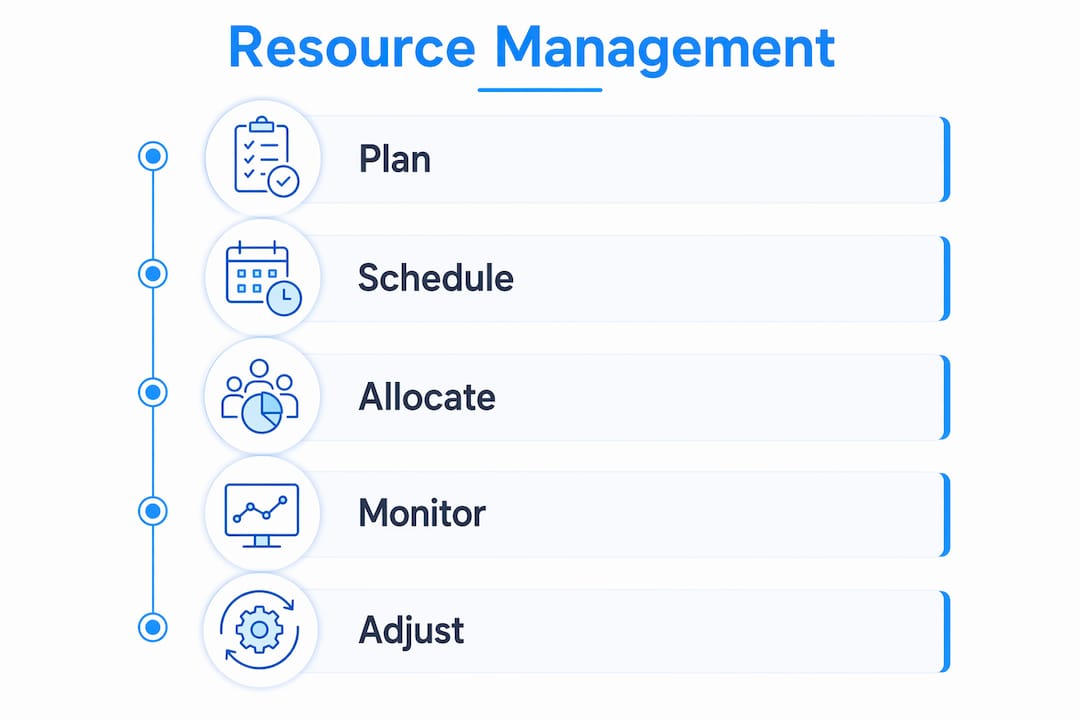
The mechanism works through five connected steps:
- Identify resources. List every asset available, including people, budget, tools, and time.
- Estimate requirements. Match resource needs to the project scope and schedule.
- Allocate resources. Assign specific assets to specific tasks based on capability, not just availability.
- Monitor usage. Track actual consumption against the plan and flag deviations early.
- Adjust dynamically. Reallocate as project priorities shift, because they always do.
The fifth step is where most plans fail. Resource management is dynamic, requiring continuous adaptation to shifting priorities rather than rigid adherence to the original plan. A project manager who treats the initial allocation as fixed will face compounding problems the moment the first assumption changes.
One of the most common and damaging mistakes is running teams at 100% utilization. Scheduling every hour of every person leaves no room for unexpected tasks, sick days, or creative thinking.
“Buffer capacity of 10–20% in scheduling prevents burnout and allows agility in resource use. One hundred percent resource utilization is counterproductive and leads to system failure under any unexpected demand.”
Buffer capacity acts as a strategic reserve. It absorbs shocks without derailing the entire project. Teams that build this buffer in consistently outperform those that do not, both in delivery speed and in staff retention.
What are unique considerations in natural resource management?
Natural resource management, often abbreviated as NRM, is the practice of overseeing how societies extract, use, and protect natural systems including forests, water, soil, and biodiversity. Its goals go beyond efficiency. NRM aims to preserve ecosystem function for future generations while meeting present needs.
Sustainable natural resource management focuses on extraction rates that respect ecosystem regeneration capacity. This means a fishery should not harvest more fish than the population can replace in a given season. A forest should not be cleared faster than new growth can restore carbon storage and habitat. The principle sounds simple, but applying it requires accurate data on regeneration rates, population dynamics, and ecosystem thresholds.
| NRM Principle | Definition | Example |
|---|---|---|
| Sustainable yield | Extract no more than the system can regenerate | Fishery catch limits |
| Inter-generational equity | Preserve resources for future generations | Protected forest reserves |
| Biodiversity preservation | Maintain species diversity within managed ecosystems | Wildlife corridors in agricultural zones |
| Ecosystem resilience | Manage for long-term system stability, not short-term output | Rotational grazing on rangelands |
Biodiversity conservation strategies are a direct application of NRM principles. Protecting species diversity is not separate from resource management. It is a core output of managing ecosystems well. When biodiversity declines, ecosystem services like pollination, water filtration, and soil fertility decline with it.
Pro Tip: When studying NRM for IB ESS, connect each principle to a real case study. Linking the concept of sustainable yield to a specific fishery or forest makes exam answers far more convincing.
What are common challenges and best practices in managing resources effectively?
The biggest challenge in resource management is not a lack of tools. It is a lack of clarity about what resources actually exist and what they can do. Without a standardized taxonomy of skills, allocation plans look good on paper but fail during execution. A project manager who does not know that a team member specializes in qualitative research, not quantitative analysis, will assign the wrong person to the wrong task.
Common pitfalls include:
- Static planning: Treating the initial resource plan as fixed rather than as a starting point for ongoing adjustment.
- Availability bias: Assigning resources based on who is free rather than who has the right skills.
- No buffer capacity: Scheduling at 100% utilization with no reserve for unexpected demands.
- Poor visibility: Lacking a clear, current picture of who is doing what and at what capacity.
- Skill mismatches: Assigning tasks without verifying that the assigned person has the required capability.
Best practices address each of these directly. Continuous monitoring replaces static snapshots with a live view of resource consumption. Agile reallocation allows managers to shift resources as priorities change without restarting the entire plan. A standardized skills taxonomy, a structured list of what each team member can do and at what level, makes capability-based allocation possible rather than accidental.
Success in resource management depends more on change management than on software tools. The best platform in the world cannot compensate for a team that does not understand its own capabilities or a manager who refuses to adjust the plan when conditions change.
Pro Tip: Review your resource allocation weekly, not monthly. Weekly check-ins catch mismatches early, before they compound into project delays or team exhaustion.
For students applying these ideas to academic work, ESS academic improvement strategies offer a practical parallel: managing your study time, research materials, and cognitive energy follows the same logic as managing a project team.
Key Takeaways
Effective resource management connects strategy to execution by matching the right resources to the right tasks, building in buffer capacity, and adapting continuously as conditions change.
| Point | Details |
|---|---|
| Core definition | Resource management is planning, allocating, and adjusting people, money, equipment, and time to meet goals efficiently. |
| Three resource types | Reusable, replenishable, and exhaustible classifications determine the correct management strategy for each asset. |
| Buffer capacity matters | Scheduling 10–20% reserve capacity prevents burnout and keeps teams agile when unexpected demands arise. |
| NRM and sustainability | Natural resource management requires extraction rates that respect ecosystem regeneration to preserve biodiversity and long-term resilience. |
| Skills clarity is critical | A standardized skills taxonomy prevents mismatches and is the single most important factor in successful resource allocation. |
Resource management is more art than algorithm
I have worked with students and educators long enough to notice a pattern: people assume resource management is a purely technical skill. They expect a spreadsheet or a software platform to solve it. The reality is more interesting and more demanding than that.
Resource management balances competing priorities, blending judgment and data rather than following a fixed formula. The data tells you what you have. Judgment tells you what to do with it when three priorities compete for the same resource at the same time.
What I find most students miss is the capability question. They ask “who is available?” when they should ask “who is right for this?” Availability is easy to see. Capability takes effort to understand. Building that understanding, whether for a team project or a natural ecosystem, is where real resource management skill develops.
Digital tools help with visibility and tracking. They do not replace the human judgment required to make good allocation decisions under pressure. The students and professionals who get this right are the ones who treat resource management as a continuous practice, not a one-time plan.
— Marija
How Esstutor supports your understanding of resource management
If you are an IB student, resource management is not just a business concept. It appears directly in Environmental Systems and Societies coursework, from sustainable yield in fisheries to ecosystem services and biodiversity conservation.

Esstutor offers personalized support for students working through these topics in their extended essay on environmental systems, internal assessments, and exam preparation. With over 13 years of experience as an IB examiner and educator, Esstutor helps you connect concepts like inter-generational equity and sustainable extraction to the specific questions your examiners will ask. Whether you are building your first resource management argument or refining your ESS coursework, a trial lesson with Esstutor gives you a clear starting point.
FAQ
What is the simplest definition of resource management?
Resource management is the process of planning, scheduling, and allocating resources, including people, money, and equipment, to complete goals efficiently. It connects organizational strategy to day-to-day execution.
Why is 100% resource utilization a problem?
Scheduling resources at full capacity leaves no room for unexpected tasks or changes, which leads to burnout and project delays. A buffer of 10–20% capacity is the standard recommendation for maintaining agility.
What is natural resource management?
Natural resource management is the practice of overseeing how societies use and protect natural systems, such as forests, water, and biodiversity, at extraction rates that allow ecosystems to regenerate over time.
What is the difference between reusable and exhaustible resources?
Reusable resources, like people and equipment, return to the resource pool after a task ends. Exhaustible resources, like fossil fuels, are permanently consumed when used and cannot be replenished.
How does capability-based allocation improve outcomes?
Matching tasks to team members based on their actual skills, rather than their availability, produces better results and fewer errors. A clear skills taxonomy is the foundation for making this kind of allocation consistently.
No Comments