


09 Jul What Is the DPSIR Model? A Student’s Guide
TL;DR:
- The DPSIR model explains how human activities cause environmental changes through interconnected components. It is widely used in education and policy to analyze causes, effects, and responses in sustainability efforts. However, its linear structure can oversimplify the complex feedbacks in social-ecological systems.
The DPSIR model is defined as a causal framework that organizes human-environment interactions into five sequential components: Drivers, Pressures, State, Impact, and Response. Environmental agencies worldwide, including the European Environment Agency, use it to structure environmental assessments and guide sustainability policy. For IB Environmental Systems and Societies (ESS) students, the DPSIR framework is one of the most testable and transferable tools you will encounter. Understanding it clearly gives you a real advantage in essays, internal assessments, and exams.
What is the DPSIR model and how does it work?
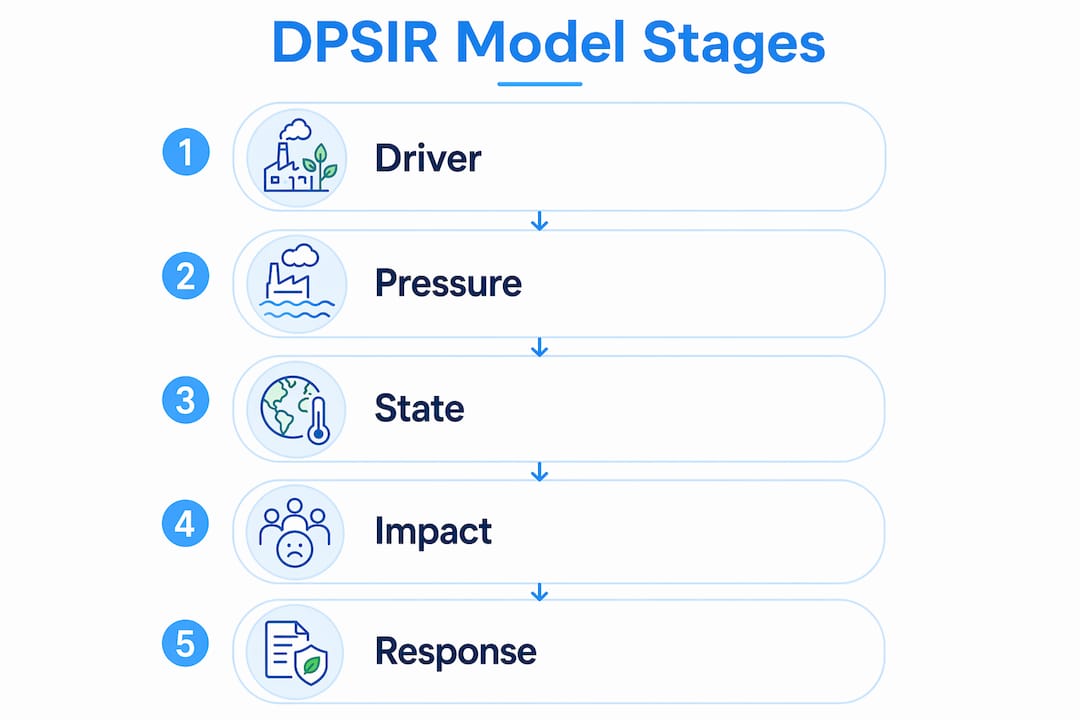
The DPSIR model definition centers on a chain of cause and effect. Each component feeds into the next, creating a loop that connects human activity to environmental change and back to societal action.
| Component | What it represents | Example |
|---|---|---|
| Drivers | Underlying social, economic, or demographic forces | Population growth, urbanization, industrial expansion |
| Pressures | Direct stresses placed on the environment | Greenhouse gas emissions, water extraction, deforestation |
| State | Measurable environmental conditions | Air quality index, river pH, species richness |
| Impact | Effects on ecosystems, human health, or economies | Coral bleaching, respiratory illness, crop failure |
| Response | Policy or societal actions taken to address impacts | Carbon taxes, protected area designation, clean energy subsidies |
The chain runs in one direction but feeds back on itself. A Response can reduce a Pressure, which then improves the State over time. That feedback loop is what makes the framework useful for adaptive management, not just description.
- Drivers are the root causes. They are often economic or demographic, such as rising demand for beef driving land clearance.
- Pressures are the direct environmental stresses that Drivers produce. Deforestation is a Pressure; the logging industry is a Driver.
- State refers to what you can actually measure. Biodiversity indices, water quality scores, and carbon concentration data all belong here.
- Impact covers the consequences of a changed State. Reduced pollinator populations, for example, directly lower agricultural yields.
- Response includes any action taken by governments, communities, or individuals to reduce harm or restore conditions.
Pro Tip: When writing an ESS essay or internal assessment, label each part of your case study with the correct DPSIR component. Examiners reward students who show they can apply frameworks, not just describe them.
How is the DPSIR framework used in environmental education?
Educational use of DPSIR builds two specific skills: systems thinking and anticipatory thinking. Systems thinking means seeing how components connect rather than viewing them in isolation. Anticipatory thinking means predicting what happens next in the chain before it occurs. Both are core sustainability competencies that IB ESS explicitly assesses.
Teachers use the DPSIR approach in several structured ways:
- Case study mapping. Students select a real environmental issue, such as eutrophication in the Baltic Sea, and assign each element of the issue to a DPSIR component. This forces precise thinking about cause and effect.
- Data collection exercises. Students gather State indicators, such as dissolved oxygen levels or nitrate concentrations, and then work backward to identify the Pressures and Drivers behind the numbers.
- Policy evaluation workshops. Students analyze existing Responses, such as EU nitrate directives, and assess whether they target the correct component of the chain.
- Scenario planning. Students predict how a change in one component, such as a new industrial Driver, ripples through the rest of the framework.
- Comparative analysis. Two similar ecosystems facing different Pressures are compared using DPSIR to identify why outcomes differ.
The DPSIR framework also supports cross-sector dialogue by giving students from different disciplines a shared vocabulary. A student focused on economics and a student focused on ecology can both contribute meaningfully to the same DPSIR analysis. That shared structure is exactly what makes it so effective in group projects and classroom discussions.
Pro Tip: If you are working on an IB ESS internal assessment, use DPSIR to frame your introduction. State the Driver and Pressure your investigation addresses, then explain which State variable you are measuring. This gives your IA a clear, examiner-friendly structure from the first paragraph.

What are the strengths and limitations of the DPSIR framework?
The DPSIR framework’s greatest strength is its clarity. It gives students, educators, and policymakers a shared structure to connect environmental data to human causes and societal responses. That clarity is rare in environmental science, where complexity often obscures the path from problem to solution.
Strengths of the DPSIR approach:
- The causal chain is intuitive. Most people can grasp Driver to Pressure to State to Impact to Response without specialized training.
- It structures data collection. Researchers know exactly which type of indicator belongs at each stage.
- It supports cross-sector collaboration by providing a common language for economists, ecologists, and policymakers.
- It connects environmental monitoring directly to policy design, making it useful for evidence-based decision-making.
Limitations to keep in mind:
- The linear structure cannot fully represent the complexity of real social-ecological systems. Feedbacks between components are often nonlinear and simultaneous.
- Social justice concerns are frequently treated as an afterthought rather than a central part of the analysis. Who bears the Impact, and who controls the Response, are questions the basic model does not automatically raise.
- Oversimplification is a real risk. Grouping all economic activity under “Drivers” can obscure the difference between subsistence farming and industrial agriculture.
“DPSIR should be treated as a flexible causal structure, not a definitive mapping of social-ecological complexity. Its simplicity helps linkage but can obscure dynamic system intricacies and social justice aspects.”
The most effective use of DPSIR treats it as a starting point, not a complete answer. Pair it with complementary frameworks, such as planetary boundaries or ecosystem services analysis, when your case study involves deep social or ecological complexity. Used iteratively and critically, it remains one of the most practical tools in environmental analysis.
How does DPSIR guide environmental policy and monitoring?
The DPSIR model in environmental policy works by structuring the indicators governments use to track environmental health. DPSIR underpins indicator systems used globally to track pollution and environmental quality linked to the Sustainable Development Goals. That connection to the SDGs means the framework is not just academic. It shapes real decisions about where to invest, what to regulate, and how to measure success.
Effective policy use depends on one critical distinction: separating underlying Drivers from immediate Pressures. A policy that targets only the Pressure, such as capping emissions from a single factory, will not solve a problem driven by broader economic forces. Targeting the Driver, such as reforming agricultural subsidies, produces more durable change.
| Policy target | Component addressed | Example |
|---|---|---|
| Emissions cap | Pressure | EU carbon trading scheme |
| Protected area designation | State/Impact | Marine protected areas under CBD |
| Renewable energy subsidy | Driver | Feed-in tariffs for solar power |
| Ecosystem restoration fund | Impact | EU Nature Restoration Law |
| Environmental monitoring program | State | National water quality reporting |
The DPSIR methodology also enables policymakers to identify vulnerability hotspots. By mapping where State indicators are declining fastest and which Impacts are most severe, governments can prioritize interventions before a system crosses a tipping point. That early-warning function is one of the framework’s most practical contributions to sustainable management.
Pro Tip: When analyzing a policy case study in your ESS exam, use the DPSIR table structure above as a mental checklist. Ask which component each policy targets. Students who demonstrate this level of analysis consistently score in the higher mark bands.
You can deepen your understanding of how environmental indicators connect to each DPSIR stage by reviewing specific examples from IB ESS contexts. Seeing real data mapped to the framework makes the abstract components concrete and memorable.
Key Takeaways
The DPSIR model is the most widely used causal framework for connecting human activities to environmental change, and applying it correctly requires treating each component as distinct, linked, and open to targeted policy action.
| Point | Details |
|---|---|
| Core definition | DPSIR stands for Drivers, Pressures, State, Impact, and Response, forming a causal chain. |
| Educational value | The framework builds systems thinking and anticipatory thinking skills in students. |
| Policy application | DPSIR structures environmental indicators linked to the Sustainable Development Goals. |
| Key limitation | Its linear structure risks oversimplifying complex social-ecological feedbacks. |
| Best practice | Use DPSIR as a flexible starting tool, not a rigid formula, and pair it with other frameworks. |
Why I think DPSIR is worth mastering, not just memorizing
After more than 13 years of teaching IB ESS and working as an IB examiner, I have seen students treat DPSIR as a vocabulary exercise. They learn the five letters, write a definition, and move on. That approach misses the point entirely.
The real value of the DPSIR framework is that it trains you to think causally about environmental problems. When you look at a river with declining fish populations, the framework forces you to ask: what changed the State, what Pressure caused that change, and what Driver is behind the Pressure? That chain of questions is exactly what environmental scientists and policymakers do in practice.
What I find most useful to teach is the distinction between Drivers and Pressures. Students consistently conflate them. Population growth is a Driver. The increased water extraction that population growth causes is a Pressure. Getting that distinction right changes the quality of your analysis completely.
I also want to be honest about the model’s limits. DPSIR does not automatically surface questions of equity. Who is most affected by the Impact? Whose Response gets implemented? Those questions require you to go beyond the framework. I always encourage students to layer social justice thinking on top of DPSIR, not treat it as a complete picture on its own.
Used well, DPSIR is one of the clearest thinking tools in environmental education. Used poorly, it becomes a checklist that produces shallow analysis. The difference is whether you treat it as a living, flexible structure or a rigid formula. I recommend the former, every time.
— Marija
Esstutor’s resources for mastering environmental frameworks
IB ESS students who apply DPSIR in their extended essays and internal assessments consistently produce stronger, more structured work.
Individual ESS support can help you discuss how to apply DPSIR to a specific environmental issue. Bring a specific question or your own attempt so the conversation has a clear focus. Request a FREE 20-minute trial lesson and include your SL or HL level, main concern, availability and time zone.
FAQ
What does DPSIR stand for?
DPSIR stands for Drivers, Pressures, State, Impact, and Response. Each term names one component in a causal chain connecting human activities to environmental change and societal action.
Who developed the DPSIR model?
The DPSIR framework was developed and popularized by the European Environment Agency as a tool for structuring environmental assessments and indicator systems. It builds on earlier pressure-state-response models used by the OECD.
What is a DPSIR model example in practice?
A clear example is ocean plastic pollution. The Driver is consumer demand for single-use plastics. The Pressure is plastic waste entering waterways. The State indicator is microplastic concentration in seawater. The Impact is harm to marine species and human health through the food chain. The Response includes plastic bag bans and extended producer responsibility laws.
What are the main advantages of the DPSIR approach?
The DPSIR approach provides a clear, shared structure that connects environmental data to policy decisions. It supports evidence-based interventions by showing exactly which component of the causal chain a policy targets, making it easier to evaluate whether a Response is likely to work.
How is DPSIR used in IB ESS?
IB ESS students use the DPSIR framework to structure case study analyses, frame internal assessment introductions, and evaluate environmental policies. Applying the framework correctly in exam responses demonstrates systems thinking, which is a skill the IB explicitly rewards in higher mark bands.
No Comments