

28 Nov IB ESS Paper 1
IB ESS Paper 1 preparation means practising how to connect case-study evidence to the question. This guide includes a practical routine and clearly labelled older exercises.
Reviewed 4 October 2026 · Current ESS SL and HL course, first assessment 2026.
Prepare for the current IB ESS Paper 1
Paper 1 uses an unseen case study and a resource booklet. Practise interpreting evidence and connecting it to the question. The SL and HL papers differ in length and scope: use the current SL/HL exam-format table when setting a timed practice.
A useful practice routine
- Identify the place, environmental issue and main stakeholders.
- Read graph axes, units, dates and scales before describing a trend.
- Link each claim to a specific resource, value or observation.
- Separate a pattern in the data from an explanation for that pattern.
- Match the depth of your response to the command term and marks.
- Check whether the evidence supports your conclusion and note important limitations.
Practise ESS command terms. For HL practice, choose materials that cover your additional course content; do not assume that a short legacy SL question tests the full HL course.
Original practice prompt: urban heat
Imagine a table comparing afternoon surface temperatures at shaded and exposed school sites. First describe the pattern using values and units. Then explain a plausible mechanism and identify a limitation in the comparison. Finally, consider what additional evidence would help you judge a proposed tree-planting programme. This is an illustrative tutor-created exercise, not an official IB question or markscheme.
Legacy BOD and eutrophication exercise
The older exercise below is retained for topic and data-handling practice. It is not labelled as a current 2026 specimen paper. Check its relevance with your teacher, and use current specimen or examination papers for full exam rehearsals.
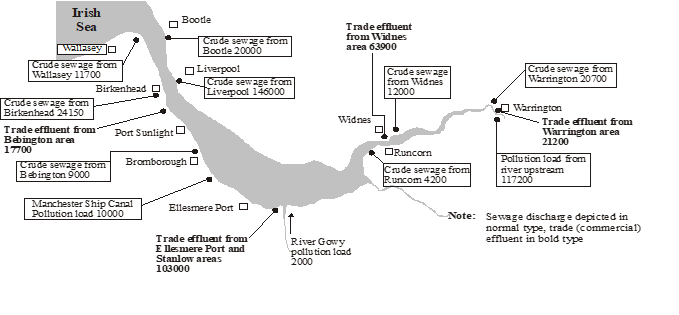
1. Figure 1 below shows the estimated biochemical oxygen demand (BOD) for a series of point and non-point sources along the river Mersey.
Figure 1. BOD values (pounds day–1) for the river Mersey in England.
[R B Clarke, Marine Pollution, (Oxford: Oxford University Press, 1994) page 17. By permission of Oxford University Press]
(a) (i) Define what is meant by the term biochemical oxygen demand.
(1)
(ii) Using figure 1, complete the scatter graph below by adding data for trade effluent from Widnes and for trade effluent from Ellesmere Port and Stanlow.
Figure 2. Selected BOD values for the river Mersey.
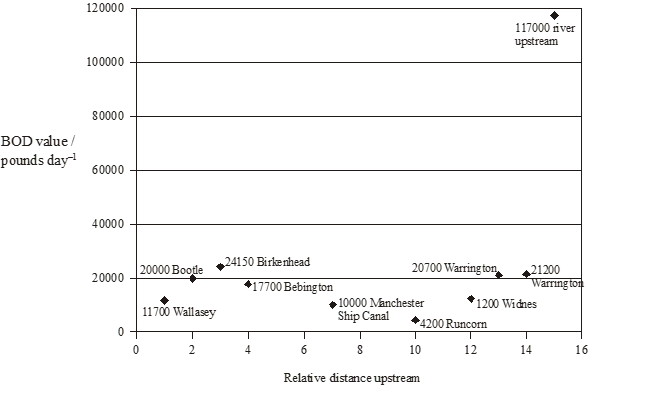
(2)
(iii) Suggest one reason why the BOD values for the Manchester Ship Canal and the “river upstream” are so different.
(1)
(iv) Suggest why some sites contribute more pollution to the river Mersey than others.
(2)
(b) (i) Define what is meant by the term eutrophication.
(1)
(ii) State one way in which humans can accelerate the process of eutrophication.
(1)
(iii) Outline and evaluate how eutrophication can be controlled from
• an ecocentric perspective
• a technocentric perspective.
Ecocentric:
Technocentric:
(4)
(Total 12 marks)
Need help applying this to your ESS work?
Explore online IB ESS tutoring for SL and HL with Marija Maletz or request a free 20-minute trial. Bring your level, the question or topic you find difficult, and your availability.
Check the official IB ESS guide for the current assessment outline.
No Comments