


30 May The Role of Lesson Flexibility in Modern Teaching
TL;DR:
- Lesson flexibility is a design principle that involves adapting instructional timing, methods, and materials to meet diverse learner needs without sacrificing core goals. It requires proactive planning, institutional support, and clear communication, enabling responsive education that benefits all students. Effective flexibility balances structure with negotiation, supported by policies and technology that facilitate real-time adaptation.
Many educators still operate under the assumption that a tightly structured lesson plan is a sign of good teaching. The tighter the script, the thinking goes, the more control you have over outcomes. But research and classroom experience tell a different story. The role of lesson flexibility in effective instruction is not about loosening standards or abandoning planning. It is about designing lessons that can respond to real students in real time. This article explores what lesson flexibility actually means, how institutional frameworks shape it, and what practical strategies help you implement it without losing sight of your learning goals.
Table of Contents
- Key Takeaways
- The role of lesson flexibility and what it actually means
- Policy and administrative frameworks that shape flexibility
- How technology enables adaptable teaching
- Flexible lesson planning strategies that actually work
- Challenges and trade-offs in implementing flexibility
- My honest take on lesson flexibility
- Flexible learning in action with Esstutor
- FAQ
Key Takeaways
| Point | Details |
|---|---|
| Flexibility starts with design | Building adaptability into your lesson from the beginning, not as an afterthought, produces better outcomes for diverse learners. |
| Policy frameworks define boundaries | Governance structures like QCAA’s approval process show that flexibility must be planned, documented, and aligned with assessment calendars. |
| Technology can support adaptation | AI-powered tools and adaptive quizzes extend flexible delivery, but require careful piloting before broad classroom use. |
| Clear goals unlock real choice | Students benefit from flexible options only when the learning objective is transparent and the options genuinely serve that objective. |
| Negotiation is part of the process | Effective flexibility is relational, not mechanical. It requires ongoing dialogue between teachers, students, and administrators. |
The role of lesson flexibility and what it actually means
Lesson flexibility is not a teaching style. It is a design principle. In practice, it means adjusting the timing, methods, materials, assessments, or environment of your lessons to better meet learner needs, without abandoning the core learning objective. The field most associated with this approach is Universal Design for Learning, commonly known as UDL.
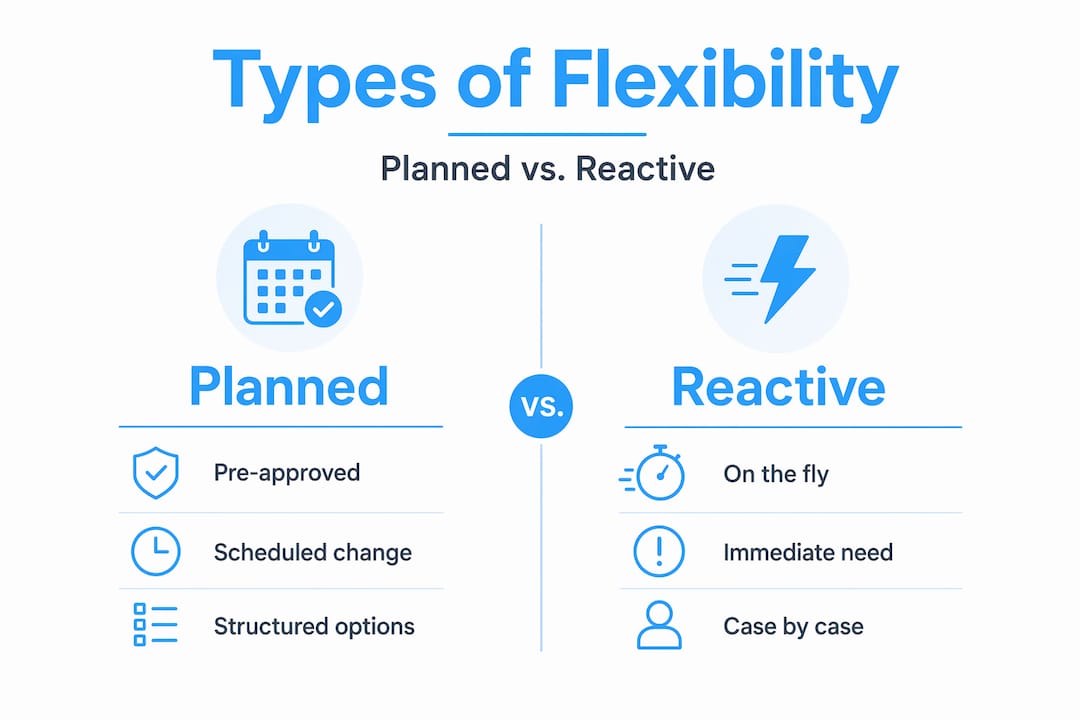
UDL builds flexibility proactively into lesson design by embedding inclusive goals, multiple methods, varied materials, and flexible assessments from the start. This is quite different from reactive flexibility, which is when a teacher pivots mid-lesson because something is not working. Both have value. But reactive flexibility is exhausting and inconsistent. Proactive flexibility is structural.
Think about what that looks like in practice:
- Timing: Students have different windows for completing tasks, rather than a single synchronized deadline.
- Methods: A concept is taught through video, text, and discussion rather than just lecture.
- Materials: Readings are available in multiple formats, including audio and visual options.
- Assessment: Students demonstrate understanding through written work, oral explanation, or a practical task.
- Environment: Seating, grouping, and digital access are designed to accommodate focus and participation needs.
The Australian Curriculum is intended to be used flexibly by schools to reflect teachers’ professional knowledge and local student contexts. The curriculum guides what and when to cover, but teachers are expected to adapt classroom activities to student backgrounds and learning needs. That is a built-in mandate for flexibility, not just a nice idea.
Pro Tip: When building flexible options into a lesson, start by locking down your learning goal first. Everything else can adapt around that fixed center.
Policy and administrative frameworks that shape flexibility
Lesson flexibility does not happen in a vacuum. It operates within institutional structures that set boundaries, require approval, and tie adaptations to accountability timelines. Understanding these frameworks is not just bureaucratic compliance. It is how you make flexibility sustainable at scale.
Queensland’s QCAA is one of the clearest examples. Their approach to flexible delivery requires formal steps:
- Schools must indicate their intent to use a flexible delivery approach in the Subject Enhancement Program (SEP) calendar.
- Principal approval is required before any assessment order or timing variation can be implemented.
- All flexibility must remain within the bounds of QCAA’s published assessment timelines.
- Reporting obligations apply, and the flexibility must be auditable to protect the integrity of summative assessment.
- Quality assurance processes mean that flexibility needs to be planned well in advance, not decided the week before an assessment.
This structured approach matters. Institutional guardrails like principal approval and scheduling constraints are what make flexible delivery sustainable at scale rather than ad hoc.
Here is a quick comparison of planned versus reactive administrative flexibility:
| Dimension | Planned flexibility | Reactive flexibility |
|---|---|---|
| Approval status | Pre-approved by leadership | Often unapproved or informal |
| Assessment alignment | Tied to SEP calendar | May conflict with deadlines |
| Documentation | Auditable and reported | Rarely recorded |
| Risk to student results | Low | Potentially significant |
| Scalability | High | Low |
Curriculum flexibility affecting assessment sequencing is both a pedagogical and an administrative challenge. QCAA’s process ensures that flexibility is planned and auditable with respect to summative and external assessment timelines. Administrators who understand this balance are far better positioned to support teachers who want to design adaptable lessons without putting student outcomes at risk.
Pro Tip: Build flexibility into your curriculum planning calendar at the start of each semester. Late requests are harder to approve and harder to implement well.
How technology enables adaptable teaching
Technology is one of the most practical levers for scaling lesson flexibility across a classroom or school. When used thoughtfully, digital tools can provide the kind of real-time adaptation that a single teacher cannot manually deliver to thirty students at once.

A recent study found that an AI-powered platform improved student engagement by offering adaptive quizzes, dynamic feedback, and multimodal content. Students specifically valued the quizzing function for retention and the feedback for understanding the reasoning behind correct answers, not just the answers themselves. That is a meaningful distinction.
What does this look like from a lesson design perspective?
- Students can choose between a video explanation, an annotated diagram, or a written summary to engage with new content.
- Adaptive quiz systems identify which concepts a student has not yet consolidated and assign follow-up tasks accordingly.
- Personalized feedback tells students not just that they got something wrong, but why, and what to revisit.
- Progress dashboards let teachers see where students are struggling in real time, rather than waiting for a formal assessment.
That said, the technology comes with real cautions. Adaptive learning tools require local evaluation before broad classroom deployment. They function as decision-support pilots rather than replacements for teacher judgment. An algorithm does not know that a student is distracted today because of something happening at home. A teacher does.
“Adaptive tools extend what a teacher can do. They do not replace what a teacher must do.” This distinction is worth keeping close when evaluating any new platform for your classroom.
The advantages of online ESS lessons for IB students show exactly this pattern: technology creates access and flexibility, but the human judgment of an experienced educator is what makes the adaptation meaningful.
Flexible lesson planning strategies that actually work
There is a version of lesson flexibility that sounds good in theory but falls apart in practice. That version involves offering students a menu of tasks with no clear connection to the learning goal. Students pick what they prefer, not what they need. The lesson feels student-centered, but the learning is scattered.
Treating flexibility as choice without clarity is a well-documented pitfall. Meaningful flexible lessons expose clear objectives first, then offer purposeful options that all lead to the same destination through different routes.
Here is what effective flexible lesson planning looks like when it is working:
- Start with a non-negotiable goal. Every student needs to be able to demonstrate this specific understanding by the end of the lesson.
- Map multiple access routes. What reading, visual, hands-on, or discussion-based path could get a student to that goal?
- Vary how students demonstrate mastery. Written, spoken, or visual. Individual or collaborative. Short-form or extended.
- Build checkpoints, not just endpoints. Brief formative checks during the lesson let you course-correct before the end.
- Design your environment intentionally. Seating, noise levels, and digital access all affect whether students can actually use the flexible options you have created.
Responsive instruction preserves high-level learning goals while varying methods, materials, and assessments within one coherent lesson architecture. This approach reduces the need to create many separate lesson versions while still supporting flexible learning pathways.
The benefits of individualized tutoring for IB ESS students reflect this same principle. When a tutor knows a student’s specific gaps and learning preferences, the lesson structure adapts around those facts rather than a generic syllabus sequence.
Pro Tip: Write your lesson’s learning goal at the top of your planning document and check every flexible option against it. If an option does not serve the goal, cut it.
Challenges and trade-offs in implementing flexibility
If flexibility were simple to implement, every lesson would already be flexible. The reality is that flexibility involves ongoing negotiation, not a one-time design decision.
Research on networked learning describes flexibility as a relational practice negotiated among teachers, students, and institutions involving timing, location, facilitation, and infrastructure. That framing is useful because it names what many educators feel but rarely articulate: flexibility is not something you do to a lesson. It is something you do with the people in the room.
The tension between structure and freedom is real. A teacher who gives students too many options too early can create anxiety rather than agency. Students who have spent years in highly structured learning environments sometimes find open-ended flexibility disorienting rather than liberating. Individual autonomy and collective responsibility also pull in different directions. If one student’s flexible timeline disrupts the pacing for everyone else, is that still good flexibility?
“Flexibility cannot be implemented via a checklist. It unfolds through negotiation within educational contexts and requires teacher involvement to align with meaningful learning goals.”
There are also institutional pressures. A teacher who wants to offer flexible assessment timelines may face resistance from a department head who is managing a reporting calendar. A school leader who supports flexibility philosophically may hesitate when they see the administrative load it generates. These tensions are not signs that flexibility is wrong. They are signs that it requires deliberate planning, clear communication, and stakeholder buy-in to function well.
My honest take on lesson flexibility
I have worked with educators and students across many different settings, and what I keep seeing is the same pattern. Teachers understand that flexibility matters. They want to do it. But somewhere between the theory and the Tuesday morning lesson, it stops being flexible and goes back to being the same thing they always do.
In my experience, the most common mistake is not rigidity. It is vagueness. Teachers offer options without connecting them to learning goals, and then wonder why students do not engage meaningfully. The accessibility and inclusion foundation of UDL is exactly the corrective here. Designing access and participation upfront, rather than retrofitting flexibility after the lesson fails, changes the whole outcome.
I also think we underestimate how much flexibility requires clear communication with students. If a student does not understand why they are being offered different options, they default to whatever is easiest. That is not agency. That is avoidance. Telling students what the goal is, and why the different paths all lead there, transforms the experience.
What gives me real confidence about the future of flexible teaching is how technology and policy are both moving in the same direction. The tools are getting better at real-time adaptation. The frameworks are getting clearer about what governance looks like. The teachers I have worked with who do this well are not the ones with the most resources. They are the ones who plan with the most intention.
— Marija
Flexible learning in action with Esstutor
If you are looking for a real-world example of lesson flexibility done well, personalized tutoring for IB Environmental Systems and Societies is a strong one. At Esstutor, every session adapts to where the student actually is, not where the syllabus assumes they should be. Whether a student needs support with the IB ESS assessment model or wants focused guidance on the ESS Extended Essay, the lesson structure adjusts to meet that specific need. Sessions can shift in format, pacing, and focus based on what each student brings to that session. That is the importance of lesson flexibility made practical. If you are an educator exploring how flexible delivery works in a one-to-one setting, Esstutor’s approach is worth examining closely.
FAQ
What is the role of lesson flexibility in teaching?
Lesson flexibility refers to designing and delivering instruction that adapts timing, methods, materials, and assessments to meet diverse learner needs while maintaining clear learning goals. It is considered a core principle of frameworks like Universal Design for Learning.
Why is lesson flexibility important for diverse classrooms?
Diverse classrooms include students with different learning speeds, backgrounds, and needs. Flexible lesson design ensures that all students can access and demonstrate learning through pathways that suit them, rather than a single rigid format.
How does lesson flexibility affect student engagement?
Research shows that students who have access to adaptive content formats and personalized feedback show higher engagement and better retention. Flexibility increases student agency, which directly supports motivation and comprehension.
What are the main challenges of implementing flexible lessons?
The main challenges include balancing individual student choice with collective pacing, gaining administrative approval for assessment variations, and avoiding vague flexibility that lacks clear learning objectives. Flexibility requires planning, communication, and stakeholder alignment.
How can administrators support flexible lesson delivery?
Administrators support flexibility by creating approval processes that are clear and accessible, aligning flexible delivery with assessment calendars, and building professional development time for teachers to design adaptable lesson architectures.
No Comments