


30 Jul Technological Fix in ESS: The IB Student’s Guide
TL;DR:
- A technological fix addresses symptoms of environmental problems with minimal social or policy change.
- It often shifts costs elsewhere and focuses narrowly on engineering solutions, leaving root causes intact.
A technological fix is an attempt to solve an environmental or social problem primarily through engineering or technology, while requiring little or no change in social behavior or policy. In IB Environmental Systems and Societies (ESS), you’ll use this concept as an analytical lens to evaluate whether an intervention truly addresses root causes or simply treats symptoms. The term was popularized by physicist Alvin Weinberg in the mid-1960s, and it remains one of the most testable ideas in the ESS course.
Here’s how to use it in your exam responses right away:
- Define it in your opening sentence. State that a technological fix addresses symptoms of a problem through technology while minimizing required social or political change, then contrast it with a systemic solution.
- Contrast it with a systemic solution. A systemic solution changes the underlying structure or behavior of the system. A technological fix leaves that structure intact.
- Use the right vocabulary. Examiners want to see terms like externalities, rebound effect, Life-Cycle Assessment (LCA), and systems thinking when you evaluate any intervention.
Table of Contents
- What are the key characteristics of a technological fix?
- Where did the concept of a technological fix come from?
- What are the most common examples of technological fixes in ESS?
- Why do technological fixes often fail or create new problems?
- How can you tell if an intervention is a fix or a systemic solution?
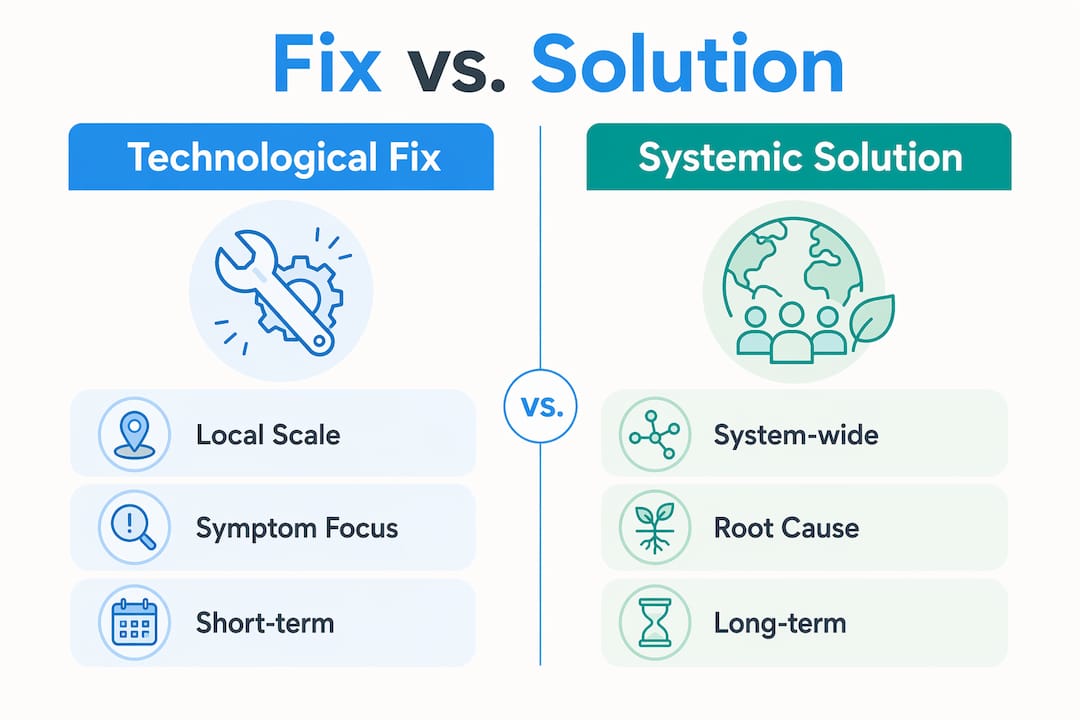
- How does a technological fix differ from a systemic solution?
- How do you apply this concept in IB ESS exams and IAs?
- Key Takeaways
- Why the “fix vs. solution” question matters more than students realize
- Esstutor can help you write stronger ESS answers
- Useful sources and further reading
What are the key characteristics of a technological fix?
Recognizing a technological fix in a case study is a skill examiners reward. These features appear consistently across examples:
- Symptom-focused. The intervention targets a visible problem without changing the underlying cause. Catalytic converters reduce tailpipe emissions but do not reduce car use.
- Minimal social or behavioral change required. People continue existing habits; the technology does the work. This makes fixes politically attractive but analytically weak.
- Engineering-centered. The solution is hardware, a chemical process, or a procedure, not a policy, a shift in values, or a redesign of the system.
- Narrow system boundary. Fixes tend to be evaluated over a short timescale and within a limited geographic or sectoral scope, which hides downstream costs.
- Potential for externalities. Because the wider system is not changed, costs often shift to another time, place, or group.
Pro Tip: When you read a case study in an exam, ask yourself: “Who is bearing the hidden cost of this intervention?” If the answer is a different community, a future generation, or a non-human species, you are almost certainly looking at a technological fix.
Where did the concept of a technological fix come from?
Alvin Weinberg coined and promoted the concept in the 1960s while directing the Oak Ridge National Laboratory. His original framing was not entirely negative. He argued that technological fixes could be useful short-term expedients, particularly when social or political change was too slow or too contested to wait for. His concern was that they would be mistaken for permanent solutions.
Over the following decades, the term shifted in meaning. What Weinberg framed as a pragmatic tool became, in modern environmental discourse, a label for overconfident or politically convenient avoidance of deeper change. Today, scholars connect techno-fix thinking to “solutionism”, the assumption that every social or environmental problem has a technical answer waiting to be deployed.
What are the most common examples of technological fixes in ESS?
These are the case studies you are most likely to encounter in class and on exams. For each one, the key question is: why is it classified as a fix rather than a solution?
- DDT insecticide. Targeted malaria-carrying mosquitoes effectively in the short term. The fix displaced the burden onto non-target species, accumulating through food chains (biomagnification) and causing widespread ecological externalities including the near-extinction of several raptor species.
- Three Gorges Dam. Addressed China’s energy demand and flood risk through a megaproject. The fix produced massive resettlement of over one million people, altered river sediment flow, and affected downstream fisheries, none of which were adequately accounted for in the original cost-benefit framing.
- Automobiles and road networks. Roads and vehicle engineering “solved” the problem of urban mobility. The fix locked in car dependency, increased total vehicle miles traveled, and generated air pollution, urban sprawl, and carbon emissions that now require further technological responses.
- Renewable energy (solar and wind) framed as a fix. When deployed without changes to energy demand or consumption patterns, renewables can function as a fix: they replace the energy source but leave high-consumption lifestyles intact. Paired with demand management and policy, the same technology can function as part of a systemic solution.
- Carbon capture and storage (CCS). Targets atmospheric CO₂ directly. Critics argue CCS allows fossil fuel use to continue, shifting the burden into geological storage rather than addressing the emission source. This is one of the most debated examples in climate engineering discussions.
- Geoengineering (e.g., stratospheric aerosol injection, cloud seeding). Proposes to manage climate symptoms, such as temperature rise, without reducing greenhouse gas concentrations. Governance, equity, and termination-shock risks make this a textbook example of a high-stakes fix.
- Genetically modified organisms (GMOs) in agriculture. Engineered crops resist pests or tolerate drought. Without accompanying changes to land tenure, monoculture practices, or input dependency, GMOs address yield symptoms while leaving the underlying agricultural system unchanged.
The renewable energy and CCS examples are deliberately ambiguous. Flag that ambiguity in your exam answer: it shows you understand that the same technology can be a fix or a solution depending on the policy and behavioral context surrounding it.
Why do technological fixes often fail or create new problems?
Techno-fixes are frequently criticized as quick responses that ignore system complexity. The failure modes follow predictable patterns:
- Externalities. Costs that are not counted in the original intervention appear elsewhere. DDT’s impact on bird populations is the classic case; battery mineral extraction is a current one.
- Rebound effects. Efficiency gains lead to increased consumption, erasing the intended benefit. More fuel-efficient cars led to more driving, not less fuel use overall.
- Burden shifting in time or place. The problem is not solved; it is moved. Landfill technology shifts waste from streets to groundwater; CCS shifts carbon from the atmosphere to geological formations with uncertain long-term stability.
- Lock-in and path dependency. Large infrastructure investments create political and economic pressure to continue using them, even when better alternatives emerge. The Three Gorges Dam committed China to a particular energy and water-management path for generations.
- Governance mismatch. Technologies often scale faster than the regulatory frameworks designed to manage them. Geoengineering proposals currently outpace any international governance structure capable of overseeing them.
- Ignoring social and political context. The Springer analysis of techno-fixes identifies this as the core failure: when designers assume the problem is purely technical, they systematically underestimate resistance, inequity, and unintended social consequences.
How can you tell if an intervention is a fix or a systemic solution?
Use this checklist in your essays and IAs. Apply it to any intervention the question gives you.
- Scale. Does the intervention address a local symptom or change the system at the level where the problem originates?
- Cost and timescale. Is the solution cheap and fast to deploy? Fixes often are. Systemic solutions typically require longer timescales and higher upfront investment.
- Behavioral or policy change required. Does the intervention require people to change how they live, consume, or govern? If not, treat it as a probable fix.
- Likely externalities. What costs are not included in the evaluation? Use Life-Cycle Assessment (LCA) to trace impacts from raw material extraction through disposal.
- Equity and distributional impacts. Who benefits and who bears the costs? Fixes often concentrate benefits in wealthy or politically powerful groups while externalizing costs onto marginalized communities or future generations. The sustainability vocabulary you use here matters to examiners.
- Measured environmental effectiveness. Does the evidence show net environmental improvement across the full life cycle, or only within a narrow boundary?
Worked example: Carbon capture vs. emissions reduction policy. Carbon capture scores poorly on criteria 3 (no behavioral change required), 4 (energy-intensive, with mineral extraction externalities), and 5 (benefits accrue to fossil fuel industries; costs are socialized). Emissions reduction through carbon pricing scores better on criteria 1, 3, and 5, but requires political will that fixes deliberately avoid. That contrast is exactly what an examiner wants to see in a Band 6–7 response.
LCA callout: LCA is the tool that makes this checklist objective. Without it, students tend to evaluate only operational emissions and miss supply-chain impacts. A solar panel that displaces coal-fired electricity still carries embodied energy costs from silicon refining and panel manufacturing. Stating this in your answer demonstrates the kind of systems awareness that earns top marks.
| Evaluation dimension | Technological fix | Systemic solution |
|---|---|---|
| Scale | Local or sectoral | System-wide |
| Behavioral change required | Minimal | Significant |
| Timescale to implement | Short | Long |
| Externalities | Often high, displaced | Lower when LCA is applied |
| Equity impacts | Often unequal | Designed to be equitable |
| Environmental effectiveness | Narrow boundary | Full life-cycle |
How does a technological fix differ from a systemic solution?
The distinction comes down to system boundaries and feedback loops. A systemic solution changes the structure or behavior of the system itself: it addresses root causes, accounts for life-cycle impacts, and typically requires policy, behavioral, or institutional change alongside the technology.
A useful mental model: picture a bathtub overflowing. A technological fix mops the floor. A systemic solution turns off the tap.

In practice, many interventions sit on a spectrum. The same solar panel installation can be a fix (replacing coal while consumption grows) or part of a systemic solution (combined with demand management, grid reform, and equitable access policy). The hardware alone does not determine the category. Context, governance, and scale do.
For your systems thinking diagrams, sketch the intervention as a stock-and-flow model. A fix typically adds a negative feedback loop to a single stock without changing the driving positive feedback. A systemic solution restructures the positive feedback itself. Examiners respond well to a simple annotated diagram that shows this distinction.
| Feature | Technological fix | Systemic solution |
|---|---|---|
| Addresses root cause? | No | Yes |
| System boundary | Narrow | Wide |
| Feedback loops changed? | No | Yes |
| Stakeholder equity considered? | Rarely | Typically yes |
| LCA applied? | Rarely | Yes |
How do you apply this concept in IB ESS exams and IAs?
This is where the concept pays off. Here is how to structure your answers and design your IA around it.

Model paragraph for analysis or evaluation questions
“Carbon capture and storage (CCS) can be classified as a technological fix because it targets the symptom of excess atmospheric CO₂ without requiring changes to energy consumption patterns or fossil fuel governance. While CCS reduces emissions at the point of capture, a Life-Cycle Assessment reveals significant energy costs in compression and injection, along with mineral extraction externalities. The burden is shifted in time: geological storage introduces long-term leakage risk that future generations will bear. A systemic solution would instead address the positive feedback between fossil fuel subsidy structures and consumption growth. On equity grounds, CCS benefits fossil fuel producers while socializing geological risk, which raises distributional justice concerns central to ESS analysis.”
Adapt this structure: BLUF classification → evidence → LCA or systems critique → equity note → verdict.
Exam tips for AO1–AO3
- AO1 (knowledge). Define the term precisely in your first sentence. Name Weinberg. State the contrast with a systemic solution.
- AO2 (application). Apply the evaluation checklist to the specific case study in the question. Do not give a generic answer.
- AO3 (synthesis and evaluation). Use LCA language, name at least one externality, and state who bears the cost. Acknowledge ambiguity where it exists (e.g., renewables can be either, depending on context).
- Common examiner pitfalls. Students lose marks by calling all technology “bad” without nuance, or by failing to distinguish between the technology itself and the policy context surrounding it.
IA design suggestions
- Research question example: “To what extent does the installation of solar panels in [local community] represent a technological fix or a systemic solution, as evaluated using Life-Cycle Assessment proxies and energy consumption data?”
- Data types: Energy output data, consumption trends before and after installation, material sourcing information, and equity data on who has access to the technology.
- LCA proxies: Embodied carbon estimates from published databases (e.g., the Ecoinvent database), energy payback period calculations, and end-of-life recycling rates.
For a full walkthrough of how to structure your ESS IA, including how to frame a research question around a technological intervention, Esstutor has a dedicated guide.
Pro Tip: In your IA, avoid framing your research question as “Is X good or bad?” Instead, ask “To what extent does X represent a technological fix?” That framing signals systems thinking and gives you a clear evaluative structure the examiner can follow.
Key Takeaways
A technological fix treats the symptoms of an environmental or social problem through technology while leaving the underlying system structure unchanged, making Life-Cycle Assessment and systems thinking the essential tools for evaluating it in ESS.
| Point | Details |
|---|---|
| Core definition | A technological fix addresses symptoms through technology with minimal social or political change required. |
| Origin | Alvin Weinberg coined the concept in the 1960s as a pragmatic expedient, not a permanent solution. |
| Evaluation tool | Apply Life-Cycle Assessment (LCA) to test whether an intervention shifts burdens rather than reducing net impact. |
| Exam structure | Use the BLUF → evidence → systems critique → LCA/equity note → verdict paragraph structure in every evaluation answer. |
| Esstutor support | Esstutor offers IA coaching, model paragraph practice, and examiner-led feedback to help you apply this concept confidently. |
Why the “fix vs. solution” question matters more than students realize
Students often treat “technological fix” as a label to stick on things they want to criticize. That misses the real analytical power of the concept. Weinberg’s original point was subtler: fixes can be genuinely useful when social change is too slow, too contested, or too costly in the short term. The problem is not the technology. The problem is mistaking an expedient for a resolution.
What I see most often in student essays is a binary framing: technology is either the answer or the villain. The ESS course is asking for something more careful than that. When you evaluate a case study, the question is not “Is this technology good?” It is “What does this technology leave unchanged, and who pays for that?” That shift in framing is what separates a Band 4 answer from a Band 7.
The rebound effect is the concept students most consistently underuse. If you can show that an efficiency gain led to increased consumption, you have demonstrated systems thinking in action. That is worth more marks than a list of externalities.
Sketch your system diagrams. Practice naming the feedback loops. And when you read a case study, always ask: who is not in the room when this solution is being designed?
Esstutor can help you write stronger ESS answers
Knowing the definition of a technological fix is one thing. Writing a Band 7 exam paragraph that applies it to a case study you have never seen before is another skill entirely. Esstutor offers one-on-one online tutoring with an IB examiner who has over 13 years of experience helping students turn concepts like this into high-scoring responses.

Sessions cover model paragraph practice, IA research question design, LCA application, and past-paper walkthroughs tailored to your specific weak points. Whether you need help structuring a top-scoring ESS IA or want to practice applying the technological-fix evaluation checklist under timed conditions, Esstutor builds the session around what you actually need. Book a trial lesson and see the difference examiner-led feedback makes.
Useful sources and further reading
- Alvin Weinberg and the promotion of the technological fix — University of Glasgow ePrints. The primary academic source on Weinberg’s original argument. Cite this when you need to show source awareness in an essay or IA bibliography.
- Technological Remedies for Social Problems — Springer / PMC. A peer-reviewed conceptual paper that distinguishes techno-fixes from techno-solutionism. Useful for AO3 evaluation and for framing an IA research question.
- Technological fix — Wikipedia. A solid starting point for definitions, examples, and a bibliography of further reading. Do not cite Wikipedia directly in your IA, but use it to find primary sources.
- Can We Design a Good Technical Fix? — Brookings Institution. A policy-focused analysis of when and whether technological fixes can be designed responsibly. Good for nuanced evaluation in Paper 2 responses.
- Technological fix — Encyclopedia.com. Encyclopedic treatment with case studies including DDT and megaprojects. Accessible background reading before tackling the peer-reviewed literature.
- Technological fix — Taylor & Francis Knowledge. Covers the modern critical framing of the term, including connections to digital solutionism. Useful for contemporary examples.
- Systems thinking for IB ESS — Esstutor. Explains how to map system boundaries and feedbacks when evaluating technological interventions. Directly applicable to exam and IA work.
- What is sustainability in ESS — Esstutor. Builds the equity and long-term sustainability vocabulary you need for the distributional impacts dimension of the evaluation checklist.
- How to write an effective ESS Internal Assessment — Esstutor. Step-by-step IA structure guidance, including how to frame a research question around a technological intervention.
- Role of global issues in ESS — Esstutor. Contextualizes technological fixes within global-scale environmental issues, useful for Paper 2 case study questions.
No Comments