


16 Mar What is environmental management: IB ESS guide 2026
Many IB ESS students initially assume environmental management is simply about controlling pollution or cleaning up waste. This narrow view misses the broader, systemic nature of the field. Environmental management actually encompasses diverse strategies to minimize human impacts across air, water, land, and biodiversity while supporting sustainable development. This guide clarifies core concepts, frameworks like Environmental Management Systems, and practical applications that matter for your IB ESS coursework. You’ll explore decision-making principles, real-world case studies, and the critical thinking skills needed to excel in your assessments and understand how societies interact with environmental systems.
Table of Contents
- Understanding Environmental Management: Core Concepts And Significance
- Environmental Management Systems And The PDCA Cycle Framework
- Nuances And Challenges In Environmental Management Decision-Making
- Applying Environmental Management In Organizations: Case Studies And Best Practices
- Explore More With Esstutor.net For IB ESS Success
- Frequently Asked Questions
Key takeaways
| Point | Details |
|---|---|
| Systemic approach | Environmental management uses frameworks like EMS and the PDCA cycle to improve organizational performance systematically. |
| Precautionary principle | This principle guides preventive action even when scientific evidence remains uncertain, especially in climate policy. |
| Measurable outcomes | Organizations with EMS certification achieve up to 15% reductions in incidents and significant energy savings. |
| Training matters | Employee competence and motivation through training directly strengthen EMS implementation and innovation. |
| Continuous monitoring | Regular performance checks and adjustments drive ongoing environmental improvements in management systems. |
Understanding environmental management: core concepts and significance
Environmental management refers to the organized methods humans use to regulate their interactions with the natural world at local, regional, and global scales. Unlike environmental science, which investigates natural processes and human impacts through research, environmental management applies practical strategies to reduce harm and promote sustainability. This distinction matters for IB ESS students because your coursework demands both scientific understanding and the ability to evaluate real-world management solutions.
The scope of environmental management extends far beyond pollution cleanup. It includes environmental impact assessments, resource conservation, habitat protection, waste reduction, and policy development. These methodologies address complex challenges where human activities intersect with ecological systems. For example, managing a watershed involves coordinating land use, water quality monitoring, stakeholder engagement, and regulatory compliance simultaneously.
Effective environmental management reduces ecological degradation while supporting economic and social goals. Organizations and governments use structured approaches to identify environmental risks, set measurable targets, implement controls, and track progress over time. This systematic thinking aligns closely with the environmental systems definition you study in IB ESS, where inputs, processes, outputs, and feedback loops shape outcomes.
Why does this matter for your academic success? IB ESS assessments frequently ask you to analyze management strategies, compare their effectiveness, and evaluate trade-offs. Grasping the full breadth of environmental management equips you to construct nuanced arguments in essays, design robust Internal Assessments, and interpret case studies with depth. You’ll move beyond surface-level descriptions to critically assess how different approaches perform under varying conditions.
Key methodologies in environmental management include:
- Environmental impact assessments that predict and mitigate project consequences before implementation
- Pollution control technologies and regulations that limit emissions and discharges
- Resource management plans that balance extraction rates with regeneration capacity
- Habitat restoration projects that rebuild degraded ecosystems
- Stakeholder engagement processes that incorporate diverse perspectives into decision-making
Recognizing this diversity prepares you to tackle IB ESS questions that demand specific examples and comparative analysis.
Environmental management systems and the PDCA cycle framework
An environmental management system (EMS) provides a structured framework for organizations to manage their environmental responsibilities systematically. The most widely recognized standard, ISO 14001, establishes requirements for developing, implementing, maintaining, and improving an EMS. This certification signals that an organization has embedded environmental considerations into its core operations, not just as an add-on compliance measure.
At the heart of ISO 14001 lies the Plan-Do-Check-Act (PDCA) cycle, a continuous improvement model that drives environmental performance gains. Each stage serves a specific function:
- Plan: Identify environmental aspects, assess legal requirements, set objectives and targets, and design programs to achieve them.
- Do: Implement the planned actions, allocate resources, train personnel, and establish operational controls.
- Check: Monitor performance against targets, conduct audits, track compliance, and gather data on environmental indicators.
- Act: Review results, identify gaps, take corrective actions, and adjust plans for the next cycle.
This iterative process ensures that environmental management evolves as conditions change, new risks emerge, or better practices become available. The cycle never truly ends; each completion feeds insights into the next planning phase.
Organizations with ISO 14001 certification reduce incidents by up to 15% and achieve measurable energy savings. These outcomes stem from systematic risk identification, employee engagement, and accountability mechanisms built into the EMS framework. For IB ESS students, understanding how the PDCA cycle operates in practice helps you analyze why some organizations succeed while others struggle with environmental goals.
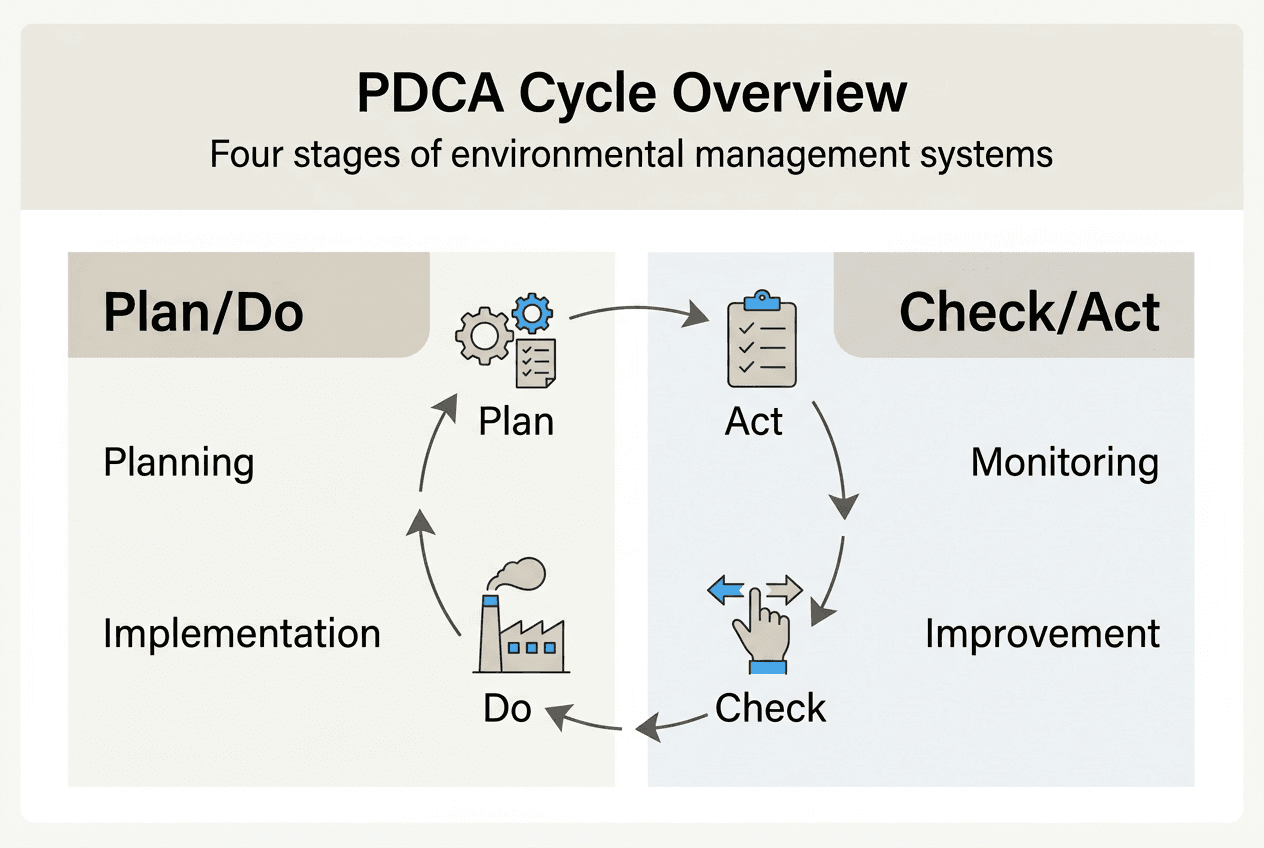
Consider this comparison of PDCA stages and typical activities:
| PDCA Stage | Key Activities | Expected Outcomes |
|---|---|---|
| Plan | Environmental review, legal compliance check, objective setting | Clear targets, resource allocation |
| Do | Training, process implementation, documentation | Operational controls, employee competence |
| Check | Monitoring, audits, performance measurement | Data on progress, gap identification |
| Act | Management review, corrective actions, process improvements | Refined plans, enhanced performance |
Pro Tip: When analyzing EMS case studies in your IB ESS coursework, map the organization’s actions to specific PDCA stages. This structured approach demonstrates depth and helps you identify where breakdowns occur, whether in planning, implementation, monitoring, or adjustment phases.
The integration of EMS into organizational culture transforms environmental management from a reactive compliance function into a proactive strategic advantage. Companies report cost savings through waste reduction, improved stakeholder relationships, and enhanced brand reputation alongside environmental benefits.
Nuances and challenges in environmental management decision-making
Environmental management decisions rarely offer simple, clear-cut solutions. Complexity arises from interconnected systems, scientific uncertainty, competing stakeholder interests, and ethical considerations. The precautionary principle addresses one dimension of this complexity by advocating preventive action when potential environmental harm exists, even if scientific evidence remains incomplete. This principle has shaped climate change policy, chemical regulation, and biodiversity protection globally.

Applying the precautionary principle means decision-makers don’t wait for absolute proof of harm before acting. Instead, they weigh potential risks against costs of intervention, erring on the side of caution when consequences could be severe or irreversible. For example, restricting a chemical compound suspected of endocrine disruption, even before long-term studies conclude, reflects precautionary thinking. This approach contrasts with waiting for definitive harm before regulating.
Environmental decisions also generate complex interlinked effects across air, water, land, and biological systems. An action targeting one environmental aspect often influences others. Installing a dam for hydroelectric power reduces fossil fuel emissions but alters river ecosystems, sediment transport, and fish migration patterns. Recognizing these interactions in environmental systems requires systems thinking, a core skill in IB ESS.
Trade-offs are inherent in environmental management. Renewable energy projects deliver climate benefits but may require significant land conversion, affecting habitats and agricultural production. Urban densification reduces sprawl and transportation emissions but increases local air pollution and heat island effects. Effective environmental managers acknowledge these trade-offs explicitly, assess them transparently, and seek solutions that optimize multiple objectives rather than maximizing a single goal.
Key challenges in environmental decision-making include:
- Balancing short-term economic pressures with long-term environmental sustainability
- Incorporating diverse cultural values and stakeholder perspectives into management plans
- Addressing scientific uncertainty while making timely decisions
- Coordinating actions across jurisdictions and sectors with different priorities
- Adapting strategies as new information emerges or conditions shift
Pro Tip: Avoid oversimplifying environmental management solutions in your IB ESS essays. Acknowledge trade-offs, discuss uncertainties, and evaluate how different approaches address competing priorities. This nuanced analysis demonstrates critical thinking and earns higher marks than one-sided arguments.
“The precautionary principle encourages us to act on reasonable suspicion of harm, not wait for scientific certainty. In environmental management, this means building safety margins into decisions and reversing the burden of proof.”
Understanding these nuances prepares you to engage with real-world environmental challenges where perfect solutions don’t exist and management strategies must navigate competing values, incomplete knowledge, and dynamic conditions.
Applying environmental management in organizations: case studies and best practices
Theory becomes meaningful when you see how organizations translate EMS frameworks into measurable environmental improvements. Companies with integrated EMS achieved substantial emissions and waste reductions over five years, demonstrating that systematic approaches deliver results. These case studies offer valuable insights for IB ESS students analyzing management effectiveness.
Consider two manufacturing companies that implemented ISO 14001 certified EMS between 2019 and 2024. Company A focused on energy efficiency and waste minimization, while Company B prioritized emissions reduction and water conservation. Both achieved significant outcomes, but their pathways and emphasis differed:
| Company | Primary Focus | Key Outcomes (5 years) | Critical Success Factors |
|---|---|---|---|
| Company A | Energy efficiency, waste reduction | 45% waste reduction, 30% energy savings | Employee training programs, continuous monitoring |
| Company B | Emissions control, water conservation | 40% emissions reduction, 35% water use decrease | Leadership commitment, stakeholder engagement |
These results highlight how tailored EMS implementation addresses organization-specific environmental aspects while following the same underlying PDCA framework. Company A’s waste reduction stemmed from redesigning production processes, implementing recycling systems, and training employees to identify improvement opportunities. Company B invested in emissions control technology, switched to cleaner energy sources, and installed water recycling infrastructure.
Employee environmental training strongly mediates EMS success by building competence and motivation across the workforce. When employees understand environmental objectives, recognize their role in achieving them, and possess skills to innovate, organizations see higher performance gains. Training transforms EMS from a management directive into a shared responsibility.
Continuous monitoring drives learning and improvement cycles within EMS. Organizations track key performance indicators like energy consumption per unit produced, waste generation rates, water use intensity, and emissions levels. This data reveals trends, identifies deviations from targets, and informs corrective actions. Without robust monitoring, organizations cannot verify progress or adjust strategies effectively.
Best practices from successful EMS implementations include:
- Securing visible leadership commitment and adequate resource allocation
- Engaging employees at all levels through training and participation mechanisms
- Setting specific, measurable, achievable, relevant, and time-bound (SMART) environmental objectives
- Integrating environmental considerations into procurement, product design, and operational decisions
- Conducting regular internal audits and management reviews to assess system effectiveness
- Communicating environmental performance transparently to stakeholders
Pro Tip: When examining environmental management case studies for your IB ESS Internal Assessment, link specific data to broader concepts like the PDCA cycle, precautionary principle, or systems thinking. This connection demonstrates your ability to apply theoretical frameworks to real-world situations and strengthens your analytical depth.
These examples illustrate that effective environmental management requires more than adopting a standard or declaring commitments. It demands systematic planning, dedicated implementation, rigorous monitoring, and willingness to adapt based on results. Organizations that embrace this continuous improvement mindset achieve lasting environmental and economic benefits.
Explore more with esstutor.net for IB ESS success
Mastering environmental management concepts positions you for success across IB ESS assessments, from exams to coursework. Whether you’re developing your ESS extended essay guide, refining your Internal Assessment, or preparing for final exams, deeper understanding of management frameworks and decision-making principles strengthens your analysis.

Esstutor.net offers specialized support tailored to IB ESS students navigating these complex topics. Our expert tutoring connects environmental management theory to practical applications, helping you build the critical thinking skills examiners reward. Explore our ESS course overview to understand how management concepts fit within the broader curriculum. Review ESS internal assessment examples to see how students successfully apply frameworks like EMS and the PDCA cycle to real-world investigations. Personalized guidance helps you move beyond memorization to genuine comprehension and application.
Frequently asked questions
What is the difference between environmental management and environmental science?
Environmental science investigates natural processes, ecosystem dynamics, and human impacts through research and data collection. It seeks to understand how environmental systems function and respond to disturbances. Environmental management applies this scientific knowledge to develop practical strategies, policies, and actions that reduce environmental harm and promote sustainability. While science focuses on understanding, management emphasizes implementation and problem-solving. IB ESS integrates both perspectives, requiring you to grasp scientific concepts and evaluate management approaches. Understanding this distinction helps you address exam questions that ask you to analyze rather than simply describe environmental systems.
How does the precautionary principle influence environmental management decisions?
The precautionary principle guides environmental managers to take preventive action when potential risks exist, even if scientific evidence remains uncertain or incomplete. This approach reverses traditional decision-making, which often waits for proof of harm before acting. In climate change policy, the precautionary principle supports emissions reductions despite uncertainties about exact future impacts, recognizing that waiting for complete certainty could result in irreversible damage. It influences decisions on chemical regulation, biodiversity protection, and technology adoption. For IB ESS students, this principle illustrates how ethical considerations and risk assessment shape environmental management strategies beyond purely technical or economic factors.
Why is employee training important in environmental management systems?
Well-trained employees initiate innovations and are key to EMS performance improvements because they understand environmental objectives, recognize their role in achieving them, and possess skills to identify opportunities. Training builds both competence and motivation, transforming environmental management from a top-down mandate into a shared organizational culture. Employees who receive comprehensive environmental training contribute ideas for waste reduction, energy efficiency, and process improvements that managers might overlook. Research shows that organizations investing in robust training programs achieve higher rates of environmental innovation and better overall EMS outcomes. This human dimension of environmental management often determines whether systematic frameworks like ISO 14001 deliver their potential benefits or remain paper exercises.
What are the main stages of the PDCA cycle in environmental management?
The PDCA cycle consists of four interconnected stages that drive continuous improvement in environmental performance. Plan involves identifying environmental aspects, setting objectives, and designing programs to achieve targets. Do focuses on implementing planned actions, training personnel, and establishing operational controls. Check encompasses monitoring performance, conducting audits, and gathering data on environmental indicators. Act includes reviewing results, identifying gaps, taking corrective actions, and adjusting plans for the next cycle. Each stage builds on the previous one, creating an iterative process where learning from one cycle informs planning for the next. This framework ensures environmental management systems evolve rather than stagnate, adapting to new challenges, technologies, and opportunities as they emerge.
Recommended
- Extended Essay Information Guide (from the IBO)
- What is meant by environmental management system (EMS) – esstutor.net
- What is environmental systems and societies ib / ESS course
- How to Succeed in IB Environmental Systems and Societies
- Green Supply Chains: Everything You Need to Know – Worldwide Express, Inc.
No Comments