


31 May Why Biodiversity Matters in ESS: A Student Guide
TL;DR:
- Biodiversity supports ecosystem services by maintaining functional redundancy, which enhances system resilience. Its loss weakens essential services like pollination, water purification, and climate regulation, impacting human well-being. Applying systems thinking and integrating policy targets, such as the Kunming–Montreal framework, deepen understanding and improve exam performance.
If you’re studying IB Environmental Systems and Societies, you’ve almost certainly covered biodiversity as a topic. But understanding why biodiversity matters in ESS goes much deeper than memorizing a definition or listing species names. Right now, around 1 million species face extinction within decades, and the consequences reach far beyond wildlife. Biodiversity underpins every major ecosystem service your ESS course examines, from food production to climate regulation. Grasping this connection is what separates a surface-level exam answer from one that earns top marks.
Key Takeaways
| Point | Details |
|---|---|
| Biodiversity supports ecosystem services | Species, genetic, and ecosystem diversity together maintain pollination, water purification, and nutrient cycling. |
| Loss has measurable human costs | Declining biodiversity weakens food security, disease control, and climate resilience in interconnected ways. |
| Policy frameworks matter for ESS | The Kunming–Montreal Global Biodiversity Framework gives you real, time-bound targets to evaluate in exam answers. |
| Soil and genetic diversity are often overlooked | High-quality ESS responses go beyond species counts to address microorganisms and genetic variation. |
| Systems thinking is the key skill | Linking biodiversity to ecosystem stability and sustainability reflects the ESS course’s core approach. |
Why biodiversity matters in ESS: the foundation
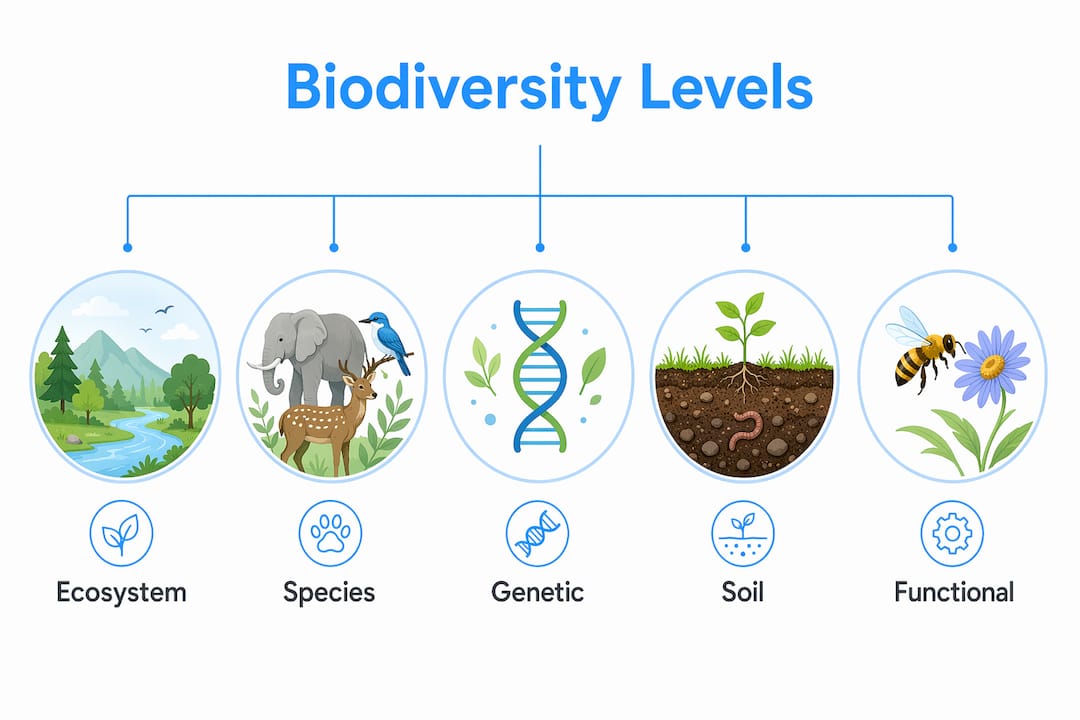
In IB ESS, biodiversity refers to three interconnected levels: species diversity (the variety of species in an area), genetic diversity (variation within a species’ gene pool), and ecosystem diversity (the range of habitats and ecological communities across a region). Each level matters independently, and all three interact constantly.
The Millennium Ecosystem Assessment frames biodiversity as the variability that makes ecosystem services possible. Those services fall into four categories your ESS course covers directly:
- Provisioning services: food, freshwater, timber, and medicinal resources
- Regulating services: pollination, water purification, climate regulation, and pest control
- Cultural services: recreation, education, and spiritual value
- Supporting services: nutrient cycling, soil formation, and primary production
Higher biodiversity generally means greater redundancy in these services. When one species declines, others can fulfill similar roles. A watershed with twenty plant species filters water more reliably than one with five, because different species handle different contaminants and weather conditions. This is not just ecological theory. It is directly relevant to ESS decision-making frameworks about land use, conservation priorities, and resource management.
Pro Tip: When you write about ecosystem services in an ESS exam, always specify which level of biodiversity supports that service and explain the mechanism. Saying “biodiversity supports pollination” earns fewer marks than “species diversity among native bees and insects provides redundancy in pollination, maintaining agricultural productivity even when one pollinator species declines.”
Ecosystem stability, food security, and resilience
Biodiversity’s most practical role in ESS is its contribution to ecosystem stability. A biodiverse system resists disturbance better and recovers faster. This is called ecological resilience, and it depends on complex food webs where energy flows through multiple pathways. Remove one species from a low-diversity system and the whole structure can collapse. In a high-diversity system, the network reroutes.
The table below summarizes how biodiversity levels affect key ecosystem services:
| Ecosystem service | Effect of high biodiversity | Effect of low biodiversity |
|---|---|---|
| Pollination | Multiple species provide redundancy | Single-species dependency creates vulnerability |
| Pest regulation | Natural predator diversity suppresses outbreaks | Pest populations spike without checks |
| Nutrient cycling | Diverse decomposers accelerate soil renewal | Slower cycling reduces soil fertility |
| Water regulation | Root and canopy variety improves infiltration | Increased runoff and erosion risk |
| Climate regulation | Carbon stored across multiple plant functional types | Reduced carbon sequestration capacity |
Agricultural systems show this clearly. A 2026 synthesis of 609 studies found that increasing plant species diversity in agro-ecosystems promotes plant performance, suppresses pests, and strengthens food security through regulating services. This matters enormously for ESS. It challenges the assumption that industrial monoculture farming is efficient when examined from a full systems perspective.
Climate regulation is another area where biodiversity’s role surprises many students. Forests with high tree species diversity store more carbon than monoculture plantations, because different species use sunlight, water, and nutrients at different canopy levels and seasons. Combined with land-use and climate change accelerating biodiversity loss, this creates a feedback loop your systems diagrams should capture.
Pro Tip: For your Internal Assessment or Paper 2 essay, framing biodiversity loss as a feedback loop (less biodiversity leads to weaker climate regulation, which leads to more habitat loss, which leads to further biodiversity loss) demonstrates exactly the systems thinking IB examiners reward.
Global biodiversity loss: urgency and policy context
The numbers here are hard to ignore. Modern vertebrate species are being lost at rates up to 100 times above the historical background rate, pointing toward what scientists now call the sixth mass extinction. For ESS, these figures are not just alarming statistics. They are evidence you can cite to support arguments about ecosystem service degradation and human well-being.
Key facts worth knowing for your exam preparation:
- Over 1 million species currently face extinction according to the 2019 IPBES global assessment
- Habitat destruction, overexploitation, invasive species, pollution, and climate change are the five primary drivers
- Ecosystem services worth trillions of dollars annually depend on biodiversity levels that are declining faster than policy responses can address
On the policy side, the Kunming–Montreal Global Biodiversity Framework, adopted in December 2022, sets 23 measurable targets for 2030. These include protecting 30% of land and ocean areas, restoring degraded ecosystems, and reducing harmful subsidies. As an ESS student, these targets give you concrete criteria to evaluate real-world conservation efforts rather than speaking in vague terms about “protecting nature.”
“Preventing the loss of intact biomes and ecosystems is the single most critical action for Earth system stability and for meeting both climate and development goals.” — Nature Positive framework, 2026
The Nature Positive approach is especially relevant here. It treats biodiversity conservation as inseparable from climate action, arguing that you cannot achieve net-zero emissions while ecosystems continue to collapse. For ESS students writing about sustainability, this integrated framing is exactly what high-level answers require.
Beyond species: genetic and soil biodiversity
Most students focus on species counts when discussing biodiversity. This is understandable but leaves marks on the table. Genetic diversity within species is what allows populations to adapt to changing conditions. A salmon population with high genetic diversity can respond to temperature changes, disease pressures, and shifts in prey availability. A genetically uniform population cannot. When environmental conditions shift rapidly, genetic diversity is what determines whether a species survives or disappears.
Below is a comparison of above-ground and below-ground biodiversity and the distinct roles each plays:
| Biodiversity type | Location | Key ESS functions |
|---|---|---|
| Species diversity | Above ground | Pollination, food webs, cultural services |
| Genetic diversity | Within populations | Adaptation, disease resistance, long-term resilience |
| Soil microbial diversity | Below ground | Nutrient cycling, decomposition, pathogen control |
| Soil invertebrate diversity | Below ground | Aeration, organic matter breakdown, water retention |
Soil biodiversity drives nutrient cycling, decomposition, and pathogen control in ways that are invisible but fundamental. A single teaspoon of healthy soil contains more microorganisms than there are people on Earth. These organisms break down organic matter, fix atmospheric nitrogen, suppress root pathogens, and regulate carbon storage. Without them, the provisioning and regulating services your ESS course depends on simply do not function.
When you write about ecosystem functioning in your IA or exam responses, referencing soil biodiversity alongside species-level diversity shows a depth of understanding that elevates your answer. Examiners notice this distinction because most students miss it entirely.
Applying biodiversity knowledge in IB ESS
Knowing the science is only part of the job. You also need to apply it effectively in your assessments. Here is how biodiversity concepts show up across the IB ESS curriculum and how to use them well:
- Paper 2 essays: Connect biodiversity loss to specific ecosystem services, then link those services to human well-being and sustainability. Use the Kunming–Montreal targets as a policy evaluation tool.
- Internal Assessment: Case studies on habitat restoration, agroforestry, protected area management, or urban greening all offer strong biodiversity angles. Quantitative data on species counts or soil health measurements work well as IA variables.
- Systems diagrams: Biodiversity connects to almost every node in an ESS systems diagram. Resilience, trophic levels, nutrient cycles, and climate feedbacks all run through it. Practice drawing these connections explicitly.
- Evaluation questions: Avoid treating biodiversity conservation as straightforwardly positive. Use systems thinking to weigh trade-offs, such as the tension between agricultural productivity and maintaining wild plant diversity.
Pro Tip: A common exam mistake is treating biodiversity as a standalone topic. Every biodiversity argument lands harder when you connect it to at least two other ESS concepts, such as food security, climate regulation, or conservation policy. This shows the examiner you understand the system, not just the component.
My take on what biodiversity really teaches you in ESS
I’ve worked with IB ESS students for over 13 years, and biodiversity is the topic where I see the biggest gap between what students know and what they can actually do with that knowledge. Most can define species diversity. Far fewer can explain why losing a keystone predator triggers a cascade that eventually reduces water quality downstream.
In my experience, the students who score highest on biodiversity questions are not the ones who memorized the most species. They are the ones who treated biodiversity as a systems concept. They asked: what functions does this diversity perform, what happens when it is reduced, and who or what bears the consequences?
What I’ve also learned is that students often underestimate the policy dimension. The Kunming–Montreal Framework is not just background reading. It is a live, debatable policy instrument. I encourage every student I work with to form an opinion on whether its targets are adequate, realistic, or likely to succeed. That critical evaluation is what separates a 6 from a 7.
My honest view is this: understanding biodiversity well does not just help you pass ESS. It gives you a framework for thinking about every major environmental problem you will encounter throughout your life. That is the real value, and no exam can take that away from you.
— Marija
Ready to strengthen your ESS biodiversity answers?
If you found this article useful, you are already thinking about biodiversity the right way. At Esstutor, we help IB ESS students move from knowing content to applying it confidently under exam conditions.

Whether you are preparing your IB ESS Internal Assessment with a biodiversity case study or working through Paper 2 essay technique, personalized tutoring with an experienced IB examiner makes a real difference. You can also browse our ESS notes and resources covering ecosystem services, conservation policy, and systems thinking in depth. For students targeting Paper 2 specifically, our IB ESS Paper 2 preparation page walks you through exactly what examiners look for. Book a trial lesson and let’s work on this together.
FAQ
What is biodiversity in IB ESS?
In IB ESS, biodiversity refers to three levels: species diversity, genetic diversity, and ecosystem diversity. Together, these levels support all ecosystem services covered in the ESS curriculum.
Why is biodiversity crucial for ecosystem services?
Higher biodiversity creates redundancy in ecosystem functions, meaning more species can perform similar roles. This makes services like pollination, water purification, and nutrient cycling more stable and reliable.
How does biodiversity loss affect human well-being?
Biodiversity loss weakens ecosystem services that humans depend on directly, including food production, clean water, disease regulation, and climate stability, with cascading effects across social and economic systems.
What is the Kunming–Montreal Global Biodiversity Framework?
The Kunming–Montreal Framework is a 2022 international agreement setting 23 biodiversity targets for 2030, including protecting 30% of land and ocean areas. It gives ESS students a concrete policy tool to analyze in essays and case studies.
How can I use biodiversity concepts to score higher in ESS exams?
Reference all three levels of biodiversity, connect loss to specific ecosystem service impacts, cite real policy frameworks like the Kunming–Montreal targets, and apply environmental literacy concepts to evaluate trade-offs rather than presenting biodiversity conservation as a simple positive.
No Comments