


17 Apr IB ESS syllabus 2026: strategies for top scores
TL;DR:
- The 2026 IB ESS syllabus introduces options at both SL and HL, emphasizing systems thinking and interdisciplinary links.
- Assessment comprises papers, an internal assessment, and requires strategic practice, especially with unseen data and case studies.
- Success relies on understanding command terms, building strong research questions, and applying systems thinking beyond memorization.
The IB ESS syllabus has changed significantly, and if you’re preparing for first assessments in May 2026, you need a clear picture of what’s ahead. Many students assume ESS is the “easy science” option in the IB Diploma Programme. That assumption is costly. The updated course demands genuine systems thinking, strong analytical writing, and a well-executed Internal Assessment. Whether you’re taking SL or HL, this guide breaks down the new structure, assessment format, and the strategies that actually move your grade from average to excellent. Let’s get into it.
Table of Contents
- Understanding the updated 2026 ESS syllabus structure
- Demystifying ESS assessment: Papers, IA, and weighting
- Mastering the Internal Assessment: Keys to a standout ESS IA
- Exam success in ESS: Smart strategies for Papers 1 and 2
- Why systems thinking is the secret to unlocking ESS excellence
- Accelerate your ESS success with expert guides and support
- Frequently asked questions
Key Takeaways
| Point | Details |
|---|---|
| Updated 2026 syllabus | ESS now features both SL and HL options, new structure, and greater real-world relevance. |
| Assessment decoded | Know the balance: Paper 1 (25%), Paper 2 (50%), IA (20–25%), with benchmarks for passing and excelling. |
| Winning IA formula | A focused, testable question and strong statistical analysis are key for internal assessment success. |
| Exam strategy essentials | Command terms, PEEL structure, and real case studies maximize marks in exam papers. |
| Systems thinking matters | Connecting science and society prepares you for top scores and success beyond the IB. |
Understanding the updated 2026 ESS syllabus structure
Once you understand why the syllabus changed, let’s break down how it’s structured and what it means for your IB path.
The IB ESS syllabus was updated for first teaching in August 2024, with first assessments scheduled for May 2026. One of the biggest shifts is the introduction of both SL and HL options, giving students more flexibility in how they engage with the subject. This is a meaningful change. Previously, ESS was offered only at SL, so the addition of HL opens up deeper academic pathways for students interested in environmental science, policy, or related university programs.
You can read more about ESS syllabus updates to understand how the course has evolved over time. The core structure of the 2026 syllabus is built around several interconnected components:
- Core topics: Shared by both SL and HL, covering foundational environmental systems and societies content
- HL extension material: Additional depth through lenses like law, economics, and ethics
- Approaches to learning: Emphasis on inquiry, research skills, and real-world application
- Internal Assessment: An individual scientific investigation, required at both levels
A key feature of the redesigned syllabus is its focus on systems thinking. Rather than treating environmental topics as isolated facts, the course asks you to see how ecosystems, human societies, and global systems interact. This is not just a teaching philosophy. It shows up directly in exam questions and IA marking criteria.
Here’s a quick comparison of the SL and HL options:
| Feature | SL | HL |
|---|---|---|
| Teaching hours | 150 | 240 |
| Core topics | Yes | Yes |
| HL extension content | No | Yes |
| Internal Assessment | Yes | Yes |
| Interdisciplinary lenses | Limited | Law, ethics, economics |
Understanding environmental concepts at a systems level is what separates students who scrape a 4 from those who reach a 6 or 7. The syllabus is designed to reward students who can connect ideas across topics, not just recall definitions. Start building those connections early.
One more thing worth noting: the ESS benefits go well beyond the grade. Students who engage seriously with this course develop skills in critical thinking, data analysis, and ethical reasoning that universities and employers genuinely value.
Demystifying ESS assessment: Papers, IA, and weighting
Now that you see the shape of the course, let’s make the assessment process less mysterious, starting with what really counts for your grade.
The ESS assessment structure is made up of three main components. Each one tests different skills, and understanding the weighting helps you prioritize your study time effectively. According to IB ESS exam breakdown, here’s how it works:
- Paper 1 (25%): A data-based unseen case study. You analyze real environmental data you’ve never seen before.
- Paper 2 (50%): Short answer questions and extended essays. This is the biggest chunk of your grade.
- Internal Assessment (20-25%): An individual scientific investigation of up to 3,000 words.
Here’s a comparison of how SL and HL students approach the exams:
| Component | SL | HL |
|---|---|---|
| Paper 1 | 1 hour, data analysis | 1 hour, data analysis |
| Paper 2 | 2 hours, essays + short answers | 2.5 hours, extended responses |
| IA | Up to 3,000 words | Up to 3,000 words |
| Total weighting | 100% | 100% |
A common misconception is that Paper 1 is straightforward because the data is provided. It’s not. You need to interpret trends, identify anomalies, and connect findings to broader ESS concepts, all under time pressure. To prepare for ESS exams effectively, practice with unseen data sets regularly.

For Paper 2, the essay component is where many students lose marks unnecessarily. Vague answers without specific case studies rarely score above a 4. Check the official syllabus details to confirm which topics are examinable at your level.
On the grade benchmarks: a passing grade is 4/7, and around 65% of SL students achieve this with consistent effort. But reaching a 6 or 7 requires more than consistent effort. You need a bank of real case studies, regular past paper practice, and a clear understanding of command terms. Using ESS past papers strategically is one of the highest-impact habits you can build.
Mastering the Internal Assessment: Keys to a standout ESS IA
Assessment success isn’t just about exams. Your Internal Assessment is a chance to shine if you know the winning formula.
The IA is your opportunity to direct your own learning. You choose the research question, collect your own data, and evaluate your findings. That freedom is exciting, but it’s also where many students go wrong. A strong ESS IA follows a clear, stepwise process:
- Choose a focused, testable research question. Local environmental issues work best. Think about water quality in a nearby river, biodiversity in a local park, or soil contamination near an industrial site.
- Design a detailed, repeatable method. Examiners want to see that another student could follow your method and get similar results. Vague procedures lose marks fast.
- Apply appropriate statistical analysis. Standard deviation, correlations, and t-tests show you can process data meaningfully. The IA step-by-step guide covers which statistical tools suit different data types.
- Link your findings to ESS concepts. Don’t just report numbers. Connect your results to systems thinking, ecological footprint, species diversity, or whichever concept applies.
- Evaluate limitations honestly. Examiners reward students who acknowledge weaknesses and suggest genuine improvements, not just “human error.”
Pro Tip: A locally focused research question almost always scores better than a broad global one. “How does distance from a road affect lichen diversity in [your town]?” is far stronger than “How does pollution affect biodiversity worldwide?”
For inspiration, browse IA examples to see what a high-scoring investigation looks like in practice. You can also find detailed support through the ESS IA writing guide, which walks you through every section.
According to the IB ESS IA criteria, the most common weaknesses examiners flag are vague research questions, insufficient statistical processing, and evaluations that don’t go beyond surface-level observations. Knowing these pitfalls in advance gives you a real advantage.
Exam success in ESS: Smart strategies for Papers 1 and 2
Ready to impress on exam day? Here’s how to apply winning exam strategies, command terms, and case studies to move from average to outstanding.
Your exam performance comes down to three things: understanding what the question is asking, structuring your answer clearly, and backing it up with specific evidence. Let’s break each one down.
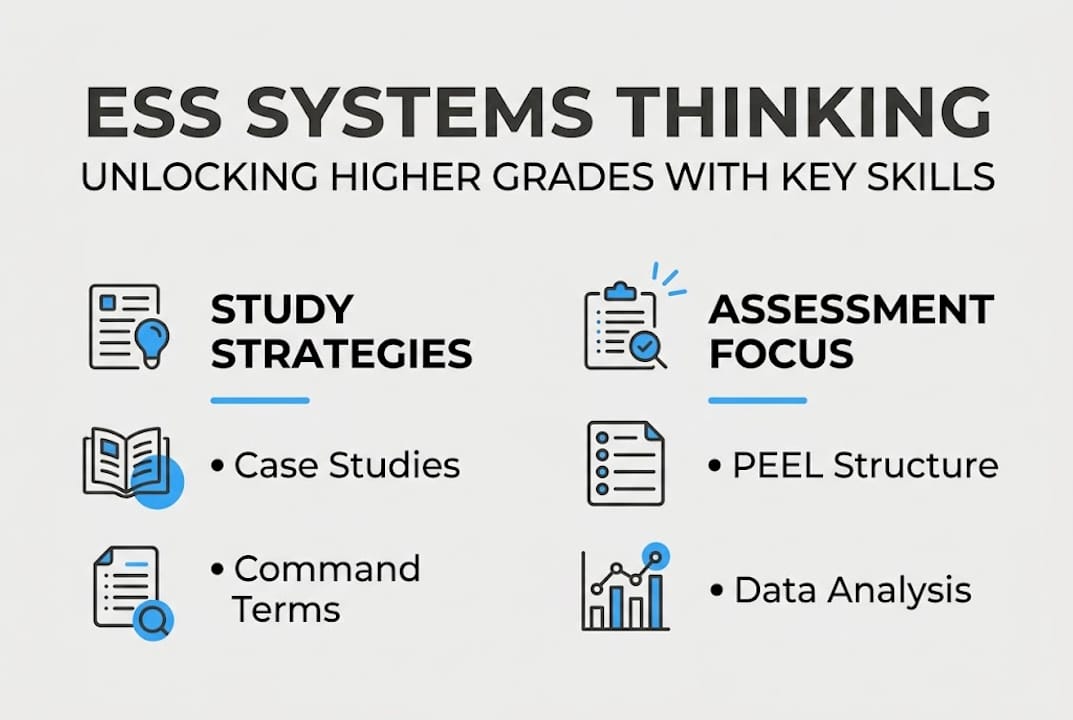
Command terms are non-negotiable. The IB uses specific words to tell you exactly what kind of answer it wants. “Describe” means give features. “Evaluate” means weigh up strengths and limitations. “Discuss” means present multiple perspectives. Misreading a command term can cost you several marks on a single question. Study command terms in ESS until you can identify what each one demands instantly.
For Paper 1, your job is to analyze an unseen case study. Here’s how to approach it:
- Read the data carefully before answering anything
- Identify trends, patterns, and anomalies in graphs or tables
- Use data values in your answers, not just general observations
- Connect findings to ESS concepts and real-world implications
For Paper 2, the PEEL structure is your best friend. Every extended answer should follow: Point (your main claim), Evidence (specific data or case study), Explanation (why this supports your point), Link (connect back to the question or broader ESS concept). According to IB ESS exam strategies, students who use PEEL with named case studies consistently score higher than those who write in general terms.
Pro Tip: Build a personal case study bank before your exams. Aim for at least 8 to 10 real-world examples covering topics like climate change, biodiversity loss, water management, and sustainable development. These examples work across multiple questions.
For more targeted advice, check out ESS success tips and evidence-based strategies that go deeper into exam technique.
Why systems thinking is the secret to unlocking ESS excellence
Now that you know the strategies, let’s step back and explore the big-picture thinking that sets exceptional ESS students apart.
Most students treat systems thinking as a concept to memorize for the exam. I’d argue that’s exactly the wrong approach. Systems thinking is actually the lens through which the entire ESS course makes sense. When you genuinely understand how feedback loops, tipping points, and interdependencies work, answering exam questions becomes more intuitive, not harder.
The IB ESS curriculum explicitly prioritizes interdisciplinary connections, blending science with society, economics, law, and ethics. HL students get even more of this through their extension content. That depth isn’t just about scoring higher. It’s about developing the kind of thinking that universities and careers in sustainability, policy, and environmental science genuinely need.
What most students miss is that these skills transfer. The ability to analyze a system, identify its inputs and outputs, and evaluate interventions is useful far beyond IB. If you invest in truly understanding broader ESS benefits, you’re building intellectual tools that will serve you for years.
Accelerate your ESS success with expert guides and support
If you’re ready to take your learning further, here’s how to access top guides, support, and focused help.
Navigating the updated ESS syllabus on your own takes time you may not have. Whether you need help planning your IA, cracking exam technique, or understanding what the new HL content actually requires, targeted support makes a real difference. Start with our What is IB ESS? guide to ground yourself in the course fundamentals.
For students working on extended writing, the ESS Extended Essay guide offers structured, practical advice. And if your IA needs hands-on support, our Internal Assessment tutoring connects you with an experienced IB examiner who knows exactly what top marks look like. Book a trial lesson and see the difference expert guidance makes.
Frequently asked questions
What are the main changes in the 2026 ESS syllabus?
The ESS syllabus now includes both SL and HL options, greater emphasis on systems thinking, and more explicit interdisciplinary links across science, ethics, and economics.
How is the ESS Internal Assessment (IA) graded?
The IA is worth 20-25% of your overall mark and is assessed on your research question, methodology, statistical analysis, and the quality of your evaluation.
What strategies help most on ESS exams?
Master ESS command terms, use the PEEL paragraph structure in Paper 2, and reference specific named case studies to push your answers into the higher mark bands.
What is a passing grade in IB ESS and how hard is it?
A 4 out of 7 is the passing threshold, and around 65% of SL students reach this with consistent study. Higher grades require deliberate practice with past papers and a strong case study bank.
What are common mistakes to avoid in the IA?
Avoid vague research questions, weak statistical analysis, and shallow evaluations. The most common IA pitfalls are easy to sidestep when you follow a clear structure and focus on a specific, locally grounded question.
No Comments