


17 May What is environmental impact assessment? A guide for IB ESS
TL;DR:
- Environmental impact assessment is a comprehensive decision-support process that evaluates potential social, economic, and ecological effects before project approval. It emphasizes predicting impacts early enough for meaningful modifications, focusing on significance determined by impact magnitude and receptor sensitivity. Understanding EIA’s structured stages, significance criteria, and real-world influence enhances environmental literacy and supports informed decision-making in sustainability efforts.
If you have ever wondered what is environmental impact assessment and why your ESS syllabus keeps coming back to it, you are not alone. Many students assume EIA is simply an ecological study of wildlife and habitats. That is a common misconception. EIA frameworks treat it much more broadly, covering social, economic, and cultural factors alongside ecological ones. Understanding the full scope of EIA will help you answer exam questions with confidence, write a stronger Internal Assessment, and genuinely grasp how environmental management works in the real world.
Table of Contents
- What is environmental impact assessment and why does it matter?
- Key steps and components of environmental impact assessment
- Understanding significance and comparing EIA frameworks
- How environmental impact assessment shapes project decisions and mitigation
- A student’s perspective: why environmental impact assessment is more than just paperwork
- Improve your IB Environmental Systems and Societies skills with ESS Tutor
- Frequently asked questions
Key Takeaways
| Point | Details |
|---|---|
| EIA is a decision-support tool | Environmental impact assessment helps predict and evaluate significant effects before project decisions are finalized. |
| Scoping shapes assessment focus | The scoping phase determines which environmental issues are studied in detail, ensuring relevant and effective analysis. |
| Significance drives assessment depth | Determining if impacts are significant controls whether a project requires a full impact statement or simpler review. |
| EIA influences project outcomes | Regulators use EIA findings to approve, modify, or reject projects to protect the environment. |
| EIA supports sustainable choices | The process enables changes to reduce harm early, promoting better environmental stewardship. |
What is environmental impact assessment and why does it matter?
An environmental impact assessment is a decision-support process used before a project gets approved. Think of it as a structured investigation that asks: what harm could this project cause, and how can we prevent or reduce it? It applies to major developments like highways, airports, mining operations, and energy plants.
Crucially, EIA goes far beyond counting species or mapping habitats. It examines social disruption, economic changes, public health risks, and cultural heritage alongside ecological effects. That is what makes it such a powerful tool in environmental management and policy.
The core purpose is captured well here:
“EIA predicts and evaluates significant effects before decisions are made, identifying ways to avoid, reduce, or compensate for impacts.”
That word before is everything. EIA is not a review of damage after the fact. It is a forward-looking process that gives decision makers evidence while they can still act on it. As the International Association for Impact Assessment explains, impact assessment is structured to consider future consequences at a point when modifications are still possible.
For your ESS studies, this connects directly to environmental literacy concepts like precaution, stewardship, and the relationship between human systems and natural ones. EIA is environmental literacy put into practice at a policy level.
Key steps and components of environmental impact assessment
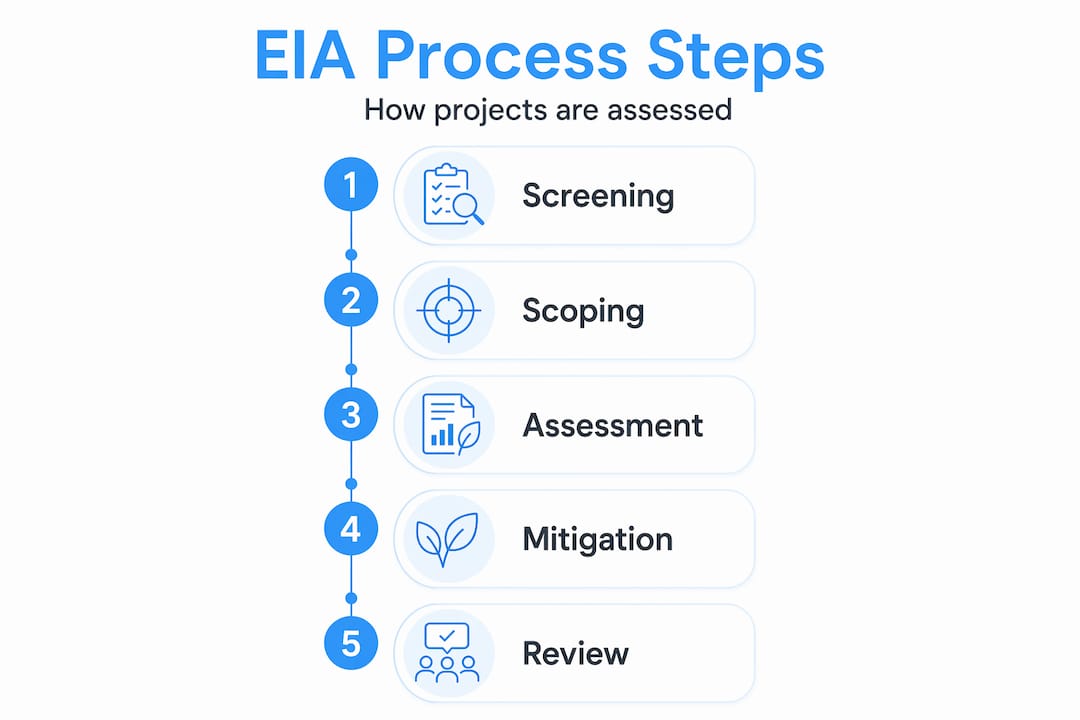
Understanding how to conduct an environmental impact assessment means knowing its main procedural stages. Each step builds on the last, and together they form the Environmental Statement that authorities use to make a final decision.
Screening. This is the first step. It decides whether a project actually requires a full EIA. Not every construction project triggers one. Authorities assess the scale, location, and potential sensitivity of the site. Small projects in non-sensitive areas may be excluded.
Scoping. This is arguably the most important step. Scoping determines which issues will be assessed in detail and directly shapes what ends up in the Environmental Statement. A poorly scoped assessment misses critical impacts. A well-scoped one focuses resources on what actually matters.
Baseline data collection. Before impacts can be predicted, you need to know the current state of the environment. Surveyors collect data on air quality, water systems, biodiversity, noise levels, and social conditions. This baseline becomes the reference point for all predictions.
Impact prediction and evaluation. Using the baseline data, specialists predict what will change if the project goes ahead. They assess both construction phase and operational phase impacts. They also consider cumulative effects, meaning impacts that combine with those from other nearby projects.
Mitigation planning. If significant negative impacts are identified, the developer must propose measures to avoid, reduce, or compensate for them. Examples include rerouting roads to avoid wildlife corridors, installing noise barriers near residential areas, or creating new habitat elsewhere.
Preparation of the Environmental Statement. All findings are compiled into a formal document. This is submitted to the relevant authority alongside the planning application.
Review and decision. The authority, the public, and independent consultees review the Environmental Statement. Their input feeds into the final decision on whether the project can proceed.
Pro Tip: In your ESS IA or extended essay, if you are analyzing a real development project, structure your analysis using these steps. It shows the examiner you understand the process, not just the outcomes. Check out this step-by-step ESS IA guide to see how this kind of structure strengthens your work.
Understanding significance and comparing EIA frameworks
One concept that trips up many students is significance. In EIA, significance does not mean “bad” or “noticeable.” It is a technical threshold that determines whether an impact requires detailed analysis, design changes, or can even block a project entirely.
Significance is assessed by combining two factors: the magnitude of the impact and the sensitivity of the receptor. A small noise increase near a hospital is significant. The same noise increase near an industrial estate might not be. Understanding environmental indicators helps you evaluate these distinctions more precisely.
Different countries use different regulatory frameworks for EIA. Here is how two major ones compare:
| Feature | UK EIA | US NEPA Process |
|---|---|---|
| Governing legislation | Town and Country Planning Act / EIA Regulations 2017 | National Environmental Policy Act (1969) |
| Initial screening document | Screening Opinion | Environmental Assessment (EA) |
| Full assessment document | Environmental Statement (ES) | Environmental Impact Statement (EIS) |
| Significance trigger | Likely significant effects on the environment | Finding of significant impact (FONSI or EIS) |
| Public participation | Required during scoping and review | Required for EIS preparation |
| Decision-making body | Local Planning Authority or Secretary of State | Federal agency responsible for the action |
Under the US NEPA process, an Environmental Assessment determines significance. If impacts are found to be significant, a full Environmental Impact Statement is required. If not, the agency issues a Finding of No Significant Impact. There is also a third option: categorical exclusions for project types that have been predetermined to cause no significant effects.
The key conceptual point about significance is that it should not be based on intuition. It requires a structured judgment using regulatory criteria, professional expertise, and site-specific data. This is a distinction worth knowing for your exams. Students who can explain significance thresholds demonstrate real command of key environmental concepts beyond surface-level understanding.
How environmental impact assessment shapes project decisions and mitigation
So what actually happens after the Environmental Statement is submitted? This is where EIA connects directly to real-world outcomes. The findings do not sit on a shelf. They directly influence whether a project is built, how it is built, and under what conditions.
After analyzing potential impacts, regulators may take one of three paths:
- Approve the project as proposed, if impacts are acceptable
- Approve with conditions, requiring the developer to implement specific mitigation measures before or during construction
- Deny the project, if the environmental or social costs are judged to be unacceptable
Here is what mitigation in practice actually looks like. A highway project through wetland habitat might be approved only if the developer agrees to:
- Construct wildlife underpasses beneath the road
- Implement a habitat management plan for a buffer zone alongside the route
- Monitor water quality in adjacent streams for five years post-construction
- Offset any unavoidable habitat loss by creating equivalent habitat elsewhere
Public consultation is also part of this stage. Local communities, environmental organizations, and technical bodies can all submit comments. These responses become part of the official record and must be considered in the final decision.
“Regulatory decisions based on professional, evidence-based predictions ensure only proposals with acceptable impacts proceed.”
For your ESS studies, connecting EIA to environmental justice principles is a strong analytical move. Who gets consulted? Whose community bears the risk? These questions go straight to the heart of why EIA matters beyond the technical process. Understanding how environmental stewardship is embedded in regulatory systems like EIA shows examiners you are thinking critically about the subject.

A student’s perspective: why environmental impact assessment is more than just paperwork
I will be honest with you. Many students encounter EIA for the first time and see it as a box-ticking exercise. A form you fill in. A report that sits in a government archive. That reading is both understandable and completely wrong.
Here is what I think is the most important thing to understand about EIA: it represents the moment in a project’s life when change is still possible. Once construction starts, options narrow fast. But during scoping and assessment, a developer can reroute a pipeline, redesign a drainage system, or relocate an access road. That flexibility exists because impact assessment is structured to allow proposals to be modified or even abandoned before it is too late.
This is not about slowing down development. It is about making development smarter. The benefits of environmental impact assessments are most visible in the projects you never hear about: the ones where an early EIA flagged a critical aquifer, and the facility was redesigned before a single permit was issued.
For you as an ESS student, internalizing this perspective changes how you write about EIA. Instead of describing it as a regulatory requirement, you can describe it as a tool for informed, precautionary decision-making. That framing earns marks. It shows you understand why the system exists, not just what it does.
Pro Tip: In any written assessment, avoid framing EIA as bureaucracy. Describe it as structured foresight, a mechanism that protects both ecosystems and communities by building evidence before commitments are made.
The benefits of studying environmental systems go beyond the exam room, and EIA is a perfect example. It connects everything you learn about ecology, society, and policy into one real-world process. Developing environmental literacy means seeing those connections clearly.
Improve your IB Environmental Systems and Societies skills with ESS Tutor
Understanding EIA conceptually is one thing. Applying that knowledge in your Internal Assessment, extended essay, or Paper 2 responses is another. That is where focused support makes a real difference.
Individual ESS lessons can help you discuss environmental impact assessment, apply evidence to a case study and develop your own reasoning. Bring the question or concept you find difficult. Request a FREE 20-minute trial lesson and include your level and time zone.
Frequently asked questions
What does environmental impact assessment (EIA) involve?
EIA involves predicting and evaluating likely significant effects of a proposed project before decisions are made, including identifying measures to avoid or reduce negative impacts across ecological, social, and economic dimensions.
Why is the scoping step important in an EIA?
Scoping is critical because it determines which effects are assessed in detail and shapes the entire Environmental Statement, ensuring that resources focus on the most significant issues rather than covering everything superficially.
How do regulators use EIA to decide on projects?
Regulators review EIA findings and may approve, require mitigation, or deny a project based on whether its predicted impacts are judged to be environmentally acceptable.
What is the difference between an Environmental Assessment (EA) and an Environmental Impact Statement (EIS) in the US?
Under NEPA, an EA determines whether impacts are significant; if they are, the agency must prepare a full EIS providing detailed analysis of environmental consequences and alternatives.
No Comments